 +86-13646196162
 info@hysonindustry.com




 русский
  عربى
عربى 


Steel Props for Reliable Heavy-Duty Construction Support
 2026.08.14
Content
- 1 Introduction
- 2 What Are Steel Props?
- 3 Core Construction and Product Design
- 4 Key Advantages Over Conventional Support Components
- 5 Product Performance Summary
- 6 Applications in Formwork Construction
- 7 Applications in Floors, Roofs, and Temporary Structures
- 8 Applications as Scaffolding Auxiliary Support
- 9 Advanced Manufacturing Processes
- 10 Manufacturing Strengths of the Supplier
- 11 OEM and Customization Capabilities
- 12 Installation Guidelines and Good Practice
- 13 Safety and Quality Considerations
- 14 Economic and Environmental Benefits
- 15 Why Choose a Specialized Heavy Steel Manufacturer?
- 16 How to Select the Appropriate Steel Prop
- 17 Q&A: Steel Props for Construction Projects
- 17.1 What is the main purpose of a steel prop?
- 17.2 How are steel props different from adjustable bases?
- 17.3 What is the stated load capacity of these steel props?
- 17.4 How much height adjustment is available?
- 17.5 Are steel props suitable for outdoor construction?
- 17.6 Can one worker install the prop?
- 17.7 Can steel props be used with ringlock scaffolding?
- 17.8 How should used props be maintained?
- 17.9 Can the props be customized?
- 17.10 What information should a buyer provide when requesting a quotation?
- 18 Conclusion
- 19 References
- 20 Product: Steel Props
Introduction
Steel props are essential vertical load-bearing components used to support formwork, floor slabs, roofs, temporary structures, and scaffolding systems during construction. Unlike components designed mainly for leveling, alignment, or connection adjustment, a steel prop is intended to provide dependable vertical support under substantial loads. It helps prevent deformation, settlement, displacement, and collapse while concrete is being poured, structural members are being installed, or temporary works are being reinforced.
Modern construction projects require support equipment that combines high load capacity, dimensional flexibility, durability, fast installation, and consistent quality. A steel prop must not only carry vertical forces; it must also remain stable in changing site conditions, withstand repeated use, resist corrosion, and integrate efficiently with other formwork and scaffolding components. These requirements are especially important in infrastructure construction, high-rise buildings, industrial facilities, bridge works, tunnels, renovation projects, and heavy civil engineering applications.
The heavy-duty steel props described in this article are manufactured from high-strength Q235 or Q345 carbon steel and produced using precision fabrication and robotic welding processes. Their telescopic threaded structure provides height adjustment, while reinforced construction, anti-slip contact surfaces, and hot-dip galvanizing improve safety and service life. With a stated vertical load-bearing capacity of approximately 100 kN to 200 kN, these props are designed for demanding temporary support applications where ordinary lightweight supports may be insufficient.
In addition to product performance, manufacturing capability is a major factor in the reliability of steel props. Nantong Hyson Road And Bridge Formwork Co., Ltd. combines steel processing, laser cutting, bending, robotic welding, quality inspection, and OEM fabrication capabilities to produce both standard and customized steel support components. Its experience in major infrastructure projects and compliance with recognized welding and quality standards support the consistent production of heavy-duty steel products for international customers.
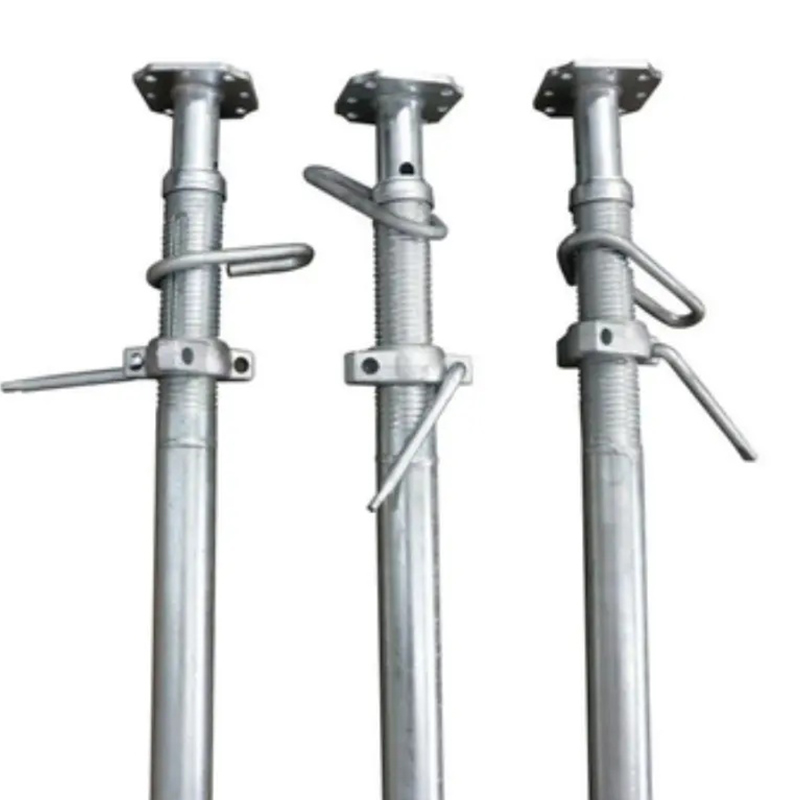
Steel Props
What Are Steel Props?
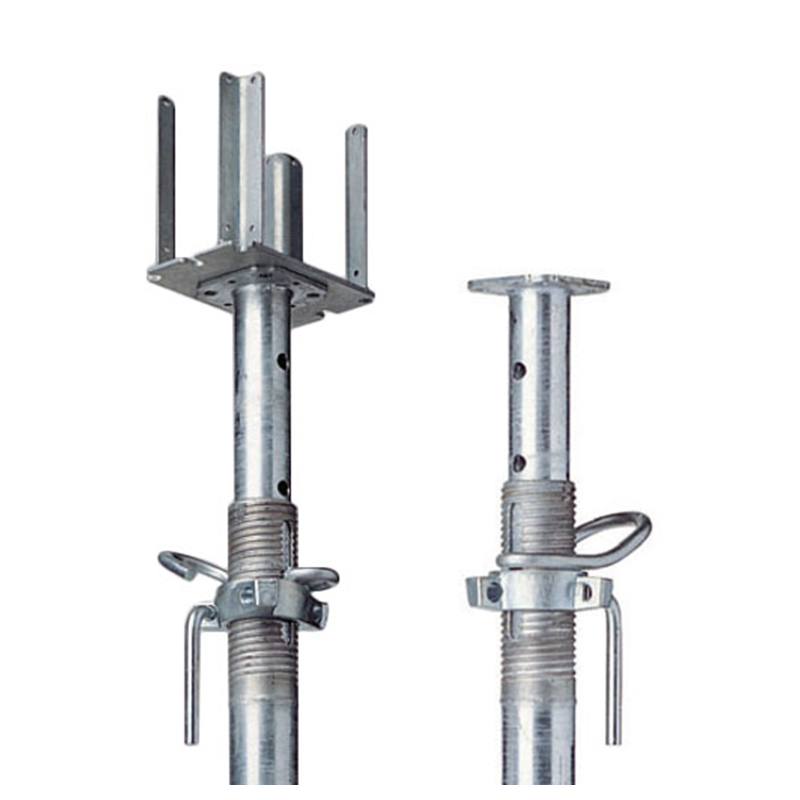
A steel prop is a vertically installed, adjustable steel support used to transfer loads from a supported structure to the ground or another stable bearing surface. It generally consists of an outer steel tube, an inner telescoping tube, an adjustment mechanism, threaded components, bearing plates, locking features, and contact surfaces designed to resist slipping. Depending on the design, the prop may be used independently or together with formwork panels, beams, adjustable bases, U-heads, scaffolding frames, braces, and other temporary works equipment.
The main purpose of a steel prop is to carry vertical loads. During concrete construction, for example, formwork and freshly poured concrete create substantial downward forces. The prop transfers those forces safely through its steel body to the supporting surface. When used under a floor slab, it may also support construction workers, equipment, reinforcement materials, and other temporary loads. In renovation or maintenance work, it can temporarily support beams, ceilings, walls, machinery, and other structural elements while permanent repairs are carried out.
Steel props should be distinguished from other adjustable support products. An adjustable base is generally used to level a support system or provide limited auxiliary adjustment. An adjustable bracket is normally intended for connection adaptation or fine positioning near the top of a structure. A steel prop, by contrast, is a primary vertical load-bearing member. Its purpose is not merely to correct height differences or connect two components, but to independently support significant structural loads when properly selected, installed, and braced.
The precise capacity of any prop depends on several factors, including extension length, installation angle, load eccentricity, end conditions, floor strength, lateral restraint, material properties, and the overall support layout. For this reason, product ratings should always be reviewed together with engineering calculations, project drawings, and applicable construction standards. The stated 100 kN to 200 kN capacity range represents the intended heavy-duty product class, while actual safe working loads must be confirmed for the specific configuration.
Core Construction and Product Design
High-Strength Steel Body
The main structural members are manufactured from Q235 or Q345 high-strength carbon steel. These commonly used structural steels provide a practical balance between strength, weldability, availability, and cost. Q235 is widely used for general structural applications, while Q345 offers higher yield strength for components exposed to greater loads or more demanding operating conditions.
Using suitable structural steel allows the prop body to withstand compression forces while maintaining dimensional stability. Material selection also affects weld quality, fatigue performance, impact resistance, and the ability to produce consistent batches. A well-controlled steel supply chain helps manufacturers maintain stable chemical composition, thickness, and mechanical performance from one production order to another.
Integrated Structural Construction
The steel prop is manufactured as a robust integrated support assembly rather than a collection of weak, loosely connected parts. Reinforced ribs and carefully designed welded joints help distribute stress through the prop body. This reduces the likelihood of local buckling, joint failure, or deformation caused by concentrated loads.
Integrated construction is particularly important when props are used under heavy formwork or floor slabs. If a support contains poorly aligned components, insufficient welds, or weak connection points, the entire support system may become unstable even when the nominal steel material is strong. A properly engineered prop must therefore combine suitable material thickness, accurate assembly, reliable welding, and appropriate end-plate geometry.
Telescopic Threaded Adjustment
The telescopic threaded structure allows the prop to adapt to different construction heights. The stated adjustment range is approximately 100 mm to 500 mm, with adjustment accuracy of about plus or minus 1 mm under suitable operating conditions. This range enables contractors to compensate for differences between floor levels, formwork elevations, slab thicknesses, and temporary support layouts without using multiple additional accessories.
Threaded adjustment provides controlled positioning and helps workers obtain firm contact between the prop and the supported structure. Once the desired height is reached, the locking system can secure the setting. Accurate adjustment is important because a prop that is too short may not properly engage the load, while a prop that is overextended or improperly tightened may experience reduced stability or unfavorable stress distribution.
Reinforced Ribs and Robotic Welding
Reinforced ribs improve the stiffness of selected prop components and help control deformation under compression. Their location and dimensions can be designed according to expected load paths and production requirements. Precision robotic welding is used to create consistent welds with repeatable penetration, alignment, and appearance.
Automated welding reduces variation between operators and supports stable production for large orders. It can also improve productivity, reduce the risk of skipped welds, and maintain consistent weld bead placement. However, robotic welding is most effective when supported by accurate cutting, fixture control, joint preparation, welding parameter management, and post-weld inspection.
Anti-Slip Contact Surfaces
An anti-slip pad or enlarged contact surface at the top of the prop increases the contact area between the support and the supported structure. This helps reduce the possibility of movement during installation and operation. The contact surface is especially useful when the prop is placed beneath timber beams, steel beams, formwork components, or concrete surfaces that require stable point support.
Anti-slip features do not eliminate the need for proper bracing, level bearing surfaces, or engineering control. The supporting floor must be strong enough to carry the transmitted load, and the prop must be installed vertically unless a specifically designed angled application is approved. Nevertheless, a well-designed top pad improves connection stability and makes the prop more practical on active construction sites.
Key Advantages Over Conventional Support Components
Higher Load-Bearing Capability
The primary advantage of a heavy-duty steel prop is its ability to carry substantial vertical loads. With a stated capacity range of 100 kN to 200 kN, it is suitable for large-volume concrete formwork, floor slab support, temporary roof support, and other demanding applications. This level of capacity is significantly greater than that of many light-duty adjustable bases or basic support accessories intended mainly for leveling and positioning.
A higher-capacity prop can reduce the number of vertical supports required in some layouts, subject to engineering approval and the spacing limits of the formwork system. Fewer supports may improve access for workers, simplify material movement, and reduce interference with reinforcement installation or concrete placement. The final support arrangement must still be designed according to total load, allowable deflection, stability, and construction sequence.
Greater Height Adaptability
The adjustment range of approximately 100 mm to 500 mm provides broader height flexibility than many general adjustable bases and fine-adjustment brackets. A base may offer only a limited leveling range, while a bracket may be intended for relatively small connection corrections. A steel prop is designed to accommodate a wider range of construction heights while remaining a load-bearing member.
This flexibility is useful on projects with varying floor-to-floor dimensions, uneven temporary work arrangements, changing slab elevations, and non-standard formwork geometries. Contractors can use the same prop family across multiple areas of a project instead of maintaining numerous specialized support sizes. Standardization can simplify logistics, reduce inventory complexity, and improve workforce familiarity with installation procedures.
Better Resistance to Corrosion
Construction equipment is often exposed to moisture, cement slurry, underground dampness, rain, dust, and fluctuating temperatures. Hot-dip galvanizing provides a protective zinc coating over the steel surface. The stated coating thickness is at least 80 micrometers, offering strong resistance to corrosion in harsh construction environments.
Corrosion resistance is important for both safety and economics. Rust can reduce cross-sectional thickness, damage threads, weaken weld areas, and make adjustment mechanisms difficult to operate. A galvanized surface slows these processes and helps maintain product performance over repeated project cycles. It also reduces the maintenance burden for rental companies and contractors who move props between job sites.
Longer Reuse Potential
The product is designed for a reuse cycle of at least 400 times under appropriate handling, inspection, cleaning, storage, and operating conditions. Reusability is a major advantage in formwork and scaffolding operations because temporary support components are repeatedly installed, adjusted, removed, transported, and stored.
Long service life lowers the average cost per use and supports more sustainable construction practices. A durable prop reduces the need for frequent replacement and helps limit steel consumption associated with short-lived temporary equipment. To achieve the expected reuse potential, users should protect threads from impact and contamination, avoid unauthorized welding or cutting, inspect components after each use, and remove damaged props from service.
Faster Installation
The quick-locking design and non-slip handle are intended to make installation and adjustment practical for a single worker without specialized tools. Workers can position the prop, extend it to the required height, apply the locking mechanism, and check contact with the supported structure. This improves productivity during repetitive formwork and temporary support operations.
Fast installation can shorten preparation time before concrete placement and reduce the labor required for changes during construction. It can also improve efficiency when support layouts must be modified because of openings, embedded items, reinforcement congestion, or changes in construction sequence. Ease of installation should always be combined with proper inspection to ensure that speed does not replace safety.
Compatibility With Complete Support Systems
Steel props can be used with adjustable bases, adjustable supports, wall formwork, beams, slab formwork, ringlock scaffolding, coupler-type scaffolding, and other temporary works equipment. This compatibility allows contractors to combine different products according to the structural requirements of each work area.
For example, an adjustable base may help level a support assembly at the ground, while the steel prop carries the main vertical load. A top support or bracket may provide connection adaptation, while the prop transfers the load through its body. Used together, these components form a coordinated support system in which each product performs its intended function.
Product Performance Summary
| Performance Item | Steel Props | Typical Adjustable Bases | Typical Adjustable Supports or Brackets |
|---|---|---|---|
| Primary function | Independent vertical load-bearing | Ground leveling and auxiliary support | Fine adjustment or connection adaptation |
| Stated adjustment range | Approximately 100–500 mm | Approximately 50–300 mm | Approximately 30–150 mm |
| Stated vertical capacity | Approximately 100–200 kN, depending on configuration | Generally intended for lighter auxiliary duties | Generally intended for adjustment or connection duties |
| Material | Q235/Q345 high-strength carbon steel | Structural steel, depending on model | Structural steel, depending on model |
| Surface protection | Hot-dip galvanized coating of at least 80 micrometers | Commonly galvanized or coated | Commonly galvanized or coated |
| Adjustment accuracy | Approximately ±1 mm | Dependent on product design | Designed mainly for fine positioning |
| Typical role in a support system | Core vertical support member | Leveling and base connection | Top adjustment or connection assistance |
| Reuse potential | Designed for at least 400 reuse cycles under suitable conditions | Dependent on construction and maintenance | Dependent on construction and maintenance |
The comparison above is intended to explain functional differences rather than replace project-specific engineering data. Actual capacities for all support products depend on design, dimensions, extension, installation, loading, and applicable standards. Users should obtain technical drawings, test reports, and allowable working load information for the exact model selected.
Applications in Formwork Construction
Slab Formwork Support
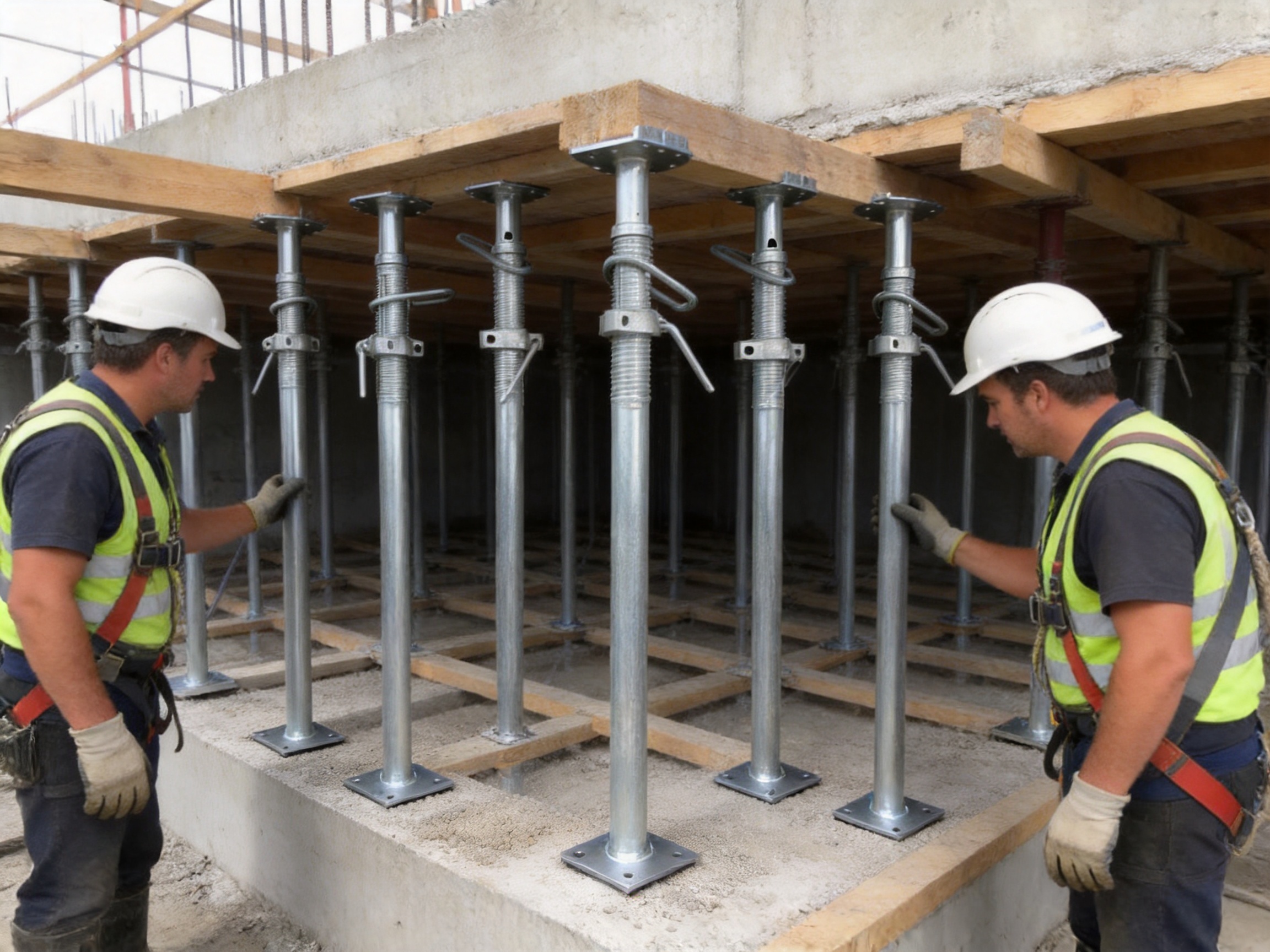
Steel props are widely used beneath slab formwork to support beams, panels, joists, and freshly placed concrete. Before pouring, the props hold the formwork at the correct elevation. During pouring, they transfer the weight of the concrete, reinforcement, workers, tools, and equipment to the supporting floor or foundation.
Correct spacing is essential. The formwork designer must consider the slab thickness, concrete density, construction load, beam arrangement, panel stiffness, prop capacity, and expected deflection. Props should be installed on stable bearing surfaces and arranged so that loads are transferred evenly. Where required, horizontal and diagonal bracing should be added to improve system stability.
Wall Formwork
Steel props can provide vertical support and stabilization for wall formwork systems. While wall formwork is also affected by lateral concrete pressure, vertical props help maintain alignment and transfer loads to the ground or supporting slab. They may be used with walers, strongbacks, tie systems, braces, and other wall formwork components.
The prop should be positioned in accordance with the formwork design so that it does not interfere with reinforcement, embedded parts, access paths, or concrete placement equipment. The anti-slip top pad and adjustable height mechanism help workers establish firm contact with the formwork assembly. A complete wall support system must address both vertical and horizontal forces.
Large-Volume Concrete Structures
Large-volume concrete work can generate high loads on temporary formwork. Examples include thick foundations, transfer slabs, industrial floors, bridge components, heavy retaining walls, and large structural beams. Heavy-duty steel props provide concentrated vertical support where lighter accessories may not offer sufficient capacity.
For these applications, the support arrangement should be checked carefully for cumulative load, bearing pressure, settlement, buckling length, and load redistribution. A prop rated for high compression must still be installed with suitable alignment and restraint. Engineering control is particularly important when concrete is placed rapidly or when the formwork height and width create significant stability demands.
Applications in Floors, Roofs, and Temporary Structures
Temporary Floor Slab Reinforcement
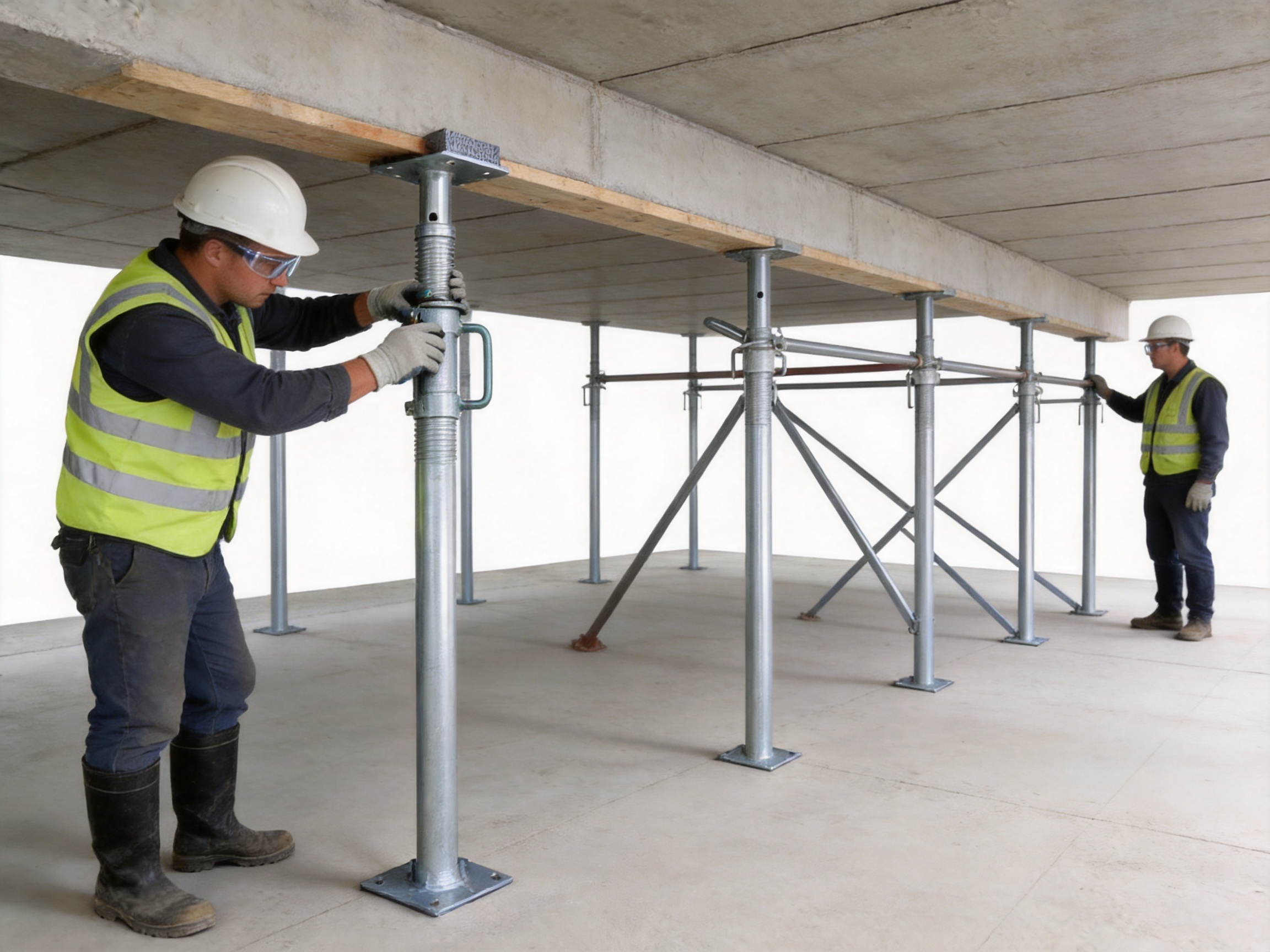
After a floor slab is poured, temporary support may be required while the concrete gains strength or while loads are introduced on upper levels. Steel props can be installed beneath the slab to reduce deflection and support construction activities. They are also useful when a project requires reshoring, back-propping, or temporary reinforcement during staged construction.
Temporary floor support should be planned according to the concrete strength development schedule, the loads from construction above, the sequence of formwork removal, and the capacity of the supporting floors below. Props should not be installed or removed arbitrarily. A coordinated method statement helps ensure that loads are transferred gradually and that the structure is not exposed to sudden stress changes.
Roof Support
Roof construction and repair often require temporary vertical support for roof decks, beams, trusses, or formwork. Steel props can be adjusted to accommodate different roof elevations and used to support temporary working platforms or structural members during installation.
Roof sites may experience wind, rain, vibration, and limited access. Props should therefore be used with suitable lateral bracing and secure bearing arrangements. The support system must account for both vertical loads and environmental forces. Galvanized protection is particularly valuable for exterior or partially exposed work, although the product should not be treated as permanently weatherproof without a project-specific assessment.
Building Renovation and Maintenance
Renovation work frequently requires temporary support before walls are removed, beams are repaired, openings are created, or damaged structural elements are replaced. Steel props provide a practical way to support ceilings, beams, floor areas, and temporary partitions while permanent work is performed.
The adjustable design allows the prop to fit changing site conditions, including older buildings with irregular dimensions. However, renovation projects may involve hidden defects, unknown load paths, deteriorated masonry, or weak floors. A qualified professional should inspect the structure and specify the support layout before installation.
Factory and Equipment Maintenance
Industrial facilities may require temporary support during machinery replacement, plant modification, pipe installation, or structural maintenance. Steel props can be used to support temporary frames, equipment components, beams, and platforms when a controlled vertical reaction is needed.
The high load capacity and reusable construction make these props suitable for maintenance departments, industrial contractors, and equipment rental companies. The galvanized finish is useful in damp or dusty industrial environments, while the adjustable mechanism helps accommodate different machinery elevations and temporary frame dimensions.
Applications as Scaffolding Auxiliary Support
Steel props can supplement ringlock scaffolding and coupler-type scaffolding when additional vertical capacity or localized support is required. Scaffolding systems are often designed for access, working platforms, and distributed loads, but certain projects may include concentrated loads, heavy formwork, material storage, or unusual geometry. A steel prop can provide additional vertical support in these areas when incorporated into an approved design.
In high-altitude operations, support stability is especially important. A prop may help reduce deflection or strengthen a specific section of the temporary works. It can also support formwork components attached to a scaffold structure. The prop should not be used as an informal substitute for a complete scaffold design. Connections, bracing, foundation conditions, access, fall protection, and load paths must all be addressed.
When combined with compatible scaffolding accessories, steel props can create a flexible temporary works system. Adjustable bases can help establish a level starting point, while the prop provides vertical load-bearing. Horizontal ledgers and diagonal braces can improve lateral stability. Formwork beams or panels can distribute loads above the prop. This coordinated approach is more reliable than using isolated components without a defined structural arrangement.
Advanced Manufacturing Processes
Engineering and Material Preparation
Reliable steel prop production begins with engineering review and material preparation. Drawings are evaluated for dimensions, load requirements, weld locations, adjustment range, plate thickness, reinforcement details, and surface treatment requirements. Steel plates, tubes, threaded components, and other parts are then selected according to the approved design.
Material traceability helps manufacturers connect finished components with incoming steel batches and production records. This is valuable for OEM projects because customers may require inspection documentation, material certificates, dimensional reports, or project-specific quality records.
CNC Laser Cutting
Advanced laser cutting equipment is used to process steel plates and other components with high dimensional accuracy. Laser cutting supports clean edges, repeatable hole patterns, precise profiles, and efficient production of customized parts. It is especially useful for base plates, top plates, reinforcing components, brackets, connection plates, and non-standard steel structures.
Compared with less controlled cutting methods, CNC laser processing can reduce dimensional variation and improve the fit-up of welded assemblies. Accurate parts help welding fixtures maintain alignment and reduce the need for manual correction. Laser cutting also enables economical customization for OEM orders without requiring extensive tooling changes.
Forming and Bending
After cutting, selected steel parts may be bent or formed to achieve the required geometry. Controlled bending improves repeatability and helps create reinforced profiles, channels, brackets, and structural components. The bending process must account for material thickness, bend radius, springback, and the final dimensional tolerance.
Accurate forming is important because poorly shaped parts can introduce eccentric loading or create gaps at welded joints. Consistent forming improves assembly efficiency and supports uniform structural behavior across a production batch.
Fixture-Controlled Assembly
Assembly fixtures help position tubes, plates, ribs, threaded parts, and other components before welding. Fixtures reduce alignment errors and help maintain consistent dimensions. They are particularly valuable for products that must be interchangeable across a large project or rental fleet.
Controlled assembly also helps ensure that the telescopic mechanism operates smoothly. The inner and outer tubes must remain correctly aligned, and threaded components must be installed without distortion. Small dimensional errors can affect adjustment, contact pressure, or the ability to lock the prop securely.
Precision Robotic Welding
Robotic welding is used to produce consistent joints on repetitive steel prop components. Automated welding can regulate travel speed, current, voltage, and weld path according to approved parameters. This helps maintain stable weld quality and improves production efficiency.
The company also applies certified AWS and EN welding craftsmanship, supporting production for customers who require internationally recognized welding practices. Welding quality involves more than appearance. Joint preparation, penetration, heat input, weld size, distortion control, and inspection all contribute to the final performance of a load-bearing prop.
Surface Finishing and Hot-Dip Galvanizing
After fabrication and inspection, steel props are hot-dip galvanized to create a protective zinc coating. Before galvanizing, surfaces must be properly prepared so that the coating can cover the steel effectively. The stated minimum coating thickness of 80 micrometers provides enhanced protection against moisture and construction-site corrosion.
Threaded areas and moving adjustment components require appropriate treatment and protection so that the product remains functional after finishing. Excess zinc, contamination, or deformation must be controlled during post-galvanizing inspection. The completed prop should provide both corrosion resistance and smooth adjustment operation.
Inspection and Testing
Quality control covers raw materials, dimensions, welding, surface treatment, adjustment function, and load performance. Visual inspection can identify surface defects, incomplete welds, sharp edges, coating damage, and assembly problems. Dimensional checks confirm tube length, plate size, hole position, thread engagement, and overall adjustment range.
Load testing is used to evaluate the ability of the prop to withstand specified compression forces. Testing may also examine deformation, stability, locking performance, and behavior at different extensions. The product information states that components undergo rigorous load testing and quality inspection to support compliance with construction safety expectations.
Manufacturing Strengths of the Supplier
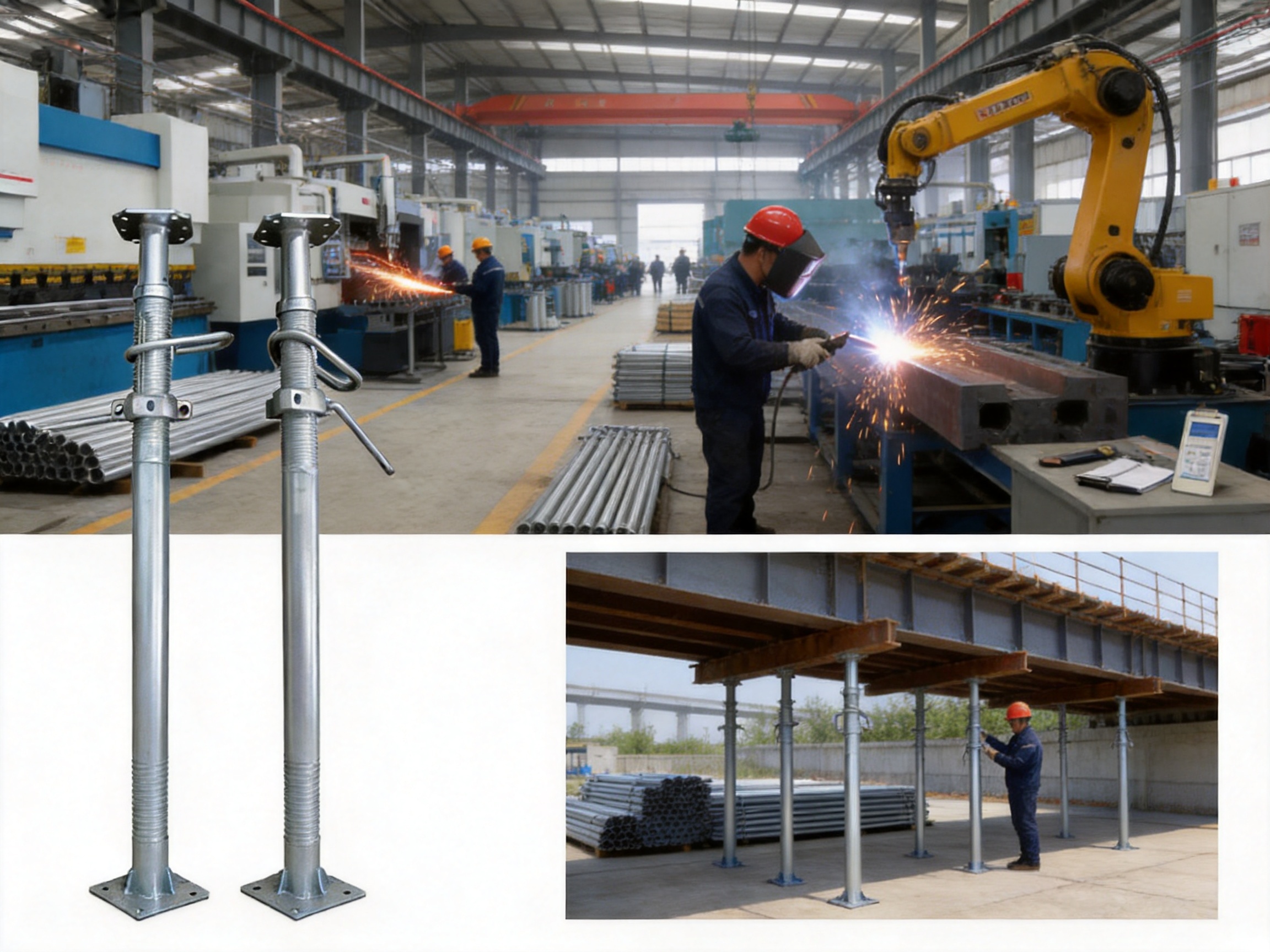
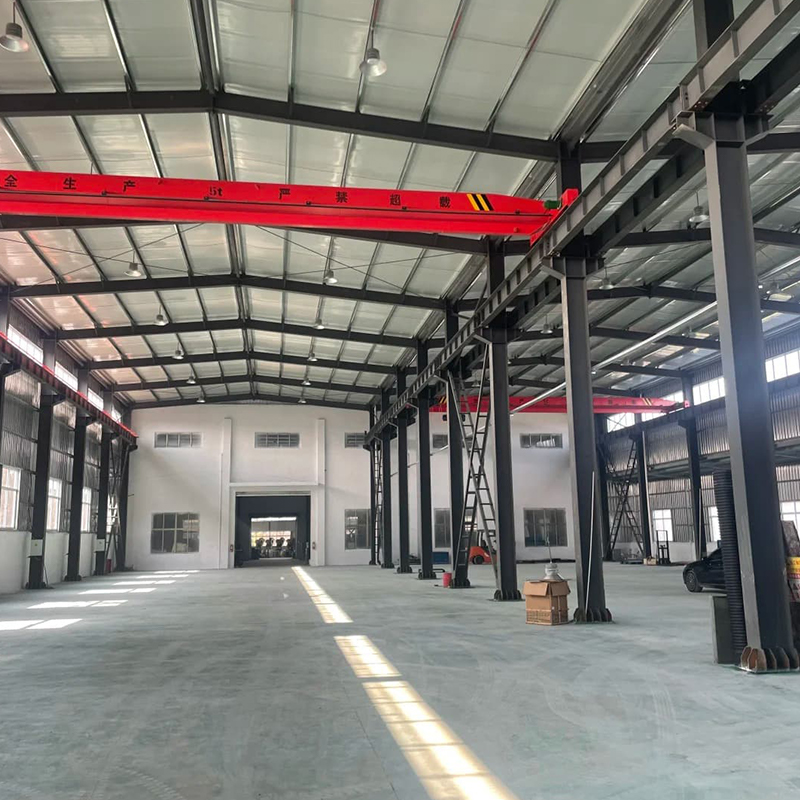
Nantong Hyson Road And Bridge Formwork Co., Ltd. is a professional manufacturer of custom steel formwork, ringlock scaffolding, heavy-duty steel structures, steel props, and OEM metal fabrication products. Its production capabilities cover steel plate processing, CNC laser cutting, bending, assembly, welding, surface treatment, and quality inspection.
The company operates standardized production lines supported by advanced equipment and automated processing. This combination is valuable for both standard products and customized orders. Customers may require special heights, plate dimensions, connection details, surface treatments, load capacities, packaging methods, or integration with an existing formwork system. A manufacturer with broad processing capability can manage these requirements within one coordinated production process.
Hyson reports compliance with ISO 9001, BS1139, and EN74-related international requirements, as well as experience with AWS and EN welding practices. These standards and practices provide a framework for quality management, scaffolding component production, welding control, and product consistency. Certification requirements should always be verified for the specific product, project, and supplied documentation, but a standards-oriented production system is an important indicator of manufacturing discipline.
The company holds 12 utility patents and has supplied strategic customers including major state-owned construction and infrastructure enterprises. Its products have been used in projects associated with the Sutong Yangtze River Bridge, Taizhou Bridge, and Sudan Thermal Power Plant. Experience with large projects helps a manufacturer understand strict delivery schedules, documentation requirements, dimensional consistency, and the consequences of temporary works failure.
Hyson’s integrated capabilities also include custom bridge and infrastructure formwork, hydraulic tunnel trolleys, scaffolding, industrial steel structures, and heavy steel OEM fabrication. This broader product range allows the company to understand how steel props interact with larger construction systems. Rather than treating a prop as an isolated item, the manufacturer can support customers with related formwork, scaffolding, and steel component requirements.
OEM and Customization Capabilities
Construction projects often differ in height, loading, connection geometry, working environment, and local standards. Standard catalogue products may not always meet the requirements of a specialized project. OEM manufacturing allows customers to provide drawings, technical specifications, samples, or performance targets for customized production.
Possible customization areas include prop length, adjustment range, tube diameter, wall thickness, base plate dimensions, top plate configuration, threaded mechanism, locking system, anti-slip pad, reinforcement layout, galvanizing specification, color coding, packaging, and identification markings. Customers may also request inspection plans, material certificates, welding records, load test reports, and production photographs.
For large orders, production planning is essential. A manufacturer should confirm the approved drawing, bill of materials, inspection points, packaging method, delivery schedule, and acceptance criteria before production begins. Sample approval can help identify design or installation issues before the full batch is manufactured.
Hyson’s laser cutting, bending, welding, and assembly capabilities support customized steel components for construction, mining, agriculture, transportation, and industrial projects. This is particularly useful for customers seeking a single supplier for steel props, formwork accessories, structural frames, cut-to-size plates, and welded assemblies.
Installation Guidelines and Good Practice
Before Installation
Inspect every prop before use. Check the tubes for dents, cracks, excessive corrosion, distortion, and unauthorized repairs. Examine welds, plates, threads, locking devices, handles, and anti-slip pads. Any component with structural damage or uncertain history should be isolated and assessed by a competent person.
Confirm that the supporting surface is capable of carrying the expected reaction. Concrete should have sufficient strength, soil should be adequately compacted, and temporary bearing plates or timber sole boards should be used where necessary. The support surface should be clean, reasonably level, and free from loose debris that could cause instability.
Positioning and Adjustment
Place the prop directly beneath the intended load path. Avoid eccentric loading unless the support system has been specifically designed for it. Extend the prop gradually until the top contact surface engages the supported member. Do not use unstable packing materials or improvised extensions.
Adjust the threaded mechanism carefully and confirm that sufficient thread engagement remains. The prop should not be extended beyond its approved working range. Once the correct height is reached, engage the locking mechanism and verify that the prop is firmly seated at both ends.
Bracing and Stability
A vertical prop can carry compression but may be vulnerable to lateral movement, impact, vibration, or accidental displacement. Where required by the design, connect props with horizontal ledgers, diagonal braces, frames, or other restraint systems. Bracing is particularly important for tall installations, uneven surfaces, exposed locations, and arrangements subjected to construction traffic.
Workers should ensure that props do not obstruct access routes or create trip hazards. Areas beneath supported structures should be controlled during installation and loading. No worker should remain beneath a structure that is inadequately supported or undergoing unauthorized adjustment.
During Concrete Placement
Concrete should be placed according to the approved sequence and rate. Rapid or uneven placement can create temporary loads that exceed the assumptions used for the support design. Workers should monitor formwork movement, unusual noise, prop deformation, settlement, and changes in alignment during the pour.
If a problem is observed, concrete placement should be stopped and the area should be evacuated or controlled according to the site safety plan. Props must not be struck, loosened, or adjusted while heavily loaded unless a qualified engineer has approved the procedure.
Removal and Storage
Props should be removed only after the concrete or permanent structure has reached the specified strength and the responsible engineer or supervisor has approved the sequence. Removal should be gradual to prevent sudden load transfer. After dismantling, clean cement residue, dirt, and moisture from the components.
Store props vertically or horizontally in a stable, organized area protected from unnecessary impact and standing water. Keep threaded parts clean and lightly protected according to the manufacturer’s maintenance recommendations. Separate damaged or heavily worn units from serviceable inventory.
Safety and Quality Considerations
Steel props are safety-critical temporary works components. Their use should be controlled by competent personnel and based on an engineered support plan. The plan should identify design loads, prop spacing, extension length, bearing conditions, bracing, construction sequence, inspection responsibilities, and removal requirements.
Nominal load capacity alone does not determine system safety. Buckling resistance decreases as unsupported length increases, and eccentric loads can significantly reduce performance. Weak ground, inadequate floor thickness, poor contact, damaged threads, missing locks, and insufficient bracing may all compromise a prop even when the steel body itself is strong.
Regular inspection should be performed before installation, during critical loading operations, after severe weather, and following any impact or accidental displacement. Inspection records can be especially valuable for rental fleets and major projects. Components that are bent, cracked, severely corroded, or modified without approval should not be returned to service.
Users should also verify that the selected product complies with the technical and regulatory requirements applicable to the project location. Depending on the market, customers may request documentation related to ISO quality management, scaffolding standards, welding procedures, material certificates, load testing, coating thickness, and product traceability.
Economic and Environmental Benefits
The economic value of steel props extends beyond their initial purchase price. A durable, reusable support can reduce the average cost of each project cycle. Its wide adjustment range may reduce the number of different sizes that a contractor needs to purchase or rent. Quick installation can reduce labor hours, while reliable load performance may reduce the risk of costly formwork deformation and rework.
For rental companies, corrosion resistance and robust construction help preserve asset value. Galvanized props can be cleaned, inspected, and redeployed across multiple projects. Standardized dimensions and clear identification markings can simplify inventory control and reduce the time required to prepare equipment for dispatch.
From an environmental perspective, long reuse life helps reduce the frequency of replacement and the associated demand for raw materials, manufacturing energy, and transportation. At the end of their service life, steel components can generally be recovered and recycled through established metal recycling channels. Responsible use, maintenance, and recycling improve the overall sustainability of temporary construction equipment.
Why Choose a Specialized Heavy Steel Manufacturer?
Purchasing steel props from a specialized heavy steel manufacturer provides advantages over sourcing from a general hardware supplier. A specialist understands load-bearing design, welded structural fabrication, formwork integration, scaffolding applications, surface treatment, and construction-site requirements.
Manufacturing control is also important. A specialist can evaluate whether a requested change affects load capacity, welding sequence, corrosion protection, or assembly performance. It can coordinate laser cutting, bending, welding, galvanizing, and inspection instead of outsourcing unrelated steps without centralized control.
Project experience adds another layer of value. Suppliers familiar with bridges, tunnels, power plants, industrial facilities, and large building projects are more likely to understand the importance of delivery reliability, repeatable quality, documentation, packaging, and technical communication. These factors are critical when steel props are used as part of a large temporary works system.
Hyson’s combination of OEM fabrication, infrastructure experience, automated processing, international welding practices, and integrated steel product capability positions it to serve contractors, formwork companies, scaffolding suppliers, distributors, and engineering procurement organizations. Customers can request standard steel props or discuss customized support solutions based on project requirements.
How to Select the Appropriate Steel Prop
Determine the Design Load
Begin with the total vertical load that each prop must carry. Include the weight of formwork, concrete, reinforcement, workers, equipment, stored materials, and any temporary or impact loads. Divide the total load across the support arrangement only after considering load distribution and possible uneven loading.
Check the Required Height
Confirm the minimum and maximum installation heights, including the dimensions of top and bottom connection components. Avoid selecting a prop that operates permanently near the extreme end of its adjustment range unless the design specifically permits it. A moderate extension generally provides better stability than excessive telescoping.
Review Bearing Conditions
Examine the strength, levelness, and uniformity of the supporting floor, foundation, or soil. Where the bearing surface is weak or uneven, use appropriately designed sole plates, spreader beams, or base systems. Never assume that a high-capacity prop can compensate for an inadequate foundation.
Confirm System Compatibility
Check the prop’s top and bottom plates, contact surfaces, threaded mechanism, and dimensions against the selected formwork or scaffolding system. Compatibility reduces installation problems and helps ensure that loads are transferred through intended contact points.
Request Technical Documentation
For commercial or infrastructure projects, request drawings, material information, load test records, coating specifications, welding documentation, inspection records, and packing details. Clear documentation helps project engineers approve the product and supports quality traceability after delivery.
Q&A: Steel Props for Construction Projects
What is the main purpose of a steel prop?
The main purpose is to provide adjustable vertical support for formwork, floor slabs, roofs, scaffolding auxiliary structures, and temporary structural reinforcement. It transfers vertical loads to a stable bearing surface and helps prevent deformation or settlement during construction.
How are steel props different from adjustable bases?
An adjustable base is mainly used to level or connect a support system at the ground or foundation. A steel prop is designed as a primary vertical load-bearing component. The two products can be used together, but they perform different structural functions.
What is the stated load capacity of these steel props?
The stated vertical load-bearing capacity is approximately 100 kN to 200 kN, depending on the specific model and installation configuration. The applicable safe working load must be confirmed through the product’s technical documentation and project-specific engineering calculations.
How much height adjustment is available?
The stated adjustment range is approximately 100 mm to 500 mm, with an adjustment accuracy of about plus or minus 1 mm. Actual adjustment should remain within the approved operating range, and sufficient thread engagement must be maintained.
Are steel props suitable for outdoor construction?
They are suitable for many outdoor and damp construction environments because the hot-dip galvanized coating provides corrosion protection. However, site conditions, exposure duration, chemical contact, coating damage, and maintenance requirements should be evaluated for each project.
Can one worker install the prop?
The quick-locking design and non-slip handle are intended to allow installation and adjustment by one worker without specialized tools. Larger or heavily loaded installations may still require additional personnel for positioning, bracing, inspection, and safe handling.
Can steel props be used with ringlock scaffolding?
Yes. Steel props can serve as auxiliary load-bearing components for ringlock and coupler-type scaffolding when included in an approved support design. They should not be added informally without checking the complete scaffolding load path and lateral stability.
How should used props be maintained?
Clean cement, dirt, and moisture from the prop after use. Protect threads from contamination and impact, inspect welds and tubes, check locking parts, and store the equipment in a stable, dry, organized location. Damaged or distorted props should be removed from service.
Can the props be customized?
OEM customization may include dimensions, adjustment range, plate design, reinforcement, connection details, surface treatment, markings, packaging, and other production requirements. Customized designs should be reviewed and approved before manufacturing.
What information should a buyer provide when requesting a quotation?
A buyer should provide the required working height, expected load, quantity, project application, preferred steel grade, surface treatment, applicable standards, delivery location, packaging requirements, and any available drawings or specifications. This information allows the manufacturer to recommend an appropriate configuration.
Conclusion
Heavy-duty steel props provide a reliable and flexible solution for vertical support in building construction, infrastructure projects, industrial maintenance, and temporary structural reinforcement. Their principal advantage is the ability to independently carry substantial vertical loads while adapting to different construction heights. Compared with adjustable bases and fine-adjustment brackets, they offer a more direct load-bearing function, a broader adjustment range, and stronger suitability for demanding support conditions.
The combination of Q235 or Q345 steel, reinforced construction, robotic welding, telescopic threaded adjustment, anti-slip contact surfaces, and hot-dip galvanizing creates a practical product for repeated use. A stated capacity of 100 kN to 200 kN, adjustment of approximately 100 mm to 500 mm, galvanizing of at least 80 micrometers, and a reuse potential of at least 400 cycles make the product suitable for contractors and rental companies seeking durable temporary works equipment.
Product quality depends on more than the finished appearance of the prop. Accurate laser cutting, controlled bending, fixture-based assembly, qualified welding, surface treatment, load testing, dimensional inspection, and traceability all contribute to dependable performance. A manufacturer with integrated heavy steel fabrication capabilities can also provide customized components and coordinated support for formwork, scaffolding, bridges, tunnels, industrial plants, and other major projects.
When selected through proper engineering review and installed with suitable bracing, bearing surfaces, inspection, and construction controls, steel props can improve safety, productivity, and cost efficiency across many temporary support applications. Their reusable design and corrosion-resistant finish further support long-term value for global construction and infrastructure customers.
References
1. ISO 9001, Quality Management Systems: Requirements.
2. BS 1139, Metal Scaffolding and Related Components.
3. EN 74, Couplers, Spigot Pins and Baseplates for Use in Falsework and Scaffolds.
4. AWS Structural Welding Standards and Recommended Practices.
5. General principles of temporary works design for formwork, falsework, scaffolding, and structural support.
6. Technical information supplied for heavy-duty steel props, including material grades, adjustment range, load capacity, galvanizing thickness, and reuse performance.
7. Manufacturer-provided information regarding CNC laser cutting, automated production, robotic welding, OEM fabrication, and quality-control procedures.
Product: Steel Props


- Location
- Group 3, Fangzhuang Village, Rucheng Subdistrict, Rugao City, Nantong, Jiangsu, China
- Follow us
- Phone
- +86-13646196162
- info@hysonindustry.com
