 +86-13646196162
 info@hysonindustry.com




 русский
  عربى
عربى 


Hot-Dip Galvanized Ringlock Scaffolding for Heavy-Duty Construction and Industrial Access
 2026.08.28
Content
- 1 What Is Ringlock Scaffolding?
- 2 Core Design Features of a Modern Ringlock System
- 3 Material Selection and Structural Performance
- 4 Hot-Dip Galvanizing for Corrosion Protection
- 5 Manufacturing Strengths of an Experienced OEM Supplier
- 6 Advantages Over Conventional Tube-and-Clamp Scaffolding
- 7 Applications in Infrastructure and Construction
- 8 Safety and Engineering Considerations
- 9 Quality Control from Raw Material to Shipment
- 10 Customization and OEM Services
- 11 Cost Efficiency and Return on Investment
- 12 Logistics, Packaging, and Site Readiness
- 13 How to Select a Reliable Ringlock Scaffolding Supplier
- 14 Project Planning Recommendations
- 15 Environmental and Sustainability Considerations
- 16 Q&A: Ringlock Scaffolding
- 16.1 What is the main difference between ringlock scaffolding and tube-and-clamp scaffolding?
- 16.2 Can one worker assemble ringlock scaffolding?
- 16.3 Is hot-dip galvanized scaffolding suitable for coastal projects?
- 16.4 How long can galvanized ringlock scaffolding last?
- 16.5 Can ringlock scaffolding support concrete formwork?
- 16.6 What steel grade is used for the main standards?
- 16.7 What quality documents should a buyer request?
- 16.8 Can the system be customized?
- 16.9 Is ringlock scaffolding appropriate for curved bridges and circular structures?
- 16.10 How should ringlock components be maintained?
- 17 Conclusion
- 18 References
- 19 Product: Ringlock Scaffolding
Ringlock scaffolding is a modular access and support system developed for construction environments where speed, stability, adaptability, and long-term durability are essential. Its standardized vertical standards, horizontal ledgers, diagonal braces, base components, working platforms, and wedge-lock connections create a rigid three-dimensional structure that can be assembled for access, shoring, maintenance, temporary works, and heavy concrete support.
Unlike conventional tube-and-clamp scaffolding, which relies on numerous loose clamps and manual alignment operations, ringlock scaffolding uses prefabricated connection points integrated into the vertical standards. The rosette-shaped connection mechanism enables multiple horizontal and diagonal members to be attached at the same node. This design reduces the number of loose components on site and allows workers to assemble complex structures with a hammer rather than a large collection of spanners and torque tools.
For infrastructure contractors, industrial maintenance companies, equipment rental fleets, and specialized temporary works contractors, the value of ringlock scaffolding extends beyond initial purchase price. A well-manufactured system can reduce labor requirements, accelerate project schedules, simplify inventory management, and provide a long service life under demanding working conditions. When hot-dip galvanizing and high-strength structural steel are incorporated into the manufacturing process, the equipment is also better prepared for outdoor, coastal, humid, and industrial environments.
This article examines the design, manufacturing process, performance advantages, applications, safety considerations, and purchasing criteria associated with hot-dip galvanized ringlock scaffolding. It also explains how an experienced OEM manufacturer can support customized dimensions, project-specific configurations, quality documentation, and large-scale supply requirements.
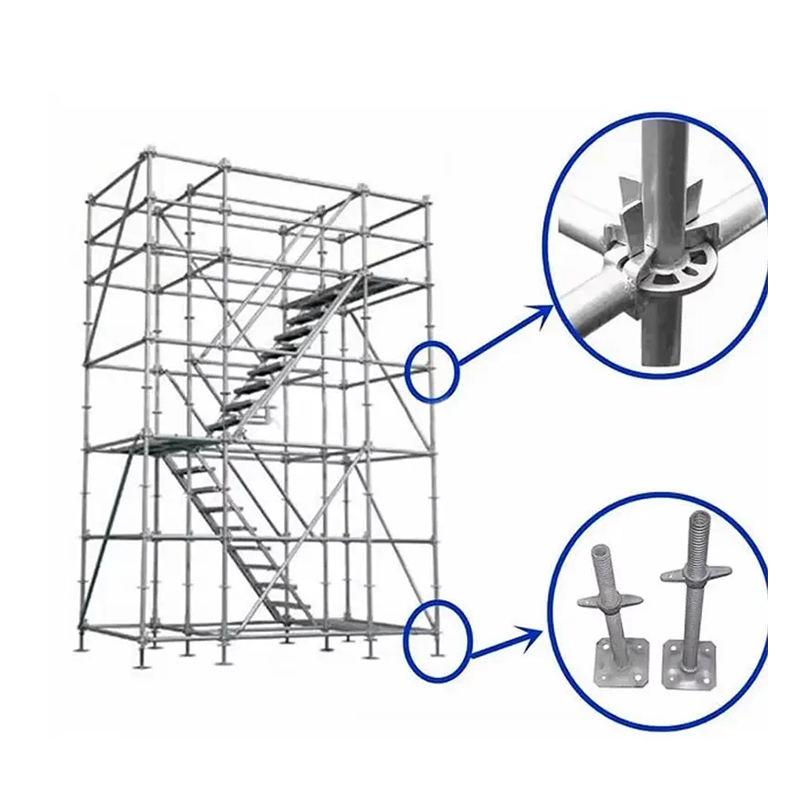
Ringlock Scaffolding
What Is Ringlock Scaffolding?
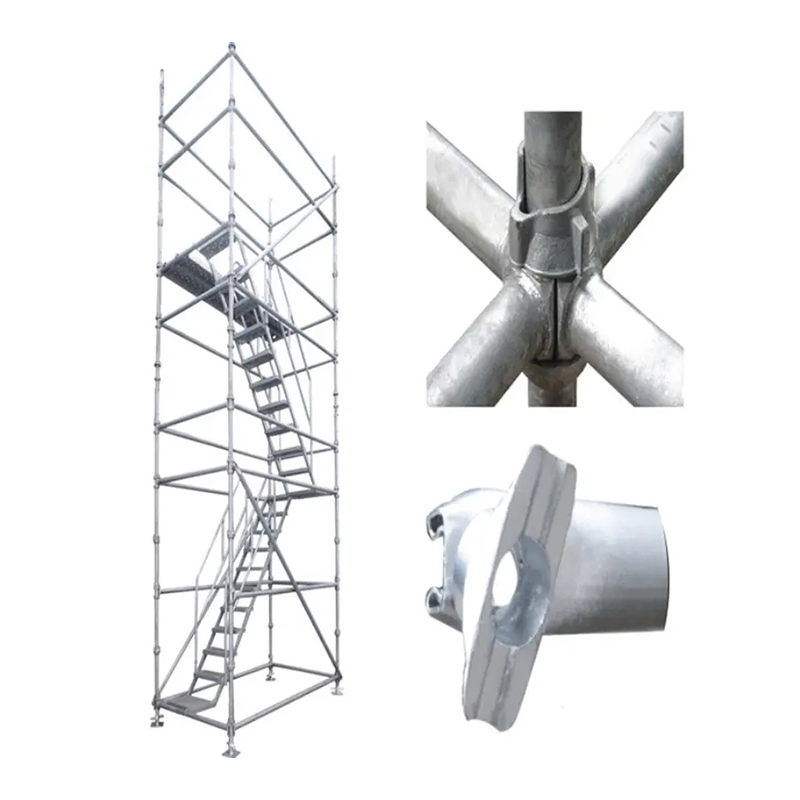
Ringlock scaffolding is a modular scaffolding system based on vertical standards with regularly spaced circular rosettes. Each rosette generally provides connection openings for several horizontal and diagonal members. Ledgers and braces are fitted into these openings, and wedge heads are secured by hammering them into position. The result is a mechanically locked connection capable of transferring vertical and horizontal forces through the assembled scaffold structure.
The system can be used as a conventional access scaffold, a heavy-duty shoring tower, a temporary support frame, or a multidirectional working platform. Its geometry is not limited to simple rectangular elevations. By using different ledger lengths, adjustable components, swivel connections, and carefully planned bracing, ringlock scaffolding can follow curved, irregular, stepped, or restricted structures.
A typical ringlock system includes the following components:
Vertical standards: These are the primary upright members. They transfer loads toward the base and provide the rosette connection points for ledgers, braces, and other components.
Horizontal ledgers: Ledgers connect standards horizontally and establish the length, width, and level spacing of the scaffold. They also contribute to the rigidity of the working platform.
Diagonal braces: Diagonal braces stabilize the scaffold against racking and lateral movement. They are particularly important for tall towers, exposed structures, bridge work, and areas subject to wind or vibration.
Base jacks and base collars: These components distribute loads and provide initial leveling and height adjustment at the bottom of the scaffold.
Steel or aluminum platforms: Platforms create working surfaces for personnel and materials. The selection depends on project requirements, load ratings, handling preferences, and local regulations.
Stairways, ladders, guardrails, toe boards, brackets, and access gates: These accessories improve safe movement, edge protection, and the usability of the finished scaffold.
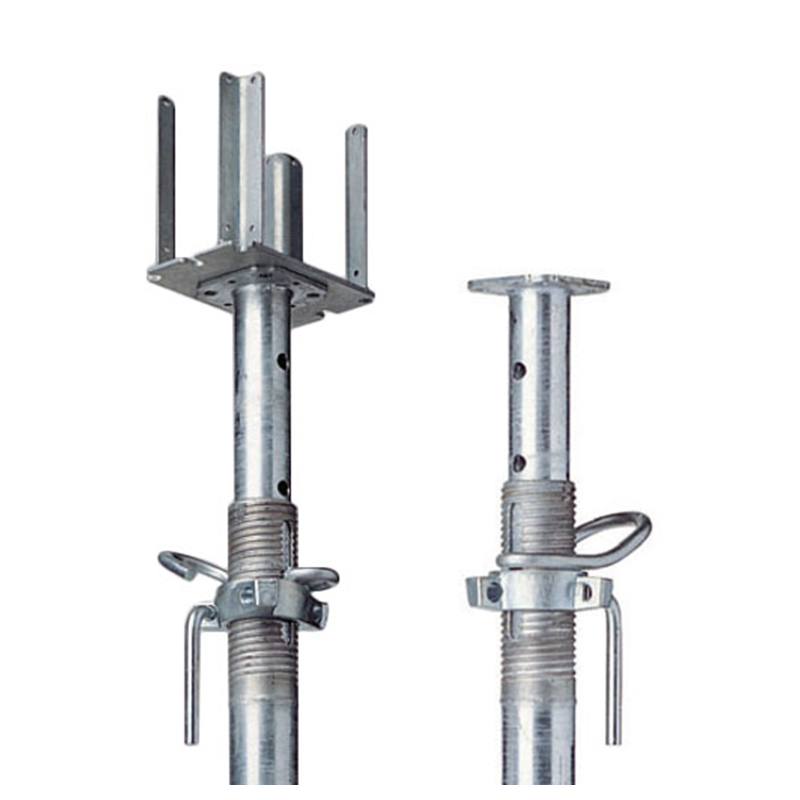
U-head jacks and fork heads: These components are frequently used in shoring and formwork support applications. They permit controlled contact with beams, panels, or other temporary works elements.
Because the components are modular and standardized, a contractor can reuse the same inventory across many projects. A single fleet may support building construction, bridge maintenance, industrial shutdowns, event structures, and temporary access works, provided that the configuration is designed and inspected for each application.
Core Design Features of a Modern Ringlock System
Eight-Way Connection Capability
The rosette connection is one of the most important features of ringlock scaffolding. Depending on the design and component configuration, the node allows members to be connected in multiple directions, commonly including four primary openings and four intermediate openings. This multidirectional connection capability gives the system more geometric flexibility than a basic two-dimensional frame scaffold.
Eight-way connection capability is especially valuable when the scaffold must follow circular tanks, curved bridge sections, inclined structures, industrial pipe racks, large vessels, or irregular building façades. Rather than forcing the entire structure into a rigid grid, designers can select suitable ledger lengths and connection angles to maintain an efficient layout.
Wedge-Locking Mechanism
The wedge head and rosette connection are designed to create a secure mechanical joint. Once the wedge is inserted into the rosette opening, a hammer blow drives it into a locking position. Under load, the connection is designed to tighten rather than loosen when properly installed and used within its specified capacity.
This connection method provides several practical advantages. It reduces the need for loose clamps, shortens the time required to connect components, and makes the assembly process easier to standardize. It also gives site supervisors a visible installation check because the wedge should be fully seated and properly engaged in the rosette.
Standardized Modular Components
Standardization is essential for productivity and inventory control. Ringlock standards and ledgers are produced in common lengths and vertical spacings, allowing contractors to create repeatable bays. Once workers become familiar with the component dimensions, they can assemble, modify, and dismantle structures with less measuring and fewer interruptions.
Standardized parts also support rental operations. A rental company can maintain a relatively manageable inventory of standards, ledgers, braces, base jacks, platforms, and accessories. Components from different projects can be sorted, inspected, and returned to service without requiring project-specific fabrication for every order.
Load Transfer Through a Rigid Node
Ringlock scaffolding is suitable for demanding support applications because its connection node is designed to transfer forces between vertical and horizontal members. The vertical standards carry primary compression loads, while ledgers and braces distribute forces and limit movement. The actual capacity of any scaffold depends on many factors, including steel grade, tube dimensions, rosette design, connection quality, bay size, height, bracing arrangement, foundation conditions, eccentric loading, and environmental forces.
For this reason, ringlock scaffolding should not be evaluated solely by the nominal capacity of an individual tube or standard. The complete system and its engineered configuration must be considered. Proper design, competent erection, inspection, and compliance with applicable standards remain essential for safe performance.

Material Selection and Structural Performance
The use of high-strength Q345B steel for the primary standards provides a strong material foundation for heavy-duty ringlock scaffolding. Q345B is a commonly used low-alloy structural steel known for its combination of yield strength, weldability, and practical availability. It is suitable for components that must resist repeated handling, compression, impact during erection, and service loads in construction environments.
Material selection affects more than static strength. Scaffolding components are repeatedly loaded, unloaded, transported, stacked, assembled, dismantled, and exposed to site impacts. A reliable material specification helps reduce the risk of premature deformation and supports consistent manufacturing results.
However, high-strength steel alone does not guarantee a safe scaffold. The complete manufacturing process must control tube dimensions, wall thickness, straightness, rosette geometry, welding penetration, heat-affected areas, and dimensional tolerances. If individual components do not fit correctly, the advantages of the selected steel grade can be reduced by assembly problems or uneven load transfer.
A professional manufacturing program therefore combines suitable raw materials with controlled fabrication. Incoming steel can be checked against procurement specifications, material certificates can be reviewed, and samples can be tested when required. Production records should identify the material batch, processing stage, and inspection status of the components.
Precision Tube Preparation
Steel tubes used for standards, ledgers, and braces must be cut to accurate lengths. Excessive variation can create gaps, misalignment, or unintended stresses during erection. CNC cutting equipment helps maintain consistent dimensions and repeatable end preparation.
Accurate tube preparation is also important for welding. When tube ends, rosettes, sleeves, and connection plates are correctly positioned before welding, the finished parts are more likely to remain within specified tolerances. This supports interchangeability between components produced in different batches.
Robotic and Mechanized Welding
Automated welding robot technology can improve the repeatability of ringlock component production. Robots follow programmed paths and controlled welding parameters, reducing variation caused by fatigue, inconsistent travel speed, or manual positioning. Mechanized welding is particularly useful for repetitive rosette, sleeve, and connector welds.
Robotic welding does not eliminate the need for skilled personnel. Engineers and welding technicians must establish suitable procedures, prepare fixtures, control joint cleanliness, monitor wire and gas settings, and inspect sample welds. Certified welding practices, including AWS or EN-based procedures where applicable, provide a structured basis for quality control.
Manual welding remains useful for non-standard accessories, repairs approved by the manufacturer, and low-volume customized parts. The strongest production systems combine automated welding for repeatable components with qualified manual welding for specialized work.
Dimensional Control and Interchangeability
Ringlock scaffolding depends on component compatibility. A standard from one production batch should connect correctly with a ledger or brace from another batch if both are manufactured to the same specification. Dimensional control therefore includes tube length, rosette spacing, rosette thickness, opening size, pin or wedge dimensions, sleeve fit, and component straightness.
Quality teams may use gauges, fixtures, calipers, coordinate measurement tools, and test assembly stations to verify the accuracy of components. Trial assembly is particularly valuable because it demonstrates whether parts connect smoothly without excessive looseness or forced fitting.
Hot-Dip Galvanizing for Corrosion Protection
Hot-dip galvanizing is a widely used surface treatment for steel scaffolding because it provides both barrier protection and sacrificial protection. During the process, cleaned steel components are immersed in molten zinc. A metallurgical reaction forms zinc-iron alloy layers bonded to the steel surface, with an outer zinc layer that protects the underlying material from moisture and oxygen.
For ringlock scaffolding, hot-dip galvanizing is especially valuable because the equipment is commonly used outdoors, transported between projects, stored in open yards, and exposed to rain, condensation, dust, salt air, concrete residue, and industrial pollutants. A high-quality coating with a minimum thickness of approximately 75 micrometers can significantly improve resistance to atmospheric corrosion, subject to the environment and applicable specification.
The galvanizing process generally includes several preparation stages:
Degreasing removes oil, grease, and other organic contamination from the steel surface.
Pickling removes rust and mill scale, exposing a chemically active steel surface.
Fluxing helps prevent oxidation before immersion and supports the formation of a consistent coating.
Hot-dip immersion allows the zinc to react with the steel and form the protective coating.
Cooling and inspection stabilize the finished component and allow the coating to be checked for coverage, adhesion, appearance, and thickness.
Uniform galvanizing of both external and accessible internal surfaces is important. If only the outside surface receives adequate protection while internal areas remain untreated, hidden corrosion may develop during long-term service. Manufacturers should also consider drainage and venting requirements for hollow components so that the galvanizing process can be performed safely and effectively.
Benefits for Rental Fleets
Rental companies often measure equipment value by the number of productive rental cycles a component can complete. Painted or lightly coated scaffolding may require more frequent maintenance, especially when components are repeatedly loaded onto trucks, dragged across yards, and exposed to weather. Galvanized components generally provide better resistance to surface damage and atmospheric corrosion.
A longer service life can lower the annualized cost of ownership. The exact result depends on utilization, handling, inspection, storage, repair practices, and local climate, but durable galvanizing can reduce repainting requirements and extend the useful period of the equipment. A service life exceeding 15 years may be achievable under normal conditions when the system is properly used and maintained; actual performance should be evaluated against the project environment and manufacturer specifications.
Benefits in Marine and Industrial Environments
Marine construction, ports, shipyards, power plants, chemical facilities, and wastewater treatment sites often expose steel equipment to high humidity, salt deposits, chemicals, or fluctuating temperatures. Hot-dip galvanizing is not a substitute for an application-specific corrosion engineering assessment, but it offers a robust baseline protection system for many atmospheric environments.
Where stronger chemical exposure or immersion conditions exist, additional measures may be necessary. These may include specialized coatings, sealing details, more frequent inspection, or a different material selection. Contractors should communicate the environmental conditions to the manufacturer before purchasing the system.
Manufacturing Strengths of an Experienced OEM Supplier
The performance of ringlock scaffolding is closely connected to the manufacturing capability of the supplier. An experienced OEM partner can support more than standard product sales. It can help translate project requirements into component lists, fabrication drawings, production schedules, quality documents, and packaging plans.
Nantong Hyson Road And Bridge Formwork Co., Ltd. specializes in custom steel formwork, ringlock scaffolding, heavy-duty steel structures, and OEM metal fabrication. Its manufacturing capabilities include laser cutting, CNC processing, bending, automated and qualified welding, galvanizing coordination, and assembly inspection. This combination is useful for customers who require both standard ringlock products and customized support components.
The company’s experience supplying major infrastructure contractors, including China Communications Construction Company and China Railway Corporation, demonstrates familiarity with large-project procurement expectations. Such projects typically require strict dimensional control, traceability, production planning, inspection records, delivery coordination, and the ability to respond to design changes.
Experience with bridge, power plant, and industrial projects also helps a manufacturer understand the practical conditions in which scaffolding is used. These conditions may include restricted access, heavy concrete loads, irregular geometry, long working periods, difficult transport routes, and the need to integrate scaffolding with formwork or permanent structures.
Integrated Laser Cutting and Steel Processing
Laser cutting supports the production of accurate plates, brackets, gussets, connection parts, base components, and non-standard accessories. Compared with less precise cutting methods, CNC laser processing can reduce dimensional variation and create clean edges suitable for subsequent forming or welding.
Integrated steel processing is particularly valuable for custom orders. A customer may require standard ringlock components together with special stair towers, platform brackets, support frames, beam heads, or connection plates. A supplier with in-house or closely controlled cutting and fabrication capacity can coordinate these parts more efficiently than a trading company dependent on multiple unrelated subcontractors.
Certified Welding Practices
Welding quality affects the strength, durability, and safety of the finished scaffold. The manufacturer applies AWS and EN welding craftsmanship, supported by trained personnel and controlled procedures. Depending on the order, quality documentation may include welding procedure information, welder qualifications, visual inspection records, dimensional inspection reports, and material certificates.
Weld inspection should consider surface appearance, continuity, undercut, porosity, lack of fusion, cracks, spatter, distortion, and the correct positioning of welded components. For critical or specially specified parts, additional non-destructive testing may be considered according to the project quality plan.
Quality Management and International Standards
An ISO 9001 quality management system provides a framework for documented processes, corrective actions, customer feedback, supplier evaluation, and continual improvement. It does not replace product testing or engineering design, but it helps establish repeatable manufacturing controls.
Compliance with relevant scaffolding standards such as BS1139 and EN74 may support international project acceptance, depending on the exact system design, certification scope, and purchasing requirements. Buyers should request current certificates and confirm that the documents apply to the offered components rather than assuming that a general company certificate covers every product.
The company also reports 12 utility patents, reflecting investment in product and manufacturing improvements. Patents do not by themselves establish structural capacity, but they can indicate a focus on developing practical improvements in equipment design, production efficiency, or application-specific solutions.
Advantages Over Conventional Tube-and-Clamp Scaffolding
Faster Assembly and Dismantling
One of the most frequently cited advantages of ringlock scaffolding is installation speed. Because connection points are built into the standards and the wedge mechanism can be secured with a hammer, a trained worker can complete connections quickly. In suitable project conditions, setup time may be reduced by up to 50 percent compared with traditional pipe-clamp systems.
The actual time saving depends on the scaffold height, layout, access conditions, worker experience, material handling, inspection requirements, and the number of special components. Nevertheless, the reduction in repetitive clamp positioning and tightening can produce a substantial productivity improvement across a large project.
Fewer Loose Parts
Tube-and-clamp systems depend on many individual couplers. These couplers must be delivered, counted, positioned, tightened, inspected, and recovered during dismantling. Ringlock scaffolding uses integrated rosettes and wedge heads, reducing the number of loose connection parts required for standard bays.
Fewer loose parts can improve site organization and reduce the likelihood of missing components. It can also simplify transportation and reduce time spent sorting equipment after a project. For rental companies, standardized component categories make inventory management more efficient.
Greater Geometric Flexibility
Traditional frame scaffolding is efficient for straight façades but less adaptable to curved or irregular structures. Ringlock scaffolding can be configured around circular tanks, bridge piers, curved decks, industrial vessels, and complex plant layouts. Its multidirectional nodes allow the structure to change direction while maintaining continuity.
This flexibility is valuable in renovation and maintenance work, where existing equipment, pipework, cable trays, and structural obstructions may prevent a simple rectangular scaffold arrangement.
Improved Structural Rigidity
A properly braced ringlock scaffold forms a rigid spatial framework. The connections between standards, ledgers, and braces help resist movement in multiple directions. This can improve the working experience for personnel and provide a more stable base for temporary platforms, formwork support, and material handling.
Rigidity must never be confused with unlimited capacity. The scaffold still requires adequate foundations, correct bracing, ties where needed, controlled loading, and design verification. The advantage is that the system provides an efficient structural framework when it is correctly configured.
Longer Service Life
Hot-dip galvanized ringlock components generally resist atmospheric corrosion better than unprotected or lightly painted steel. This is a significant advantage for equipment that must be repeatedly reused. A durable surface also helps preserve identification markings and component dimensions when handling is controlled.
Galvanizing can be damaged by severe impact, cutting, welding, or contact with incompatible chemicals. Damaged areas should be inspected and repaired according to the manufacturer’s recommendations. Components with serious deformation, cracked welds, excessive corrosion, or unreliable connections should be removed from service.
Applications in Infrastructure and Construction
Bridge and Viaduct Construction
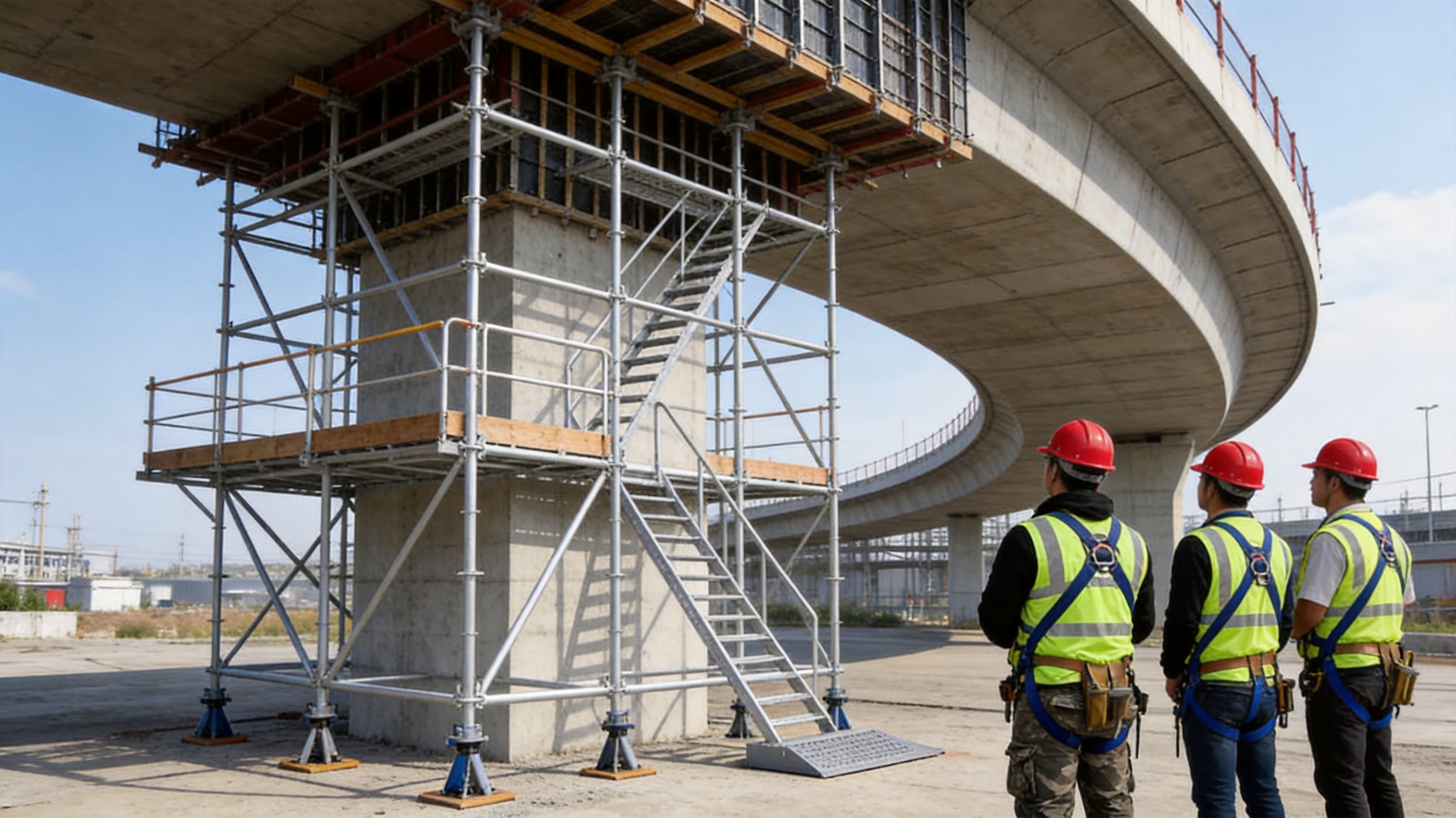
Bridge projects frequently require temporary support towers beneath decks, box girders, pier caps, and formwork systems. Ringlock scaffolding can be arranged as a heavy-duty support frame capable of distributing substantial temporary loads through a braced grid.
Its modular layout is useful when pier spacing, ground conditions, or deck geometry varies along the project. The system can be adapted to different widths and heights while maintaining common connection principles. In box girder construction, it may support formwork, working platforms, access stairways, and inspection routes.
Bridge construction involves significant hazards, including falling objects, vehicle movement, wind exposure, uneven ground, concrete placement loads, and changing work elevations. A project-specific temporary works design should identify these risks and define foundation requirements, bracing, ties, access, loading zones, inspection procedures, and dismantling sequences.
Industrial Plant Maintenance
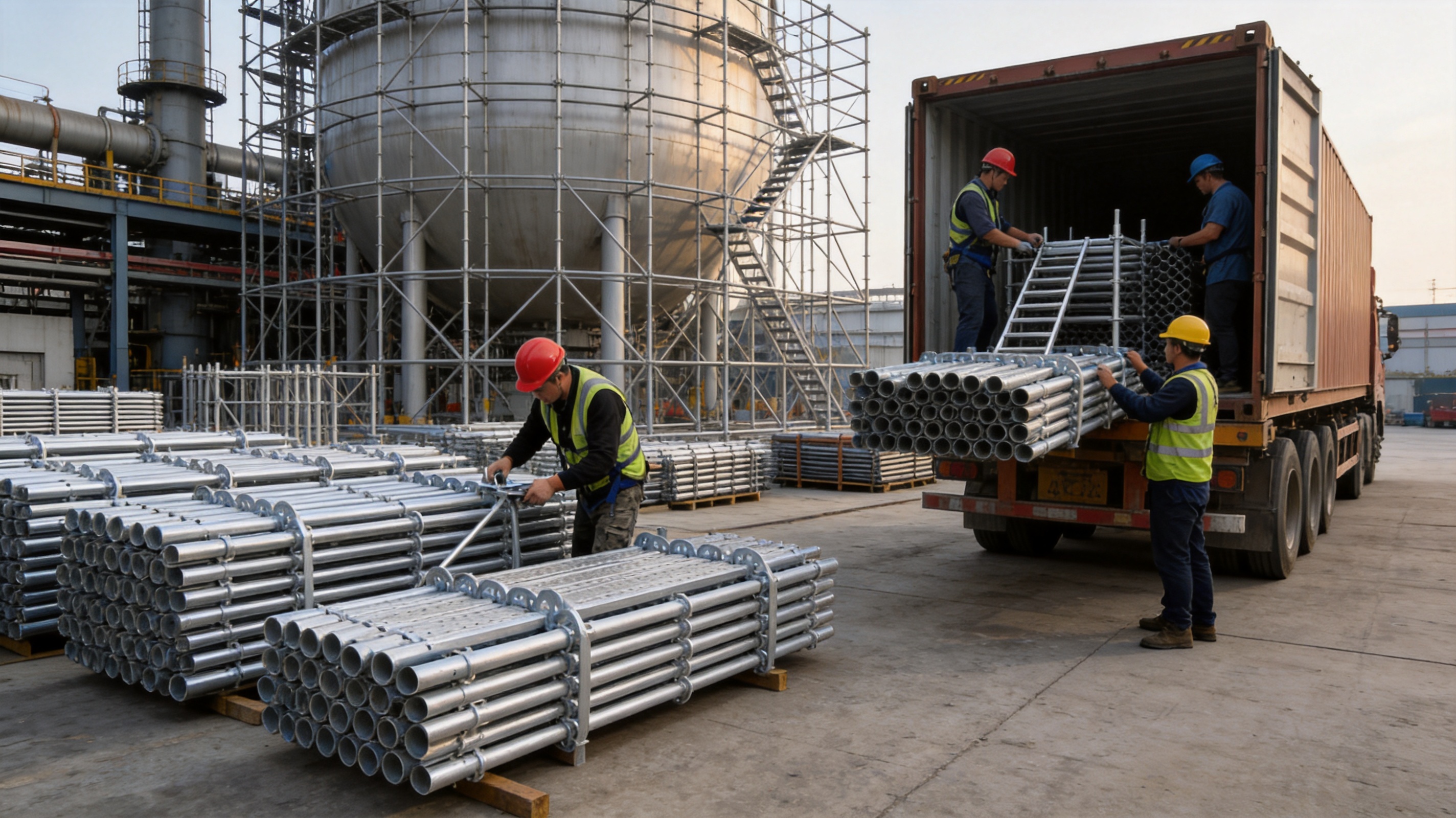
Refineries, chemical plants, power stations, steel mills, cement plants, and wastewater facilities often require temporary access around equipment with complicated shapes. Ringlock scaffolding can be assembled around vessels, pipes, platforms, ducts, turbines, boilers, and structural frames.
The system’s multidirectional connections allow contractors to create working platforms at different elevations while maintaining access around obstructions. During planned shutdowns, rapid installation is especially important because every lost hour can affect production schedules. The ability to assemble with fewer tools and standardized components can support a more efficient maintenance program.
Industrial environments require additional planning. Scaffolding may need to coexist with hot work, electrical isolation, hazardous substances, confined spaces, process lines, cranes, and moving machinery. The scaffold design and work permit system should address these conditions before erection begins.
Commercial High-Rise Buildings
Ringlock scaffolding can provide working platforms for façade installation, masonry, mechanical services, glazing, painting, repair, and finishing work. Its modular arrangement can be adapted to building elevations and internal atriums. Guardrails, toe boards, access ladders, stairways, and platform brackets can be integrated into the system.
For high-rise applications, wind effects, façade ties, loading platforms, material hoists, debris protection, and emergency access require careful consideration. The scaffold should be inspected after severe weather and whenever it has been altered or impacted.
Temporary Stages and Grandstands
Ringlock scaffolding is also used for temporary structures such as concert stages, spectator stands, observation decks, exhibition platforms, and event access systems. Its fast assembly and reusable components make it suitable for temporary installations with short construction windows.
Event structures may experience crowd loads, dynamic movement, weather exposure, and unusual load distributions. They require engineering calculations and approval procedures appropriate to the event and local authority requirements. Platforms, stairs, handrails, barriers, and emergency routes must be designed as part of the complete structure rather than added as an afterthought.
Safety and Engineering Considerations
Ringlock scaffolding is a safety-critical temporary works system. Its reliable performance depends on design, component quality, erection, inspection, use, alteration, and dismantling. A high-quality product cannot compensate for an unsuitable foundation, missing braces, unauthorized modifications, or overloading.
Foundation and Base Conditions
Loads must be transferred safely into the ground or supporting structure. The base must be sufficiently strong, level, and stable for the planned load. Sole boards, base plates, adjustable jacks, or other distribution measures may be required depending on the ground condition.
Soft soil, voids, slopes, underground services, water accumulation, and recently filled ground can create settlement risks. Uneven settlement may introduce additional stresses and cause the scaffold to lean. The foundation arrangement should therefore be reviewed before erection and monitored during use.
Bracing and Ties
Diagonal braces are essential for controlling lateral movement and maintaining the intended geometry. Taller or exposed scaffolds may require additional façade ties, buttresses, stabilizers, or other restraint systems. The spacing and pattern of braces should follow the engineering design and manufacturer instructions.
Removing a brace, ledger, tie, or guardrail without authorization can compromise the entire structure. If access requirements change, a competent person should review and approve the modification.
Load Management
Scaffolding should be used only within its specified load class and configuration. Loads include personnel, tools, stored materials, platforms, formwork, wet concrete, wind, impact, and any equipment attached to the scaffold. Materials should be distributed rather than concentrated in one bay unless the structure has been specifically designed for concentrated loading.
Concrete support applications require especially careful engineering. Fresh concrete, reinforcement, formwork, construction equipment, and placement forces can create substantial vertical and lateral loads. The scaffold must be designed as a temporary works support system, not treated as ordinary access scaffolding.
Inspection and Maintenance
Components should be inspected before delivery, after transportation, before erection, after installation, after significant alteration, and following events such as storms or impacts. Inspections should look for bent standards, damaged rosettes, cracked welds, distorted wedges, excessive corrosion, missing pins, damaged platforms, and contamination that prevents proper connection.
Equipment should be stored on stable supports to prevent unnecessary bending. Components should not be thrown from height during dismantling. Galvanized surfaces should be protected from prolonged contact with corrosive chemicals, and damaged coatings should be addressed in accordance with the manufacturer’s repair guidance.
Quality Control from Raw Material to Shipment
A robust quality program follows the product through every major stage of production. The process begins with raw material verification and continues through cutting, forming, welding, galvanizing, assembly, inspection, packing, and dispatch.
| Production Stage | Typical Control Activity | Customer Benefit |
|---|---|---|
| Raw material purchasing | Specification review, material certificates, batch identification | More reliable material traceability and consistent performance |
| CNC cutting | Length checks, edge condition checks, program verification | Improved interchangeability and reduced fitting problems |
| Component forming | Dimensional inspection, straightness checks, fixture control | Better alignment during erection |
| Robotic or qualified welding | Procedure control, visual inspection, sample testing | More consistent connection strength and weld quality |
| Hot-dip galvanizing | Surface preparation, coating coverage, thickness inspection | Improved corrosion resistance and service life |
| Trial assembly | Connection fit, wedge engagement, component compatibility | Faster and safer field installation |
| Final inspection | Quantity, labeling, dimensions, appearance, packing review | Fewer delivery errors and easier site inventory control |
Inspection records should be matched to the customer’s documentation requirements. Large infrastructure projects may require inspection and test plans, product certificates, welding records, galvanizing reports, packing lists, dimensional reports, and photographs of production stages.
Clear labeling is also important. Standards, ledgers, braces, jacks, platforms, and special accessories should be identifiable by size or part number. Consistent labeling reduces the time required to prepare material for erection and assists with later inventory reconciliation.
Customization and OEM Services
Although ringlock scaffolding is based on standardized modules, many projects require customized accessories or special dimensions. An OEM manufacturer can adapt the supply package to the customer’s design, local regulations, project schedule, and logistics requirements.
Possible customization areas include standard length, rosette spacing, tube diameter, wall thickness, platform dimensions, base jack capacity, stair configuration, guardrail arrangement, special brackets, support heads, access gates, protective finishes, packaging, and identification markings.
Customization should be managed carefully. Any change to the standard system may affect load capacity, connection behavior, assembly sequence, or certification status. Engineering review is therefore required before non-standard dimensions or components are introduced into a project.
For customers purchasing complete support systems, the manufacturer can assist with quantity calculations and component schedules. A typical project review considers the number of bays, scaffold height, working levels, access routes, support loads, bracing requirements, base conditions, platform requirements, and expected reuse frequency.
OEM cooperation can also include drawing review, sample production, prototype assembly, third-party inspection coordination, container loading plans, spare-part recommendations, and technical support. This integrated approach is more effective than purchasing separate components from several sources without confirming compatibility.
Cost Efficiency and Return on Investment
The financial value of ringlock scaffolding should be assessed through total cost of ownership rather than unit price alone. A lower-cost system may become expensive if it requires more labor, experiences high component loss, suffers rapid corrosion, or creates delays during erection.
Important cost factors include purchase price, shipping volume, assembly labor, dismantling labor, maintenance, replacement rate, rental utilization, storage requirements, inspection time, project delay risk, and resale value. A durable modular system can generate value over many projects, especially when it is well maintained and compatible with a broad range of applications.
For rental companies, the return on investment is influenced by utilization rate and fleet flexibility. Components that can be used for bridges, buildings, industrial maintenance, and temporary event structures are more likely to remain productive throughout the year. Standardized parts also make it easier to combine inventory for large orders.
For contractors, the main benefit may be schedule reliability. Faster erection can release crews for other work, reduce the duration of traffic restrictions, shorten plant shutdowns, and support earlier formwork or finishing operations. Time savings can therefore have a greater financial impact than the initial difference between competing product prices.
Hot-dip galvanizing contributes to long-term economics by reducing the frequency of repainting and improving resistance to outdoor storage conditions. The equipment should still be cleaned, inspected, and stored properly, but the protective coating can reduce routine maintenance demands.
Logistics, Packaging, and Site Readiness
Scaffolding is a high-volume product, so logistics planning has a direct effect on project efficiency. Components should be bundled according to type and length, protected against unnecessary damage, and labeled clearly. Standards, ledgers, braces, jacks, platforms, and accessories should be packed in a way that supports rapid unloading and counting.
Efficient packaging can reduce container space and handling costs, but it must not create unsafe bundles or make components difficult to separate. Heavy items should be arranged to prevent shifting during transport. Galvanized surfaces should be protected from prolonged moisture entrapment and contact with materials that may cause staining or accelerated corrosion.
Before shipment, the supplier and customer should confirm the component list, quantities, shipping marks, loading sequence, delivery address, documentation, and any required inspection arrangements. For large infrastructure projects, phased delivery may be preferable to a single shipment because it aligns material arrival with the erection schedule.
Site readiness is equally important. The receiving area should have adequate space for unloading, sorting, inspection, and temporary storage. The contractor should prepare a component control system so that parts can be distributed to erection teams without unnecessary searching or double handling.
How to Select a Reliable Ringlock Scaffolding Supplier
Buyers should assess the supplier’s technical, manufacturing, quality, and service capabilities before placing an order. The following questions can help distinguish a qualified manufacturer from a company that only resells generic components.
Does the supplier provide clear material specifications for standards, ledgers, braces, rosettes, wedges, platforms, and accessories?
Can the supplier provide evidence of production capability, including CNC cutting, controlled welding, surface treatment, and final inspection?
Are the connection dimensions compatible with the customer’s existing inventory or project design?
Can the supplier issue material certificates, welding documentation, galvanizing reports, dimensional records, and packing lists when required?
Does the supplier have experience with bridge construction, industrial maintenance, high-rise buildings, or other demanding applications?
Can the supplier support customized components without compromising the standard system or creating unverified combinations?
Are product samples, trial assemblies, or third-party inspections available before mass production?
Does the supplier provide technical drawings, assembly guidance, and recommendations for inspection and maintenance?
Is the company able to coordinate production and delivery for large projects with phased schedules?
Nantong Hyson Road And Bridge Formwork Co., Ltd. offers OEM manufacturing for steel formwork, ringlock scaffolding, heavy steel structures, and custom metal components. Its experience with major infrastructure and industrial projects, together with its laser cutting, bending, welding, and quality control capabilities, supports customers seeking a complete manufacturing partner rather than a basic product broker.
Project Planning Recommendations
Successful ringlock scaffolding projects begin with accurate information. Before quotation or design, the buyer should provide the intended application, approximate dimensions, working height, load requirements, platform levels, access needs, environmental conditions, project standards, delivery schedule, and whether the system will be used as access scaffolding or temporary structural support.
For bridge and formwork applications, the customer should also provide concrete loads, formwork weights, pour sequences, support spacing, ground elevations, settlement assumptions, and any interaction with permanent structures. For industrial maintenance, equipment drawings, restricted access zones, hazardous area requirements, and shutdown dates may be necessary.
The manufacturer can then prepare a component schedule and identify any special parts. Early design coordination helps avoid late changes, incomplete accessory packages, and delivery interruptions. It also provides an opportunity to verify that the proposed system is appropriate for the required load and geometry.
Training should be provided to erection crews before the first installation. Workers should understand standard and ledger orientation, wedge engagement, bracing patterns, base adjustment, platform installation, guardrail requirements, and the procedures for inspection and alteration.
Environmental and Sustainability Considerations
Reusable scaffolding can support more sustainable construction by reducing the demand for disposable temporary materials. A modular steel system can be dismantled, transported, repaired where appropriate, and reused across multiple projects. Its long service life improves the utilization of the material and reduces the frequency of replacement.
Steel is also recyclable at the end of its useful life. The galvanized coating may require appropriate recycling and processing procedures, but the steel substrate remains a valuable recyclable material. Manufacturers can support sustainability goals through efficient cutting plans, reduced production waste, responsible packaging, and durable product design.
Long-lasting corrosion protection contributes to sustainability because fewer components need to be repainted or replaced. Nevertheless, environmental performance should be evaluated across the full life cycle, including raw material production, manufacturing energy, galvanizing, transportation, maintenance, reuse, and recycling.
Q&A: Ringlock Scaffolding
What is the main difference between ringlock scaffolding and tube-and-clamp scaffolding?
Ringlock scaffolding uses integrated rosette connection points and wedge heads, while tube-and-clamp scaffolding relies on separate couplers tightened around individual tubes. Ringlock systems generally require fewer loose parts and can be assembled more quickly. Tube-and-clamp systems may offer flexibility for unusual one-off arrangements, but they typically require more manual fitting and tightening.
Can one worker assemble ringlock scaffolding?
A single trained worker can often complete individual standard connections using a hammer. However, the number of workers required for a complete project depends on component weight, scaffold height, site access, safety requirements, lifting methods, and the complexity of the structure. Large or heavy-duty systems should be erected by a properly trained and supervised team.
Is hot-dip galvanized scaffolding suitable for coastal projects?
Hot-dip galvanized scaffolding is generally suitable for many outdoor and coastal atmospheric applications because the zinc coating provides strong corrosion protection. The exact suitability depends on salt concentration, exposure duration, maintenance, and whether the components are subject to immersion or aggressive chemicals. A project-specific corrosion assessment may be necessary for severe environments.
How long can galvanized ringlock scaffolding last?
Under normal use and with proper storage, inspection, and maintenance, a galvanized ringlock system may have a service life exceeding 15 years. Actual life depends on loading, handling damage, corrosion exposure, repair practices, and whether components remain within dimensional and structural tolerances.
Can ringlock scaffolding support concrete formwork?
Yes, ringlock scaffolding can be configured as a temporary support tower for concrete formwork and bridge construction. The support arrangement must be designed for the complete load, including wet concrete, reinforcement, formwork, personnel, equipment, impact, and construction sequence effects. It should not be used for heavy concrete support without an appropriate engineering review.
What steel grade is used for the main standards?
The described system uses high-strength Q345B steel for the columns or primary standards. Buyers should confirm the material grade, tube dimensions, wall thickness, welding requirements, and applicable certification in the technical documentation for each order.
What quality documents should a buyer request?
Depending on the project, buyers may request material certificates, dimensional inspection records, welding procedure information, welder qualifications, galvanizing thickness reports, product test records, packing lists, certificates of conformity, and applicable ISO, BS, or EN documentation.
Can the system be customized?
Yes. Common customization areas include component lengths, rosette spacing, platform dimensions, base jacks, special brackets, stairways, support heads, guardrails, surface treatment, labeling, and packaging. Any non-standard change should be reviewed by the manufacturer’s technical team to confirm compatibility and performance.
Is ringlock scaffolding appropriate for curved bridges and circular structures?
Its multidirectional connection design makes it well suited to curved bridges, circular tanks, vessels, and irregular industrial structures. The final layout should be developed from accurate project geometry, with suitable bay lengths, bracing, ties, platforms, and access components.
How should ringlock components be maintained?
Components should be inspected regularly for bending, cracked welds, damaged rosettes, distorted wedges, excessive corrosion, and missing parts. They should be handled carefully, stored off the ground where possible, kept organized, and removed from service if their structural integrity or connection reliability is uncertain.
Conclusion
Hot-dip galvanized ringlock scaffolding provides a practical combination of rapid assembly, multidirectional adaptability, structural stability, and long-term durability. Its rosette-and-wedge connection reduces the dependence on loose clamps and allows trained workers to assemble standard connections efficiently with a hammer. The system can be used for access platforms, industrial maintenance, bridge support towers, high-rise construction, temporary stages, and other modular structures.
The use of Q345B steel, CNC cutting, robotic welding, dimensional control, and hot-dip galvanizing helps create a product suited to demanding construction and industrial environments. Compared with conventional tube-and-clamp systems, ringlock scaffolding can offer faster installation, simpler inventory management, greater geometric flexibility, and improved resistance to corrosion.
The strongest results come from combining a quality product with professional engineering, competent erection, proper inspection, and responsible maintenance. An experienced OEM manufacturer such as Nantong Hyson Road And Bridge Formwork Co., Ltd. can add value through integrated steel processing, certified welding practices, international quality management, customized components, and project-based technical support.
For contractors, infrastructure companies, and rental fleets, the decision should be based on total project value rather than initial price alone. A reliable ringlock system can become a long-term productive asset that improves construction efficiency, supports safer work at height, and provides dependable performance across a wide range of heavy-duty applications.
References
1. BS1139, Metal Scaffolding: General Requirements and Related Guidance.
2. EN74, Couplers, Spigot Pins and Base-Plates for Use in Falsework and Scaffolds.
3. ISO 9001, Quality Management Systems: Requirements.
4. AWS Structural Welding Codes and Recommended Welding Practices.
5. European and international guidance concerning the design, erection, inspection, use, and dismantling of temporary access and support structures.
6. Structural steel material specifications and technical documentation for Q345B low-alloy structural steel.
7. Manufacturer technical data, inspection procedures, and installation guidance for modular ringlock scaffolding systems.
Product: Ringlock Scaffolding



- Location
- Group 3, Fangzhuang Village, Rucheng Subdistrict, Rugao City, Nantong, Jiangsu, China
- Follow us
- Phone
- +86-13646196162
- info@hysonindustry.com
