 +86-13646196162
 info@hysonindustry.com




 русский
  عربى
عربى 


Advanced Pier Column Formwork for Precise and Efficient Bridge Construction
 2026.09.07
Content
- 1 1. The Role of Pier Column Formwork in Bridge Engineering
- 2 2. Product Overview
- 3 3. Main Technical Characteristics
- 4 4. Advantages Compared with Conventional or Lower-Quality Formwork
- 5 5. Applications
- 6 6. Manufacturing Process and Quality Control
- 7 7. Manufacturing Strengths Supporting Project Reliability
- 8 8. Selecting the Correct Pier Column Formwork
- 9 9. Recommended Construction Workflow
- 10 10. Maintenance and Service Life
- 11 11. Economic and Environmental Benefits
- 12 12. Why Custom Manufacturing Matters
- 13 13. Comparison of Common Formwork Options
- 14 14. Technical Support and Project Coordination
- 15 15. Questions and Answers
- 15.1 Q1: What is pier column formwork used for?
- 15.2 Q2: Can the formwork be used for both circular and rectangular piers?
- 15.3 Q3: Is this formwork suitable for cast-in-place concrete?
- 15.4 Q4: What steel grades are available?
- 15.5 Q5: How does the formwork prevent concrete leakage?
- 15.6 Q6: Can the formwork dimensions be customized?
- 15.7 Q7: How many times can the formwork be reused?
- 15.8 Q8: What manufacturing processes are used?
- 15.9 Q9: Can the manufacturer supply other steel products?
- 15.10 Q10: What information should be provided for a quotation?
- 15.11 Q11: Is the formwork suitable for fair-faced concrete?
- 15.12 Q12: How can the formwork be maintained after use?
- 16 16. Ordering and Customization Considerations
- 17 17. Conclusion
- 18 References
- 19 Product: Pier Column Formwork
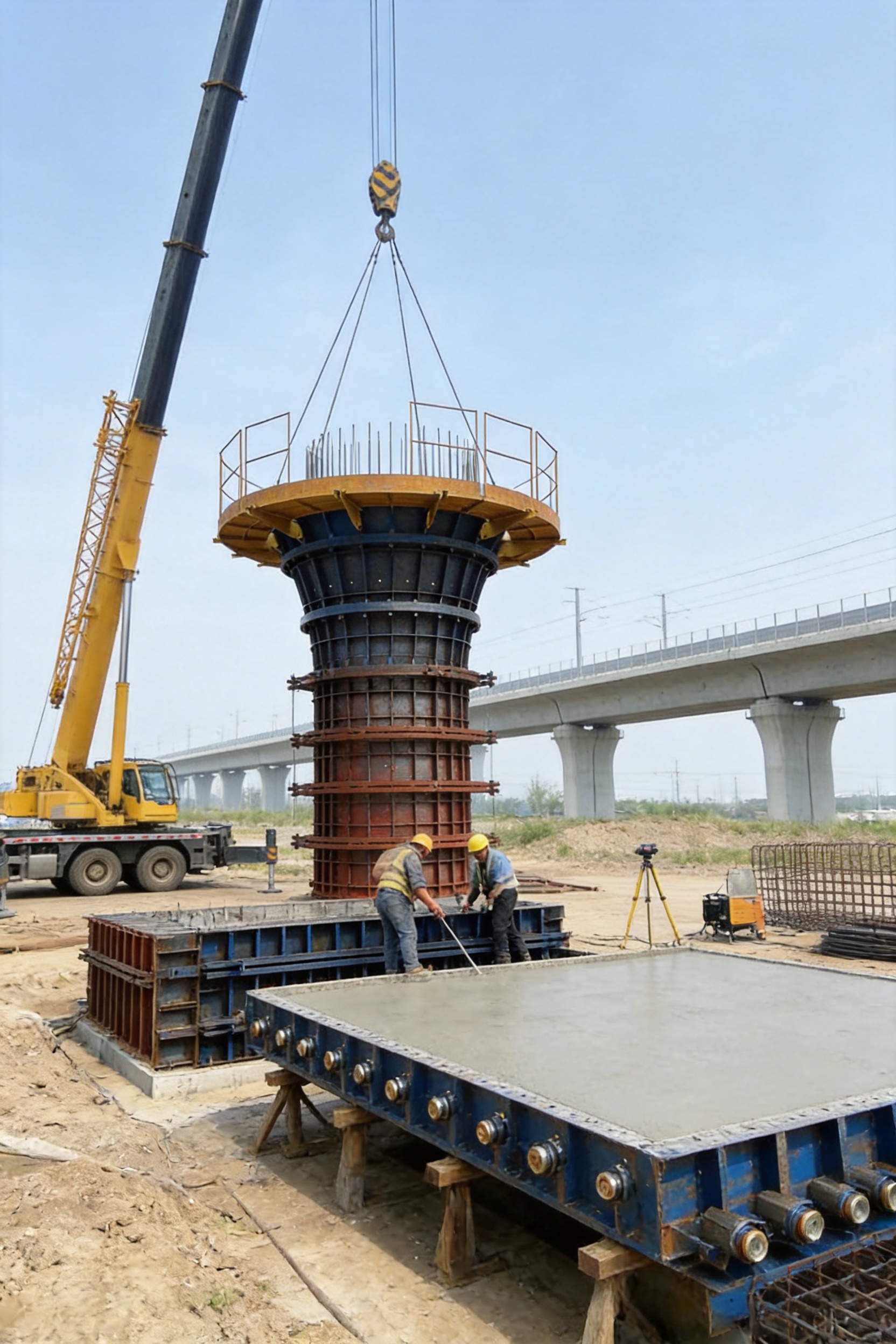
Pier column formwork is one of the most important temporary works systems in bridge and infrastructure construction. It defines the geometry, surface quality, alignment, and dimensional accuracy of concrete piers, columns, and vertical support elements. When the formwork is not sufficiently rigid, accurately manufactured, or properly sealed, problems such as deformation, grout leakage, honeycombing, poor verticality, and difficult stripping can affect both construction efficiency and long-term structural quality.
Modern bridge projects require more than a simple steel shell. Contractors need a complete formwork solution that can withstand fresh concrete pressure, resist vibration, support repeated use, adapt to changing pier dimensions, and allow rapid assembly and disassembly on demanding construction sites. Pier column formwork must also be compatible with lifting equipment, reinforcement cages, working platforms, construction tolerances, and the overall sequencing of bridge substructure works.
The pier column formwork described in this article is engineered for highway, railway, elevated road, municipal, water conservancy, port, and precast concrete applications. Manufactured from high-strength Q235B or Q355B steel plates and reinforced with rigid ribs, standardized positioning components, and precision-fabricated joints, it provides a practical balance of strength, accuracy, durability, and cost efficiency.
Its modular segmented configuration allows the formwork to be configured for different pier heights and cross-sectional dimensions. Depending on project requirements, the system can be designed for circular, rectangular, square, polygonal, or other non-standard pier shapes. The result is a reusable formwork solution for contractors, precast factories, infrastructure developers, and engineering companies that need dependable performance across multiple concrete pours.
1. The Role of Pier Column Formwork in Bridge Engineering
Bridge piers transfer loads from the superstructure to foundations and ground. Although the concrete pier may appear geometrically simple, its construction involves several demanding requirements. The formwork must maintain the specified shape while containing fresh concrete. It must remain stable during placing and vibration. It must prevent cement grout from escaping through joints. It must also permit safe access for workers and efficient removal after the concrete has reached the required strength.
Fresh concrete produces considerable lateral pressure against formwork panels. The magnitude of this pressure depends on the pour height, concrete mix, placing speed, temperature, slump, vibration method, and setting characteristics. Tall piers and rapid placement can create especially demanding conditions. If the formwork is too thin, inadequately braced, or poorly connected, panels may bulge, joints may open, or the finished pier may fall outside the required tolerance.
In bridge construction, even small dimensional errors can create installation problems for pier caps, bearings, precast segments, girders, crash barriers, and other structural components. A formwork system with accurate positioning and reliable rigidity helps ensure that the concrete pier is produced according to the approved drawings and that subsequent construction stages can proceed without unnecessary correction work.
Surface quality is another important consideration. Concrete cast against steel formwork can achieve a smooth and uniform finish when the panels are accurately fabricated and the joints are properly sealed. This is particularly valuable for fair-faced concrete, visible bridge columns, urban viaducts, and projects where architectural appearance is part of the quality specification.
2. Product Overview
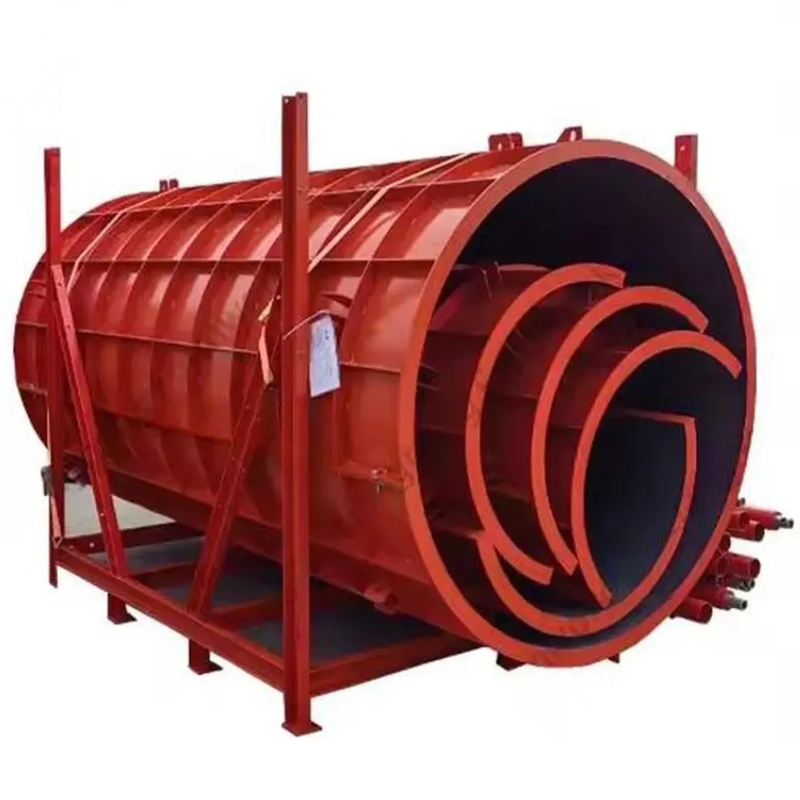
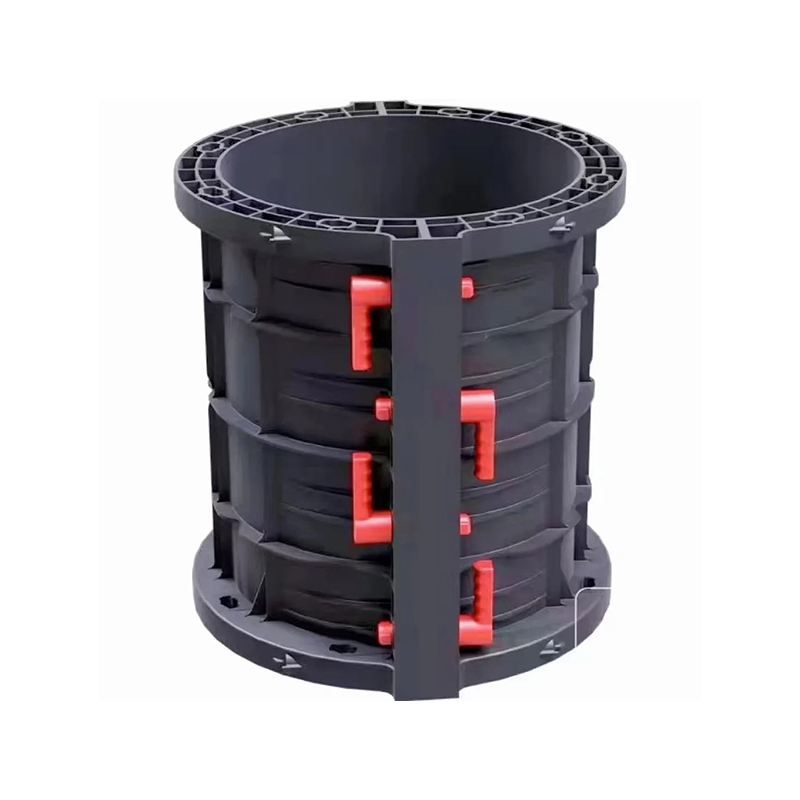
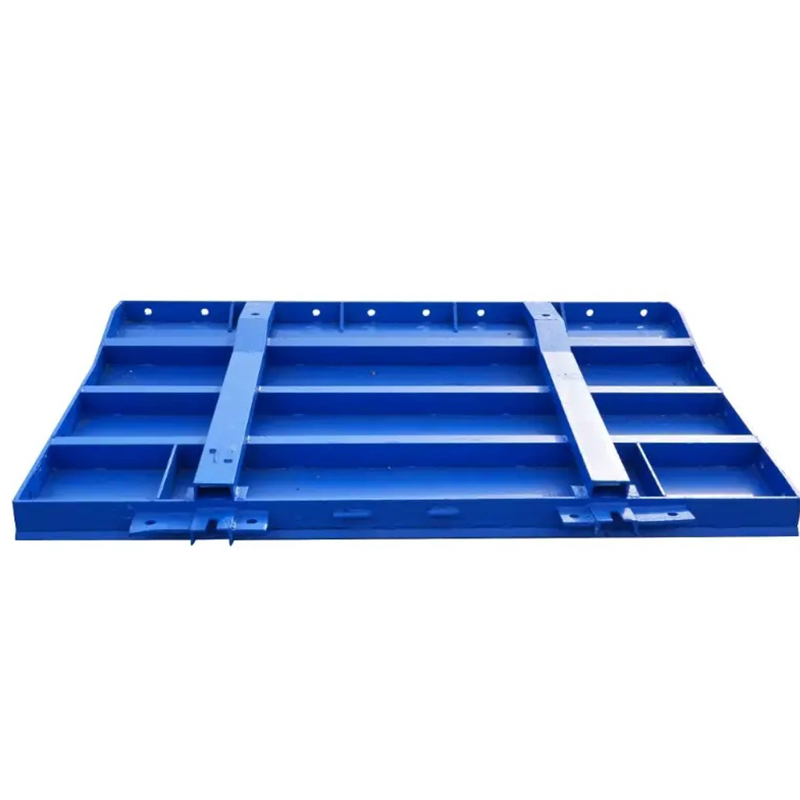
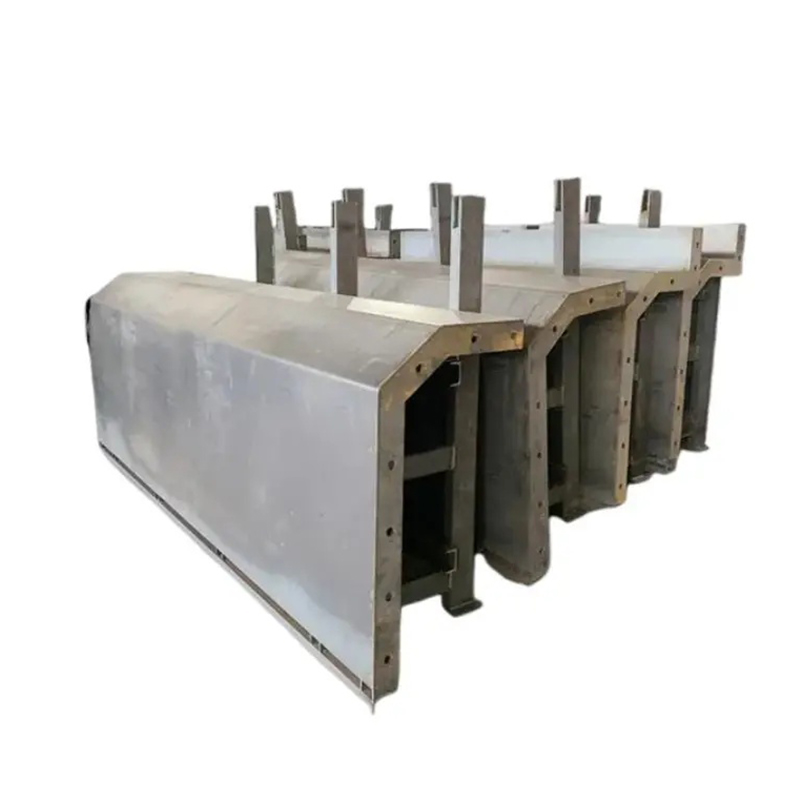
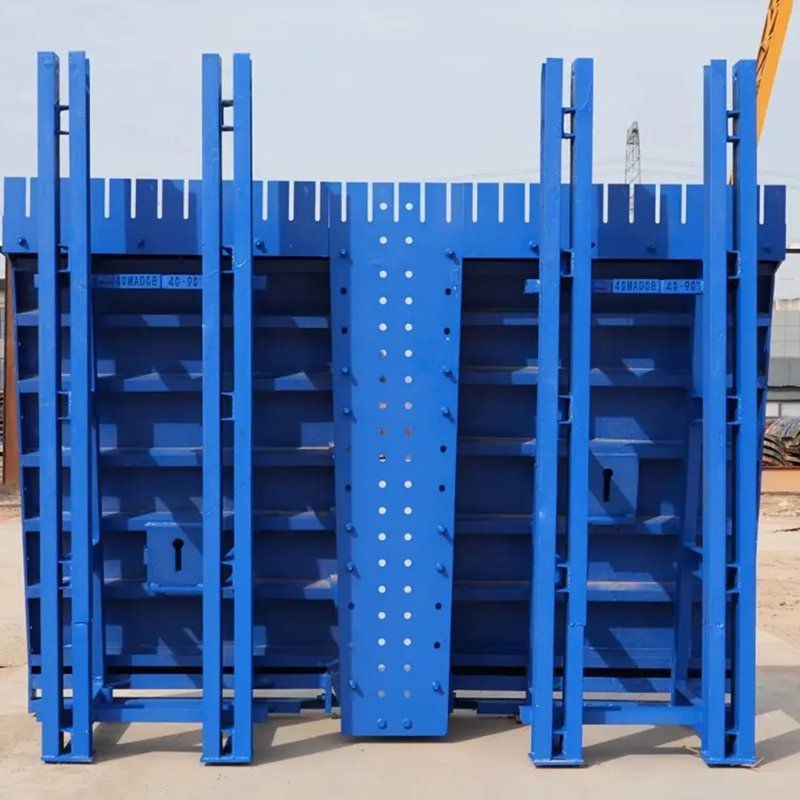
Pier column formwork is a high-precision steel mold used to shape concrete bridge piers, vertical columns, and support pillars. It can be used for both cast-in-place construction and selected precast production applications. The system is normally composed of curved or flat steel panels, reinforcing ribs, connecting flanges, bolts, alignment components, lifting points, and other project-specific accessories.
The primary panels form the contact surface against which concrete is poured. Behind the panels, stiffening ribs and structural frames distribute pressure and limit deflection. The joints between sections are designed to provide accurate alignment and reduce leakage. Connecting systems allow individual segments to be assembled into the required height and circumference or cross-sectional size.
For a circular pier, the formwork may be manufactured as two or more semicircular sections, depending on the pier diameter, lifting capacity, and project requirements. For rectangular or polygonal piers, panels can be configured with straight or angled faces. Segmented height extensions allow the same basic system to be adapted to different pier elevations, reducing the need to fabricate a completely new mold for every pour.
The design is suitable for bridge substructure works where dimensional stability, fast turnover, and consistent concrete quality are essential. It can be integrated with construction platforms, ladders, working brackets, tie systems, lifting equipment, and other site accessories when required by the project.
3. Main Technical Characteristics
3.1 High-Strength Steel Construction
The formwork is manufactured using Q235B or Q355B steel plates, selected according to structural requirements, panel dimensions, loading conditions, and customer specifications. These materials provide a dependable foundation for heavy-duty formwork fabrication. Q355B can be selected for components that require higher yield strength, while Q235B may be suitable for certain structural and accessory elements when permitted by the design.
Material selection is not considered separately from the overall structural design. Panel thickness, rib spacing, flange dimensions, connection layout, lifting points, and support arrangements all influence formwork performance. A properly engineered system combines suitable steel grades with an effective reinforcing structure rather than relying only on heavier plates.
3.2 Reinforced Rib Frame
Rigid reinforcing ribs are welded behind the face panels to improve resistance to bending and local deformation. The rib frame transfers concrete pressure across the panel and toward the connecting and support points. This helps maintain the designed radius, width, thickness, or angle of the formwork during casting.
Rib layout is adapted to the geometry and size of the formwork. Circular panels require reinforcement that supports curved surfaces without interfering with connection points. Large rectangular panels may require horizontal and vertical ribs, perimeter frames, or additional stiffeners. The objective is to create a balanced structure that is strong enough for the intended load while remaining practical to transport, assemble, and lift.
3.3 Standardized Positioning Structure
Accurate positioning is essential for pier construction. Formwork sections include standardized connection and positioning features that help workers align panels during installation. Properly designed flanges, bolt holes, locating components, and adjustment points reduce assembly variation and improve the repeatability of each concrete pour.
Standardized positioning also makes the formwork easier to inspect before casting. Site teams can confirm that sections are correctly connected, that the required dimensions have been achieved, and that the form is vertical before concrete placement begins.
3.4 Effective Joint Sealing
Open or poorly fitted joints can allow cement grout to escape during casting. This may create fins, voids, honeycombing, rough edges, or surface discoloration. The formwork uses accurately fabricated joint faces and suitable sealing arrangements to reduce the risk of leakage.
Good sealing depends on both manufacturing precision and site installation. Straight and consistent joint edges allow sealing strips or other approved materials to work effectively. Properly tightened connections hold the panels together under pressure and help maintain a clean concrete profile.
3.5 Modular and Adjustable Configuration
The segmented design allows the formwork to be configured for different heights and dimensions. Standard sections can be combined where project geometry permits, while special sections can be manufactured for unusual pier shapes or transitions. This adaptability is a major advantage for contractors working on bridge projects with several pier types.
Modularity can reduce fabrication time for future projects, simplify transportation, and improve storage. It also supports repeated use across multiple pours. Where a project includes piers with the same diameter or cross-sectional profile, the formwork can be moved from one location to another with limited adjustment.
3.6 Smooth Concrete Contact Surface
The steel face of the formwork is designed to provide a consistent concrete finish. When the panels are clean, correctly treated with release agent, and properly aligned, they can produce a smooth surface that requires little remedial work. This is particularly useful for visible pier columns and fair-faced concrete applications.
A consistent surface also improves the repeatability of precast production. When the same formwork is used for multiple components, uniform panel geometry supports consistent appearance and dimensions from one unit to the next.
4. Advantages Compared with Conventional or Lower-Quality Formwork
4.1 Better Resistance to Bulging and Deformation
Inexpensive or lightly reinforced formwork may deform under high concrete pressure. Bulging changes the pier dimensions and can create uneven surfaces that require grinding, patching, or partial reconstruction. The combination of thickened panels and a reinforced rib structure provides improved resistance to these problems.
Compared with timber formwork or thin steel shells, a rigid steel system is less susceptible to moisture-related dimensional changes, repeated handling damage, and local loss of shape. It provides a more stable geometry during long pours and high-frequency vibration.
4.2 More Consistent Pier Geometry
Bridge construction often involves strict requirements for pier diameter, wall thickness, corner location, verticality, and connection to the pier cap. A standardized steel formwork system supports more consistent results than improvised site-built molds. Accurate manufacturing of curved panels and connection components helps maintain the intended geometry throughout the construction cycle.
Consistency is especially valuable on projects with many similar piers. Once the formwork has been correctly checked and adjusted, subsequent pours can follow a repeatable process. This reduces the variation that may occur when individual forms are assembled manually from different materials.
4.3 Reduced Grout Leakage and Surface Repair
Joint leakage increases material waste and often creates visible defects. It can also make stripping and cleaning more difficult. Precision-fabricated joints, reinforced flanges, and suitable sealing methods help reduce leakage and improve surface quality.
Lower repair requirements can save labor and reduce schedule risk. On large bridge projects, avoiding repeated patching operations across many piers can produce substantial economic benefits, even when the initial formwork investment is higher than that of a basic temporary mold.
4.4 Faster Assembly and Disassembly
Standardized fasteners and positioning devices simplify the installation sequence. Panels can be lifted into place, connected, aligned, checked, and prepared for casting using a controlled method. After the concrete reaches the required stripping strength, the sections can be released and moved to the next pier or storage area.
Faster turnover is important because formwork often represents a critical resource in the construction schedule. A contractor with a limited number of formwork sets can achieve more pours when each cycle is organized efficiently.
4.5 Higher Reuse Value
Steel formwork is designed for repeated use. With appropriate cleaning, inspection, storage, and surface protection, it can serve multiple construction cycles. Its reuse value is generally higher than that of single-use or heavily damaged timber molds.
High turnover reduces the average formwork cost per pier. It also reduces material waste and supports a more sustainable construction approach. For contractors involved in bridge programs with repeated pier designs, the long-term economic advantage can be significant.
4.6 Greater Suitability for Heavy-Duty Projects
Large infrastructure projects impose demanding conditions on temporary works. Formwork may be exposed to frequent lifting, outdoor weather, vibration, dust, mud, and intensive work schedules. A robust steel structure is better suited to these conditions than a fragile or lightly built alternative.
The formwork can be designed around project-specific lifting and handling requirements. Lifting lugs, access arrangements, and panel sizes can be coordinated with available cranes and transportation equipment to improve site safety and logistics.
5. Applications
5.1 Highway Bridges
Highway bridges commonly use repeated pier columns with standardized cross-sections. Pier column formwork supports fast and consistent production along long bridge alignments. The modular design is particularly suitable when the project includes multiple piers with similar diameters or heights.
For elevated expressways, the formwork can be adapted to circular columns, rectangular piers, hammerhead pier arrangements, or other common substructure geometries. The final configuration depends on the structural drawings and the requirements of the general contractor.
5.2 Railway Bridges
Railway infrastructure requires strict dimensional control because pier alignment affects the superstructure, track geometry, bearings, and construction tolerances. Steel formwork with rigid reinforcement and accurate positioning features helps support the required level of precision.
Railway projects may also involve repeated pier types over long distances. A reusable system can improve construction rhythm and reduce the need for repeated on-site fabrication.
5.3 Municipal Elevated Roads and Overpasses
Urban viaducts and overpasses often have visible concrete piers located near roads, buildings, and public spaces. Surface appearance and geometric consistency may be important in addition to structural performance. Smooth steel panels and well-sealed joints can help produce a clean architectural finish.
Urban construction sites may have restricted working areas, limited storage space, and strict traffic management requirements. Compact modular formwork sections can be planned for efficient transport, lifting, and temporary storage.
5.4 Water Conservancy and Port Structures
Piers, columns, and support elements in water conservancy and port projects may be exposed to difficult environmental conditions. Steel formwork can be configured for marine-related concrete construction, support structures, elevated platforms, and other heavy-duty applications, subject to the project design and corrosion protection requirements.
5.5 Precast Component Factories
Precast factories benefit from molds that deliver repeatable dimensions and stable surface quality. Pier column formwork can be adapted for repeated production of standardized components. Its rigid construction helps maintain shape across multiple cycles, while the segmented design can support different component heights or configurations.
In a factory environment, the formwork may be integrated with fixed casting beds, reinforcement cages, lifting systems, curing operations, and production inspection procedures. Customized dimensions and accessories can be considered during the design stage.
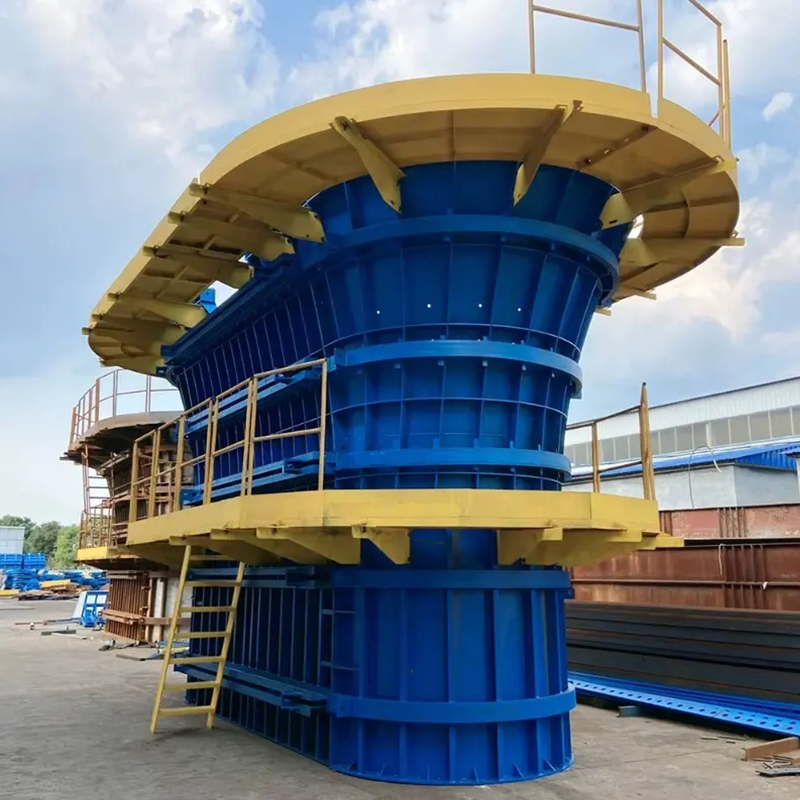
Pier Column Formwork
6. Manufacturing Process and Quality Control
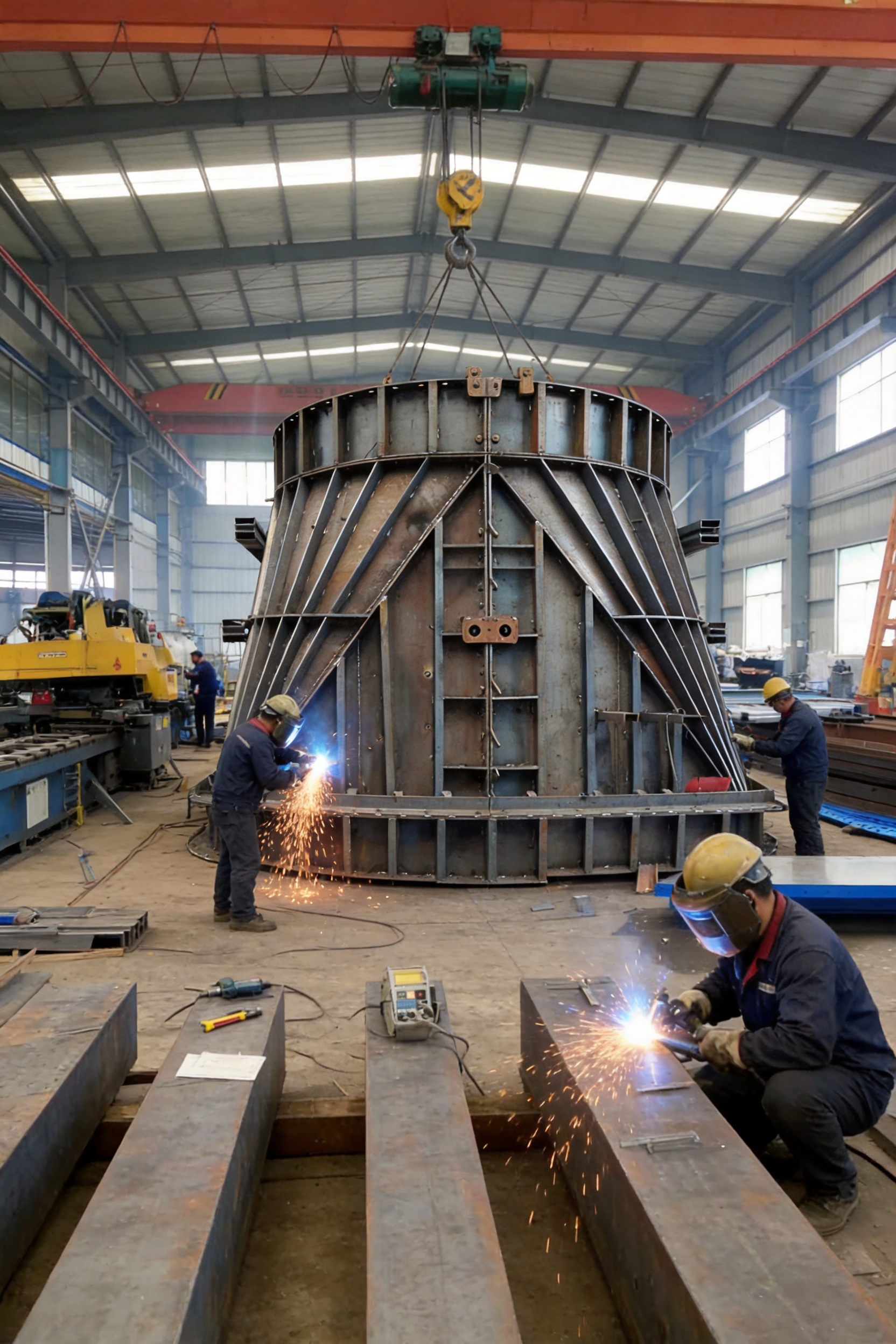
The performance of steel formwork depends heavily on how it is manufactured. A strong design can still underperform if plates are inaccurately cut, ribs are poorly positioned, welds are inconsistent, or the panels are not inspected before delivery. Advanced manufacturing therefore combines digital preparation, precision cutting, controlled assembly, qualified welding, dimensional inspection, and surface treatment.
6.1 Engineering Review and Customized Design
Every pier project has specific requirements related to diameter, height, cross-sectional shape, concrete pressure, lifting capacity, reuse frequency, site conditions, and construction sequence. The manufacturing process begins with a review of these requirements.
Technical personnel evaluate the available drawings and determine the panel configuration, segment length, steel grade, plate thickness, reinforcing layout, connection type, lifting arrangement, and accessory requirements. Where the same formwork must be used for several pier types, the design can identify which components should be standardized and which should be customized.
Three-dimensional modeling or detailed production drawings can be used to verify curved surfaces, flange positions, bolt-hole patterns, rib intersections, and assembly clearances before fabrication begins. Early review helps reduce manufacturing errors and makes the final product easier to install on site.
6.2 CNC Steel Plate Cutting
Advanced laser cutting equipment and other CNC processing systems are used to produce accurate steel components. Precision cutting is particularly important for curved panels, joint flanges, stiffening ribs, base plates, and connection parts.
Accurate cutting reduces the need for excessive grinding or manual correction. It also improves the fit-up of components during assembly and supports consistent dimensions across repeated panels. CNC processing enables the manufacturer to handle both standard and non-standard steel parts for custom bridge formwork and related industrial applications.
6.3 Bending and Forming
Circular and curved pier formwork requires steel plates to be formed to the specified radius. Controlled bending helps ensure that the finished panel follows the design profile. Inaccurate forming may create gaps between adjacent sections or produce a pier that is not truly circular.
Bending procedures are selected according to plate thickness, steel grade, radius, and component size. After forming, the parts are checked against templates, drawings, or dimensional control tools before rib frames and flanges are attached.
6.4 Component Fit-Up
Before welding, panels, ribs, flanges, and other structural elements are positioned and temporarily secured. Proper fit-up is essential for maintaining overall geometry. Fixtures and assembly platforms can help control alignment and reduce cumulative dimensional errors.
The order of assembly is planned so that welding does not cause unacceptable distortion. Critical dimensions, including panel curvature, overall length, width, diagonal measurements, and connection locations, are monitored throughout the process.
6.5 Qualified Welding
Welding connects the face panels with the reinforcing ribs and structural frames. The company applies AWS and EN welding craftsmanship to support reliable fabrication quality. Welding procedures are selected according to the material, joint type, thickness, load requirements, and applicable project standards.
Qualified welding practices help reduce defects such as incomplete fusion, undercutting, excessive spatter, porosity, and distortion. Welders and supervisors follow controlled procedures for preparation, fit-up, welding sequence, inspection, and repair where necessary.
Welding quality is especially important at lifting points, primary ribs, perimeter frames, and connection components. These areas may experience concentrated loads during lifting, assembly, and concrete casting. The finished structure must be strong not only under static pressure but also during repeated handling.
6.6 Dimensional Inspection
After fabrication, the formwork is inspected for overall dimensions, panel flatness or curvature, flange alignment, bolt-hole locations, rib positioning, weld quality, and assembly compatibility. Inspection results can be recorded as part of the manufacturing quality file.
For circular formwork, the radius and assembled diameter are key inspection items. For rectangular or irregular formwork, the width, angle, corner location, and cross-sectional tolerances must be confirmed. Inspection before shipment reduces the likelihood of adjustment problems at the construction site.
6.7 Surface Treatment and Protection
Steel formwork may receive rust-proof surface treatment or protective coating according to the project environment and customer requirements. Proper preparation helps protect the steel during storage, transportation, and repeated use.
The concrete-contact surface must be maintained in a condition that supports a clean finish. Coatings, release agents, and repair procedures should be selected so they do not adversely affect concrete appearance or bonding requirements. Site teams should follow the recommended maintenance procedure after each pour.
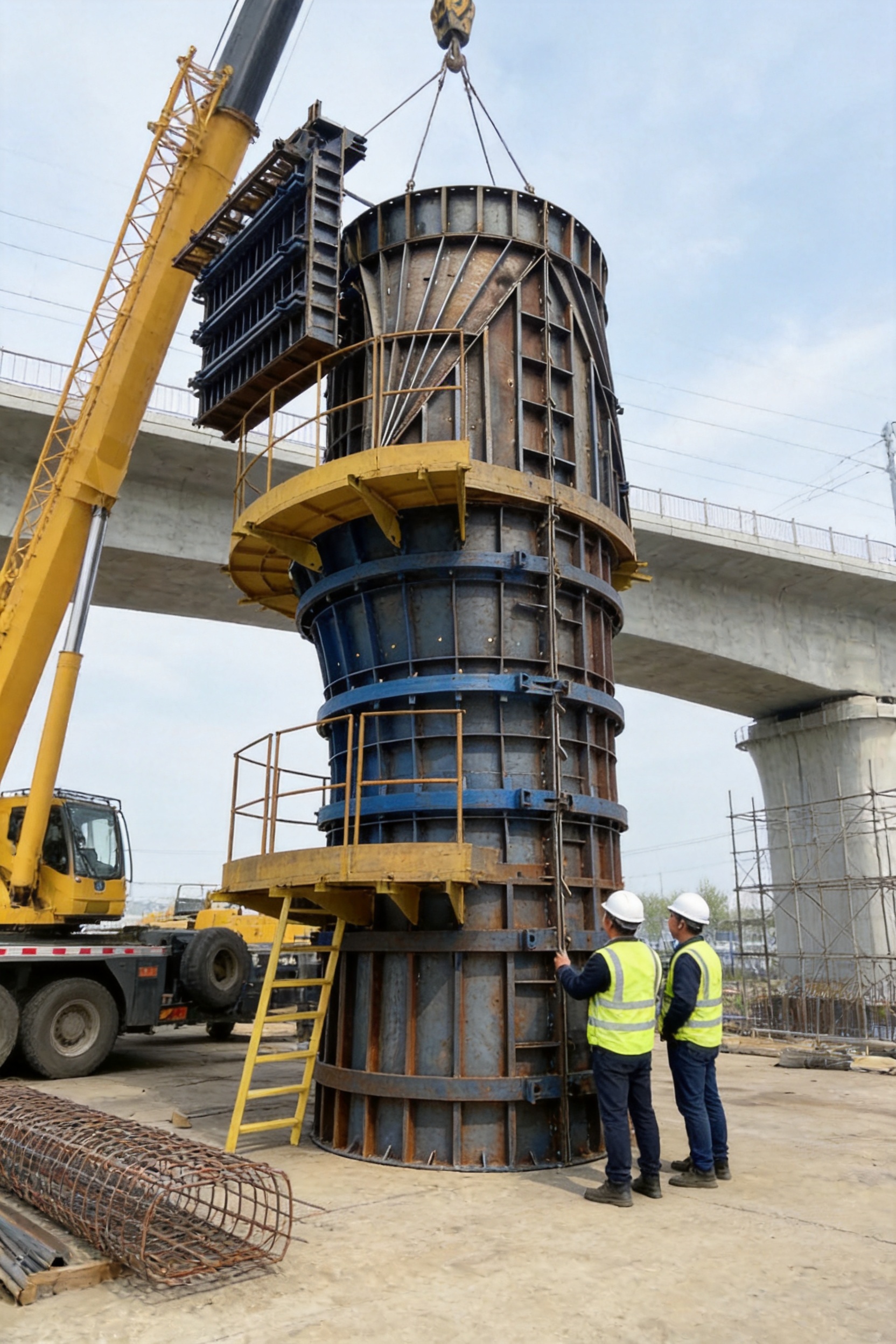
7. Manufacturing Strengths Supporting Project Reliability
The manufacturer combines custom steel fabrication with bridge formwork production. This combination is valuable because bridge formwork is rarely a simple off-the-shelf product. Each project may require different dimensions, reinforcement details, lifting arrangements, and connection systems. A factory with broad heavy-metal fabrication capacity can respond more effectively to these non-standard requirements.
7.1 Integrated Cutting, Bending, and Welding
Integrated processing allows the main manufacturing stages to be coordinated within one production system. Laser cutting creates accurate parts, bending equipment forms curved components, and controlled welding converts them into rigid panels and frames. This reduces dependence on fragmented subcontracting and supports better control of production timing and quality.
The same capability also allows the manufacturer to produce associated brackets, support frames, embedded steel components, scaffolding accessories, and other structural parts needed for infrastructure projects.
7.2 Experience with Large Steel Components
Large bridge formwork requires more than small-part fabrication experience. The manufacturer must understand how full-size components behave during lifting, assembly, welding, transportation, and casting. Experience with heavy steel structural components supports practical decisions about panel size, reinforcement, handling points, and modular connections.
This experience is also relevant when customers request large custom structures, industrial frames, tunnel equipment, steel platforms, or other non-standard assemblies. The ability to work across multiple steel product categories strengthens the company’s engineering and production resources.
7.3 International Standards and Quality Systems
The company operates with ISO 9001 quality management principles and manufactures products associated with BS1139 and EN74 requirements in its scaffolding range. AWS and EN welding practices support controlled fabrication for steel structures and formwork components.
Standards do not replace project-specific engineering, but they provide a structured framework for documentation, inspection, process control, and continuous improvement. For international customers, a standards-oriented manufacturing environment can make technical communication and quality verification more straightforward.
7.4 Patent and Product Development Experience
Support from 12 utility patents reflects continuing product development and practical innovation. In heavy construction equipment, useful innovation often involves improving assembly speed, connection reliability, safety, adjustability, handling, or material efficiency.
Product development experience enables the manufacturer to refine formwork details based on project feedback. It also supports customized solutions for unusual pier profiles, difficult site conditions, or special construction sequences.
7.5 Experience in Major Infrastructure Projects
The company has supplied products for major projects associated with organizations such as CCCC and CRCC, as well as landmark works including the Sutong Yangtze River Bridge, Taizhou Bridge, and Sudan Thermal Power Plant. Experience connected with large infrastructure programs requires attention to delivery schedules, technical documentation, quality consistency, and coordination with multiple project stakeholders.
This background helps the manufacturer apply demanding project standards to custom formwork and steel fabrication orders. It also provides experience in managing production for customers that require reliable delivery across complex construction programs.
8. Selecting the Correct Pier Column Formwork
Choosing the appropriate formwork begins with the structural and construction requirements of the project. The customer should provide accurate information about pier geometry, height, concrete mix, placing method, expected pour rate, vibration process, reuse frequency, and site lifting conditions.
8.1 Pier Shape and Dimensions
The shape may be circular, rectangular, square, polygonal, tapered, or irregular. The manufacturer needs the relevant dimensions, including diameter, width, depth, corner radius, taper, and height. If the same formwork must serve multiple dimensions, the required adjustment range should be identified at the beginning.
8.2 Concrete Pressure
Concrete pressure depends on mix design and placing conditions. A high-slump mix placed rapidly may generate greater pressure than a slower pour with faster setting characteristics. The formwork design should account for the project’s actual casting method rather than relying on a generic assumption.
8.3 Panel Segmentation
Segment size influences transportation, crane requirements, assembly time, and storage. Larger panels may reduce the number of joints but require greater lifting capacity. Smaller panels may be easier to handle in restricted areas but increase the number of connections. A balanced segmentation plan is therefore important.
8.4 Reuse and Turnover Requirements
A project with dozens or hundreds of similar piers may justify a highly optimized reusable system. A single pier or a small number of non-standard columns may require a more specialized configuration. The expected number of cycles should be considered when selecting plate thickness, coating, accessories, and maintenance provisions.
8.5 Site Conditions
Site access, crane capacity, wind exposure, ground conditions, working space, and nearby structures can all affect formwork design. Lifting points and panel weights should be compatible with the available equipment. Where the work is performed in an urban area or beside active traffic, compact components and fast installation may be priorities.
8.6 Concrete Finish Requirements
If the pier will be visible, the formwork should be designed and maintained for a high-quality surface finish. Joint locations, panel seams, release-agent practices, and cleaning procedures should be considered in advance. For non-visible surfaces, the design may focus more heavily on speed and cost, while still meeting structural and dimensional requirements.
9. Recommended Construction Workflow
A controlled installation sequence helps the formwork deliver its designed performance. The following workflow should be adapted to the approved method statement and project safety plan.
9.1 Preparation
Before installation, inspect the foundation or construction base, reinforcement cage, embedded components, and survey reference points. Confirm that the formwork sections are clean, undamaged, and correctly identified. Check bolts, pins, sealing materials, lifting accessories, and working platforms.
9.2 Assembly of Sections
Place the panels on a stable and suitable surface or lift them into position using approved equipment. Connect the sections according to the assembly drawings. Install all required bolts, clamps, pins, and alignment components before final tightening.
9.3 Alignment and Surveying
Check the pier centerline, diameter or cross-sectional dimensions, verticality, elevation, and orientation. Adjust the formwork using the designated adjustment points or temporary supports. Do not rely on forced alignment through uncontrolled tightening, as this may damage flanges or distort panels.
9.4 Joint Sealing and Release Agent
Install approved sealing materials at panel joints and around openings where applicable. Apply release agent evenly to the concrete-contact surface. Excessive release agent can affect surface quality, while insufficient application may make stripping difficult.
9.5 Pre-Pour Inspection
Before concrete placement, inspect the complete formwork system. Confirm connection tightness, support stability, access arrangements, reinforcement clearance, embedded items, cleanliness, and lifting or working platform safety. The inspection should be documented according to the project’s quality procedures.
9.6 Concrete Placement
Place concrete at a controlled rate suitable for the formwork design. Avoid sudden uneven loading that could create unbalanced pressure. Use vibration equipment correctly and avoid striking the panels or reinforcement cage. Monitor the formwork during the pour for movement, leakage, unusual noise, or other signs of distress.
9.7 Stripping and Transfer
Remove the formwork only after the concrete has reached the required stripping strength and the responsible technical personnel have approved the operation. Release connections in a controlled sequence. Avoid using cranes or impact tools to force panels away from the concrete.
After removal, clean the contact surfaces, inspect the panels and joints, repair minor damage, and apply protection where required. Store the sections on suitable supports to prevent distortion and water accumulation.
10. Maintenance and Service Life
Proper maintenance protects the value of reusable steel formwork. After each pour, remove concrete residue before it hardens. Use cleaning methods that do not damage the panel surface, welds, flanges, or protective coating. Inspect for dents, cracks, distorted joints, worn bolt holes, damaged lifting points, and loose or broken ribs.
Small defects should be corrected before the next use. A dent in a panel may affect the concrete profile, while a damaged flange may prevent proper sealing. Weld repairs should be carried out by qualified personnel and inspected before the formwork returns to service.
Lubricate or protect connection hardware as appropriate. Keep bolts, pins, clamps, and adjustment components organized so that missing parts do not delay assembly. Store panels on level supports and protect them from unnecessary impact during handling.
When stored outdoors, the formwork should be positioned to promote drainage. Long-term exposure to water, mud, salt, or aggressive chemicals can accelerate corrosion. Periodic coating maintenance can extend service life and preserve appearance.
11. Economic and Environmental Benefits
The initial purchase price is only one part of the cost of a formwork system. A proper evaluation should include assembly labor, crane time, concrete repair, cleaning, transport, maintenance, expected number of uses, and disposal. Rigid modular steel formwork may offer a lower total cost over the life of a project because it supports repeated use and reduces corrective work.
Faster installation and stripping can improve equipment utilization and shorten the time required for each pier. Reduced leakage limits concrete waste and cleaning effort. Better surface quality can reduce the need for patching, grinding, or cosmetic treatment.
Steel is also recoverable and recyclable at the end of its useful service life. Unlike temporary timber systems that may be damaged after a limited number of uses, well-maintained steel formwork can remain in circulation for many construction cycles. This supports material efficiency and reduces waste from bridge construction.
12. Why Custom Manufacturing Matters
Standard catalog products cannot always meet the geometry and working conditions of modern bridge projects. Pier designs may include changing diameters, tapered profiles, flared heads, unusual offsets, angled faces, or restricted access conditions. Custom manufacturing allows the formwork to be developed around the actual engineering requirements.
Customization can cover steel grade, plate thickness, segment height, number of sections, connection details, lifting points, working platforms, access openings, surface treatment, and packaging. It can also include matching formwork sets for several pier types within the same project.
A manufacturer with laser cutting, bending, welding, and heavy steel assembly capabilities can provide a more complete custom solution than a supplier limited to standard panels. Technical communication is also easier when the same team manages design review, production, quality inspection, and delivery coordination.
13. Comparison of Common Formwork Options
| Formwork Type | Main Advantages | Typical Limitations | Suitability for Repeated Bridge Piers |
|---|---|---|---|
| Timber Formwork | Flexible and relatively simple to modify on site | Lower durability, moisture sensitivity, more variable dimensions, and limited reuse | Suitable for limited or irregular work when appearance and turnover requirements are moderate |
| Thin Sheet-Metal Formwork | Lightweight and easy to handle | Greater risk of deformation, local buckling, and short service life under heavy pressure | Suitable only when loads and reuse requirements are limited |
| Traditional Site-Fabricated Steel Formwork | Can be adapted to local requirements | Quality and dimensional consistency depend heavily on site workmanship | Useful for one-off work but less efficient for standardized high-volume production |
| Modular Reinforced Steel Formwork | High rigidity, accurate geometry, fast turnover, strong sealing, and repeated use | Requires careful design, lifting planning, and initial investment | Highly suitable for highway, railway, municipal, and precast bridge programs |
14. Technical Support and Project Coordination
Successful formwork delivery requires coordination between the manufacturer, contractor, designer, site supervisor, survey team, and safety personnel. The manufacturer should receive the latest approved drawings and understand any changes before production begins.
Technical documents may include general arrangement drawings, assembly drawings, component lists, material information, welding or inspection records, lifting recommendations, and maintenance instructions. Clear documentation helps the site team assemble the formwork correctly and reduces uncertainty during the first installation.
For export projects, packaging and shipping preparation are also important. Panels should be protected against impact and moisture during transportation. Components should be clearly marked so that the receiving team can identify each section and accessory. Efficient packing can reduce shipping volume and simplify unloading at the construction site.
Where required, the manufacturer can discuss trial assembly, inspection hold points, dimensional acceptance criteria, and customer-specific quality documentation. These measures are especially useful for major infrastructure projects with formal approval procedures.
15. Questions and Answers
Q1: What is pier column formwork used for?
Pier column formwork is used to shape and support fresh concrete during the construction of bridge piers, columns, pillars, and related vertical support structures. It controls the final dimensions, alignment, surface finish, and geometry of the concrete element.
Q2: Can the formwork be used for both circular and rectangular piers?
Yes. The formwork can be customized for circular, rectangular, square, polygonal, tapered, and other non-standard profiles. The panel arrangement, ribs, connections, and dimensions are designed according to the pier drawings.
Q3: Is this formwork suitable for cast-in-place concrete?
Yes. It is primarily intended for cast-in-place bridge construction, where the assembled steel mold contains fresh concrete until it reaches the required strength. It can also be adapted for selected precast production applications.
Q4: What steel grades are available?
Common material options include Q235B and Q355B steel plates. The appropriate grade depends on the structural design, project requirements, component function, and customer specifications.
Q5: How does the formwork prevent concrete leakage?
Accurately fabricated joint faces, reinforced flanges, standardized fasteners, and suitable sealing materials work together to limit gaps between panels. Correct assembly and tightening at the construction site are also essential for effective sealing.
Q6: Can the formwork dimensions be customized?
Yes. Height, diameter, width, depth, taper, segment length, plate thickness, rib layout, connection details, lifting points, and surface treatment can be customized according to the project requirements.
Q7: How many times can the formwork be reused?
Service life depends on design, handling, cleaning, storage, concrete conditions, and maintenance. A robust steel system is intended for repeated use, and proper inspection after every pour helps maximize turnover and service life.
Q8: What manufacturing processes are used?
The manufacturing process can include engineering review, CNC laser cutting, steel plate bending, component fit-up, controlled welding, dimensional inspection, surface treatment, trial assembly, and final quality checking.
Q9: Can the manufacturer supply other steel products?
Yes. The company also specializes in custom steel formwork, ringlock scaffolding, steel props, heavy-duty steel structures, industrial steel components, and OEM metal fabrication. Integrated laser cutting, bending, and welding services support a wide range of construction and industrial requirements.
Q10: What information should be provided for a quotation?
Customers should provide pier drawings or key dimensions, quantity, concrete type, required reuse frequency, project location, preferred steel grade, lifting limitations, surface finish requirements, delivery schedule, and any applicable technical standards. These details allow the manufacturer to prepare a more accurate proposal.
Q11: Is the formwork suitable for fair-faced concrete?
It can be suitable for fair-faced concrete when the panel surface, joints, release-agent application, alignment, concrete placement, and vibration process are properly controlled. The final result also depends on the concrete mix and site workmanship.
Q12: How can the formwork be maintained after use?
Remove concrete residue promptly, inspect panels and welds, repair damage, protect exposed steel, organize hardware, and store sections on stable supports. These practices help preserve dimensional accuracy and extend the service life of the system.
16. Ordering and Customization Considerations
When ordering pier column formwork, customers should begin with the project’s approved structural and construction drawings. A clear technical package allows the manufacturer to evaluate loads, panel configuration, segmentation, and required accessories.
The order should identify whether the formwork is intended for a single pier type or several pier types. If multiple configurations are required, a modular approach may reduce the total number of unique components. The customer should also clarify whether working platforms, ladders, guardrails, hydraulic adjustment systems, or other accessories are included in the supply scope.
Delivery planning should consider manufacturing lead time, inspection, packing, transportation, customs documentation, and site readiness. Early coordination is especially important for large bridge projects because formwork delivery must align with reinforcement fabrication, foundation completion, crane availability, and the concrete placing schedule.
17. Conclusion
Pier column formwork is a critical component of reliable bridge substructure construction. Its performance directly influences concrete geometry, verticality, surface quality, construction speed, labor requirements, and total project cost. A properly designed steel system provides the rigidity needed to resist concrete pressure, the accuracy required for dimensional control, and the modularity needed for repeated construction cycles.
The product discussed here combines high-strength Q235B or Q355B steel plates, reinforced rib frames, standardized positioning structures, accurate joints, and a modular segmented configuration. These features help reduce deformation, leakage, assembly time, surface defects, and long-term maintenance costs compared with weaker or less accurately fabricated alternatives.
Its value is further supported by an advanced manufacturing process that includes CNC laser cutting, controlled bending, qualified AWS and EN welding practices, dimensional inspection, and protective surface treatment. The manufacturer’s experience in custom formwork, heavy steel structures, scaffolding, and OEM fabrication provides the technical foundation needed to serve demanding infrastructure and industrial projects.
For highway bridges, railway viaducts, municipal overpasses, water conservancy works, port structures, and precast factories, customized pier column formwork can provide a durable and cost-effective method for producing precise concrete support elements. When correctly designed, installed, inspected, and maintained, it becomes a reusable production asset that contributes to safer construction, faster project progress, and more consistent structural quality.
References
1. ACI Committee 347. Guide to Formwork for Concrete. American Concrete Institute.
2. European Committee for Standardization. EN 1090, Execution of Steel Structures and Aluminium Structures.
3. European Committee for Standardization. EN 74, Couplers, Spigot Pins and Baseplates for Use in Falsework and Scaffolds.
4. British Standards Institution. BS 1139, Metal Scaffolding.
5. American Welding Society. AWS D1.1, Structural Welding Code—Steel.
6. ISO 9001. Quality Management Systems—Requirements.
7. American Concrete Institute. Building Code Requirements for Structural Concrete and Commentary.
8. International Federation for Structural Concrete. Recommendations for Good Practice in Concrete Construction.
9. Project-specific structural drawings, concrete placement procedures, temporary works designs, and approved construction method statements.
Product: Pier Column Formwork



- Location
- Group 3, Fangzhuang Village, Rucheng Subdistrict, Rugao City, Nantong, Jiangsu, China
- Follow us
- Phone
- +86-13646196162
- info@hysonindustry.com
