 +86-13646196162
 info@hysonindustry.com




 русский
  عربى
عربى 


Adjustable Jack Base for Stable, Precise, and High-Performance Scaffolding Support
 2026.08.06
Content
- 1 What Is an Adjustable Jack Base?
- 2 Why Jack Base Quality Matters in Construction
- 3 Main Structural Features
- 4 Key Technical Performance Advantages
- 5 Advantages Over Basic or Low-Quality Alternatives
- 6 Applications in Scaffolding Systems
- 7 Applications in Formwork and Shoring
- 8 Manufacturing Process and Quality Control
- 9 Company Manufacturing Strengths
- 10 Customization Options
- 11 Installation Guidelines
- 12 Safety and Maintenance Recommendations
- 13 Quality and Procurement Checklist
- 14 Logistics, Packaging, and Project Supply
- 15 Environmental and Cost Benefits
- 16 Choosing the Right Product Configuration
- 17 Why Work With an Experienced OEM Manufacturer?
- 18 Frequently Asked Questions
- 18.1 What is the main purpose of an adjustable jack base?
- 18.2 What adjustment range is available?
- 18.3 What materials are used?
- 18.4 What load capacity can the product provide?
- 18.5 Is the jack base suitable for disc-lock scaffolding?
- 18.6 Can it be used with formwork?
- 18.7 Is hot-dip galvanizing available?
- 18.8 Can the product be customized?
- 18.9 How accurate is the adjustment?
- 18.10 Can the jack base be used on soft ground?
- 18.11 Does the product require special tools?
- 18.12 How should used jack bases be inspected?
- 18.13 How does this product compare with a fixed base plate?
- 18.14 What information should be provided when requesting a quotation?
- 18.15 What industries can use this product?
- 19 Conclusion
- 20 References
- 21 Product: Jack Base
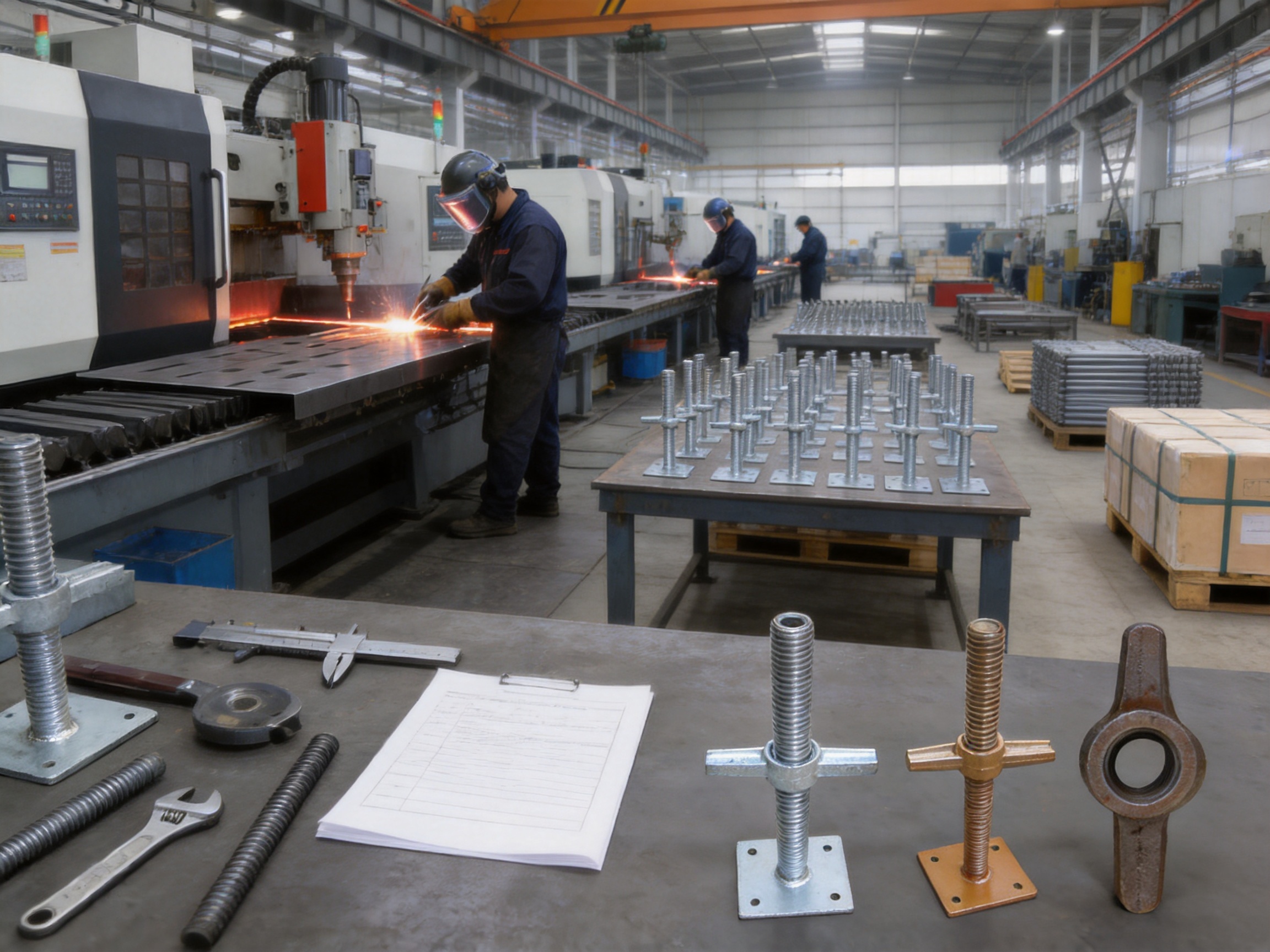
In modern construction, the reliability of a temporary support system depends on the performance of every individual component. Scaffolding, formwork, shoring towers, bridge supports, and temporary platforms must remain stable while carrying workers, equipment, reinforcement, fresh concrete, and construction materials. Among all support components, the adjustable jack base plays a particularly important role because it creates the connection between the support structure and the ground. A properly selected jack base can correct uneven surfaces, regulate support height, distribute loads, and improve the overall safety and accuracy of a construction operation.
The adjustable jack base described in this article is designed for use with scaffolding and formwork support systems. It combines a high-strength steel threaded stem, a load-distributing base plate, a convenient adjustment mechanism, and protective surface treatment. The product is suitable for disc-lock scaffolding, coupler scaffolding, triangular supports, wall formwork supports, plane formwork systems, temporary equipment supports, and other modular construction applications.
Unlike simple fixed base plates, an adjustable jack base allows workers to compensate for variations in ground level and regulate the vertical position of a support system. This capability is especially valuable on bridge projects, industrial construction sites, underground works, infrastructure projects, and areas where the ground is muddy, sloped, irregular, or temporarily prepared. Through controlled adjustment, the jack base helps keep a scaffold or formwork structure level and reduces the risk of settlement, tilting, uneven loading, and dimensional errors.
Nantong Hyson Road And Bridge Formwork Co., Ltd. manufactures adjustable jack bases as part of its broader product range covering steel formwork, scaffolding systems, heavy steel structures, steel plate cutting, welding, bending, and OEM metal fabrication. Its manufacturing approach combines precision processing, high-strength steel fabrication, certified welding procedures, surface protection, and full-process quality control. This enables the company to supply not only standard products but also customized jack bases for specific load requirements, dimensions, connection standards, and project conditions.
What Is an Adjustable Jack Base?
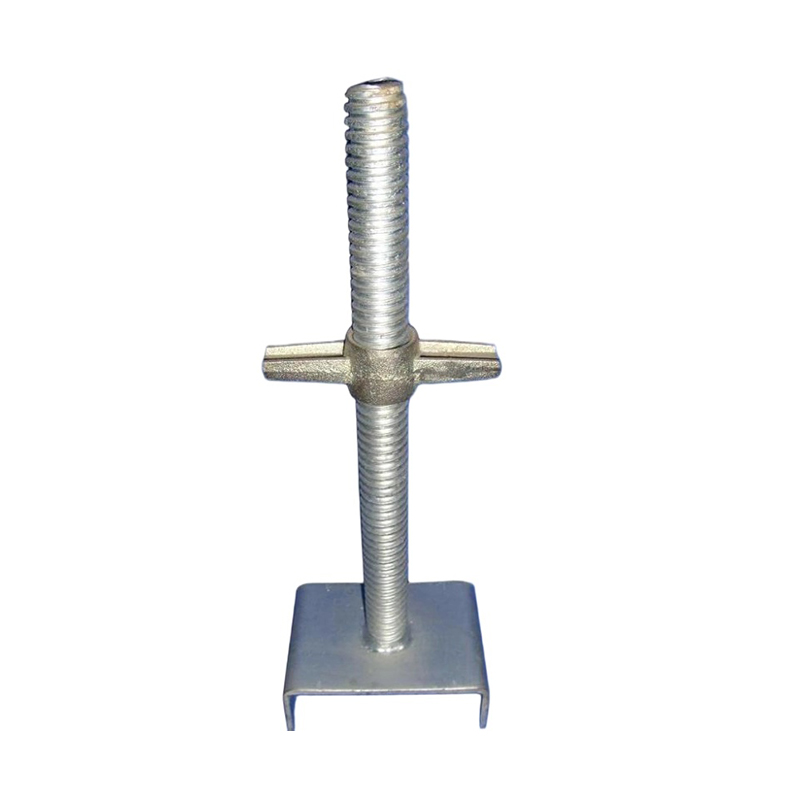
An adjustable jack base is a height-regulating support component used beneath a scaffold standard, shoring post, formwork prop, or other vertical support member. The basic assembly generally includes a threaded steel stem, an adjustment nut or collar, and a steel base plate or load-bearing tray. By rotating the adjustment mechanism, the user can raise or lower the supported structure within the available adjustment range.
The base plate transfers the vertical load from the support member to the ground or to a prepared foundation. The threaded stem provides vertical adjustment, while the nut or collar locks the selected height. In some designs, the top portion may include a U-head, flat plate, socket, pin, or other interface according to the requirements of the connected support system. This modular design allows the same general product concept to serve different applications.
The primary functions of an adjustable jack base include:
• Adjusting the height of scaffolding and formwork support structures.
• Correcting differences in ground elevation.
• Maintaining the horizontal level of working platforms and formwork decks.
• Distributing vertical loads over a larger contact area.
• Reducing pressure concentration at the bottom of each support.
• Helping prevent support settlement, sliding, and local deformation.
• Simplifying installation, leveling, dismantling, and repeated reuse.
Although the component is relatively compact, its performance directly affects the geometry and stability of the complete support system. A poor-quality jack base may have inaccurate threads, insufficient plate thickness, weak welding, inadequate corrosion protection, or an unstable connection. These weaknesses can create operational problems even when the remaining scaffolding or formwork components are properly manufactured.
Why Jack Base Quality Matters in Construction
Temporary support systems are often exposed to changing loads and demanding site conditions. A scaffold may carry workers, tools, masonry materials, and weather-related forces. A formwork support system may carry the weight of panels, reinforcement, fresh concrete, construction personnel, and vibration effects during pouring. Bridge and tunnel projects can introduce additional challenges, including uneven terrain, limited access, moisture, mud, dust, and repeated assembly cycles.
The jack base is the first load-transfer point in many of these systems. If its base plate does not sit flat, the vertical support may be eccentric. If the thread is damaged or difficult to rotate, workers may fail to achieve accurate leveling. If the locking nut is not properly formed, the selected height may change under load. If the steel or welds are inadequate, the base may deform or lose stability.
A well-engineered adjustable jack base improves the support system in several ways. It creates a larger and more stable contact surface with the ground. It helps align vertical standards and props. It provides a controlled adjustment process rather than improvised packing or wedging. It also supports more consistent installation practices across different work teams and project locations.
Compared with makeshift leveling methods such as loose timber pieces, bricks, scrap steel, or unverified packing materials, a standardized jack base offers predictable dimensions and a more controllable load path. This improves both safety and productivity. It also allows site supervisors to inspect, record, and maintain the support system using a defined component rather than relying on inconsistent field modifications.
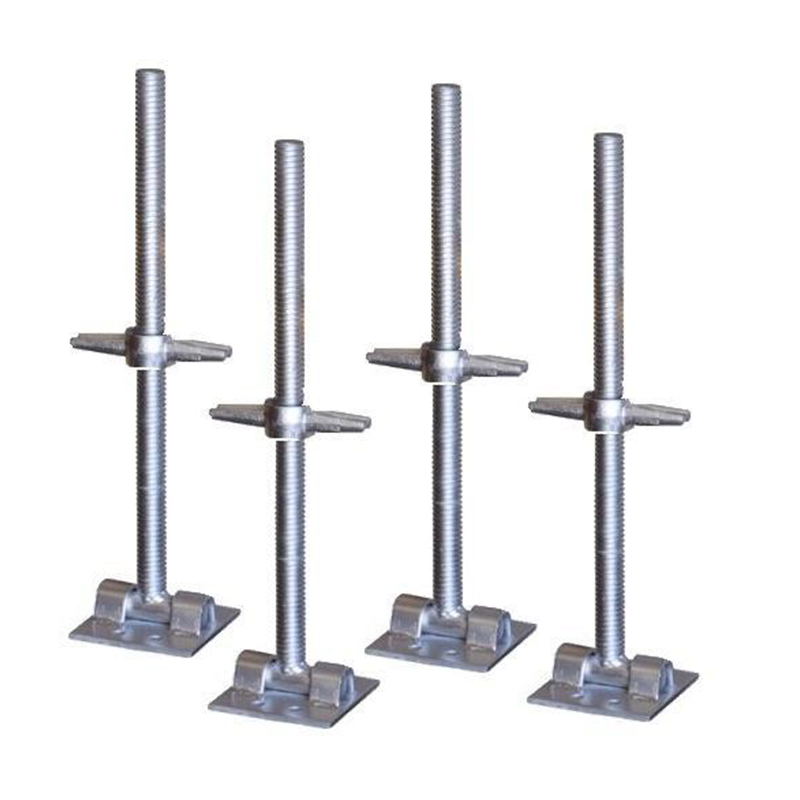
Jack Base
Main Structural Features
High-Strength Steel Construction
The adjustable jack base is manufactured from high-strength carbon steel grades such as Q235 or Q345, according to the required specification and application. These materials provide a balance of weldability, strength, toughness, availability, and cost efficiency. The selection of steel grade can be adapted to the expected load, stem diameter, plate dimensions, thread design, and customer requirements.
Q235 steel is widely used for general structural components because it offers reliable mechanical performance and good weldability. Q345 steel provides higher strength and may be selected for heavy-duty applications, larger support loads, or special project requirements. The final material selection should be based on engineering calculations, applicable standards, and the complete support-system design rather than on the jack base alone.
High-quality steel construction reduces the risk of permanent deformation during normal service. It also supports repeated use in rental fleets and large construction projects where components are assembled and dismantled many times. Steel components can be inspected, cleaned, recoated, and returned to service when their dimensions and structural condition remain within acceptable limits.
Threaded Height Adjustment
The threaded stem is the central adjustment element of the jack base. A properly manufactured thread allows the worker to change the support height smoothly and accurately. The design can provide an adjustment range of approximately 50 millimeters to 300 millimeters, depending on the product configuration. Customized dimensions may be developed for projects that require a different range, stem length, thread form, or connection method.
Precise thread processing is important because rough, incomplete, or inconsistent threads can make installation slow and may create uneven load transfer. Hyson’s production capabilities include controlled steel processing and machining procedures intended to maintain consistent component dimensions. Threaded parts can be checked for fit, movement, visual defects, and operational smoothness before assembly and shipment.
The stated adjustment accuracy can reach approximately ±1 millimeter under suitable operating conditions. This level of control is valuable when formwork levels must be maintained across a large slab, bridge deck, tunnel section, or industrial floor. Accurate adjustment also reduces the need for repeated manual correction after the support structure has been installed.
Load-Distributing Base Plate
The base plate or load-bearing tray is designed to transfer pressure from the vertical support into the ground or supporting surface. An enlarged plate spreads the load over a greater area, reducing local pressure concentration. This is particularly useful on compacted soil, temporary platforms, concrete slabs, and other surfaces where a small contact area could produce excessive pressure or indentation.
Plate dimensions and thickness can be adapted to the expected load and project conditions. For heavy-duty applications, an enlarged tray may be combined with additional stiffening, a reinforced connection between the stem and plate, or a special anti-slip treatment. The plate must remain sufficiently rigid so that it does not curl, buckle, or deform when the support is loaded.
The bottom surface may also receive an anti-slip treatment to increase friction and reduce movement. However, an anti-slip coating cannot replace a properly prepared foundation, suitable bracing, or correct installation. The ground must still be evaluated for bearing capacity, drainage, slope, and settlement risk.
Locking and Adjustment Mechanism
The adjustment nut or collar allows workers to set the desired height and maintain the position of the connected support. A user-friendly knob design helps workers make adjustments quickly without specialized tools. This is important on busy construction sites where leveling may need to be completed across hundreds or thousands of support points.
The adjustment mechanism should be rotated only after the support load has been considered and the system has been installed according to the project method statement. The thread and nut must be kept free of excessive dirt, concrete, paint buildup, and mechanical damage. Regular cleaning improves service life and reduces the effort required during adjustment.
For some applications, additional locking features or retention arrangements may be specified. The correct configuration depends on the support system, expected load, adjustment height, local safety requirements, and engineering design.
Key Technical Performance Advantages
Precise Leveling
The most visible advantage of an adjustable jack base is its ability to regulate height. Instead of compensating for uneven ground with random packing materials, workers can use a controlled mechanical adjustment. This makes it easier to establish a level working platform or a consistent formwork elevation.
In formwork applications, accurate leveling is directly connected to the quality of the finished concrete. If the formwork support levels vary, the finished slab may have an incorrect thickness, uneven elevation, poor drainage direction, or dimensional deviation. By allowing fine adjustment at the support points, the jack base helps formwork teams achieve more consistent geometry before concrete placement.
High Load-Bearing Capacity
Depending on the configuration, material, dimensions, and testing conditions, the product can be designed for load-bearing capacities in the range of approximately 50 kilonewtons to 100 kilonewtons. The actual permissible working load must always be confirmed through engineering documentation and the complete support-system design.
High load-bearing performance depends on more than the steel grade. It is influenced by stem diameter, thread root geometry, effective thread engagement, nut dimensions, base plate thickness, weld quality, load eccentricity, unsupported height, foundation condition, and system bracing. Hyson’s manufacturing approach considers these factors when producing custom or project-specific components.
Improved Stability
A jack base supports vertical alignment and reduces the tendency of the support system to rock or settle at individual points. The enlarged base plate provides a broader footprint, while the threaded adjustment allows the standard or prop to sit at the intended elevation. When combined with horizontal bracing and proper foundation preparation, the jack base contributes to a stable and predictable support arrangement.
Stability is especially important for high-altitude work platforms, multi-level scaffolding, bridge formwork, tunnel support, and temporary structures exposed to construction traffic. A stable base reduces unwanted movement and helps maintain the designed relationship between vertical, horizontal, and diagonal members.
Corrosion Resistance
The product can be hot-dip galvanized with a coating thickness of at least approximately 75 micrometers, subject to the agreed specification. Hot-dip galvanizing creates a protective zinc coating that helps shield the steel from moisture, oxygen, and corrosive environmental conditions.
Galvanizing is particularly valuable for components used outdoors, in damp construction areas, in muddy ground conditions, or in projects where the equipment will be stored and reused. A durable coating can reduce maintenance requirements and help extend the usable life of rental or fleet equipment.
Surface treatment does not eliminate the need for inspection. Threads, cut edges, impact areas, and damaged coating zones should be checked regularly. If zinc coating is seriously damaged, suitable repair procedures should be applied according to the project maintenance requirements.
Fast Installation and Adjustment
The jack base is designed for practical site operation. Workers can install it beneath a scaffold standard or support post, rotate the adjustment mechanism, and establish the required elevation. The simple operating principle reduces training requirements and can shorten the leveling stage of a project.
Because the product does not generally require complex tools for ordinary adjustment, it is suitable for repetitive installation work. Faster setup can reduce labor cost, improve coordination between trades, and allow formwork or scaffold erection to proceed more efficiently.
Repeated Use
Construction companies and rental businesses often require components that can withstand repeated assembly, transportation, storage, and exposure to changing site environments. High-strength steel, protective galvanizing, robust welds, and a serviceable thread design make the adjustable jack base suitable for repeated use when it is maintained correctly.
Before reuse, each unit should be inspected for bent stems, damaged threads, cracked welds, distorted plates, severe corrosion, missing nuts, and other defects. A clear inspection and replacement policy helps maintain the reliability of the equipment fleet.
Advantages Over Basic or Low-Quality Alternatives
Many low-cost support products appear similar at first glance, but differences in material thickness, thread accuracy, welding quality, coating, and dimensional control can significantly affect their performance. An adjustable jack base should be evaluated as an engineered load-transfer component rather than as a simple metal accessory.
Compared with fixed base plates, the adjustable version provides height regulation and ground leveling. This reduces the need for site modifications and allows one product family to serve a wider range of construction conditions.
Compared with unverified imported or locally improvised bases, a professionally manufactured product offers clearer material selection, repeatable dimensions, controlled welding, documented production procedures, and more consistent quality. These advantages are important when the products are used across large projects with formal inspection requirements.
Compared with thin-plate economy products, a heavy-duty jack base can provide better resistance to bending and deformation. The enlarged load-bearing tray also improves pressure distribution and can reduce the risk of local ground indentation.
Compared with poorly protected carbon-steel products, hot-dip galvanized components provide better resistance to outdoor moisture and repeated handling. This can reduce premature replacement and improve the total cost of ownership.
Compared with products that require special tools or complicated mechanisms, a user-friendly adjustment nut enables faster operation. The simpler mechanism also makes routine inspection and cleaning easier.
| Performance Factor | Standard Fixed Base | Low-Quality Adjustable Base | Engineered Adjustable Jack Base |
|---|---|---|---|
| Height adjustment | Not available | Available but may be inconsistent | Controlled threaded adjustment |
| Ground leveling | Requires packing or modification | Limited by design quality | Designed for precise leveling |
| Load distribution | Depends on plate size | May be inadequate | Enlarged load-bearing tray available |
| Thread operation | Not applicable | May be rough or inaccurate | Processed for smooth adjustment |
| Corrosion protection | Often basic coating | Varies by supplier | Hot-dip galvanizing available |
| Reuse potential | Moderate | Uncertain | Suitable for repeated construction use |
| Customization | Limited | Supplier-dependent | Stem, plate, thread, and interface options |
Applications in Scaffolding Systems
Disc-Lock Scaffolding
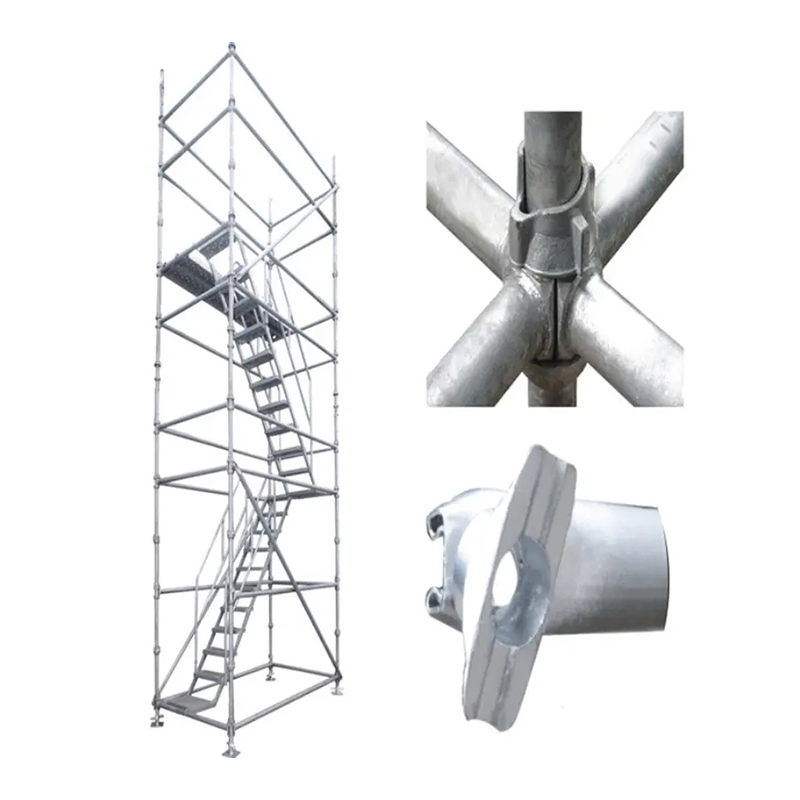
Disc-lock scaffolding requires accurate vertical standards and stable support points. The adjustable jack base can be installed at the bottom of the standards to compensate for variations in the working surface. This helps maintain the level of ledgers, platforms, stairs, and guardrails.
On large construction sites, ground levels may change due to excavation, temporary filling, drainage channels, concrete placement, or access roads. Adjustable bases allow the scaffold erection team to respond to these conditions without cutting standards or using irregular packing materials.
The jack base must be selected with the appropriate stem diameter, connection interface, and load rating for the specific disc-lock system. The scaffold must also include the required horizontal and diagonal bracing, ties, guardrails, platforms, and foundation preparation.
Coupler-Type Scaffolding
Coupler-type scaffolding is widely used for building, maintenance, industrial, and infrastructure work. Adjustable jack bases can support the lower ends of the vertical tubes and provide a more stable starting point for the scaffold assembly.
Because coupler scaffolding often allows flexible layouts, it may be installed on surfaces with changing elevations or unusual geometry. A height-adjustable base simplifies the process of creating a continuous working level while preserving the intended vertical alignment of the tubes.
High-Altitude Work Platforms
High-altitude scaffolding requires careful control of verticality and base stability. A height difference at the bottom of the structure can become more significant as the scaffold rises. Adjustable jack bases help establish a level foundation, but they must be used together with proper ties, bracing, platform loading controls, and access arrangements.
The adjustment should not exceed the permitted extension. Excessive stem extension may reduce stability and increase bending risk. The project engineer or scaffold designer should define the allowable adjustment range for each application.
Applications in Formwork and Shoring
Wall Formwork Support
Wall formwork systems must remain aligned while resisting concrete pressure, vibration, wind, and construction activity. Adjustable jack bases can be used beneath vertical props, frames, or triangular support assemblies to set the correct elevation and maintain a stable support line.
Accurate base adjustment can simplify the alignment of wall panels and reduce the risk of irregular concrete dimensions. It also allows workers to compensate for variations in the foundation slab, working platform, or temporary support surface.
Plane Formwork and Slab Support
For slab formwork, the elevation of each support point contributes to the final level and thickness of the concrete structure. Adjustable jack bases enable workers to fine-tune support heights before installing secondary beams, primary beams, panels, and other formwork components.
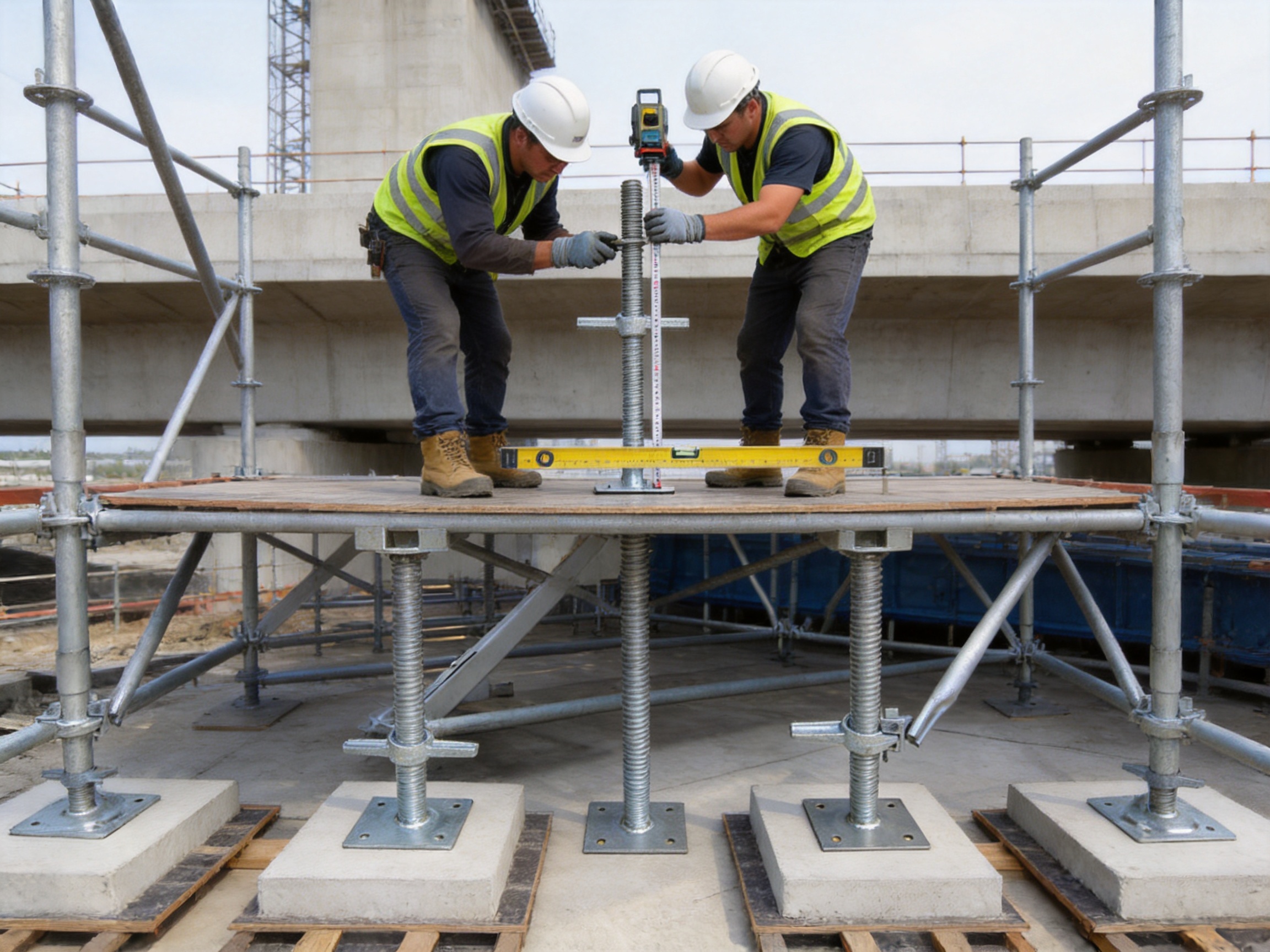
The adjustment process should be carried out systematically. Survey points or laser levels may be used to establish a reference elevation. Each support can then be adjusted according to the design grid. After installation, the complete formwork system should be checked for level, verticality, bracing, load paths, and safe access.
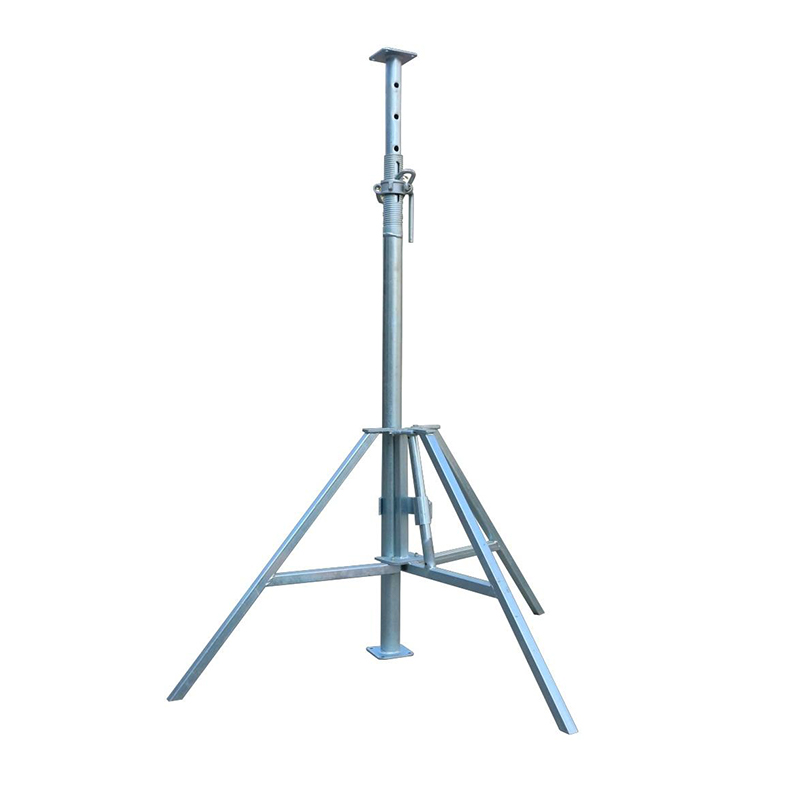
Triangular Support Systems
Triangular supports are used for wall formwork, bridge components, retaining structures, and other temporary support requirements. Their performance depends on the correct relationship between the base, diagonal member, vertical member, and connection points.
An adjustable jack base provides a controllable lower support point and can help accommodate differences in ground elevation. For heavy-duty applications, the base plate, stem, and connection must be selected according to the calculated reaction forces and possible horizontal components.
Bridge and Infrastructure Formwork
Bridge construction often takes place over irregular terrain, temporary access roads, riverbanks, embankments, piers, and complex work platforms. The adjustable jack base can assist in establishing stable support for formwork and access scaffolding in these changing environments.
Infrastructure projects also require products that can withstand transportation, outdoor storage, repeated handling, and strict inspection procedures. A galvanized steel jack base with consistent dimensions is easier to identify, inspect, and manage within a large project supply chain.
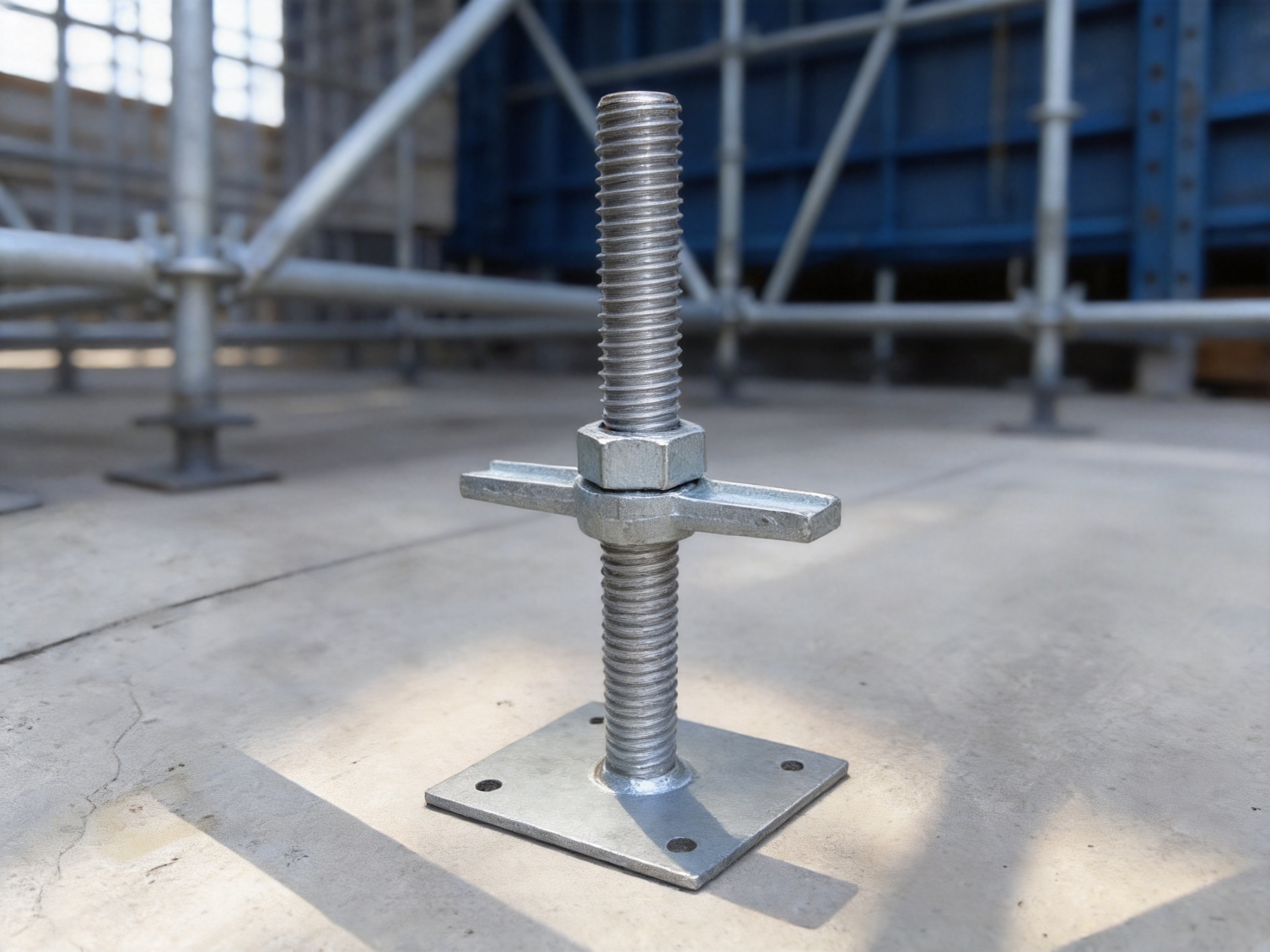
Manufacturing Process and Quality Control
Engineering Review and Customization
Manufacturing begins with a review of the customer’s application, drawings, standards, load requirements, and connection details. Important design inputs include the required adjustment range, plate size, plate thickness, stem diameter, thread type, nut configuration, top interface, surface treatment, packaging method, and estimated quantity.
For OEM orders, the manufacturer can review customer drawings and recommend practical adjustments for production efficiency, welding access, galvanizing coverage, assembly, and transport. This engineering review helps prevent dimensional conflicts and ensures that the product is suitable for the intended support system.
Steel Material Preparation
Steel plates, bars, tubes, and forged or machined components are prepared according to the approved production documentation. Material identification and dimensional inspection are important at this stage. Correct material selection supports predictable strength and welding performance.
Hyson operates advanced steel processing equipment, including laser cutting machinery and standardized fabrication lines. Laser cutting can provide accurate plate shapes, holes, slots, and custom profiles. Controlled cutting reduces dimensional variation and helps improve the fit of parts during welding and assembly.
Laser Cutting and CNC Processing
Laser cutting is particularly useful for producing base plates, reinforcement plates, brackets, and other components with repeatable dimensions. Compared with manual cutting, CNC laser processing can reduce edge irregularities, improve hole positioning, and support efficient production of both standard and customized parts.
For large steel fabrication projects, digital cutting programs also help organize material usage and reduce unnecessary waste. Accurate nesting and controlled cutting contribute to stable production costs and more consistent delivery schedules.
Forming, Bending, and Machining
Some jack base components require bending, pressing, turning, threading, or other machining operations. The adjustment stem and nut require particular attention because their fit determines how smoothly the product operates and how reliably the load is transferred.
CNC or controlled machining processes can maintain consistent dimensions across production batches. Finished threads may be checked using suitable gauges or mating components. The base plate may also be formed or reinforced according to the required load-bearing performance.
Welding and Assembly
The connection between the threaded stem and base plate is a critical structural area. Welding must provide sufficient strength and continuity without creating excessive distortion. Hyson applies AWS and EN welding craftsmanship and uses controlled fabrication procedures for steel components.
Welding quality control may include checking joint preparation, welding consumables, welder qualifications, visual appearance, dimensional alignment, and the absence of visible cracks or unacceptable porosity. For projects requiring additional verification, non-destructive testing or project-specific inspection plans may be arranged.
After welding, components are assembled with the adjustment nut, collar, plate, and any specified top interface. Assembly checks confirm that the nut moves through the usable thread range and that the parts are correctly aligned.
Surface Treatment
Hot-dip galvanizing is available for corrosion protection. Before galvanizing, steel components should be properly cleaned and prepared. Oil, scale, rust, welding residues, and other contaminants must be removed so that the zinc coating can bond effectively.
After galvanizing, the product can be inspected for coating coverage, visible defects, excess zinc, sharp projections, thread usability, and overall appearance. Excess coating on threaded areas may require controlled finishing so that the adjustment mechanism operates correctly without compromising corrosion protection.
Final Inspection and Testing
Final inspection may include verification of overall dimensions, plate thickness, stem length, thread condition, nut movement, welding appearance, galvanizing quality, labeling, quantity, and packaging. Load or functional testing can be performed when required by the project or purchase specification.
Quality control is most effective when it covers the complete process rather than relying only on final inspection. Hyson’s ISO 9001 quality-management framework supports systematic control of material purchasing, production, inspection, documentation, corrective action, and customer communication.
Company Manufacturing Strengths
Nantong Hyson Road And Bridge Formwork Co., Ltd. is a professional manufacturer serving construction, infrastructure, industrial, mining, agricultural, and transportation sectors. Its core capabilities include custom steel formwork, ringlock scaffolding, steel props, heavy-duty steel structures, steel plate cutting, bending, welding, and OEM metal fabrication.
The company combines automated processing equipment with experienced fabrication personnel. This combination is valuable for adjustable jack bases because the product requires both dimensional consistency and practical knowledge of steel assembly. Automated laser cutting supports precision, while skilled welding and inspection help maintain structural integrity.
Hyson has developed experience in supplying steel products for major infrastructure and industrial projects. Its solutions have supported projects associated with the Sutong Yangtze River Bridge, Taizhou Bridge, and Sudan Thermal Power Plant. Experience with demanding projects helps the company apply disciplined manufacturing and inspection practices to smaller construction components as well as large structural assemblies.
The company holds 12 utility patents and works according to recognized quality and product standards, including ISO 9001, BS1139, and EN74, where applicable to the ordered product and project requirements. Standards compliance should always be confirmed for the specific product configuration, because different markets and support systems may require different testing, marking, and documentation.
As an OEM supplier, Hyson can provide customized product dimensions, surface treatments, packaging, labels, drawings, and production quantities. This is useful for distributors, scaffolding rental companies, formwork contractors, engineering firms, and construction-equipment importers that require products under their own specifications or private labels.
Customization Options
Different construction systems require different interface and performance details. Adjustable jack bases can be customized in several areas:
• Stem diameter and overall length.
• Thread form, pitch, and usable adjustment range.
• Flat base plate, reinforced plate, or enlarged load-bearing tray.
• Plate thickness and stiffening arrangement.
• Standard nut, wing nut, handle nut, or special locking design.
• Flat top, U-head, socket, pin connection, or other upper interface.
• Q235, Q345, or another specified steel grade.
• Hot-dip galvanizing, painted finish, or other surface treatment.
• Customer-specific markings, labels, inspection marks, and packaging.
• Export cartons, bundles, pallets, or steel-frame packaging.
Customization should be based on the intended load path and system compatibility. Increasing the adjustment range, for example, may affect stability if the stem is extended too far. Enlarging the base plate may improve pressure distribution but could change packaging volume and installation clearance. Engineering review is therefore important before finalizing an OEM design.
Installation Guidelines
Prepare the Foundation
The supporting surface should be inspected before installation. Remove loose soil, standing water, debris, oil, ice, and unstable materials. On soft or uneven ground, use an engineered foundation, sole board, steel grillage, concrete pad, or other approved load-distribution method as required by the project design.
Position the Base
Place the jack base so that the entire bottom surface is properly supported. The plate should not rest on a sharp stone, narrow edge, unsupported void, or loose pile of materials. The stem should be positioned vertically and aligned with the scaffold standard, prop, or support post.
Set the Initial Height
Before loading the system, rotate the adjustment nut to establish the approximate height. Avoid using excessive extension when a shorter stem position can achieve the required elevation. The selected adjustment should remain within the manufacturer’s recommended operating range.
Install the Connected Support
Place the scaffold standard, prop, frame, or support member onto the appropriate top interface. Confirm that the connection is fully seated and that the vertical member is not resting on an edge. Install the required horizontal members, diagonal bracing, ties, and other components according to the design.
Complete Leveling
Use a calibrated level, laser level, survey instrument, or approved measurement method to adjust the support points. Work systematically from a known reference point. After adjustment, verify the level in both directions and check that the vertical members remain plumb.
Lock and Inspect
Once the required height has been achieved, secure the adjustment mechanism according to the product design. Inspect the base plate, thread, nut, welds, connection points, bracing, and foundation. Do not permit loading until the complete support system has been checked by a competent person.
Safety and Maintenance Recommendations
An adjustable jack base is a structural support accessory, but it cannot compensate for an incorrectly designed or poorly braced scaffold or formwork system. The complete structure must be designed for the expected vertical and horizontal loads, wind effects, construction sequence, eccentricity, impact, vibration, and foundation conditions.
Do not exceed the rated working load. Do not use visibly bent, cracked, severely corroded, or thread-damaged components. Do not weld unauthorized modifications to the stem or plate. Do not extend the threaded stem beyond the specified limit. Do not place loose packing materials under the plate unless they are part of an approved foundation arrangement.
During service, keep threads clean and lightly protected according to the maintenance procedure. Remove concrete splashes and compacted soil before they harden. Store the components off the ground in a dry and well-ventilated area. Separate damaged products from serviceable products so that they are not accidentally reused.
Inspection should be performed before first use, after relocation, after exposure to abnormal loading, and at regular intervals during long projects. Inspection records can include product identification, date, condition, defects found, corrective action, and approval for continued use.
Particular attention should be given to:
• Cracks or incomplete welds around the stem and base plate.
• Bent or visibly distorted threaded stems.
• Damaged, flattened, or contaminated threads.
• Loose or deformed adjustment nuts.
• Cracked, bent, or excessively worn base plates.
• Severe corrosion or loss of section.
• Slippage caused by an unsuitable or unstable foundation.
• Misalignment between the jack base and connected support member.
Quality and Procurement Checklist
When purchasing adjustable jack bases, buyers should evaluate more than unit price. The following checklist can support a professional procurement decision:
1. Confirm the required application, such as scaffolding, formwork, shoring, bridge work, or equipment support.
2. Define the required safe working load and adjustment range.
3. Confirm the steel grade and material documentation.
4. Check the stem diameter, thread specification, nut design, and top interface.
5. Confirm base plate dimensions, thickness, reinforcement, and anti-slip requirements.
6. Specify the required corrosion-protection system and coating thickness.
7. Request drawings or samples for interface verification.
8. Confirm quality standards, inspection procedures, and test documentation.
9. Review packaging, labeling, loading method, and export requirements.
10. Establish procedures for handling nonconforming products and replacement parts.
A qualified supplier should be able to discuss how the product will be manufactured, inspected, packed, and supported after delivery. Clear communication at the quotation stage reduces the risk of receiving a component that fits dimensionally but does not meet the project’s load or durability requirements.
Logistics, Packaging, and Project Supply
Jack bases are compact but heavy in large quantities. Proper packaging helps prevent thread damage, coating abrasion, deformation, and loss of small components during transport. Products may be bundled, palletized, placed in steel frames, or packed according to the customer’s distribution requirements.
Threaded parts should be protected from impact during loading and unloading. If the products are shipped in mixed containers with heavier steel components, packaging should prevent direct crushing or uncontrolled movement. Clear labels can identify product type, size, quantity, batch, and customer order.
For rental companies and distributors, consistent packaging can simplify warehouse counting and product identification. For large infrastructure projects, delivery schedules may be coordinated with erection phases, site storage limitations, and container loading plans.
Hyson’s experience in heavy steel fabrication and international supply allows it to support both standard orders and customized OEM production. Customers can discuss product specifications, drawings, inspection requirements, packaging, and shipping arrangements directly with the manufacturer.
Environmental and Cost Benefits
Steel is a recyclable material, and durable steel components can remain in service through multiple construction cycles. A reusable adjustable jack base can reduce the need for disposable timber packing, improvised supports, and frequent replacement of low-quality accessories.
Long service life also improves total cost efficiency. The lowest purchase price is not always the lowest project cost if the product causes slow installation, frequent damage, corrosion-related replacement, or quality problems. A professionally manufactured and galvanized component may provide better value through reduced maintenance, reliable reuse, and fewer interruptions.
Precise adjustment can also reduce material waste in formwork operations. When support levels are set accurately, fewer corrective modifications may be required. Better dimensional control can help reduce concrete overconsumption caused by unintended formwork variation, although the complete effect depends on the project design and construction process.
Choosing the Right Product Configuration
The correct jack base configuration depends on the complete support system. For light-duty scaffolding on a prepared concrete slab, a standard base plate and moderate adjustment range may be sufficient. For bridge formwork or heavy shoring on variable ground, a larger plate, stronger stem, greater load capacity, and additional engineering review may be required.
The adjustment range should be large enough to correct expected elevation differences but not so large that the stem becomes unnecessarily extended. The plate should be sized for the foundation condition and support reaction. The top interface should match the standard, prop, frame, or triangular support without loose or incomplete seating.
Buyers should also consider whether the product will be used in a rental fleet. In that case, hot-dip galvanizing, clear identification, robust packaging, easy inspection, and replaceable or serviceable components may be especially valuable.
Why Work With an Experienced OEM Manufacturer?
An experienced OEM manufacturer can provide more than a catalog component. It can review the customer’s design, identify production challenges, recommend practical specifications, and coordinate manufacturing with quality and delivery requirements. This is valuable when the jack base must integrate with a proprietary scaffolding system or a project-specific formwork arrangement.
Hyson’s combined capabilities in steel formwork, scaffolding, structural steel, laser cutting, bending, machining, and welding allow it to manage multiple production processes within one manufacturing organization. This can simplify communication and improve consistency between components.
The company’s experience with central state-owned enterprise supply chains and major infrastructure projects also supports disciplined documentation, production planning, and quality management. Its manufacturing standards are applied to both large structural products and smaller high-importance accessories such as adjustable jack bases.
For international customers, direct communication with the factory can help clarify technical specifications, container quantities, packaging, surface treatment, inspection, and after-sales requirements. Customized production can be developed for distributors, contractors, engineering companies, and construction-equipment brands.
Frequently Asked Questions
What is the main purpose of an adjustable jack base?
The main purpose is to adjust the height and level of scaffolding, formwork, shoring, or another vertical support system. It also transfers loads to the ground through a steel base plate and helps establish a stable foundation for the connected structure.
What adjustment range is available?
A common adjustment range is approximately 50 millimeters to 300 millimeters, depending on the model. The stem length, thread design, nut position, and customer requirements can be customized for different applications.
What materials are used?
High-strength carbon steel such as Q235 or Q345 can be used. The appropriate grade depends on the required capacity, design, welding requirements, and project specification.
What load capacity can the product provide?
Depending on the configuration and application conditions, the product can be designed for approximately 50 kilonewtons to 100 kilonewtons. The allowable working load must be confirmed through the specific technical design and should not be assumed from a general product description.
Is the jack base suitable for disc-lock scaffolding?
Yes. The product can be manufactured with a standardized interface for disc-lock scaffolding and other common support systems. The exact stem diameter, top connection, and load requirements should be confirmed before ordering.
Can it be used with formwork?
Yes. It can be used with wall formwork, plane formwork, slab support systems, triangular supports, and other temporary formwork arrangements. The complete formwork structure must be designed and braced according to the project requirements.
Is hot-dip galvanizing available?
Yes. Hot-dip galvanizing is available as a corrosion-protection option. A coating thickness of at least approximately 75 micrometers can be specified subject to the agreed production and inspection requirements.
Can the product be customized?
Yes. Customization may include stem length, thread dimensions, base plate size, plate thickness, top interface, nut style, steel grade, coating, marking, and packaging. OEM production should be based on approved drawings or technical specifications.
How accurate is the adjustment?
Under suitable operating conditions, the adjustment accuracy can reach approximately ±1 millimeter. Actual field accuracy depends on the thread condition, measurement method, foundation stability, installation procedure, and load distribution.
Can the jack base be used on soft ground?
It can be used in projects involving soft or uneven ground, but the base plate alone does not make unstable ground safe. An engineered foundation, sole board, concrete pad, steel grillage, or other approved load-distribution solution may be required.
Does the product require special tools?
Normal height adjustment can generally be performed using the product’s adjustment nut or knob without specialized tools. Larger or heavily loaded systems may require an approved procedure and additional equipment for safe adjustment.
How should used jack bases be inspected?
Inspect the stem, threads, nut, welds, base plate, corrosion condition, deformation, and connection interface. Remove damaged units from service until they have been assessed and approved for reuse.
How does this product compare with a fixed base plate?
A fixed base plate provides a stable contact surface but cannot regulate height. An adjustable jack base adds mechanical height adjustment, enabling leveling and compensation for variations in the supporting surface.
What information should be provided when requesting a quotation?
Provide the application, required quantity, load requirement, adjustment range, stem dimensions, base plate size, top connection, steel grade, surface treatment, standards, packaging, delivery location, and any drawings or inspection requirements.
What industries can use this product?
The product is suitable for building construction, bridge construction, tunnels, industrial plants, infrastructure projects, maintenance work, mining facilities, transportation projects, and temporary support operations.
Conclusion
The adjustable jack base is a small but essential component in modern scaffolding and formwork systems. By combining precise threaded adjustment, high-strength steel, an enlarged load-bearing tray, corrosion-resistant surface treatment, and a practical operating design, it helps construction teams create more level, stable, and controllable support structures.
Its advantages are most valuable where ground conditions vary, support elevations must be controlled, and temporary structures must be assembled and reused efficiently. The product can support disc-lock scaffolding, coupler scaffolding, wall formwork, slab formwork, triangular supports, bridge construction, underground engineering, and heavy-duty temporary support applications.
The performance of a jack base depends on correct design, manufacturing, installation, foundation preparation, inspection, and maintenance. A high-quality product should therefore be sourced from a manufacturer with proven capabilities in steel processing, laser cutting, welding, surface treatment, quality control, and OEM engineering.
Nantong Hyson Road And Bridge Formwork Co., Ltd. brings these capabilities together through its experience in steel formwork, scaffolding, heavy steel structures, and custom metal fabrication. With advanced processing equipment, standardized production lines, AWS and EN welding craftsmanship, ISO 9001 quality management, and experience supporting major infrastructure projects, the company can provide adjustable jack bases tailored to demanding construction requirements.
For technical inquiries, OEM development, or project supply discussions, customers may contact Nantong Hyson Road And Bridge Formwork Co., Ltd. at Group 3, Fangzhuang Village, Rucheng Subdistrict, Rugao City, Nantong, Jiangsu, China. Telephone and WhatsApp support are available at +86-13646196162, and email inquiries can be sent to info@hysonindustry.com.
References
1. ISO 9001, Quality Management Systems — Requirements.
2. BS 1139, Metal Scaffolding — Specifications and Related Requirements.
3. EN 74, Couplers, Spigot Pins and Baseplates for Use in Falsework and Scaffolds.
4. AWS Structural Welding Guidance, Steel Fabrication and Welding Quality Practices.
5. General principles of temporary works design, scaffold stability, load distribution, and formwork support engineering.
6. Construction equipment inspection and maintenance practices for reusable steel scaffolding components.
7. Manufacturer technical information for adjustable scaffolding base jacks, steel formwork support systems, and OEM fabricated steel components.
Product: Jack Base


- Location
- Group 3, Fangzhuang Village, Rucheng Subdistrict, Rugao City, Nantong, Jiangsu, China
- Follow us
- Phone
- +86-13646196162
- info@hysonindustry.com
