 +86-13646196162
 info@hysonindustry.com




 русский
  عربى
عربى 


Hot-Dip Galvanized Ringlock Scaffolding for Heavy-Duty Construction and Industrial Access
 2026.08.04
Content
- 1 What Is Ringlock Scaffolding?
- 2 Key Advantages Over Conventional Scaffolding Systems
- 3 Hot-Dip Galvanizing for Corrosion Protection
- 4 Advanced Manufacturing and Quality Control
- 5 Manufacturing Strengths of the Supplier
- 6 Product Performance Comparison
- 7 Applications in Bridge and Infrastructure Construction
- 8 Applications in Industrial Maintenance
- 9 Applications in Commercial and High-Rise Construction
- 10 Applications in Temporary Modular Structures
- 11 Safety and Correct Installation
- 12 Maintenance, Storage, and Asset Management
- 13 Customization and OEM Supply
- 14 Economic Benefits for Contractors and Rental Companies
- 15 Recommended Selection Criteria
- 16 Installation Planning Checklist
- 17 Q&A: Ringlock Scaffolding Frequently Asked Questions
- 17.1 What is the main difference between ringlock scaffolding and tube-and-clamp scaffolding?
- 17.2 Can one worker assemble ringlock scaffolding?
- 17.3 Is ringlock scaffolding suitable for bridge construction?
- 17.4 Why is Q345B steel used for the columns?
- 17.5 What does the eight-way connection mean?
- 17.6 How long can hot-dip galvanized ringlock scaffolding last?
- 17.7 Is hot-dip galvanizing suitable for marine and industrial environments?
- 17.8 Can ringlock components from different batches be mixed?
- 17.9 Can the system be customized?
- 17.10 What quality documents should buyers request?
- 17.11 Can ringlock scaffolding be used as a permanent structure?
- 17.12 How should damaged components be handled?
- 18 Conclusion
- 19 References
- 20 Product: Ringlock Scaffolding
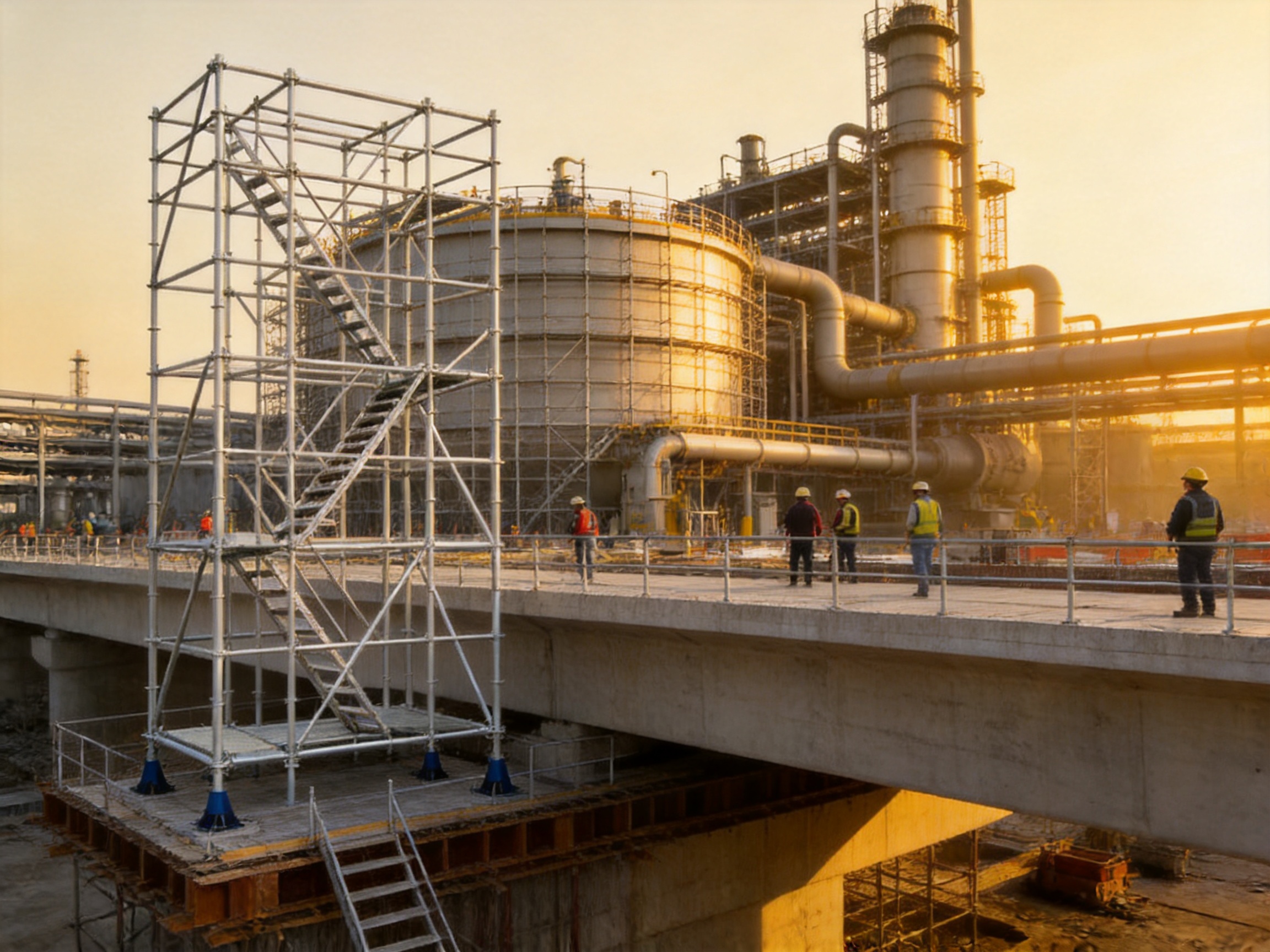
Ringlock scaffolding is a modular access and support system developed for projects that demand fast assembly, high load capacity, structural stability, and long service life. Unlike conventional tube-and-clamp scaffolding, which depends on numerous loose fittings and repeated manual tightening, ringlock scaffolding uses prefabricated vertical standards, horizontal ledgers, diagonal braces, base components, and flower-shaped rosette connections. This configuration creates a reliable three-dimensional structure that can be assembled, modified, inspected, and dismantled efficiently.
Modern construction projects increasingly require scaffolding that can perform beyond ordinary building access. Bridge construction, viaduct work, industrial plant maintenance, power station projects, commercial high-rise construction, marine infrastructure, and temporary event structures all involve different loads, geometries, working heights, and environmental conditions. A flexible modular system must therefore combine mechanical strength with practical installation features. Ringlock scaffolding addresses these requirements through multi-directional connections, high-strength steel components, mechanized production, and corrosion-resistant surface treatment.
For contractors, rental companies, infrastructure developers, and industrial maintenance providers, the value of a ringlock system is not limited to its initial purchase price. The total return depends on assembly speed, component compatibility, usable service life, repair frequency, transport efficiency, worker safety, and the ability to adapt the equipment to different projects. A well-manufactured hot-dip galvanized ringlock system can support repeated deployment across many project types while reducing maintenance and replacement costs.
Ringlock Scaffolding
What Is Ringlock Scaffolding?
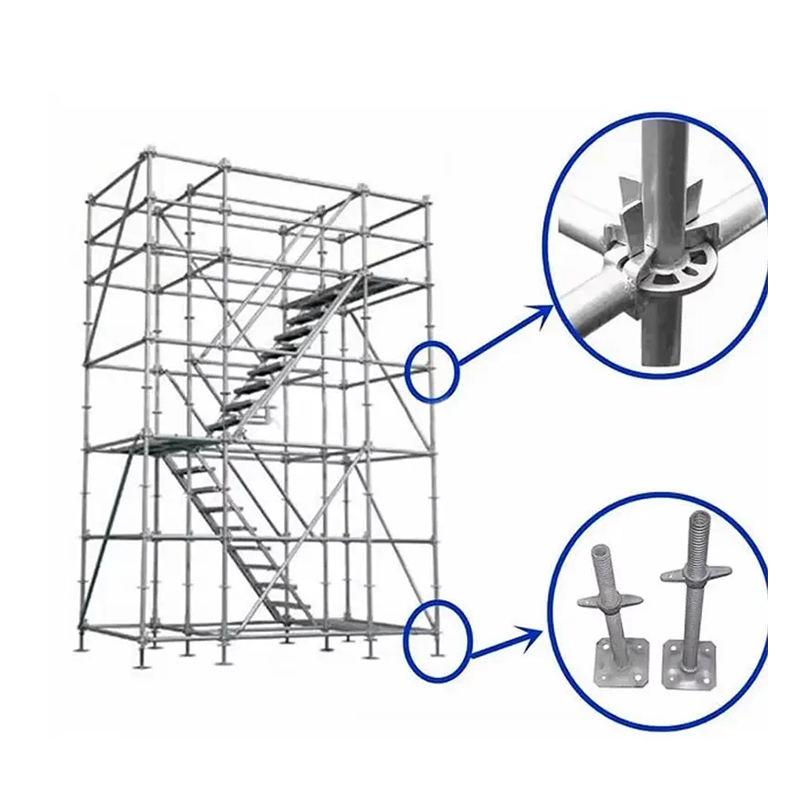
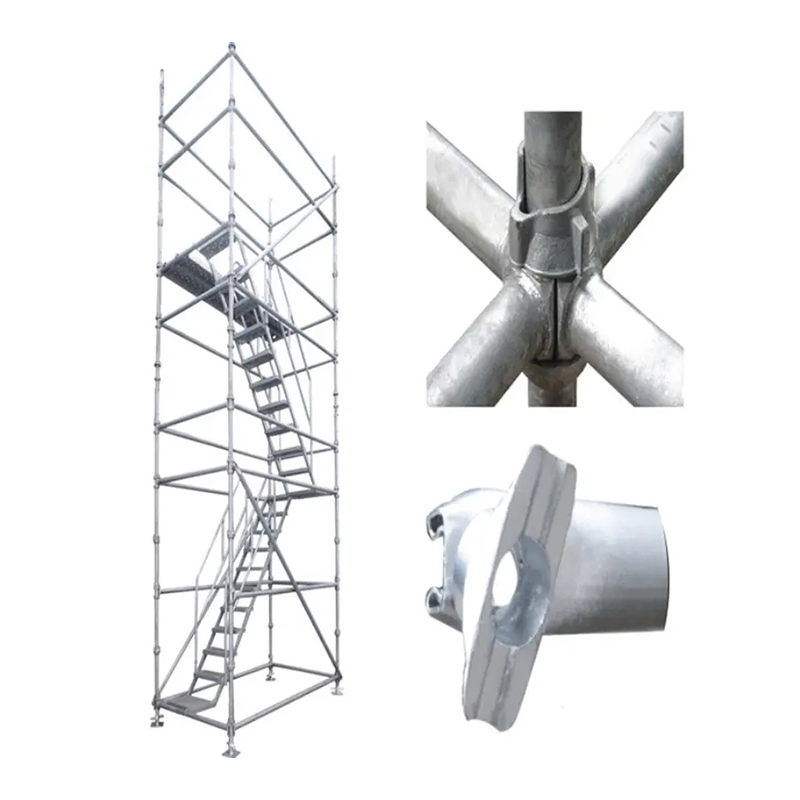
Ringlock scaffolding is a modular scaffolding and shoring system based on vertical steel standards with fixed rosettes welded at predetermined intervals. Horizontal ledgers and diagonal braces connect to the rosettes using wedge heads. Once the wedge is inserted into the rosette opening and struck with a hammer, the connection becomes tight and stable. The system can provide working platforms, access towers, temporary support frames, shoring towers, façade platforms, and heavy-duty formwork support structures.
The central rosette is commonly designed with eight connection openings. This allows ledgers and braces to be connected in multiple directions and at different angles. The result is a scaffolding structure that can follow straight, curved, circular, irregular, or stepped layouts. This flexibility is particularly valuable around bridge piers, water tanks, curved bridge decks, industrial equipment, pipe networks, and structures with restricted access.
A typical ringlock scaffolding arrangement consists of the following components:
Vertical standards: These are the primary load-bearing members. They transfer vertical loads toward the base and foundation. Standards are manufactured in different lengths to create the required working height and structural arrangement.
Horizontal ledgers: Ledgers connect the standards horizontally, define the scaffold bay dimensions, support platforms, and help maintain the geometry of the assembled structure.
Diagonal braces: Braces improve lateral stability and resistance to sway. They are essential in towers, tall access structures, temporary grandstands, and support frames exposed to wind or dynamic loads.
Rosette connections: These flower-shaped connection plates are welded to the standards. Their multiple openings allow the system to be configured in several directions and at different angles.
Wedge heads: Wedge heads are attached to ledgers and braces. They fit into the rosette openings and are secured by driving the wedge into position with a hammer.
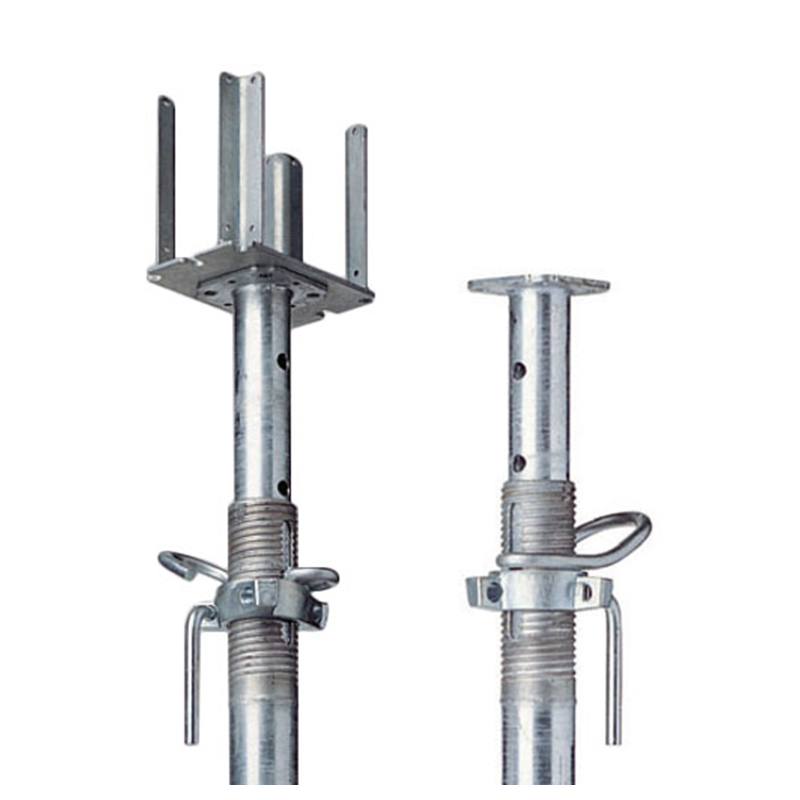
Base jacks and adjustable bases: These components provide height adjustment, load distribution, and a means of leveling the scaffold on foundations with minor variations.
U-head jacks and support accessories: In shoring and formwork applications, U-head jacks can support beams, primary girders, timber members, or steel formwork systems.
Steel platforms, stair units, guardrails, toe boards, and access components: These accessories convert the structural frame into a safe working platform or access system suited to the project.
Because the main components are standardized and modular, a ringlock inventory can be configured for many applications without requiring a separate purpose-built scaffold for every project.
Key Advantages Over Conventional Scaffolding Systems
Rapid Assembly With Fewer Loose Components
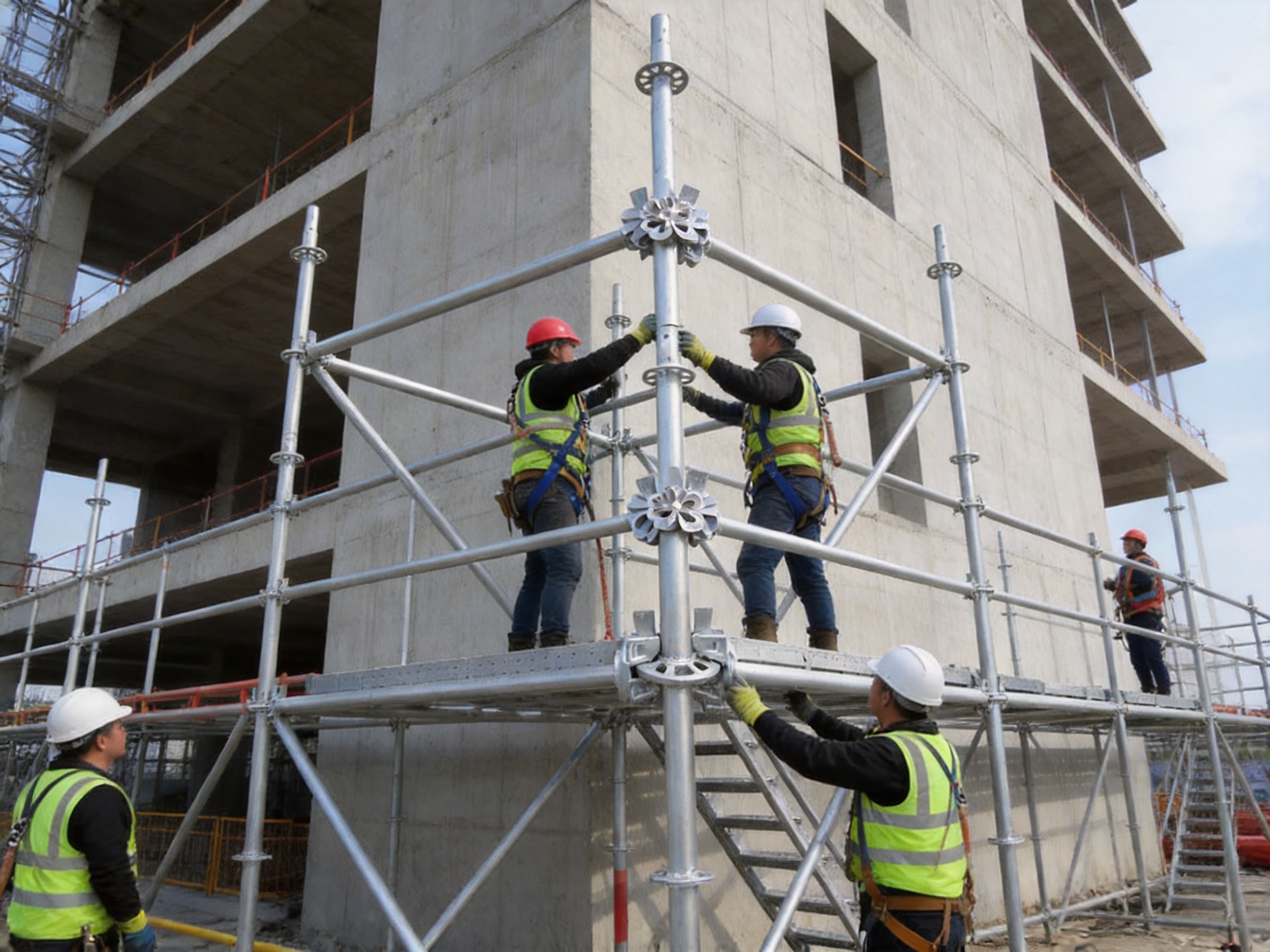
One of the most important advantages of ringlock scaffolding is its rapid installation. A conventional tube-and-clamp system requires workers to position tubes, select fittings, align clamps, and tighten bolts repeatedly. The quality of the finished structure can depend heavily on the consistency and experience of individual installers. Ringlock scaffolding simplifies this process through fixed rosettes and integrated wedge connections.
A single worker can normally complete a basic connection using a hammer rather than a large collection of spanners or torque tools. The connection sequence is straightforward: position the wedge head in the selected rosette opening, insert the wedge, and strike it into the locked position. This reduces the number of loose parts handled at height and allows crews to work more quickly.
Under suitable site conditions, the installation time can be reduced by up to 50 percent compared with traditional pipe-and-clamp scaffolding. Actual results depend on structure height, layout complexity, crew experience, access conditions, and inspection procedures, but the reduction in connection operations can provide a major productivity benefit.
Eight-Way Connection Flexibility
Traditional scaffolding is often most efficient when installed in a regular rectangular grid. However, construction sites rarely remain completely regular. Industrial plants contain tanks, ducts, pipelines, pumps, platforms, and machinery. Bridges may include curved decks, variable-width sections, sloping surfaces, and complex pier arrangements. Commercial buildings may have balconies, setbacks, irregular façades, and architectural projections.
The eight-way ringlock connection allows ledgers and braces to be arranged in multiple directions. This makes it easier to create right-angle, diagonal, radial, circular, and irregular layouts. The scaffolding can be adapted around obstacles instead of forcing the entire project into a rigid grid. This flexibility can reduce the need for field modifications and minimize gaps between the scaffold and the work area.
For circular water tanks and curved bridges, the connection geometry helps the scaffold follow the structure more closely. For industrial maintenance, it allows access around pipe racks and machinery. For temporary stages and grandstands, it supports modular layouts that can be expanded or reconfigured as the event design changes.
High Load Capacity for Heavy-Duty Support
Ringlock scaffolding is not limited to light-duty façade access. When correctly designed and assembled, it can serve as a heavy-duty support tower for concrete formwork, bridge construction, viaduct work, and other infrastructure applications. The vertical standards, ledgers, braces, joints, and base components work together to transfer loads through a stable three-dimensional frame.
The use of Q345B high-strength steel for the columns provides a strong material foundation for demanding applications. The steel is selected for its combination of strength, weldability, and suitability for structural fabrication. The precise design of the rosette and wedge connection also contributes to effective load transfer between vertical and horizontal members.
Heavy-duty applications require engineering verification. Load capacity depends on standard length, bay size, bracing arrangement, effective height, foundation conditions, eccentric loading, wind exposure, connection condition, and the use of adjustable accessories. The system should therefore be erected according to approved drawings, manufacturer instructions, and applicable local safety standards.
Automatic Wedge Locking Under Load
The wedge connection is designed to become more secure when the scaffold is loaded correctly. As forces are transferred through the joint, the wedge and rosette assembly maintains firm contact. This feature helps reduce the risk of loose connections caused by vibration or ordinary movement during use.
However, an automatically tightening connection does not eliminate the need for proper assembly. Every wedge must be fully inserted and securely driven into position. Standards must be vertical, ledgers must be correctly seated, braces must be installed as designed, and the foundation must be capable of supporting the calculated load. A mechanically efficient joint still depends on correct installation and inspection.
Reduced Structural Sway
Scaffolding stability is influenced by the quality of connections, the arrangement of braces, the height-to-base ratio, anchorage, foundation conditions, and environmental forces. Ringlock scaffolding provides a rigid modular framework in which the ledgers and braces work together to resist lateral movement.
Compared with a loosely assembled tube-and-clamp structure, a properly installed ringlock system can offer more consistent geometry from bay to bay. Fixed rosette positions help maintain repeatable connection heights, while standardized components reduce variation during assembly. This can contribute to a stable working platform and improve worker confidence during high-altitude operations.
Long Service Life and Rental Fleet Value
Scaffolding used by rental companies is repeatedly transported, assembled, dismantled, stacked, and exposed to outdoor conditions. Surface damage, corrosion, deformation, and poor weld quality can reduce the usable life of rental equipment. A corrosion-resistant system with robust components can therefore produce a better return on investment over many rental cycles.
The hot-dip galvanized finish protects the steel against moisture and atmospheric corrosion. The specified minimum coating thickness of 75 micrometers provides a substantial protective layer when the components are processed correctly and handled responsibly. Under normal use and with appropriate maintenance, the service life may exceed 15 years. Actual service life depends on the operating environment, exposure to salt or chemicals, mechanical damage, cleaning practices, storage, inspection, and repair procedures.
Hot-Dip Galvanizing for Corrosion Protection
Corrosion is a major concern for scaffolding used outdoors, near the coast, in humid industrial environments, or around chemical processing facilities. Rust can reduce wall thickness, weaken connections, damage threads, and make components difficult to assemble. Painted surfaces may provide protection, but they can be vulnerable to impact, abrasion, and local damage during transportation and erection.
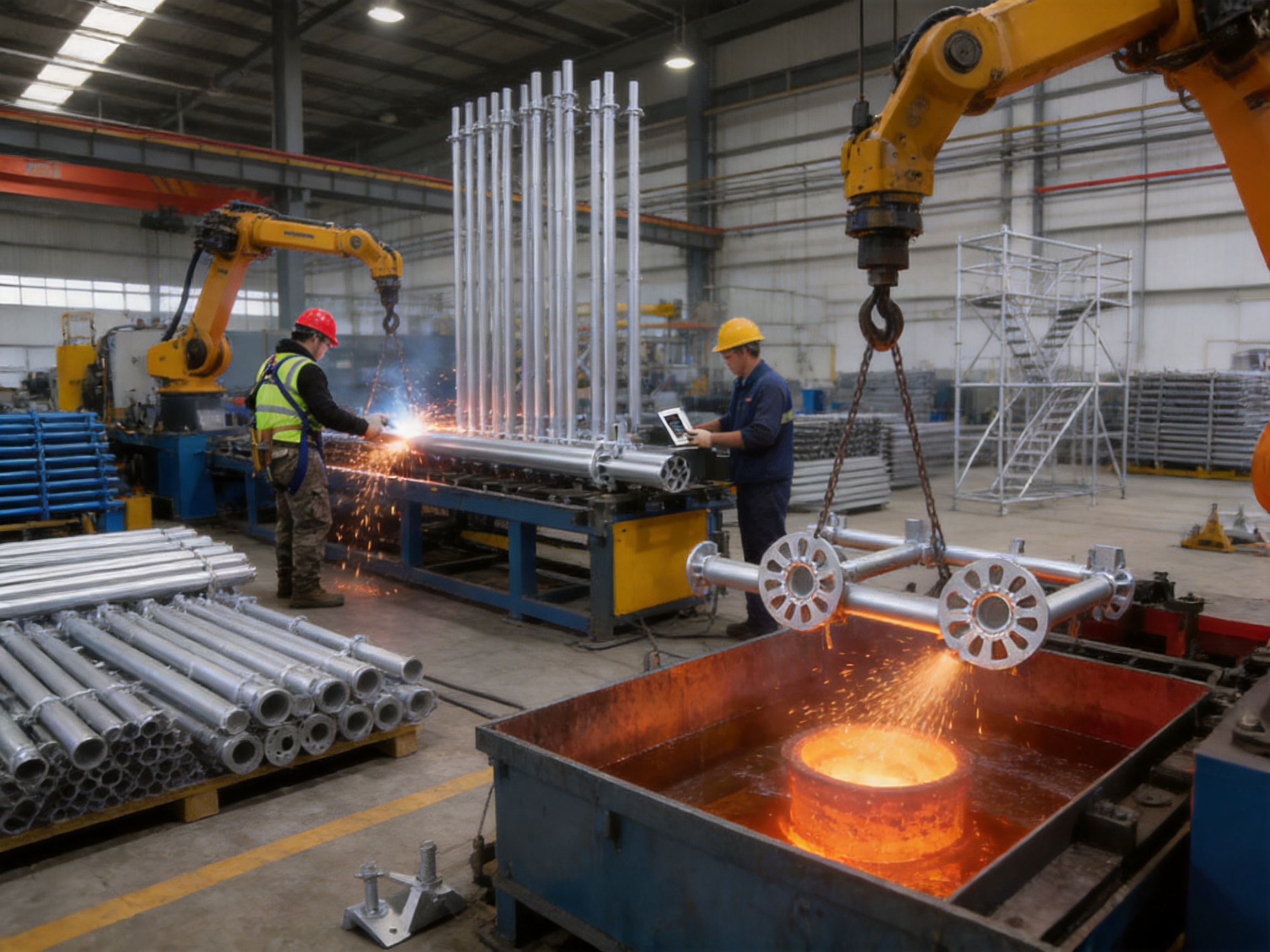
Hot-dip galvanizing creates a metallurgically bonded zinc coating on the steel surface. The components are prepared, immersed in molten zinc, and withdrawn with a protective layer covering the exposed surfaces. When the process is properly controlled, the coating protects the underlying steel through barrier protection and sacrificial action. Zinc can continue to protect exposed areas around small scratches more effectively than many conventional paint systems.
A quality hot-dip galvanizing process should address both external and internal surfaces. Hollow scaffold tubes can be particularly vulnerable if their internal surfaces are not properly prepared and coated. The use of suitable vent and drain openings, controlled cleaning, appropriate immersion, and inspection procedures helps promote uniform coverage.
The hot-dip galvanized finish offers several practical advantages:
It reduces routine repainting requirements and associated labor costs.
It improves resistance to rain, humidity, salt-laden air, and many industrial atmospheres.
It supports longer service life in rental and infrastructure applications.
It provides a bright, easily inspected surface that makes visible damage and contamination easier to identify.
It helps maintain component value during repeated project deployment.
Galvanizing is not a substitute for maintenance. Components should still be cleaned, inspected, stored off the ground, and protected from prolonged contact with aggressive chemicals. Deep cuts, severe abrasion, deformation, or weld damage should be evaluated before reuse.
Advanced Manufacturing and Quality Control
High-Precision CNC Cutting
Dimensional accuracy is essential in a modular scaffolding system. If standards, ledgers, and braces do not meet their specified lengths, components from different production batches may not assemble properly. Inaccurate cuts can create uneven bays, misaligned joints, excessive adjustment requirements, or installation failures.
CNC cutting equipment provides repeatable control over component length and preparation. Automated cutting reduces variation caused by manual measurement and helps maintain consistent tolerances across large production runs. It also supports efficient production of standard and customized components for projects with different bay sizes or height requirements.
Before cutting, production personnel should verify material grade, tube dimensions, wall thickness, and order specifications. After cutting, components can be checked for length, squareness, burrs, surface condition, and identification markings. Consistent preparation supports reliable welding and reduces unnecessary rework.
Robotic Welding Technology
The welds connecting rosettes, sleeves, base components, and other fittings directly affect the performance of the scaffold. Inconsistent weld penetration, excessive spatter, poor alignment, or incomplete fusion can weaken a connection and create problems during assembly.
Automated welding robot technology helps provide repeatable weld paths, controlled parameters, and consistent positioning. Robotic equipment is particularly useful for high-volume production of identical components. It can maintain a stable torch angle and welding speed while reducing variation between individual operators.
Robotic welding does not replace skilled manufacturing personnel. Engineers and technicians remain responsible for fixture design, welding procedure control, parameter verification, machine maintenance, and inspection. Certified welding practices, including AWS and EN-based craftsmanship where required, can provide an additional framework for controlling the quality of structural welds.
Mechanically Welded Flower-Shaped Rosettes
The rosette is one of the defining parts of a ringlock scaffold. It must be positioned accurately on the standard so that ledgers and braces connect at the intended elevations. It must also be welded securely enough to transfer forces through the joint.
Mechanized production helps control rosette spacing, orientation, and concentricity. Proper fixtures hold the standard and rosette in position during welding, reducing angular errors. After welding, inspection can verify alignment, weld appearance, dimensional consistency, and the absence of visible defects.
Accurate rosette positioning allows parts from different batches to remain interchangeable. This is especially important for rental fleets and contractors who combine components purchased at different times. Interchangeability reduces sorting labor, simplifies inventory management, and limits the risk of site delays caused by incompatible parts.
Material Traceability and Process Control
A professional manufacturer should control the process from incoming raw material to finished product. Material certificates, batch records, production instructions, inspection reports, and galvanizing records can support traceability. Clear marking of components can also help users identify dimensions, production batches, or system types during site operations.
Quality control may include dimensional inspection, visual weld inspection, coating thickness measurement, component fit testing, and load-related verification. For projects with special requirements, additional testing may be specified by the customer, engineer, or applicable standard.
Standardized production lines are valuable because they reduce uncontrolled variation. When laser cutting, CNC preparation, automated welding, galvanizing, and final inspection are organized into a coordinated workflow, the manufacturer can improve production efficiency while maintaining repeatable quality.
Manufacturing Strengths of the Supplier
Nantong Hyson Road And Bridge Formwork Co., Ltd. is a manufacturer specializing in custom steel formwork, ringlock scaffolding, heavy-duty steel structures, and OEM metal fabrication. Its production capabilities combine automated processing with structural fabrication experience for infrastructure and industrial applications.
The company operates advanced laser cutting equipment and standardized production lines. This supports the fabrication of non-standard steel components as well as repeat production of modular scaffolding parts. Laser cutting can produce accurate profiles, openings, connection plates, and custom steel elements with clean edges and repeatable dimensions.
Its manufacturing capabilities also include integrated bending and welding services. This allows customers to source multiple processing stages from one supplier rather than coordinating separate cutting, forming, and welding vendors. Integrated production can simplify quality communication, shorten procurement cycles, and improve responsibility for the final assembly.
The company reports experience with AWS and EN welding craftsmanship, ISO 9001 quality management, BS1139 requirements, and EN74 international standards. These references are relevant to customers who require structured quality procedures and internationally recognized approaches to scaffolding component production. Project-specific compliance should always be confirmed before purchase, particularly when a local authority or engineering consultant requires additional certification.
With 12 utility patents and experience supporting major infrastructure projects, the manufacturer applies heavy-industry production principles to its product range. It has served customers and projects associated with major transportation and industrial construction, including bridge and power plant applications. This background is important because heavy infrastructure projects generally require more than standard product supply. They demand accurate documentation, stable production capacity, predictable delivery, and the ability to respond to customized engineering requirements.
The company’s broader product portfolio includes bridge and infrastructure formwork, hydraulic tunnel trolleys, steel props, industrial steel structures, and heavy steel OEM fabrication. This allows ringlock scaffolding customers to discuss related support systems, formwork components, structural steel members, and custom-fabricated accessories with the same engineering and manufacturing organization.
Product Performance Comparison
The following comparison summarizes the practical differences between hot-dip galvanized ringlock scaffolding and conventional tube-and-clamp scaffolding. Actual performance depends on design, materials, workmanship, site conditions, and inspection.
| Performance Factor | Hot-Dip Galvanized Ringlock Scaffolding | Conventional Tube-and-Clamp Scaffolding |
|---|---|---|
| Connection method | Rosette and wedge connection secured with a hammer | Separate clamps and bolts tightened manually |
| Installation speed | Fast assembly with fewer loose fittings; potential time reduction of up to 50 percent | More connection operations and greater dependence on manual tightening |
| Directional flexibility | Eight-way rosette connection supports varied layouts and angles | Flexible in principle, but layout changes require positioning and tightening individual fittings |
| Load-bearing application | Suitable for access, shoring, support towers, and heavy-duty infrastructure when properly engineered | Suitable for many access applications; heavy-duty use requires careful design and extensive fitting control |
| Loose component quantity | Reduced through integrated wedge heads and fixed rosettes | Higher number of separate clamps, bolts, and fittings |
| Surface protection | Hot-dip galvanized coating with a specified minimum thickness of 75 micrometers | Varies by product; painted or galvanized options may be available |
| Rental fleet management | Standardized, modular, and easier to sort and reuse | Requires careful control of many fitting types and individual components |
| Assembly consistency | Fixed connection points support repeatable bay geometry | Geometry depends more heavily on installer positioning and tightening |
| Adaptability | Well suited to bridges, circular structures, industrial plants, stages, and high-rise work | Highly adaptable but generally more labor-intensive for complex shapes |
Applications in Bridge and Infrastructure Construction
Bridge Deck and Box Girder Support
Bridge construction often requires temporary support systems capable of carrying formwork, reinforcement, wet concrete, construction equipment, and workers. Ringlock scaffolding can be erected as a support tower beneath bridge decks, box girders, pier caps, and other large concrete elements.
The modular standards and ledgers allow the support grid to be adjusted to the width and length of the bridge section. Diagonal bracing provides lateral stability, while base jacks and U-head components help level the system and transfer loads into the supporting foundation. The arrangement can be expanded or dismantled in stages as the bridge construction sequence progresses.
Bridge support is a highly engineered application. Designers must consider the total construction load, concrete placement sequence, wind, uneven settlement, foundation bearing capacity, horizontal forces, and possible impact from construction equipment. Ringlock scaffolding provides the structural components, but the final arrangement should be approved by a qualified engineer.
Viaduct and Elevated Structure Work
Viaduct projects may contain repeated spans, variable ground conditions, and restricted access beneath the structure. The standardized nature of ringlock scaffolding helps contractors repeat support configurations while adapting individual bays to local conditions.
For elevated construction, the system can also provide access platforms for reinforcement installation, formwork adjustment, inspection, concrete finishing, and maintenance. Its modular geometry can be coordinated with stair units, guardrails, platform decks, and material handling routes.
Marine and Coastal Infrastructure
Coastal bridges, port structures, shipyards, and marine facilities expose steel equipment to humidity and salt-laden air. The hot-dip galvanized finish helps reduce corrosion risk compared with unprotected carbon steel. Regular inspection remains necessary, especially at cut edges, impact points, connection areas, and locations where salt or chemicals can accumulate.
Applications in Industrial Maintenance
Industrial facilities frequently require temporary access around equipment that cannot be relocated. Refineries, power plants, chemical plants, cement facilities, steel mills, and manufacturing sites contain complex networks of pipes, tanks, ducts, cables, and machinery. A scaffold system must provide safe access without interfering with essential operations.
Ringlock scaffolding is suitable for building access towers and work platforms around industrial equipment. The eight-way connection pattern makes it easier to create narrow platforms, offset bays, wraparound access, and structures that follow curved tanks or irregular machinery layouts.
During shutdown maintenance, installation speed can have a direct commercial impact. Every additional day of shutdown may affect production schedules and operating costs. A modular system that can be assembled quickly, inspected efficiently, and modified as work progresses may help maintenance contractors shorten preparation time.
Industrial environments also place greater demands on surface protection and inspection. Galvanized components should be checked for chemical attack, coating damage, contamination, deformation, and contact with incompatible substances. Site-specific rules for hot work, hazardous areas, access control, and emergency evacuation must be followed.
Applications in Commercial and High-Rise Construction
Commercial high-rise buildings require safe access for façade installation, masonry, glazing, painting, mechanical services, exterior finishing, and inspection. Ringlock scaffolding can be used to create working platforms, stair towers, loading platforms, and localized access structures.
The modular system allows platforms to be adjusted as the building façade changes from floor to floor. It can also support material access routes and temporary work areas during different stages of construction. Guardrails, toe boards, access ladders, and stair components can be integrated into the system to improve workplace organization.
High-rise installations require careful attention to anchorage, wind loading, platform loading, falling-object protection, and the relationship between the scaffold and the building envelope. The scaffold should be tied or otherwise stabilized according to the design. Open edges, gaps, incomplete platforms, and unauthorized alterations must be controlled through formal inspection procedures.
Applications in Temporary Modular Structures
Ringlock scaffolding can be assembled into temporary structures such as concert stages, grandstands, observation decks, exhibition platforms, temporary roofs, and event access towers. The system is particularly suitable where the layout must be assembled quickly and removed after a short operating period.
Its repeated modular components support efficient transport and storage. A rental company can use the same standards, ledgers, braces, platforms, and accessories for multiple event layouts. This improves asset utilization and reduces the need to purchase separate systems for each temporary project.
Temporary public structures require special attention to crowd loading, vibration, wind, emergency access, guardrail design, stair capacity, fire safety, and local approval requirements. The modular nature of the equipment simplifies construction but does not reduce the need for professional structural design and event safety management.
Safety and Correct Installation
Ringlock scaffolding is designed to improve safety, but safe performance depends on the complete system rather than one connection detail. The foundation, base components, standards, ledgers, braces, platforms, guardrails, ties, access equipment, and inspection procedures must work together.
Before erection begins, the project team should review the approved design, ground conditions, intended loads, access requirements, environmental conditions, and assembly sequence. Components should be checked for bent tubes, cracked welds, damaged rosettes, missing wedges, excessive corrosion, distorted base plates, damaged threads, and other defects.
The scaffold should be erected on a stable and adequately prepared foundation. Sole boards or other load-distribution measures may be required where the ground is soft or uneven. Adjustable bases should remain within their permitted extension limits and should not be used to compensate for a fundamentally unsuitable foundation.
Standards should be installed vertically and connected at the specified levels. Ledgers and braces must be fully engaged with the rosettes. Wedges should be driven firmly into place using the correct hammering method. Bracing and ties should not be omitted merely because the scaffold appears stable at a lower height.
Working platforms should be fully decked where required, with secure platform units, guardrails, midrails, toe boards, and controlled access. Materials should not be stored beyond the designed platform capacity. Unauthorized removal of ledgers, braces, or guardrails can compromise the entire structure.
After erection, a competent person should inspect the system before use. Additional inspections may be required after severe weather, impact, alteration, prolonged non-use, or changes in loading. Rental companies should establish a clear return inspection process so that damaged components are removed from circulation before the next deployment.
Maintenance, Storage, and Asset Management
Good maintenance increases the value of a ringlock scaffolding fleet. Components should be cleaned after use to remove concrete residue, soil, oil, salt, and chemical contamination. Concrete or mortar should not be allowed to harden on rosettes, wedge heads, threads, or platform supports because buildup can prevent proper assembly.
Galvanized surfaces should be inspected for deep scratches, peeling, severe white corrosion deposits, red rust, and chemical damage. Small areas of damage may be treated according to an approved zinc repair procedure. Components with significant section loss, deformation, or damaged welds should be evaluated by qualified personnel.
Standards, ledgers, and braces should be stacked by type and length. They should be stored on supports that keep them off the ground and prevent standing water. Wedges and small accessories should be stored in bins or dedicated containers to reduce loss. Clear inventory labeling can speed up loading and reduce site shortages.
For rental companies, digital or paper records can track component quantities, inspection status, repair history, and project allocation. Standardized components are easier to count, load, and redistribute than large inventories of unique fittings. This can improve fleet utilization and reduce administrative labor.
Customization and OEM Supply
Although ringlock scaffolding is based on standardized modules, many projects require customized components. Customers may need special standard lengths, platform dimensions, stair units, adjustable bases, U-head arrangements, loading bays, protective screens, transition components, or structural frames that connect with existing formwork.
An experienced OEM manufacturer can review drawings, material specifications, loading requirements, surface treatment requirements, packaging instructions, and delivery schedules. Custom fabrication may include laser-cut plates, bent sections, welded frames, machined components, and non-standard support assemblies.
Integrated steel fabrication is especially valuable when a project combines ringlock support with bridge formwork, steel structures, hydraulic tunnel equipment, or heavy custom components. Coordinating these products through one manufacturing partner can reduce interface problems and make it easier to maintain consistent quality documentation.
Before production, customers should confirm component dimensions, steel grades, welding requirements, galvanizing specifications, inspection standards, allowable tolerances, packaging methods, and applicable national regulations. Drawings and approval samples can help prevent misunderstandings, particularly for large orders or complex infrastructure projects.
Economic Benefits for Contractors and Rental Companies
The economic value of ringlock scaffolding comes from its repeated operational advantages. Faster assembly can reduce labor hours and shorten the time required to prepare a work area. Fewer loose fittings can reduce lost components and simplify transport. Standardized parts can improve fleet flexibility, while galvanizing can reduce repainting and replacement costs.
For contractors, the system may reduce the duration of temporary works and help crews reach productive construction activities sooner. The modular structure can also reduce field fabrication and the associated safety risks. When the scaffold is used across multiple projects, its adaptability allows the same inventory to support bridges, buildings, industrial maintenance, and temporary structures.
For rental companies, long service life and interchangeability are central to return on investment. A galvanized component that remains serviceable through many rental cycles produces more revenue over its useful life. The ability to assemble different layouts from a common inventory also increases utilization and reduces idle stock.
Economic evaluation should include more than the purchase price. Important factors include labor requirements, erection and dismantling time, inspection costs, repair frequency, transport volume, storage efficiency, loss rates, compliance documentation, and expected service life. A high-quality system may provide a lower total cost of ownership even when its initial price is higher than a basic alternative.
Recommended Selection Criteria
When selecting ringlock scaffolding, buyers should first identify the intended application. Access scaffolding, bridge shoring, industrial maintenance, façade work, and temporary public structures may require different component configurations and design documentation.
The material grade and dimensions should be confirmed. Q345B steel columns are suitable for high-strength structural applications when manufactured and designed correctly. Buyers should also verify tube wall thickness, rosette dimensions, weld quality, component tolerances, and the compatibility of accessories.
Surface treatment should be clearly specified. A hot-dip galvanized system should include the required coating thickness, preparation method, inspection process, and treatment of internal surfaces where applicable. Buyers should ask how coating thickness is measured and how damaged areas are repaired.
Manufacturing capability is another important consideration. CNC cutting, robotic welding, controlled fixtures, standardized production, and documented inspection can improve consistency. Customers should evaluate whether the supplier can provide batch production, customized components, sample approval, quality records, and stable delivery.
Compliance requirements should be reviewed before ordering. Depending on the market and application, buyers may require ISO quality management, EN74, BS1139, AWS welding practice, local scaffolding regulations, project-specific load tests, or third-party inspection. Certification should be matched to the actual product and intended use.
Installation Planning Checklist
Confirm the approved structural design and intended load capacity.
Assess the foundation, soil condition, drainage, and potential settlement.
Check all standards, ledgers, braces, rosettes, wedges, platforms, jacks, and accessories before erection.
Establish the required bay dimensions, working levels, access routes, bracing pattern, and building ties.
Use trained personnel and appoint a competent supervisor.
Install base components on suitable load-distribution materials where required.
Keep standards plumb and ensure every connection is fully seated and locked.
Install diagonal bracing, guardrails, toe boards, platforms, stairs, and ties according to the design.
Control material loading and prevent unauthorized alterations.
Inspect the completed scaffold before use and after any event that could affect stability.
Q&A: Ringlock Scaffolding Frequently Asked Questions
What is the main difference between ringlock scaffolding and tube-and-clamp scaffolding?
Ringlock scaffolding uses fixed rosettes and wedge heads to create standardized modular connections. Tube-and-clamp scaffolding uses separate clamps and bolts for each connection. Ringlock systems generally require fewer loose fittings and can be assembled more quickly, while tube-and-clamp systems remain highly flexible but are usually more labor-intensive for large or complex structures.
Can one worker assemble ringlock scaffolding?
A single worker can complete many individual ringlock connections using a hammer. However, the total erection of a scaffold should be managed by a trained crew appropriate to the structure’s height, weight, access conditions, and safety requirements. The one-person connection feature improves productivity but does not mean that large or high scaffolds should be erected without adequate supervision and assistance.
Is ringlock scaffolding suitable for bridge construction?
Yes. Ringlock scaffolding is commonly configured as a heavy-duty support tower or temporary support frame for bridge decks, box girders, viaducts, and pier-related work. The final design must consider concrete and formwork loads, foundation bearing capacity, wind, settlement, bracing, and construction sequence.
Why is Q345B steel used for the columns?
Q345B is a high-strength structural steel grade selected for its strength and suitability for fabricated load-bearing components. It can provide a strong basis for standards and support members when the material, welding, dimensions, and design are properly controlled.
What does the eight-way connection mean?
The rosette connection provides multiple openings around the standard, allowing ledgers and braces to connect in several directions and at different angles. This makes the scaffold adaptable to straight, curved, circular, irregular, and offset layouts.
How long can hot-dip galvanized ringlock scaffolding last?
Under normal use and with proper maintenance, the service life may exceed 15 years. The actual period depends on exposure, mechanical damage, loading, storage, cleaning, inspection, and the severity of the operating environment.
Is hot-dip galvanizing suitable for marine and industrial environments?
Hot-dip galvanizing provides strong corrosion protection in many humid, marine, and industrial environments. Nevertheless, highly aggressive chemicals, salt deposits, abrasion, and standing water can still damage the coating. Regular inspection and appropriate cleaning remain necessary.
Can ringlock components from different batches be mixed?
Components manufactured to the same specifications should be interchangeable, particularly when the supplier maintains strict dimensional tolerances. Buyers should confirm compatibility before mixing products from different manufacturers or production standards.
Can the system be customized?
Yes. Standard components can be supplemented with customized lengths, platforms, stairs, loading bays, adjustable support parts, structural frames, and other OEM-fabricated accessories. Customized products should be reviewed against the project drawings and load requirements before production.
What quality documents should buyers request?
Depending on the project, buyers may request material certificates, dimensional inspection records, weld inspection records, galvanizing thickness reports, production batch information, load-related test documents, quality management certificates, and compliance declarations. The required documentation should be confirmed during the purchasing stage.
Can ringlock scaffolding be used as a permanent structure?
Ringlock scaffolding is generally intended as a temporary access or support system. It should not be treated as a permanent structural frame unless a qualified engineer specifically designs and approves such use with suitable materials, connections, protection, and documentation.
How should damaged components be handled?
Components with bent standards, cracked welds, distorted rosettes, damaged wedges, severe corrosion, or damaged threads should be removed from service and evaluated. They should not be straightened, welded, or reused without an approved repair and inspection procedure.
Conclusion
Hot-dip galvanized ringlock scaffolding provides a practical combination of speed, flexibility, strength, corrosion resistance, and long-term asset value. Its flower-shaped rosette and wedge locking mechanism simplify assembly, reduce loose fittings, and support efficient construction operations. Eight-way connections allow the system to adapt to bridges, curved structures, industrial plants, high-rise buildings, temporary stages, and other complex environments.
The use of Q345B steel columns, CNC cutting, robotic welding, controlled rosette positioning, and hot-dip galvanizing supports reliable performance when the system is correctly designed and installed. These manufacturing features also improve interchangeability, rental fleet management, and long-term return on investment.
For contractors and equipment rental companies, the most important benefits extend beyond installation speed. A durable galvanized system can serve across many projects, reduce maintenance demands, and provide a consistent platform for demanding work at height. For infrastructure and industrial customers, OEM manufacturing capabilities allow the standard modular system to be adapted to specialized support, access, and formwork requirements.
Nantong Hyson Road And Bridge Formwork Co., Ltd. combines ringlock scaffolding production with laser cutting, bending, welding, steel structure fabrication, and custom OEM manufacturing. Its reported experience with major infrastructure and industrial projects supports a manufacturing approach centered on dimensional accuracy, process control, structural reliability, and project-specific service.
Ultimately, ringlock scaffolding should be selected as part of a complete engineered solution. The right product, manufacturing process, design, erection method, inspection program, and maintenance plan must work together. When these factors are properly coordinated, hot-dip galvanized ringlock scaffolding can provide a safe, efficient, and economical temporary works system for demanding construction and industrial applications.
References
EN 74, Couplers, Spigot Pins and Base-Plates for Use in Falsework and Scaffolds.
BS 1139, Metal Scaffolding: Specifications and Related Requirements.
ISO 9001, Quality Management Systems: Requirements.
AWS Structural Welding Code: Steel.
ISO 1461, Hot Dip Galvanized Coatings on Fabricated Iron and Steel Articles.
Occupational safety guidance for the design, erection, alteration, inspection, and use of temporary access and support structures.
Manufacturer technical information for modular ringlock scaffolding, hot-dip galvanizing, structural steel fabrication, and OEM metal processing.
Product: Ringlock Scaffolding


- Location
- Group 3, Fangzhuang Village, Rucheng Subdistrict, Rugao City, Nantong, Jiangsu, China
- Follow us
- Phone
- +86-13646196162
- info@hysonindustry.com
