 +86-13646196162
 info@hysonindustry.com




 русский
  عربى
عربى 


Steel Props for Heavy-Duty Construction Support: Load Capacity, Adjustability, and Reliable OEM Manufacturing
 2026.08.30
Content
- 1 What Are Steel Props?
- 2 Core Functions in Construction
- 3 Steel Props Compared with Other Adjustable Components
- 4 Heavy-Duty Load-Bearing Performance
- 5 Height Adjustment and Site Flexibility
- 6 Corrosion Protection and Reusability
- 7 Fast Installation and Practical Handling
- 8 Safety Features and System Compatibility
- 9 Applications of Steel Props
- 10 Advanced Manufacturing Capabilities
- 11 OEM and Custom Manufacturing Support
- 12 Advantages Over Conventional Support Solutions
- 13 Use in Major Infrastructure and Industrial Projects
- 14 Inspection, Storage, and Maintenance
- 15 How to Select the Right Steel Prop
- 16 Q&A About Steel Props
- 16.1 What is the main purpose of a steel prop?
- 16.2 Can a steel prop replace an adjustable base?
- 16.3 What load capacity is available?
- 16.4 How much height adjustment is available?
- 16.5 Are steel props suitable for outdoor construction?
- 16.6 How many times can a steel prop be reused?
- 16.7 Can one worker install the prop?
- 16.8 Can steel props be used with scaffolding?
- 16.9 Does a galvanized finish eliminate maintenance?
- 16.10 What information should be provided for a customized order?
- 17 Why Manufacturing Capability Matters
- 18 Conclusion
- 19 References
- 20 Product: Steel Props
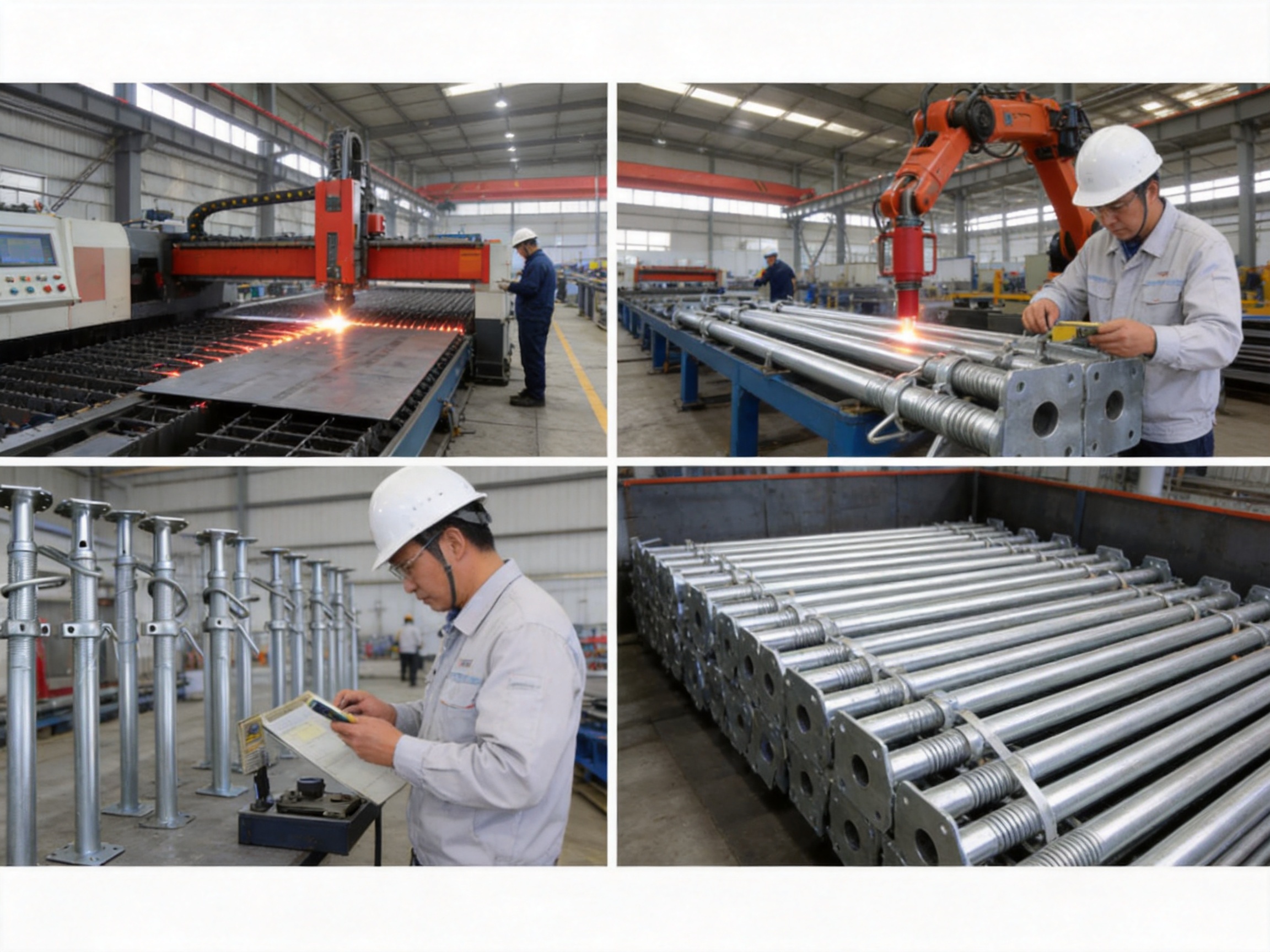
Steel props are essential temporary support components for construction projects that require dependable vertical load-bearing performance. They are used to support formwork, floor slabs, roofs, walls, scaffolding systems, temporary structures, and equipment during construction, maintenance, renovation, and repair work. Unlike components that primarily level a base or make a minor connection adjustment, a steel prop is designed to function as a substantial vertical support member within a properly engineered temporary works system.
Modern construction projects increasingly require support equipment that combines strength, dimensional flexibility, corrosion resistance, ease of installation, and repeat-use value. A suitable steel prop must not only carry vertical loads, but also remain stable under changing site conditions, adapt to different working heights, and integrate with formwork and scaffolding systems. Manufacturing quality is equally important. The steel grade, welding quality, dimensional accuracy, surface treatment, inspection procedures, and production consistency all influence the safety and service life of the finished product.
Hyson supplies steel props and related heavy steel products for construction, infrastructure, industrial, and OEM applications. Its manufacturing capabilities include steel plate cutting, bending, robotic welding, surface treatment, inspection, and the production of customized steel components. Through standardized processes and experience in major infrastructure projects, the company provides steel support products intended for demanding working environments and repeat-use applications.
What Are Steel Props?
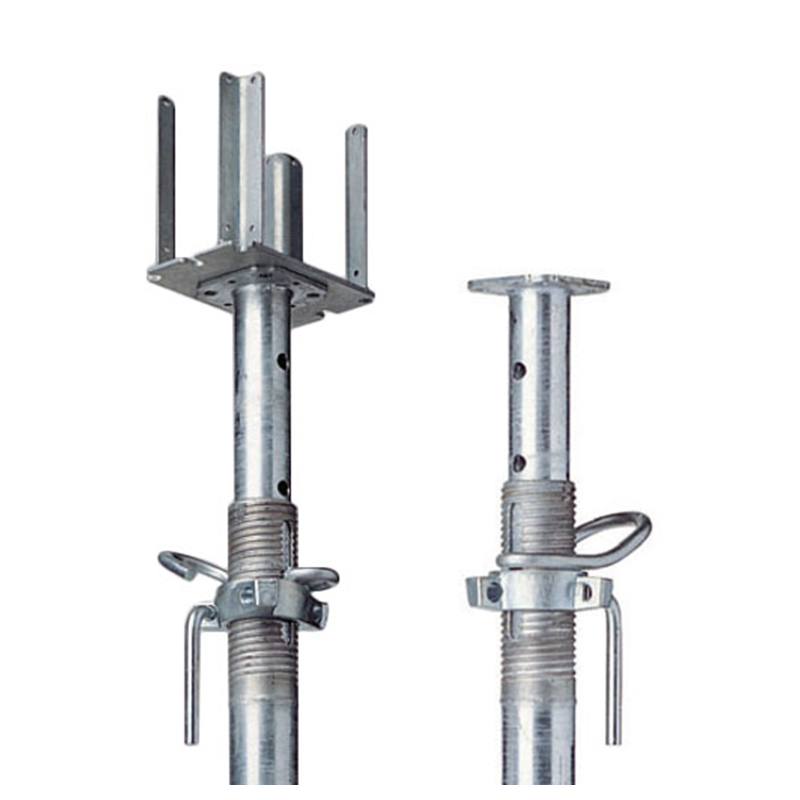
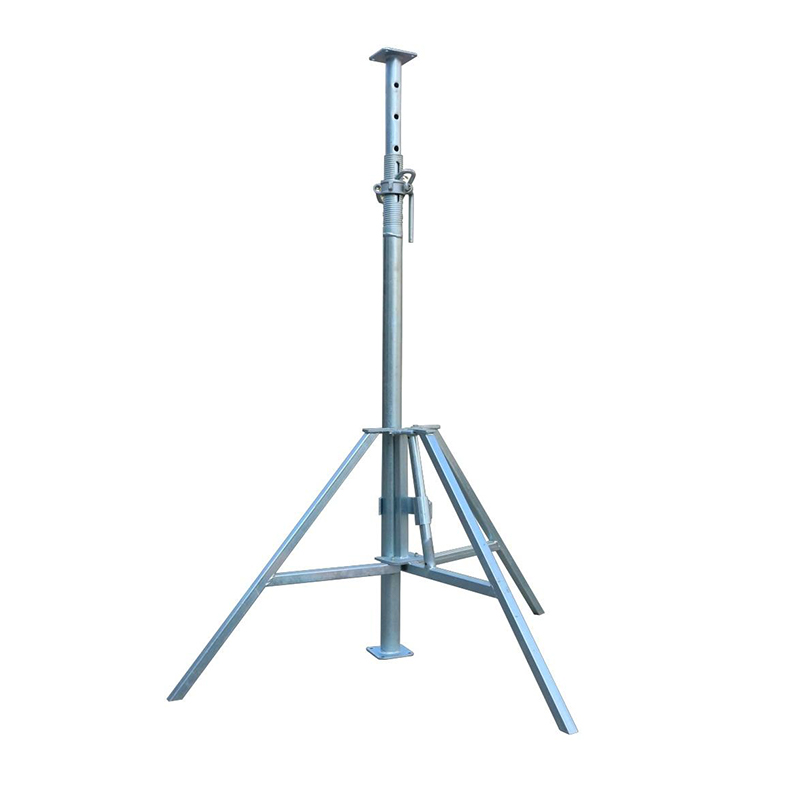
A steel prop is a vertically oriented, adjustable steel support used to transfer loads from an upper structure to a stable supporting surface. It normally consists of a high-strength steel tube or main body, an adjustable threaded section, a locking mechanism, support plates or end plates, and associated reinforcement components. Depending on the design, the prop can be adjusted to suit different construction heights while maintaining a secure load path.
During construction, many structural elements have not yet reached their final strength or are temporarily unsupported. Freshly poured concrete, floor formwork, roof systems, wall panels, beams, and temporary platforms can all require additional vertical support. Steel props provide a controlled support point that helps reduce deflection, settlement, shifting, and local instability when installed according to an approved temporary works design.
The prop does not replace engineering design, proper bracing, adequate foundations, or a complete formwork and scaffolding system. Instead, it serves as one of the principal load-bearing components within that system. The number of props, spacing, orientation, adjustment height, base condition, connection method, and allowable load must be determined according to the project requirements and applicable safety procedures.
Core Functions in Construction
The primary function of a steel prop is to provide vertical support. It can be positioned beneath formwork beams, floor slab panels, roof structures, temporary platforms, or other elements that need support during construction. By transferring the load downward through a steel body and base assembly, the prop helps maintain the intended geometry of the temporary structure.
Steel props are also used to assist with temporary reinforcement. In building renovation, factory maintenance, bridge repair, and structural modification projects, existing elements may need support before a permanent repair or replacement is completed. Properly positioned props can help stabilize a temporary condition and reduce the risk associated with removing, modifying, or repairing structural components.
Another important function is height adaptation. Construction sites rarely have perfectly uniform dimensions. Floor-to-floor heights, slab levels, ground conditions, formwork arrangements, and temporary access requirements can vary from one location to another. An adjustable prop allows workers to compensate for these variations without fabricating a separate support for every height.
In scaffolding applications, steel props may serve as auxiliary vertical load-bearing members. They can reinforce areas where ordinary scaffolding components are exposed to higher loads or where a temporary support arrangement requires additional vertical capacity. Such use must be based on a suitable system design, because the prop and scaffolding must work together as a stable, braced assembly.
Steel Props Compared with Other Adjustable Components
Construction support systems often include several adjustable products, but their functions are not identical. Confusing a steel prop with an adjustable base or adjustable support can result in an unsuitable application. Product selection should therefore begin with a clear understanding of the load path and the role required from each component.
Difference from Adjustable Bases
An adjustable base is generally used to level, position, or support the lower portion of a scaffolding or formwork system. Its adjustment range is often intended for correcting ground-level variations rather than providing the full vertical load-bearing function of a heavy-duty prop. A base may be important for stability and alignment, but it is not necessarily designed to independently support large-volume concrete formwork or floor slab loads.
A steel prop, by contrast, is designed as a vertical support member. Its main body, threaded adjustment system, end plates, and reinforcement are developed to transmit a substantial vertical load. In the product configuration described for this application, the adjustment range is approximately 100 mm to 500 mm, while adjustable bases commonly provide a smaller correction range of approximately 50 mm to 300 mm. The exact capacity and dimensions must always be confirmed against the selected model and project design.
Difference from Adjustable Supports
Adjustable supports or brackets are often used for top-level fine adjustment, connection adaptation, or localized positioning. They may be useful for aligning a component or accommodating a connection detail, but their design objective is not necessarily to act as an independent heavy-duty vertical column.
Steel props are intended to provide a more direct load-bearing function. They can independently support designated vertical loads when used within their rated capacity and installed on an adequate bearing surface. Their reported adjustment range of approximately 100 mm to 500 mm is also broader than the approximate 30 mm to 150 mm range associated with many adjustable support components.
Why Functional Distinction Matters
Each component in a temporary works system must be used for its intended purpose. A leveling base may correct a small ground variation, while a bracket may fine-tune the connection between two components. A steel prop provides the vertical load path. Combining these products can create a complete and flexible support system, but one component should not be substituted for another without checking load capacity, geometry, stability, and compatibility.
| Component | Primary Function | Typical Adjustment Role | Position in a Support System |
|---|---|---|---|
| Steel prop | Heavy-duty vertical load-bearing support | Height adjustment over a comparatively broad range | Core vertical support member |
| Adjustable base | Leveling and lower support positioning | Correction of base-level variation | Bottom or foundation interface |
| Adjustable support or bracket | Connection adaptation and fine adjustment | Localized top or connection adjustment | Interface or fine-tuning component |
| Scaffolding frame or standard | Access, working platform, and system support | System-level dimensional arrangement | Primary scaffolding framework |
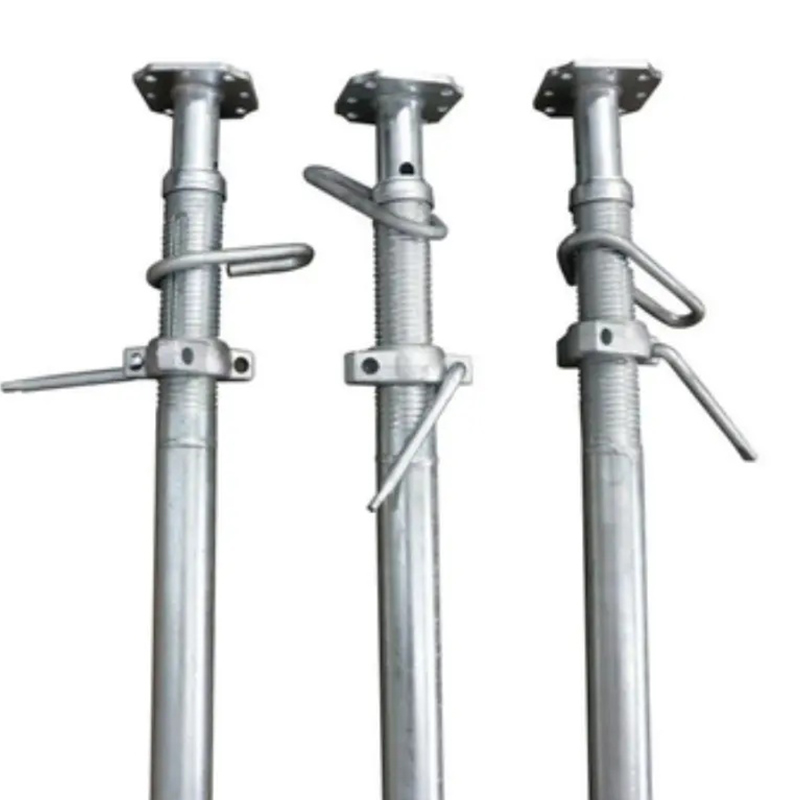
Steel Props
Heavy-Duty Load-Bearing Performance
The most important advantage of a steel prop is its ability to carry vertical loads with stability and predictability. The product described for this application uses Q235 or Q345 high-strength carbon steel, depending on the selected specification. These commonly used structural steel grades provide a balance of strength, weldability, availability, and cost efficiency for construction support products.
The steel prop is manufactured as a robust integrated assembly with reinforced ribs and precision robotic welding. This approach is intended to reduce weak points that can occur when components are poorly aligned, inadequately welded, or assembled without consistent process control. A uniform and properly inspected weld helps transfer forces between the main body, plates, reinforcement, and adjustment components.
The stated vertical load-bearing range is approximately 100 kN to 200 kN, depending on the specific design and configuration. This capacity enables the product to support demanding temporary loads such as large-volume concrete formwork and floor slab systems when the prop is correctly selected and installed. The actual safe working load depends on extension height, eccentricity, end conditions, bracing, base stability, material properties, and the relevant design standard.
A high load rating does not mean that the prop can be used without a support plan. Slender vertical members can lose capacity through buckling if they are excessively extended, inadequately braced, installed on weak ground, or loaded off-center. For this reason, the rated capacity should be considered together with the full system arrangement and the site-specific engineering calculation.
Load Stability and Structural Integrity
A reliable prop should maintain a continuous load path from the supported structure to the foundation or lower support. The upper plate must make stable contact with the supported member, the adjustment mechanism must be properly locked, the main body must remain straight, and the base must rest on a firm bearing surface. Reinforced construction helps the component resist local deformation at highly stressed areas.
Robotic welding contributes to consistency by controlling welding speed, position, and process parameters. Repeatable welding can reduce variation between production batches and support more stable dimensional accuracy. It also improves production efficiency when many identical or similar components are required for major projects.
For high-volume orders, manufacturing consistency is particularly important. A construction contractor may need hundreds or thousands of props that must work together within a single formwork or scaffolding plan. Consistent dimensions allow more predictable installation, adjustment, stacking, inspection, and replacement.
Height Adjustment and Site Flexibility
Construction support products must accommodate changing site dimensions. Steel props with telescopic or threaded adjustment systems can be extended or shortened to fit different floor heights and temporary support conditions. The described product offers an adjustment range of approximately 100 mm to 500 mm, with an adjustment accuracy of approximately plus or minus 1 mm under controlled operating conditions.
This range gives contractors greater flexibility than a component intended only for minor leveling or fine-tuning. A single prop design can be used across multiple locations, reducing the need to stock many fixed-length supports. It can also help construction teams respond to variations caused by floor tolerances, formwork thickness, temporary beam positioning, and site layout changes.
Adjustment must be performed before loading or while following the procedure specified by the project engineer and manufacturer. The threaded section should be clean, undamaged, and fully engaged. The locking mechanism must be secured after the required height is reached. Workers should never exceed the permitted extension, use a damaged thread, or rely on friction alone where a positive locking arrangement is provided.
Adjustment Accuracy
Fine adjustment accuracy is valuable when formwork and structural elements must be aligned precisely. A prop that can be adjusted in small increments helps workers achieve the required elevation and distribute support more evenly. It can also reduce the need for improvised packing materials, which may be unstable or inconsistent.
Accurate adjustment is especially useful in floor slab and beam formwork, where uneven support heights can result in localized load concentration, formwork distortion, or unwanted variation in concrete thickness. While the prop cannot compensate for poor design or incorrect layout, its adjustment mechanism can make a properly planned installation faster and more controllable.
Corrosion Protection and Reusability
Construction support components are frequently exposed to moisture, concrete residue, dust, mud, outdoor rain, and underground humidity. Without an effective surface treatment, carbon steel can develop rust that affects appearance, thread operation, dimensional accuracy, and long-term durability. Corrosion can also make inspection more difficult and accelerate wear at moving or contacting surfaces.
The steel props described here use hot-dip galvanizing with a coating thickness of at least approximately 80 micrometers. Hot-dip galvanizing provides a protective zinc layer over exposed steel surfaces and can offer useful resistance in demanding construction environments. The coating acts as a barrier and also provides sacrificial protection where the zinc is exposed to the atmosphere.
Surface preparation before galvanizing is important. Oil, scale, welding residue, and other contaminants must be removed so that the zinc coating can bond effectively. After galvanizing, the product should be inspected for coverage, adhesion, excessive runs, blocked threads, and other conditions that could affect use. Threaded areas may require controlled finishing or protection to ensure smooth adjustment.
Value for Rental and Reuse Applications
Steel props are often used repeatedly on different projects. A durable galvanized finish can extend the service life of the product and reduce the frequency of replacement. The described product is designed for a reuse cycle of at least approximately 400 uses under suitable handling, inspection, maintenance, and storage conditions.
Actual reuse life depends on factors such as loading frequency, maximum extension, exposure to concrete and chemicals, impact damage, storage conditions, cleaning practices, and inspection standards. Products used in rental fleets should be checked after each return. Threads should be cleaned, plates should be examined for bending, welds should be inspected, and any prop with significant deformation or cracking should be removed from service.
High reuse potential can improve the total cost of ownership. Although purchase price is an important consideration, contractors and rental companies should also evaluate service life, repairability, coating performance, ease of inspection, transport efficiency, and compatibility with existing support systems.
Fast Installation and Practical Handling
Construction sites operate under strict time and labor constraints. A support product that is strong but difficult to install may increase project costs and create avoidable handling risks. The steel prop uses a quick-locking arrangement and a non-slip handle to simplify height adjustment and fixing.
In suitable applications, one worker can carry out installation, adjustment, and locking without specialized tools. This can reduce the time required to prepare a support line or adjust a formwork area. It may also reduce dependence on improvised tools and help standardize the installation method across a project team.
The non-slip handle is useful when workers are wearing gloves or operating in dusty, wet, or concrete-contaminated conditions. A clear adjustment interface helps the operator identify the threaded section and apply controlled force. However, simple operation should not be confused with unrestricted use. Workers still require training in load limits, inspection procedures, safe access, and the correct installation sequence.
Installation Considerations
Before installing a prop, the supporting ground or slab should be checked for adequate strength, flatness, and stability. Where necessary, suitable sole plates, timber spreaders, steel plates, or engineered distribution members should be used to reduce bearing pressure. The upper end should be positioned directly beneath the intended load path and should not be allowed to slide or bear on an unstable edge.
The prop should be placed vertically unless the design specifically permits another arrangement. The base and top plate should be seated fully. The height should be adjusted gradually, and the lock should be engaged once the correct position is reached. Where lateral movement is possible, the prop should be tied, braced, or integrated with the formwork or scaffolding system as required by the design.
After installation, supervisors should verify spacing, verticality, contact condition, locking status, and overall system stability. The support system should be rechecked after concrete placement, vibration, heavy equipment movement, impact, or any event that could disturb the arrangement.
Safety Features and System Compatibility
The upper anti-slip pad increases the contact area between the prop and the supported structure. This can help reduce localized sliding and improve contact stability when the supported surface is suitable. The pad also helps distribute pressure over a larger area, although it does not eliminate the need for proper alignment and positive restraint where lateral forces are present.
Safety depends on the whole temporary works system rather than on one component alone. Steel props should be used with appropriate formwork, beams, ledgers, braces, connectors, bases, and working procedures. When used with adjustable bases and adjustable supports, the prop can form part of a complete support arrangement in which each product performs its intended function.
The product is suitable for use with planar formwork, wall formwork, floor formwork, disc-lock scaffolding, and coupler-type scaffolding, provided that the connection and load requirements are compatible. Compatibility should be verified by dimensions, interface geometry, load calculations, and the applicable project standards.
Quality Inspection and Load Testing
Before dispatch, steel props should undergo dimensional inspection, visual inspection, weld inspection, surface treatment inspection, and functional adjustment checks. Load testing can be used to verify performance under controlled conditions. Inspection records help manufacturers and customers identify production batches, confirm conformity, and support traceability.
Important inspection points include tube straightness, plate flatness, thread engagement, locking operation, handle attachment, reinforcement alignment, weld continuity, coating thickness, and the absence of sharp edges or dangerous projections. Props should also be checked for smooth movement without excessive looseness or binding.
On the construction site, inspection should continue throughout the product life cycle. A prop that has been dropped from height, struck by machinery, overloaded, exposed to severe corrosion, or visibly bent should not be returned to service without a competent assessment. Damaged threads, cracked welds, distorted end plates, and permanent deformation are serious warning signs.
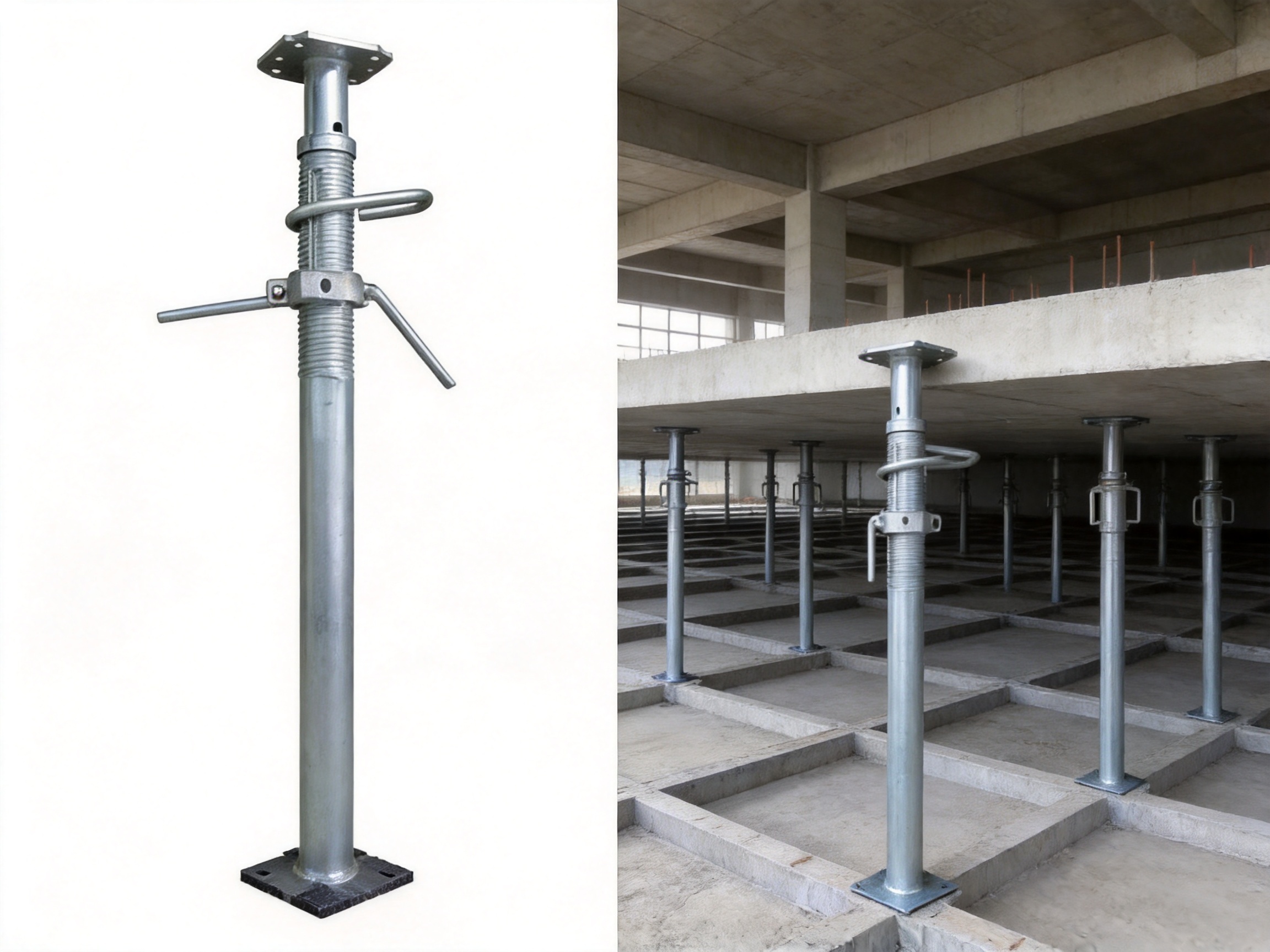
Applications of Steel Props
Formwork Support
Formwork support is one of the most common applications for steel props. During concrete placement, the formwork must resist the weight and pressure of fresh concrete, reinforcement, workers, equipment, vibration, and other temporary loads. Props positioned beneath beams, panels, or support members help transfer these loads to the lower structure or foundation.
For wall formwork, props may be used with braces and connecting hardware to help maintain panel position and alignment. For floor and beam formwork, they can provide vertical support at calculated spacing intervals. The required configuration depends on slab thickness, beam dimensions, concrete density, pouring rate, formwork design, and construction sequence.
A steel prop can help reduce formwork deflection and maintain the intended elevation during pouring. It should not, however, be used as a substitute for correctly designed primary beams, joists, walers, ties, or lateral bracing. The complete formwork arrangement must be checked for vertical and horizontal forces.
Floor and Roof Support
After floor or roof construction, temporary supports may be required until the concrete or structural assembly reaches the required strength. Steel props can support floor slabs, roof structures, beams, or areas carrying temporary construction loads. They are also useful when construction is performed in phases and an existing level must temporarily support new work.
Temporary support may help reduce settlement, cracking, and unwanted deformation. The support period must be determined by the project engineer based on material strength development, span, load conditions, weather, construction sequence, and the requirements for removing the temporary works. Props should not be removed simply because the surface appears hardened.
Scaffolding Auxiliary Support
Scaffolding systems are designed to provide access, working platforms, and temporary support. In high-load areas, a steel prop can serve as an auxiliary vertical support when incorporated into a compatible and engineered arrangement. It may be used to supplement disc-lock scaffolding or coupler-type scaffolding in locations exposed to concentrated loads or unusual operating conditions.
Examples include areas beneath heavy formwork, high-level working platforms, bridge repair zones, industrial maintenance areas, and locations where ordinary scaffold standards require additional support. Bracing, tie-in, base conditions, platform loading, and access requirements must all be considered before installation.
Temporary Structural Reinforcement
Building renovation and industrial maintenance often require temporary reinforcement. Sections of a building may need support while walls are removed, openings are created, equipment is replaced, or structural repairs are completed. A height-adjustable prop can be positioned beneath a beam, slab, roof member, or temporary frame to maintain support during the work sequence.
Temporary reinforcement is a high-responsibility application. The load carried by the existing structure must be assessed, and the prop arrangement must be designed to avoid transferring excessive force to a weak floor or damaged member. The prop is one part of a controlled method statement and should be monitored throughout the operation.
Advanced Manufacturing Capabilities
Product performance begins with manufacturing control. A steel prop may appear simple, but it contains multiple elements that must work together accurately. Material selection, cutting, forming, welding, machining, galvanizing, assembly, testing, and packaging all affect the final result.
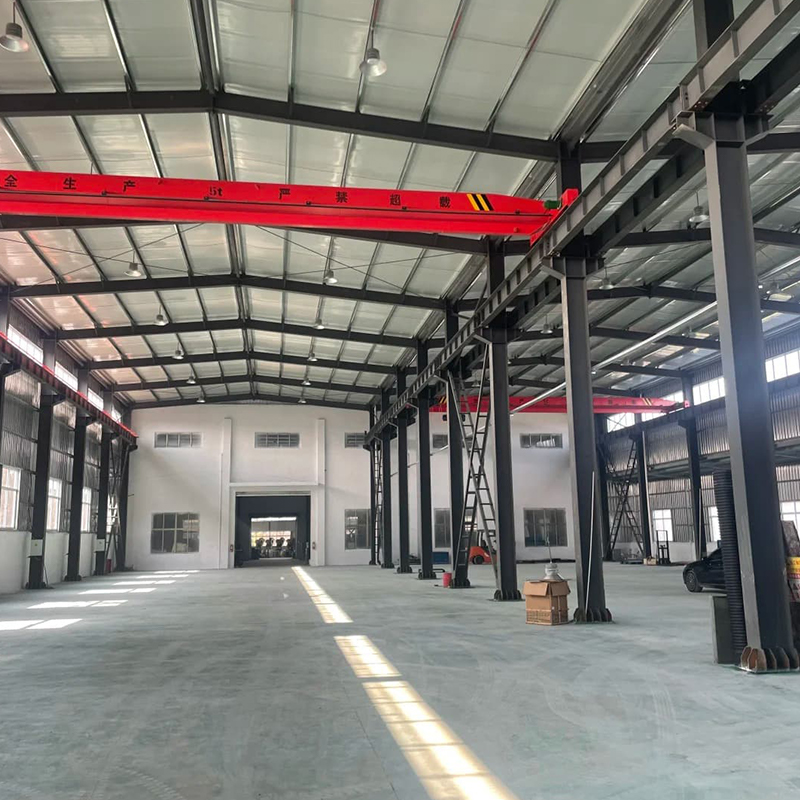
Nantong Hyson Road And Bridge Formwork Co., Ltd. operates as an OEM manufacturer specializing in custom steel formwork, ringlock scaffolding, heavy-duty steel structures, steel props, and fabricated metal components. Its production capabilities include advanced laser cutting equipment, standardized processing lines, automated manufacturing, and precision welding.
Laser Cutting and Steel Plate Processing
Laser cutting is used to produce accurately shaped steel plates, brackets, reinforcement ribs, base plates, top plates, and customized components. Compared with less controlled cutting methods, CNC laser processing can improve repeatability, reduce dimensional variation, and create clean edges suitable for subsequent bending and welding.
Accurate plate preparation supports better assembly. When plates and ribs fit correctly before welding, the risk of excessive gaps, misalignment, distortion, and inconsistent weld geometry can be reduced. Laser cutting also enables the production of non-standard parts for OEM projects without requiring extensive manual modification.
For customers requiring large steel structural components, integrated cutting and fabrication can simplify procurement. Instead of sourcing plate cutting, forming, welding, and finishing from separate suppliers, a customer can coordinate multiple stages through one experienced manufacturing partner.
Robotic and Certified Welding
Precision robotic welding is used for suitable repetitive assemblies. Robotic systems provide consistent travel paths and repeatable process parameters, which can support stable weld quality across production batches. This is particularly valuable for steel props and scaffolding components manufactured in large quantities.
Hyson also applies certified AWS and EN welding craftsmanship for demanding and customized projects. The combination of automated welding and qualified manual processes allows the factory to select an appropriate method for each component. Repetitive standard products can benefit from automation, while complex or non-standard assemblies may require controlled manual welding by qualified personnel.
Welding quality involves more than appearance. Joint preparation, material compatibility, heat input, weld size, penetration, distortion control, inspection, and post-weld finishing must all be managed. Proper welding practice helps ensure that the prop body and reinforcement elements act as an integrated load-bearing assembly.
Standardized Production Lines
Standardized production lines help organize material flow, work instructions, inspection points, and production records. This structure supports consistent manufacturing from raw material receipt through final packaging. It can also improve delivery planning for OEM orders that involve multiple product types, dimensions, or surface treatments.
Standardization does not mean that every project must use one fixed design. Instead, a controlled production system allows customized dimensions and configurations to be manufactured within defined process capabilities. Customers can provide drawings, specifications, load requirements, interface details, and packaging needs for technical review before production.
Integrated Quality Control
Full-process quality control is important for products used in temporary works. Hyson’s stated quality system is supported by ISO 9001 compliance, while its product and process experience includes BS1139 and EN74-related scaffolding requirements. The appropriate standard depends on the product, market, project specification, and contract requirements.
Quality control may include incoming material verification, cutting inspection, dimensional checks, welding inspection, load testing, galvanizing inspection, assembly testing, and final release review. A documented process makes it easier to identify nonconforming products and maintain consistent production performance.
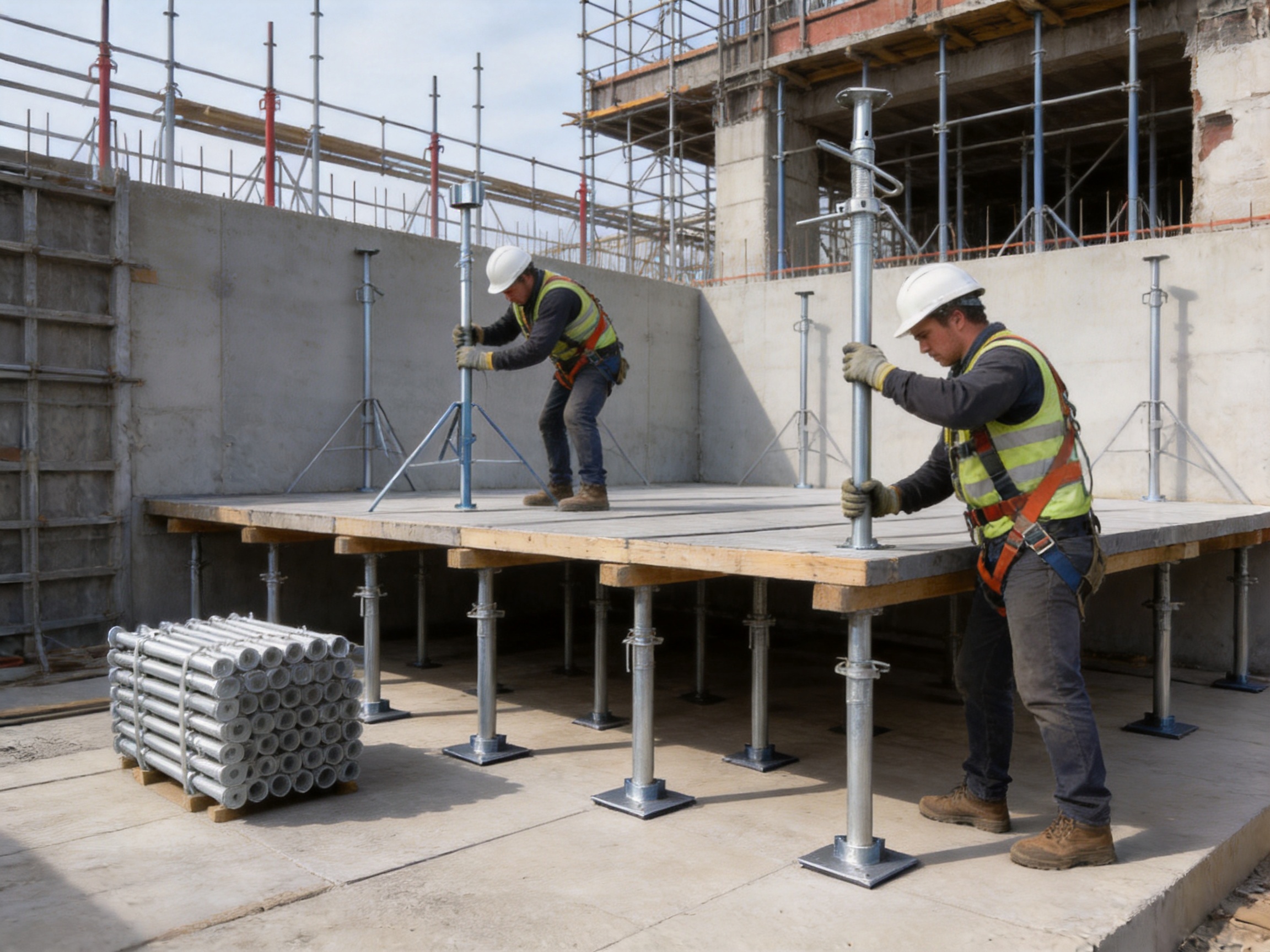
OEM and Custom Manufacturing Support
Different customers may require different prop lengths, adjustment ranges, tube diameters, plate sizes, handles, threads, coatings, markings, and packaging. An OEM manufacturer should be able to review these requirements and determine whether they can be produced safely and consistently.
Hyson provides customized OEM services for global customers and manufactures non-standard steel components for construction, mining, agriculture, transportation, and industrial applications. Its capabilities in laser cutting, bending, welding, and assembly support the production of ready-to-install steel components rather than unfinished raw parts.
A typical OEM project begins with technical information. This may include drawings, three-dimensional models, material grades, load requirements, tolerances, welding specifications, surface treatment requirements, inspection standards, quantity, delivery schedule, and packaging instructions. Where a customer has only a concept or sample, the manufacturer may need to clarify dimensions, application conditions, and safety factors before preparing a production proposal.
Technical Information for a Steel Prop Inquiry
For an accurate quotation, buyers should provide the required working height range, closed and extended lengths, target load capacity, adjustment accuracy, tube dimensions, plate dimensions, thread type, locking method, surface treatment, quantity, and applicable standards. Information about the intended use, such as slab formwork, wall formwork, scaffolding reinforcement, or temporary structural support, is also useful.
Customers should distinguish between ultimate load, test load, and recommended safe working load. They should also identify whether the load is centered or eccentric and whether the prop will be braced against lateral movement. These details influence the design and the appropriate testing method.
Large Steel Structural Component Production
Steel props are part of a wider heavy fabrication capability. A supplier experienced in large steel structural components can often support related products such as formwork panels, bridge formwork, tunnel trolley components, scaffolding assemblies, brackets, base plates, frames, platforms, and custom structural weldments.
This broader capability can be valuable for contractors and engineering companies that require a coordinated temporary works package. Related parts can be reviewed together for interface compatibility, manufacturing sequence, coating requirements, and delivery planning. It can also reduce the risk of dimensional conflicts between components manufactured by different suppliers.
Advantages Over Conventional Support Solutions
Steel props offer several practical advantages over improvised timber supports, fixed-length steel members, or light-duty adjustable components. Their height adjustment allows one product to cover multiple applications. Their steel construction provides a predictable load path when properly designed. Their reusable nature can support project efficiency and reduce material waste.
Compared with improvised supports, engineered steel props provide better consistency in dimensions, locking, contact surfaces, and inspection. Timber may be useful in certain temporary works, but its strength and condition can vary with moisture, defects, grain direction, damage, and storage. A manufactured steel prop offers more standardized characteristics and can be inspected using repeatable criteria.
Compared with fixed-length members, adjustable props reduce the need for cutting, packing, or site fabrication. This can save time and help maintain a more organized work area. It also allows a support system to be adjusted during installation without replacing the entire member.
Compared with light-duty adjustable bases or brackets, heavy-duty props are more appropriate when the main requirement is vertical load-bearing capacity. Bases and brackets remain important parts of a complete system, but their intended functions are different. Selecting a prop for the principal vertical support role can improve the relationship between product capability and actual site demand.
| Evaluation Factor | Steel Props | Improvised Timber Support | Light-Duty Adjustable Component |
|---|---|---|---|
| Height flexibility | Threaded or telescopic adjustment | Usually requires cutting or packing | Often designed for limited adjustment |
| Load consistency | Standardized steel construction and inspection | Can vary with material condition | Depends on product design and rating |
| Repeat use | Suitable for repeated project use with maintenance | May deteriorate or become damaged | Depends on duty and surface protection |
| Installation | Quick adjustment and positive locking | May require additional cutting and wedges | Usually simple but not necessarily heavy-duty |
| Corrosion protection | Hot-dip galvanized option | Not applicable to wood | Varies by manufacturer |
| Typical role | Primary or major vertical temporary support | Supplementary support where engineered and suitable | Leveling, connection, or fine adjustment |
Use in Major Infrastructure and Industrial Projects
Infrastructure projects place high demands on temporary works. Bridges, tunnels, power plants, transportation facilities, industrial buildings, and large commercial structures may require formwork and support systems that can withstand substantial loads and repeated relocation.
Hyson has supplied products and solutions associated with major projects including the Sutong Yangtze River Bridge, Taizhou Bridge, and Sudan Thermal Power Plant. Experience in these types of projects helps a manufacturer understand the importance of delivery coordination, dimensional control, documentation, and reliability under demanding site conditions.
Large projects also require communication between the manufacturer, contractor, engineer, and procurement team. Product drawings, inspection documents, packing lists, installation information, and delivery schedules must be coordinated carefully. A factory that can combine standard products with customized fabrication is better positioned to respond to complex project requirements.
Inspection, Storage, and Maintenance
Proper maintenance helps preserve the performance of steel props throughout their service life. After use, concrete, soil, and other contaminants should be removed from the prop. Threads should be cleaned and inspected for damage. Galvanized surfaces should be checked for deep scratches, exposed steel, or heavy corrosion.
Props should be stored in a dry, organized location where they are protected from unnecessary impact. They should not be thrown into piles from a height or stored beneath heavy materials that can bend the tube or plate. Threaded components should be protected from contamination, and different lengths or models should be clearly separated.
Before each use, workers should examine the main tube, adjustment section, welds, end plates, handle, locking device, and anti-slip pad. The prop should be straight and free from cracks, severe dents, uncontrolled corrosion, or permanent deformation. If the locking mechanism does not function correctly, the prop should be removed from service.
Common Conditions Requiring Rejection
A prop should be rejected or professionally assessed if it has a visibly bent shaft, cracked weld, damaged thread, missing locking component, severely deformed plate, deep gouging, extensive corrosion, or evidence of overload. Painting over damage does not restore structural capacity. Repairs should only be carried out through an approved procedure by qualified personnel.
Inspection records are especially useful for rental companies and contractors operating large inventories. A simple tracking system can record the prop identification number, date of inspection, condition, repair history, and project assignment. This supports safer reuse and helps identify recurring handling or storage problems.
How to Select the Right Steel Prop
Selection should begin with the design load and working height. The prop must be suitable for the maximum vertical load at the actual extension length, not merely its shortest or ideal configuration. Buyers should ask for the rated capacity, test information, dimensional drawings, material details, and recommended operating limits.
The next consideration is the support environment. If the prop will stand on soil, an existing slab, a bridge deck, or a temporary platform, the bearing capacity and load distribution must be evaluated. A strong prop cannot compensate for weak ground or an undersized base plate.
Environmental conditions also influence selection. Outdoor, underground, coastal, industrial, and chemically exposed locations may require stronger corrosion protection, careful cleaning, or a special coating specification. Hot-dip galvanizing is a practical option for many construction environments, but the customer should confirm whether additional protection is required.
Compatibility with the rest of the support system is equally important. The top plate must fit the supported beam or formwork arrangement, and the base must interface correctly with the lower support. If the prop is being combined with scaffolding, the connection and bracing method should be reviewed before purchase.
| Selection Question | Why It Matters |
|---|---|
| What is the design vertical load? | Determines the required prop capacity and quantity. |
| What is the actual working height? | Extension length affects stability and load behavior. |
| Is the load centered? | Eccentric loading can reduce capacity and increase bending risk. |
| What is the bearing condition? | Weak or uneven support can cause settlement or instability. |
| What surface treatment is required? | Determines corrosion resistance and maintenance needs. |
| Which standards apply? | Ensures the product meets project and market requirements. |
| How often will the product be reused? | Influences coating, inspection, storage, and lifecycle value. |
| Are custom dimensions needed? | Allows the manufacturer to assess OEM feasibility before production. |
Q&A About Steel Props
What is the main purpose of a steel prop?
The main purpose is to provide adjustable vertical support for temporary construction loads. It can support formwork, floor slabs, roofs, walls, scaffolding arrangements, and temporary structural reinforcement when selected and installed according to an approved design.
Can a steel prop replace an adjustable base?
No. The two products serve different functions. An adjustable base generally levels or positions the lower part of a support system, while a steel prop is intended to provide a substantial vertical load-bearing path. They may be used together, but one should not automatically replace the other.
What load capacity is available?
The product information indicates a vertical load-bearing range of approximately 100 kN to 200 kN, depending on the model and configuration. The applicable safe working load must be confirmed for the actual prop length, extension, loading condition, bracing arrangement, and project design.
How much height adjustment is available?
The stated adjustment range is approximately 100 mm to 500 mm, with an adjustment accuracy of about plus or minus 1 mm. The exact adjustment range depends on the selected specification and should be confirmed before ordering.
Are steel props suitable for outdoor construction?
Yes, galvanized steel props are suitable for many outdoor construction environments. The described product uses hot-dip galvanizing with a coating thickness of at least approximately 80 micrometers. Regular inspection is still necessary, particularly where the coating has been damaged or the product is exposed to aggressive chemicals or marine conditions.
How many times can a steel prop be reused?
The product is designed for a reuse cycle of at least approximately 400 uses under appropriate conditions. Actual service life depends on load history, handling, storage, cleaning, inspection, corrosion, and maintenance. Any prop showing structural damage should be removed from service regardless of its number of previous uses.
Can one worker install the prop?
The quick-locking design and non-slip handle are intended to allow installation and adjustment by one worker in suitable conditions. The site must still provide safe access, adequate lifting practices, and supervision. Heavy or unusually long props may require two-person handling or mechanical assistance.
Can steel props be used with scaffolding?
They can be used as auxiliary load-bearing components for disc-lock or coupler-type scaffolding when the arrangement is properly designed. Compatibility, bracing, tie-ins, base support, platform loading, and connection details must be checked before use.
Does a galvanized finish eliminate maintenance?
No. Galvanizing improves corrosion resistance but does not eliminate inspection and maintenance. Concrete, mud, impact, abrasion, and chemical exposure can damage the coating or affect threads. Props should be cleaned, inspected, and stored correctly after use.
What information should be provided for a customized order?
Customers should provide the required height range, load capacity, tube and plate dimensions, adjustment mechanism, locking method, material grade, surface treatment, applicable standards, quantity, packaging requirements, and delivery schedule. Drawings, samples, photographs, and details of the intended application can also support technical review.
Why Manufacturing Capability Matters
A steel prop is a safety-related product, so manufacturing capability should be evaluated alongside price. A low-cost component may create higher lifecycle costs if it has inconsistent dimensions, poor welding, weak threads, inadequate coating, or limited service life. Reliable production requires control over both the raw material and every processing stage.
Hyson’s combination of steel plate processing, laser cutting, bending, robotic welding, certified welding methods, galvanizing, assembly, and inspection provides an integrated manufacturing foundation. This reduces dependence on unrelated subcontractors and allows the factory to coordinate product quality across multiple operations.
The company’s experience with custom formwork, ringlock scaffolding, steel structures, and major infrastructure projects also supports a practical understanding of construction-site requirements. Products are developed not only as isolated steel parts, but as components that must be transported, installed, adjusted, inspected, reused, and integrated into larger temporary works systems.
Its stated support from 12 utility patents and compliance with ISO 9001, BS1139, and EN74-related requirements further demonstrate an emphasis on documented production and international project expectations. Buyers should nevertheless confirm the exact certification, test report, and standard applicable to the specific steel prop model ordered.
Conclusion
Steel props provide a practical and dependable solution for temporary vertical support in building construction, infrastructure, industrial maintenance, renovation, and scaffolding applications. Their principal advantages include heavy-duty load-bearing performance, broad height adjustment, high-strength steel construction, reinforced welded assemblies, hot-dip galvanized corrosion protection, quick installation, and suitability for repeated use.
Compared with adjustable bases and adjustable brackets, steel props are intended to serve a more substantial vertical support function. They can be combined with those components to form a complete support system, but their role should remain clearly defined. Safe performance depends on correct product selection, adequate bearing conditions, proper locking, suitable bracing, compliance with the temporary works design, and regular inspection.
The manufacturing process is a major part of product value. Q235 or Q345 steel, CNC laser cutting, standardized production, precision robotic welding, certified welding practices, hot-dip galvanizing, load testing, and full-process quality control all contribute to a more consistent and durable support component.
For contractors, rental companies, infrastructure developers, and OEM buyers, the right steel prop is more than an adjustable steel tube. It is a reusable engineered component that must perform consistently across demanding construction conditions. By selecting a manufacturer with integrated heavy metal fabrication capabilities and experience in large steel structural components, customers can obtain support products that are easier to install, simpler to inspect, and better suited to long-term project requirements.
References
1. ISO 9001, Quality Management Systems: Requirements.
2. BS 1139, Metal Scaffolding: Applicable Product and Performance Requirements.
3. EN 74, Couplers, Spigot Pins and Baseplates for Use in Falsework and Scaffolds.
4. AWS Structural Welding Standards and Recommended Practices.
5. General principles of temporary works design for formwork, falsework, scaffolding, and structural support.
6. Technical information supplied for adjustable steel props, including material grades, load capacity, adjustment range, galvanizing thickness, and reuse performance.
7. Manufacturer information concerning steel formwork, ringlock scaffolding, steel structures, laser cutting, robotic welding, OEM fabrication, and infrastructure project experience.
Product: Steel Props



- Location
- Group 3, Fangzhuang Village, Rucheng Subdistrict, Rugao City, Nantong, Jiangsu, China
- Follow us
- Phone
- +86-13646196162
- info@hysonindustry.com
