 +86-13646196162
 info@hysonindustry.com




 русский
  عربى
عربى 


High-Precision Dolos Formwork for Efficient Coastal Protection Block Production
 2026.08.24
Content
- 1 1. The Role of Dolos Blocks in Coastal and Marine Engineering
- 2 2. Product Overview
- 3 3. Precision Geometry and Interlocking Performance
- 4 4. Heavy-Duty Q235B Steel Construction
- 5 5. Advanced Manufacturing Process
- 6 6. Quick-Release Locking System
- 7 7. Easy Demolding and Concrete Surface Quality
- 8 8. Comparison with Conventional and Low-Cost Alternatives
- 9 9. Production Efficiency and Total Cost of Ownership
- 10 10. Applications in Marine Engineering
- 11 11. Manufacturing Strengths of the Supplier
- 12 12. Quality Control and Standards
- 13 13. Installation and Operating Considerations
- 14 14. Maintenance and Service Life
- 15 15. Customization and OEM Support
- 16 16. Selecting the Right Dolos Mold Supplier
- 17 17. Project Planning and Recommended Workflow
- 18 18. Environmental and Operational Benefits
- 19 19. Frequently Asked Questions
- 19.1 Q1: What is the Dolos Formwork/Mold used for?
- 19.2 Q2: Why is Dolos mold accuracy important?
- 19.3 Q3: What material is used to manufacture the mold?
- 19.4 Q4: How many times can the mold be reused?
- 19.5 Q5: Does the mold require manual finishing of the concrete blocks?
- 19.6 Q6: How does the quick-release locking system improve production?
- 19.7 Q7: Can the mold be customized?
- 19.8 Q8: Is the mold suitable for rental companies?
- 19.9 Q9: What quality systems support production?
- 19.10 Q10: What information should be supplied for a quotation?
- 19.11 Q11: Can the supplier provide other steel products?
- 19.12 Q12: What should be checked before each casting cycle?
- 20 20. Conclusion
- 21 References
- 22 Product: Dolos Formwork/Mold
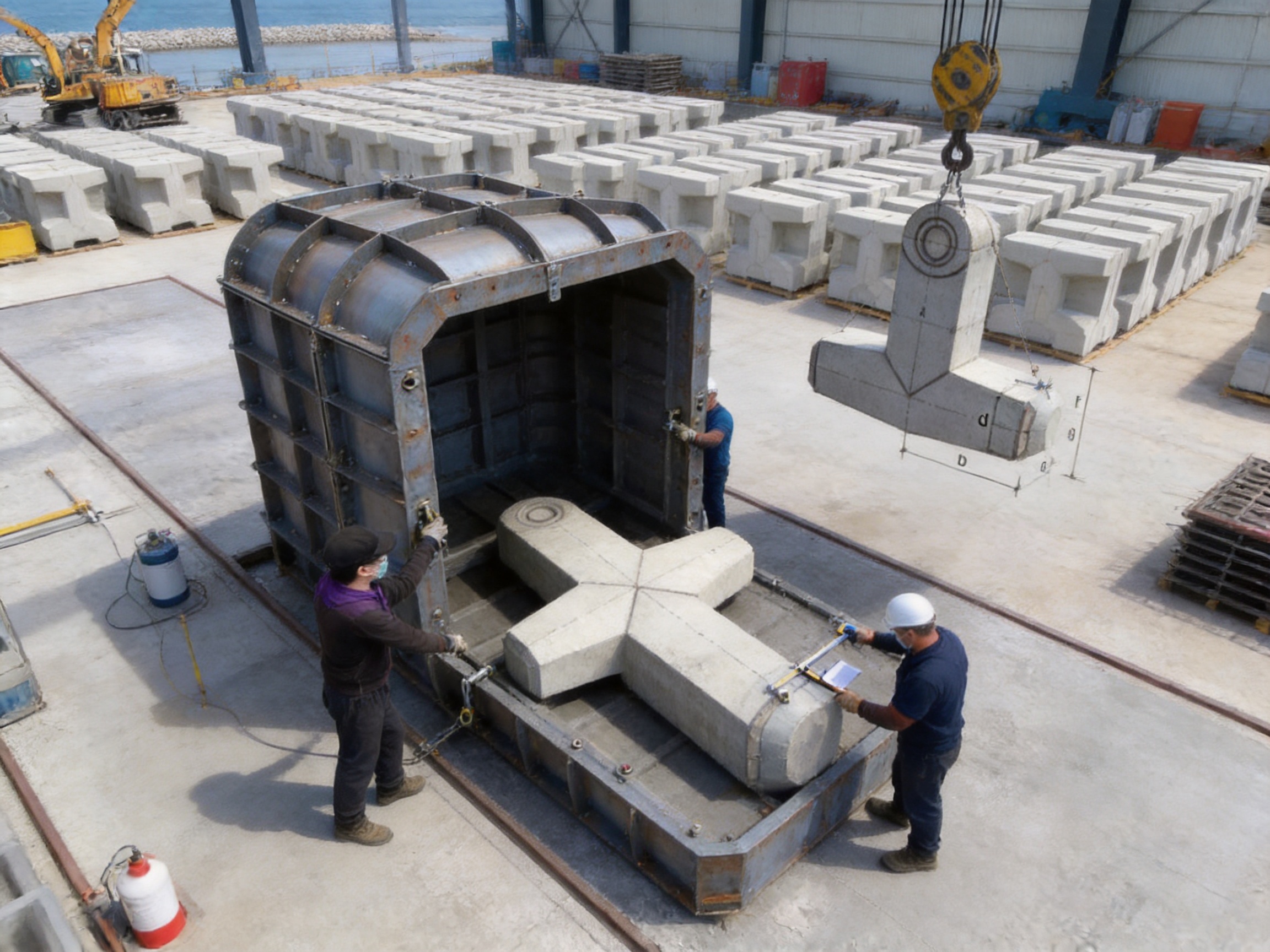
Coastal infrastructure is exposed to constant hydraulic forces. Waves, currents, tides, storms, and changing seabed conditions can gradually weaken shorelines, port facilities, reclaimed land, and artificial islands. For this reason, marine engineers use specially shaped concrete armor units to dissipate wave energy and reduce erosion. Among the most technically demanding armor units is the Dolos block, a three-dimensional concrete structure with intersecting legs, curved transitions, and carefully controlled dimensions.
The performance of a Dolos block depends not only on its concrete mix and installation method, but also on the precision of the formwork used during production. Even small dimensional errors can affect the way blocks interlock, create uneven load distribution, increase installation difficulty, and reduce the stability of a breakwater. The Dolos Formwork/Mold is engineered specifically to address these challenges. It is a heavy-duty prefabricated steel mold designed for repeated production of accurately shaped concrete wave-damping blocks.
Manufactured by Nantong Hyson Road And Bridge Formwork Co., Ltd., the mold combines three-dimensional design, CNC steel plate processing, reinforced welding, controlled assembly, and practical demolding features. Its purpose is to provide precast concrete plants, marine contractors, rental companies, and infrastructure project owners with a durable and efficient solution for large-scale coastal protection work.
Unlike basic site-fabricated molds, this product is developed around the full production cycle. Its geometry is carefully modeled, its steel components are cut and formed with controlled accuracy, its load-bearing areas are reinforced, and its locking system is designed for repeated assembly and release. This integrated approach helps improve concrete block consistency, reduce labor requirements, shorten production cycles, and support long-term reuse.
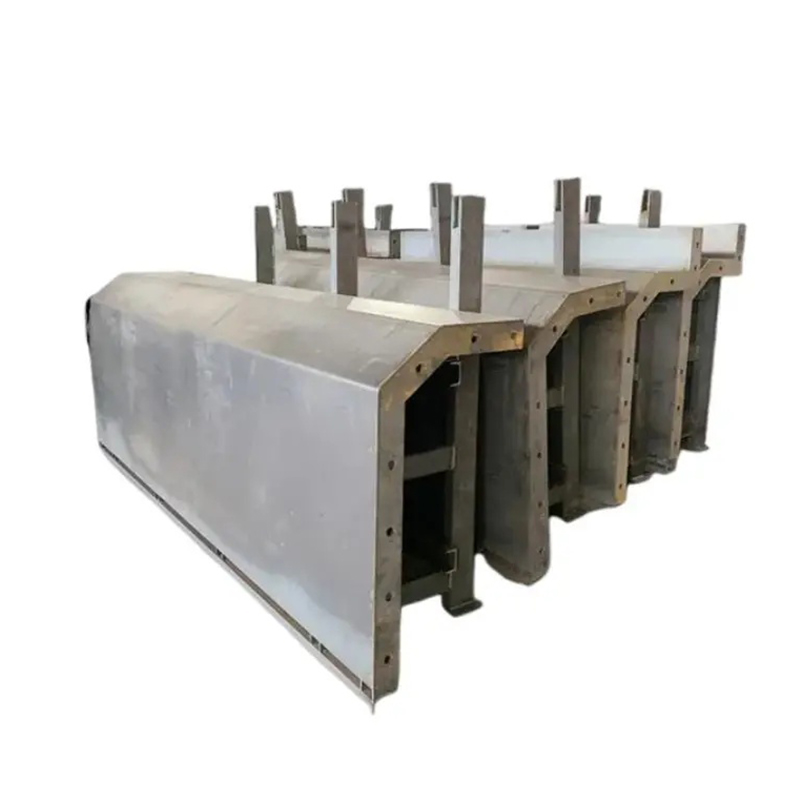
Dolos Formwork/Mold
1. The Role of Dolos Blocks in Coastal and Marine Engineering
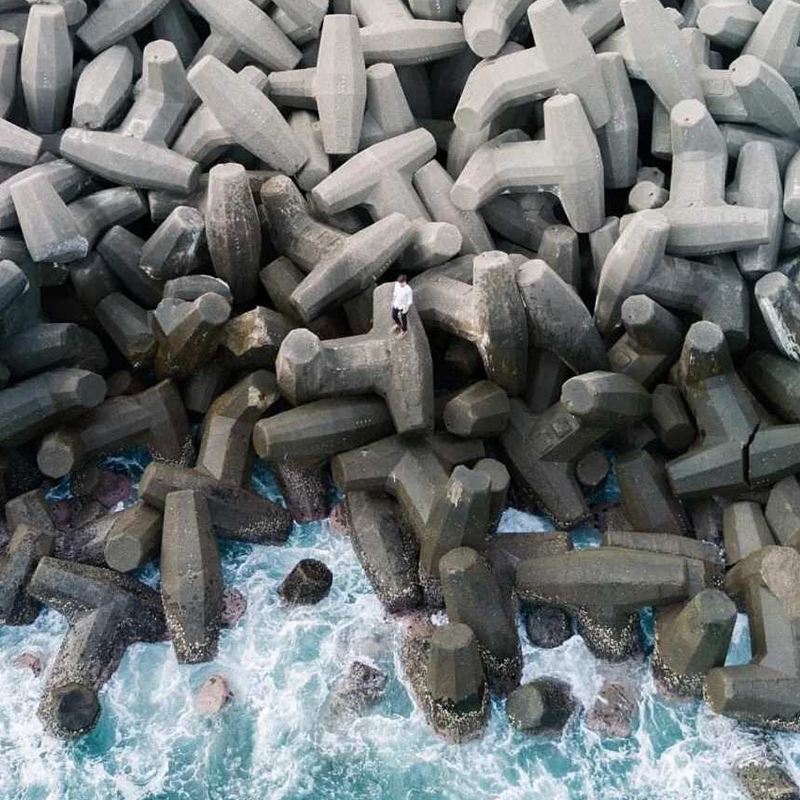
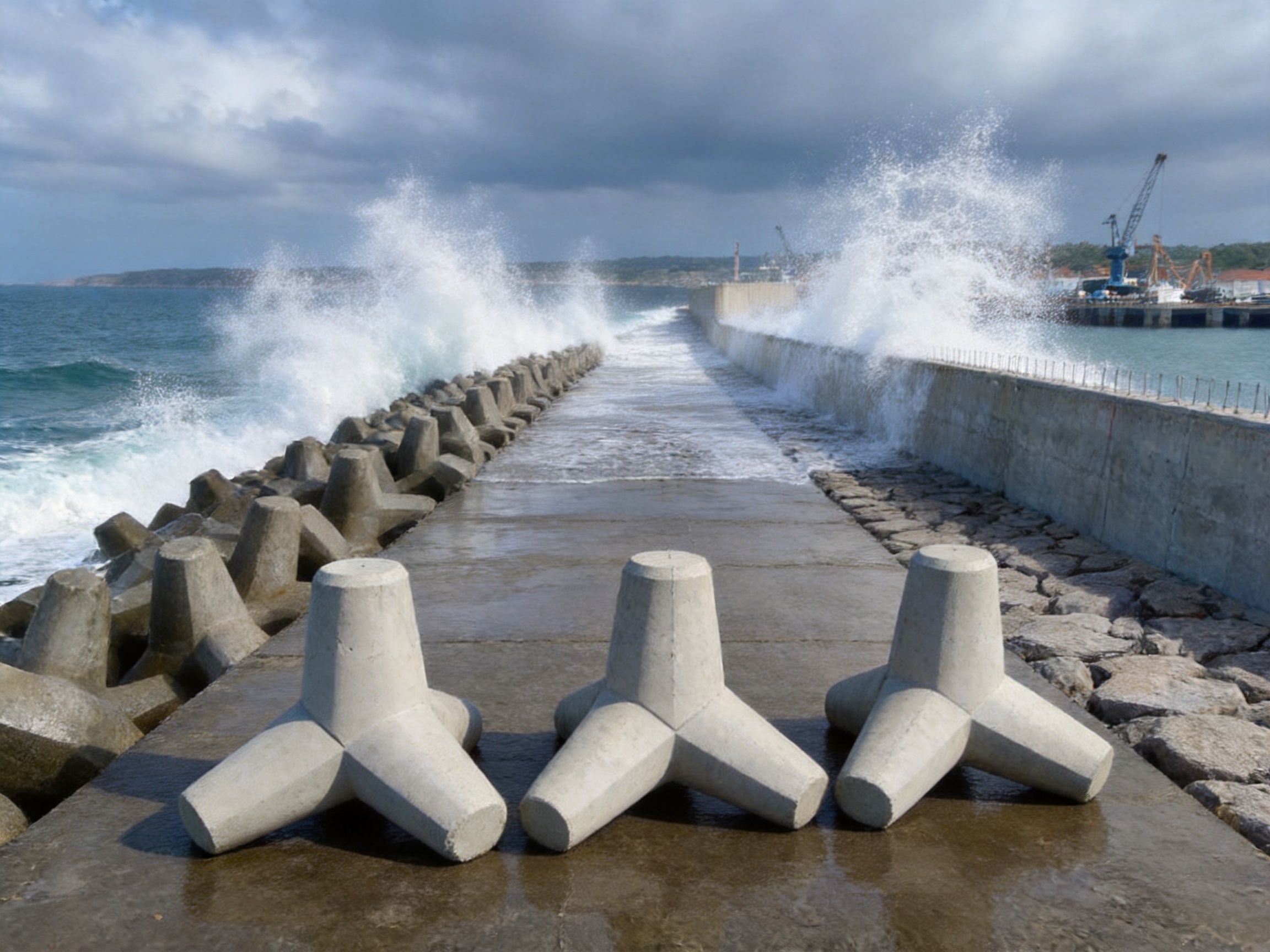
A breakwater is designed to reduce wave energy before waves reach a protected harbor, seawall, shoreline, or reclaimed area. Traditional barriers may rely on rock armor, concrete caissons, or other heavy structural systems. In many projects, specially shaped concrete armor units are placed on the outer slope of a breakwater. Their irregular geometry creates voids and interlocking contact points, allowing the armor layer to absorb and dissipate wave energy more effectively than a simple smooth surface.
Dolos blocks are widely recognized for their complex, interlocking configuration. Their long legs and angled geometry create a three-dimensional armor layer. When correctly manufactured and installed, the units can form a stable arrangement that resists displacement under wave action. However, this performance relies on consistent dimensions. If one leg is too short, one angle is inaccurate, or the central connection is distorted, the block may not fit properly within the armor layer.
Concrete armor units are also subject to considerable handling forces. After demolding, they may be lifted, stored, transported, and placed by cranes or other heavy equipment. A distorted shape may lead to concentrated stresses and local cracking. In a large coastal project, even a small percentage of defective units can increase material waste, handling costs, and construction delays.
The mold is therefore a critical production tool rather than a simple container. It must accurately reproduce the design profile, withstand the pressure of fresh concrete, tolerate repeated handling, support efficient demolding, and remain stable through many production cycles. These requirements are especially important when a project involves thousands of units and a tight marine construction schedule.
2. Product Overview
The Dolos Formwork/Mold is a prefabricated steel mold for manufacturing Dolos-shaped concrete breakwater blocks. It is produced from Q235B carbon steel and includes structural ribs, precision-fabricated panels, standardized connecting hardware, and a quick-release locking system. The design is intended for repeated use in precast concrete facilities and large-scale marine engineering projects.
Its configuration can be adapted to the required Dolos block dimensions, project specifications, lifting arrangements, concrete mix characteristics, and production workflow. The mold can be supplied as a complete assembly or as a coordinated set of accurately manufactured sections for transportation and on-site installation.
The product is suitable for contractors that require reliable dimensional reproduction and fast mold turnover. It is also appropriate for formwork rental companies because its reinforced construction and replaceable hardware support repeated use over an extended service life.
Key product characteristics include:
• Specialized geometry for Dolos concrete armor units.
• Q235B carbon steel construction.
• Reinforced ribs for improved resistance to concrete pressure and handling loads.
• Three-dimensional modeling for complex curved and intersecting surfaces.
• CNC cutting and controlled fabrication of steel components.
• Polished internal surfaces to support clean demolding and improved concrete finish.
• Segmented construction for practical assembly, storage, and maintenance.
• Standardized bolts and pins for repeatable positioning.
• Patented quick-release locking system for faster opening and closing.
• Production capability aligned with ISO 9001:2015, CCCC, and CRCC project expectations.
3. Precision Geometry and Interlocking Performance
The principal advantage of a purpose-built Dolos mold is the ability to reproduce the exact geometry required by the engineering design. The shape of a Dolos unit is not decorative. Each transition, leg, angle, and curved surface contributes to the manner in which the unit contacts neighboring blocks and transfers wave-induced forces.
Hyson uses three-dimensional modeling to develop the mold geometry before fabrication. This process enables engineers to review the complete form digitally, examine the relationship between segmented mold components, and identify potential interference points during opening and closing. It also supports the preparation of accurate cutting files for CNC equipment.
For complex products, conventional manual layout and uncontrolled cutting may introduce cumulative errors. A minor deviation in one part can become more significant when multiple panels are assembled. Digital modeling and CNC processing reduce this risk by providing a consistent reference from design through fabrication.
Accurate geometry provides several practical benefits. Concrete units are more uniform from one production cycle to the next. The finished blocks can be arranged more predictably on the breakwater slope. Interlocking behavior is more consistent, and the possibility of excessive gaps or unstable contact points is reduced. Consistent shapes also make inspection easier because the production team can compare units against a defined standard.
The mold is designed to support the complex contours of Dolos blocks without relying on excessive manual correction. This is an important distinction between engineered heavy steel formwork and low-cost molds made through improvised fabrication. A cheaper mold may appear acceptable during initial production, but dimensional variation, difficult demolding, and early deformation can increase the total project cost.
Why Precision Matters in Armor Unit Production
Precision affects the entire value chain. At the precast plant, it helps reduce rejected units and finishing work. During storage, uniform units are easier to stack and handle. During transport, predictable dimensions simplify lifting and loading. At the construction site, consistent geometry supports more orderly placement and reduces the need for workers to search for suitable orientations.
Precision also helps protect the design assumptions used by marine engineers. Breakwater armor layers are often designed using hydraulic model testing, physical testing, numerical analysis, and established engineering practice. These methods assume that the manufactured units have dimensions reasonably close to the design geometry. A mold that consistently produces distorted blocks can weaken the relationship between design and construction.
4. Heavy-Duty Q235B Steel Construction
The mold is fabricated from Q235B carbon steel, a widely used structural steel grade suitable for welded construction, fabrication, and heavy-duty industrial applications. Its availability, workability, and balanced mechanical properties make it practical for large formwork assemblies that must withstand repeated production and handling.
Fresh concrete exerts pressure on the mold walls, particularly when the mix is placed rapidly or compacted through vibration. The mold must resist local bulging, joint movement, and deformation at corners and transitions. In addition, the assembly is exposed to crane handling, lifting impacts, storage movement, cleaning, and repeated opening and closing.
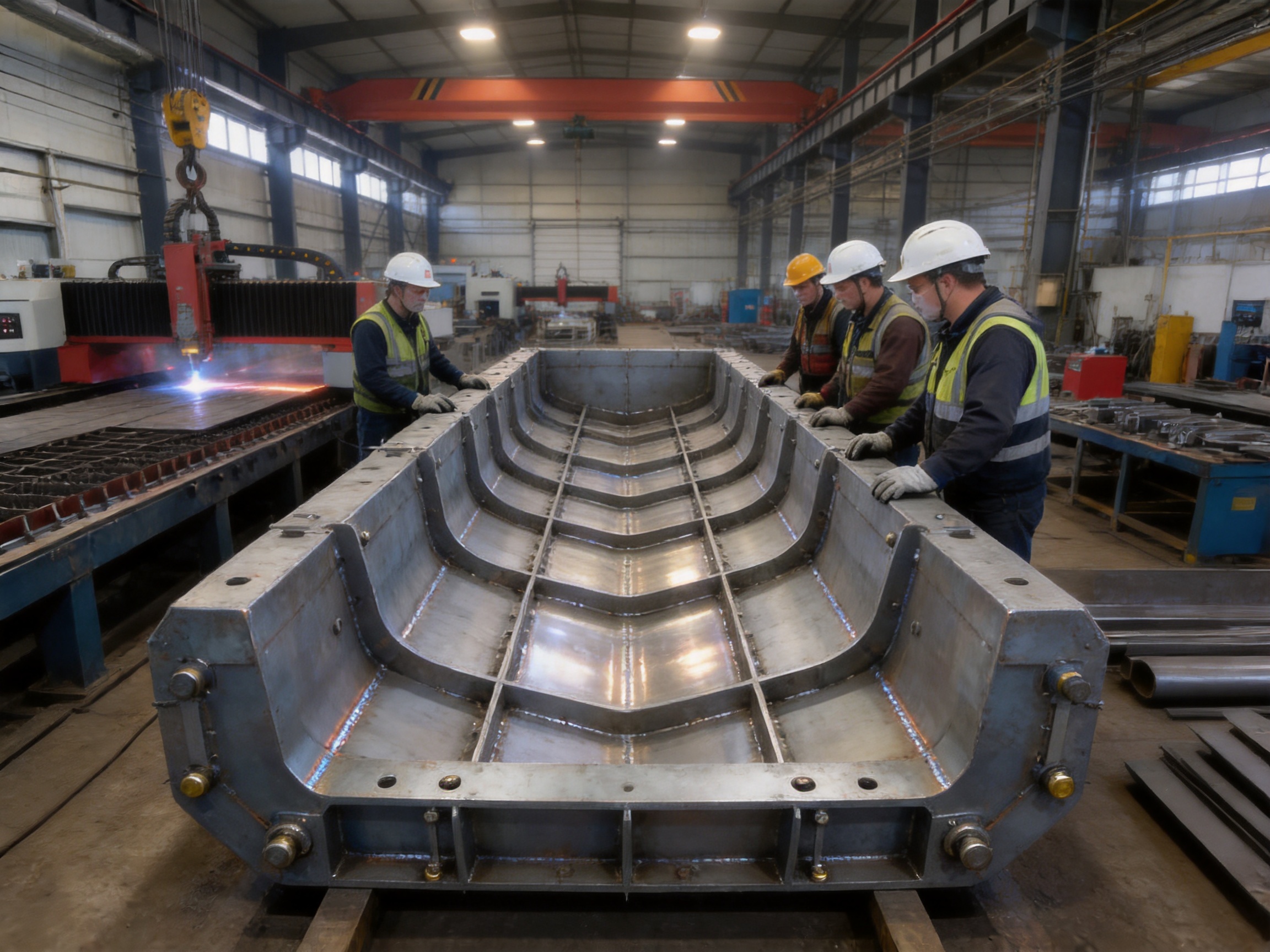
To address these conditions, the mold incorporates strong reinforcing ribs. These ribs help distribute loads across the panels and reduce unsupported spans. They also improve the rigidity of the assembly during concrete placement. Reinforcement is particularly important around complex intersecting sections, where the geometry may create concentrated forces or require segmented construction.
The steel structure is produced by professional welders using controlled fabrication procedures. Welding quality influences not only strength but also dimensional stability. Excessive or poorly sequenced welding can cause distortion, while incomplete or inconsistent welds may reduce structural reliability. Controlled welding practice helps maintain the intended shape and supports a longer service life.
For customers working on long-duration infrastructure projects, durability is a major consideration. A robust mold can be used for multiple production campaigns instead of being discarded after a short project. With proper cleaning, inspection, lubrication, storage, and repair, the Dolos mold is designed for a reuse rate of 500 cycles or more. Actual service life will depend on concrete mix, handling methods, maintenance quality, and operating conditions, but the reinforced design provides a strong foundation for repeated use.
5. Advanced Manufacturing Process
The production of a high-quality Dolos mold begins long before steel cutting. The manufacturing process integrates engineering review, digital design, material preparation, precision cutting, forming, welding, surface treatment, assembly, and inspection. Each stage contributes to the final performance of the mold.
5.1 Engineering Review and 3D Modeling
The first stage is a review of the required block geometry and project conditions. Engineers examine the dimensions, tolerances, section breakdown, opening direction, handling requirements, and expected production process. If the mold is intended for use with a particular concrete plant or lifting system, those operational requirements can be considered during the design stage.
A three-dimensional model is then developed or refined. The model defines the internal cavity and the external structural arrangement. It also helps determine where the mold should be divided into sections, where locking points should be positioned, and how the sections can be removed without damaging the newly cast concrete unit.
Digital design provides a common technical reference for engineering, production, inspection, and customer approval. It reduces misunderstandings that may occur when fabrication relies solely on two-dimensional sketches or verbal instructions.
5.2 CNC Steel Plate Cutting
After design approval, cutting data is prepared for CNC processing. CNC equipment produces repeatable profiles and helps maintain consistency among matching panels. Accurate cutting is especially valuable for curved transitions and connection areas, where manual trimming can cause irregular gaps or misalignment.
The use of advanced laser or CNC cutting equipment also supports efficient material utilization. Properly arranged cutting layouts can reduce unnecessary waste and help maintain a consistent production sequence. Clean cut edges simplify subsequent fitting and welding operations.
5.3 Forming and Component Preparation
Some mold sections may require bending, rolling, edge preparation, or additional machining. These operations are performed according to the three-dimensional design. The objective is to create components that fit together accurately without excessive force or uncontrolled adjustment during assembly.
Component preparation includes the fabrication of panels, stiffening ribs, flanges, brackets, hinge or support areas, locking components, and replaceable hardware. Each part must be identified and organized so that assembly remains efficient and repeatable.
5.4 Controlled Welding
Welding joins the steel panels and reinforcement into a rigid structural assembly. Professional welders apply appropriate welding procedures to achieve strong joints while controlling heat distortion. Weld sequencing is important because large fabricated structures can move if heat is introduced unevenly.
Welded areas are examined for visible defects, dimensional variation, incomplete fusion indicators, and other quality concerns. Depending on project requirements, inspection may include dimensional checks and additional non-destructive examination for critical joints.
5.5 Surface Finishing
The internal mold surface is polished or finished to reduce concrete adhesion and support a smooth appearance on the finished block. A well-prepared internal surface also makes cleaning easier after demolding. The external surface and structural areas can be treated according to the customer’s storage environment, handling conditions, and corrosion protection requirements.
5.6 Trial Assembly and Final Inspection
Before dispatch, the mold sections are assembled and checked. This process verifies that the bolts, pins, locking system, contact surfaces, and segmented panels operate as intended. It also allows the manufacturer to identify interference or alignment issues before the mold reaches the customer’s site.
Inspection records may include material documentation, dimensional verification, welding inspection, surface condition checks, hardware confirmation, and assembly photographs. This documented approach supports traceability and provides customers with greater confidence in the delivered product.
6. Quick-Release Locking System
Production efficiency is strongly affected by the time required to close, secure, open, and clean a mold. A mold that is geometrically accurate but slow to operate can still limit the output of a precast plant. The Dolos mold therefore includes a patented quick-release locking system intended to simplify routine production operations.
The system works together with standardized bolts and pins. During closing, the mold sections can be positioned and secured with repeatable hardware. During opening, the operator can release the locking points more quickly than with a fully improvised bolted assembly. This reduces the time spent on repetitive fastening and loosening operations.
A faster release process can improve daily mold turnover. More cycles per mold may help increase plant capacity without requiring a proportional increase in floor space or mold inventory. It can also reduce the amount of time workers spend in awkward positions around heavy steel components.
Quick-release features must be designed carefully. They need to remain secure during concrete placement and vibration while still being practical for operators. The locking arrangement must also tolerate repeated use, which is why replaceable pins, standardized bolts, and maintainable components are important.
Compared with non-standard molds assembled with miscellaneous hardware, a coordinated locking system offers better repeatability. Operators can follow a defined procedure instead of relying on individual experience to determine whether the mold is correctly closed. This supports more consistent production across different shifts and project locations.
7. Easy Demolding and Concrete Surface Quality
Demolding is one of the most sensitive stages in the production of complex concrete units. If the mold does not open smoothly, the concrete block may be damaged, the mold may be distorted, or workers may spend excessive time using wedges and impact tools. These problems can reduce output and shorten mold life.
The Dolos mold uses a segmented design that allows sections to be removed in a controlled sequence. The opening arrangement is developed around the geometry of the block so that the concrete unit can be released without unnecessary interference. This is especially important around the intersecting legs and central regions of a Dolos unit.
A polished internal surface helps prevent concrete from bonding strongly to the steel. When combined with suitable release agents and correct concrete curing practice, the surface finish can produce a smoother, less porous appearance. In many cases, this reduces the need for secondary repairs such as patching, grinding, or filling surface defects.
Reduced repair work provides both direct and indirect savings. Direct savings come from lower labor and material consumption. Indirect savings include fewer rejected units, less interruption to production, and improved appearance when the blocks are visible above water or near public infrastructure.
The mold does not replace proper concrete technology. Concrete placement, vibration, water-cement ratio, aggregate grading, reinforcement requirements, curing conditions, and release-agent application remain important. However, a well-designed mold gives the production team a reliable foundation for controlling these variables.
8. Comparison with Conventional and Low-Cost Alternatives
Customers evaluating formwork often compare the purchase price of several options. A basic steel mold may initially appear attractive because it requires less investment. However, a meaningful comparison should consider production speed, dimensional consistency, maintenance, service life, concrete repair, labor, and total cost per finished unit.
Low-cost molds are sometimes fabricated from thin steel plate with limited reinforcement. They may be suitable for very small quantities or temporary work, but they can deform when exposed to repeated concrete pressure. Their joints may become difficult to align, and their surfaces may deteriorate quickly under cleaning and handling.
Another alternative is a manually fabricated mold assembled without a complete digital model. Such a mold may produce acceptable units at the beginning, but repeated adjustment can create variation between production batches. The lack of standardized replacement parts may also make maintenance more difficult.
Basic molds may also use numerous loose bolts without a coordinated quick-release arrangement. This increases assembly and demolding time. It can lead to missing hardware, uneven tightening, or inconsistent alignment. Over a large production run, these small delays may become a substantial operating cost.
The Dolos Formwork/Mold is differentiated by its engineering-led design and full manufacturing process. Its advantages over less-developed alternatives include:
| Evaluation Factor | Basic or Improvised Mold | Dolos Formwork/Mold |
|---|---|---|
| Geometry development | May rely on manual layout or limited drawings | Three-dimensional modeling for complex geometry |
| Steel processing | Manual cutting may create variation | CNC and precision cutting for repeatable components |
| Structural support | Limited ribs or thin unsupported panels | Reinforced Q235B steel construction |
| Assembly | Non-standard hardware and extensive adjustment | Standardized bolts and pins |
| Demolding | May require forceful manual removal | Segmented configuration and quick-release locking |
| Concrete finish | Greater risk of adhesion and surface defects | Finished internal surfaces support cleaner release |
| Maintenance | Replacement parts may be difficult to match | Replaceable standardized components |
| Repeated use | Service life can be limited by deformation | Designed for high-turnover production and reuse |
| Project suitability | Short-term or low-volume applications | Marine engineering and large-scale precast production |
The comparison does not mean that every project requires the same mold configuration. A small temporary project may have different priorities from a national coastal protection program. The key point is that heavy-duty, engineered formwork is generally more economical when production volume, quality requirements, and schedule pressure are high.
9. Production Efficiency and Total Cost of Ownership
The economic value of the mold is linked to its total cost of ownership rather than only its purchase price. A durable mold that produces more units per day and remains serviceable for many cycles can reduce the average tooling cost of each concrete block.
Several factors contribute to this calculation. The first is mold turnover. Faster assembly and demolding allow the same mold to support more cycles within a given period. The second is product yield. Accurate geometry and effective release help reduce defective or damaged units. The third is maintenance. Replaceable hardware and robust reinforcement can reduce the frequency and severity of repairs.
Labor is another important factor. Large Dolos molds require coordinated handling, and every unnecessary fastening, adjustment, or cleaning step increases worker hours. A quick-release system and segmented construction can streamline these tasks while helping operators follow a more predictable workflow.
Transportation and storage should also be considered. A segmented mold can be more practical to ship and store than a permanently assembled structure. Sections can be organized according to production requirements and moved using standard lifting equipment, subject to the approved lifting plan and site safety procedures.
For rental companies, reuse is especially important. A mold may serve several customers or project phases. Its value depends on its ability to maintain alignment, retain its locking performance, and withstand repeated cleaning and handling. The reinforced design and standardized components support this type of business model.
10. Applications in Marine Engineering
10.1 Coastal Breakwaters
The primary application is the production of concrete Dolos units for coastal breakwaters. These units are placed along the exposed face of a breakwater to dissipate wave energy and protect the underlying core and filter layers. The mold helps precast plants manufacture units with consistent dimensions for organized placement and inspection.
10.2 Seawalls and Shoreline Protection
Coastal communities may use armor units in combination with seawalls, revetments, or sloping protection systems. The blocks can help reduce direct wave impact and protect vulnerable shoreline areas. Project-specific hydraulic and geotechnical design remains necessary to determine the appropriate unit size, quantity, layout, and foundation treatment.
10.3 Port Construction
Ports require protection from waves to maintain safer and calmer conditions for vessel berthing, cargo handling, and navigation. Dolos units can be used on breakwaters and outer harbor structures. The mold supports the high-volume production often required when a port project includes long protection arms or multiple marine structures.
10.4 Land Reclamation
Artificial islands and reclaimed coastal areas are vulnerable to wave attack during construction and after completion. Specialized concrete armor blocks can provide protection around exposed edges, temporary working areas, and permanent coastal defenses. A durable mold enables local or regional precast production close to the project site, potentially reducing transport requirements.
10.5 Precast Concrete Plants
Precast manufacturers can use the mold as part of a repeatable production line. Multiple molds may be operated in rotation, allowing concrete placement, curing, demolding, inspection, and storage to proceed in an organized sequence. The system is particularly suited to projects requiring large numbers of identical or standardized armor units.
11. Manufacturing Strengths of the Supplier
Nantong Hyson Road And Bridge Formwork Co., Ltd. is a professional manufacturer of custom steel formwork, ringlock scaffolding, heavy-duty steel structures, and OEM metal fabrication. Its manufacturing capabilities extend beyond a single product category, allowing the company to manage steel cutting, bending, welding, assembly, and customized component production within an integrated production system.
The company has 15 years of manufacturing experience and 12 design or utility patents. This background supports the development of non-standard steel products that require practical engineering judgment rather than simple catalog production. Dolos formwork is a good example of such work because its complex shape must be combined with structural strength, operator access, and production efficiency.
Advanced laser cutting equipment and standardized production lines support consistent processing. Automated or semi-automated equipment is used where it improves repeatability, while certified welding craftsmanship is applied to structural assemblies. The company reports experience with AWS and EN welding practices, as well as quality systems aligned with ISO 9001:2015.
Hyson also serves customers involved in major infrastructure projects. Its reported supply experience includes work associated with China Communications Construction Company, China Railway Construction Corporation, the Sutong Yangtze River Bridge, Taizhou Bridge, and Sudan Thermal Power Plant. Such project exposure helps establish manufacturing procedures suitable for demanding construction environments.
The company’s broader capabilities include custom bridge formwork, hydraulic tunnel trolleys, scaffolding, steel props, industrial steel structures, and heavy steel OEM fabrication. This range is valuable for customers that need several types of fabricated steel equipment from one supplier. It also demonstrates the ability to work with large components, complex welding assemblies, and non-standard engineering requirements.
12. Quality Control and Standards
Quality control for heavy steel formwork should cover the entire process rather than relying only on final visual inspection. A comprehensive system begins with material verification and continues through cutting, assembly, welding, surface finishing, dimensional inspection, and functional testing.
Material traceability helps confirm that the specified steel grade has been used. Cutting inspection checks the profile and key dimensions of each component. Assembly inspection verifies that panels, ribs, flanges, pins, bolts, and locking parts fit correctly. Welding inspection examines joint appearance, continuity, and compliance with the applicable procedure.
Dimensional inspection is particularly important for Dolos molds. Critical cavity dimensions, centerline relationships, leg angles, contact surfaces, and opening clearances should be checked against approved drawings or three-dimensional data. The mold should also be assessed in its assembled condition because individual components may appear acceptable while the complete assembly contains alignment errors.
Quality documentation provides customers with a record of production and inspection. Depending on the project, documentation may include material certificates, welding records, dimensional reports, assembly checklists, surface treatment information, and packing lists.
The product information identifies compliance with ISO 9001:2015, CCCC, and CRCC standards or project expectations. These references are important for contractors serving large infrastructure programs, where procurement and quality procedures often require formal documentation and controlled manufacturing.
13. Installation and Operating Considerations
Before first use, the mold should be placed on a stable, level working surface capable of supporting the combined weight of the mold and fresh concrete. The production area should provide adequate space for crane movement, operator access, concrete placement, curing, cleaning, and safe storage of released units.
Operators should inspect the mold before each cycle. The inspection should confirm that all panels are correctly positioned, locking devices are fully engaged, pins are installed, bolts are tightened according to the approved procedure, and no debris remains on the internal surface. Any deformation, cracked weld, damaged thread, or missing hardware should be addressed before concrete placement.
Release agent should be applied evenly and in accordance with the concrete supplier’s and project engineer’s recommendations. Excessive release agent can affect the concrete surface, while insufficient application may increase adhesion. The internal surface should be clean and free of hardened concrete from previous cycles.
Concrete should be placed in a controlled sequence to avoid unbalanced loading. If vibration is used, its intensity and duration should be managed to achieve proper consolidation without creating unnecessary pressure or segregation. The mold should remain undisturbed during the required initial curing period.
Demolding should follow the recommended release sequence. Operators should not use uncontrolled impact or excessive prying force because such actions can damage both the mold and the concrete block. After opening, the mold sections should be cleaned, inspected, and prepared for the next cycle.
14. Maintenance and Service Life
Regular maintenance is essential to achieving long service life. After each use, residual concrete should be removed before it hardens. Cleaning tools should be selected to avoid gouging the steel surface or damaging contact edges. Particular attention should be given to joints, locking points, corners, and areas where concrete slurry may accumulate.
Bolts, pins, hinges, quick-release parts, and contact surfaces should be checked periodically. Moving or sliding components may require suitable lubrication. Damaged or worn hardware should be replaced rather than forced into service. Standardized parts make this process more manageable and reduce the risk of using incompatible replacements.
Welded ribs and structural joints should be inspected for cracks, distortion, or signs of fatigue. If a repair is necessary, it should be performed by qualified personnel using an appropriate welding procedure. Any repair that affects the internal cavity should be followed by dimensional verification.
When not in use, the mold should be stored in a clean, dry, and organized location. Sections should be supported to prevent bending and protected from standing water. Corrosion protection should be maintained, especially in coastal areas where salt-laden air can accelerate steel deterioration.
Proper maintenance can improve the possibility of achieving 500 or more reuse cycles. The actual number will vary according to project conditions, but maintenance remains one of the most important factors under the customer’s control.
15. Customization and OEM Support
Marine engineering projects rarely have identical requirements. Dolos units may differ in size, weight, lifting arrangement, concrete specification, production volume, and installation method. A manufacturer with OEM fabrication capability can adjust the mold design to suit approved project drawings and plant conditions.
Customization may include cavity dimensions, sectional arrangement, reinforcement layout, lifting points, locking locations, access features, surface treatment, identification marks, and packing configuration. The customer may also request matching accessories or additional molds for a coordinated production program.
Effective customization requires technical communication. Customers should provide the approved block drawings, tolerances, expected production quantity, concrete placement method, curing process, available lifting equipment, and site limitations. The manufacturer can then review the information and propose a practical mold configuration.
OEM support is also useful for related products. A contractor purchasing Dolos molds may require steel storage frames, lifting devices, maintenance platforms, repair components, or other fabricated structural items. Integrated laser cutting, bending, and welding capacity allows these requirements to be evaluated together.
16. Selecting the Right Dolos Mold Supplier
Purchasers should evaluate more than product photographs or initial quotation price. The following questions can help identify a capable supplier:
Does the supplier understand the hydraulic and geometric importance of Dolos units?
Can the supplier provide three-dimensional design data and fabrication drawings for approval?
What steel grade and thicknesses are proposed for the mold panels and reinforcement?
How are dimensional accuracy and welding quality verified?
Is the mold tested through trial assembly before shipment?
Are bolts, pins, and quick-release components standardized and replaceable?
How is the mold divided for transportation and on-site handling?
What maintenance instructions and inspection documents are provided?
Can the supplier manufacture additional molds or replacement parts later?
Does the supplier have experience with infrastructure, marine, bridge, or other heavy-industry projects?
A supplier that can answer these questions clearly is more likely to provide a solution that performs reliably throughout the production program. Documentation, engineering communication, and after-sales support are especially important when the mold is used in an overseas project.
17. Project Planning and Recommended Workflow
A successful mold program begins with production planning. The contractor should estimate the total number of Dolos blocks, the required completion date, daily production target, curing time, available yard space, and number of molds needed. These factors determine whether a single mold, a rotating group, or a larger mold fleet is appropriate.
The next step is technical confirmation. The approved Dolos geometry should be compared with the mold design. Tolerances, demolding direction, lifting points, concrete placement method, and reinforcement layout should be reviewed before fabrication begins.
Following design approval, the supplier prepares material and production schedules. Customers should receive a clear timeline covering engineering, steel procurement, cutting, welding, assembly, inspection, packing, and delivery. For large projects, staged deliveries may be arranged to match site readiness and production expansion.
On arrival, the customer should inspect the packaging and components before assembly. Any shipping damage should be documented promptly. The first assembly should be supervised by a competent technical team, and the initial concrete cycle should be treated as a controlled trial. Lessons from that cycle can be used to optimize release-agent application, vibration, curing, and demolding procedures.
Once the workflow is standardized, the mold can support repeatable production. Operators should maintain a simple cycle record showing casting date, demolding condition, defects, repairs, and maintenance actions. This data helps identify trends before they become major problems.
18. Environmental and Operational Benefits
Durable reusable formwork can support more efficient resource use. A mold that serves hundreds of production cycles reduces the need to manufacture and discard short-lived tooling. Improved concrete yield also helps reduce waste caused by defective or damaged armor units.
Faster demolding and reduced repair work can lower energy and labor consumption per finished unit. A more efficient production process may reduce the number of plant hours required to produce the same quantity of blocks, although actual environmental performance depends on concrete materials, transport, curing systems, and project logistics.
Local or regional production of Dolos units can also reduce transportation distances when a suitable precast facility is available near the marine project. Because the blocks are heavy and irregularly shaped, transportation efficiency is an important consideration in coastal construction.
Operational safety is another benefit of a well-designed mold. Standardized locking points and a controlled demolding sequence reduce the need for improvised tools and excessive manual force. Nevertheless, all lifting, concrete placement, crane operation, and mold handling must follow the project’s approved safety plan.
19. Frequently Asked Questions
Q1: What is the Dolos Formwork/Mold used for?
It is used to cast Dolos-shaped concrete armor units for breakwaters, seawalls, port protection, land reclamation projects, and other coastal engineering applications. The mold is designed for repeated production in precast plants or controlled project yards.
Q2: Why is Dolos mold accuracy important?
Dolos units rely on their complex three-dimensional shape to interlock and dissipate wave energy. Accurate molds help produce consistent dimensions, improve placement predictability, and reduce the risk of defective or poorly fitting armor units.
Q3: What material is used to manufacture the mold?
The mold is manufactured from Q235B carbon steel and reinforced with structural ribs. The selected construction is intended to withstand concrete pressure, repeated opening and closing, handling, cleaning, and transportation.
Q4: How many times can the mold be reused?
With proper cleaning, inspection, lubrication, storage, and timely repair, the mold is designed for reuse of 500 cycles or more. Actual service life depends on operating conditions, concrete characteristics, handling methods, and maintenance practices.
Q5: Does the mold require manual finishing of the concrete blocks?
The polished internal surface and segmented design are intended to support clean demolding and a smooth concrete finish. Proper concrete placement, vibration, curing, and release-agent application are still necessary. Minor finishing requirements depend on the project specification and concrete quality.
Q6: How does the quick-release locking system improve production?
It allows operators to secure and release mold sections more efficiently than a fully non-standard bolted assembly. This can shorten assembly and demolding time, improve mold turnover, and reduce repetitive labor during high-volume production.
Q7: Can the mold be customized?
Yes. Customization can be considered for block dimensions, mold segmentation, reinforcement, lifting arrangements, hardware, surface treatment, and other project-specific requirements. Approved engineering drawings and operating information should be provided before production.
Q8: Is the mold suitable for rental companies?
Yes. Its reinforced construction, standardized hardware, and maintainable design make it suitable for rental companies and contractors operating multiple production campaigns. A formal inspection and maintenance program should be established between rental cycles.
Q9: What quality systems support production?
The manufacturing process is supported by ISO 9001:2015-oriented quality management and project experience associated with CCCC and CRCC requirements. Depending on the contract, additional material, welding, dimensional, and inspection documentation can be arranged.
Q10: What information should be supplied for a quotation?
Customers should provide the approved Dolos block drawings, unit dimensions and weight, required quantity, production schedule, concrete placement method, lifting system, delivery location, preferred surface treatment, and any applicable project standards.
Q11: Can the supplier provide other steel products?
Yes. The company also manufactures custom bridge and infrastructure formwork, hydraulic tunnel trolleys, ringlock scaffolding, steel props, industrial steel structures, and heavy steel OEM components. Laser cutting, bending, welding, and assembly services can be combined for integrated orders.
Q12: What should be checked before each casting cycle?
Operators should check the internal surface, release agent, alignment of all sections, condition of bolts and pins, engagement of the locking system, structural condition of ribs and welds, and cleanliness of the cavity. Any abnormal condition should be corrected before concrete is placed.
20. Conclusion
The Dolos Formwork/Mold is a specialized production solution for one of the most geometrically demanding types of coastal concrete armor units. Its value comes from the combination of accurate three-dimensional geometry, CNC steel processing, Q235B construction, reinforced ribs, polished internal surfaces, segmented demolding, standardized hardware, and a quick-release locking system.
These features address the main challenges faced by marine contractors and precast plants: maintaining shape accuracy, resisting concrete pressure, releasing complex units safely, increasing daily production, reducing finishing work, and extending mold service life. Compared with basic or improvised alternatives, the engineered design provides a stronger foundation for high-volume and long-duration projects.
The manufacturing capability of Nantong Hyson Road And Bridge Formwork Co., Ltd. further strengthens the product offering. Experience in custom formwork, heavy steel structures, scaffolding, OEM fabrication, laser cutting, bending, and certified welding enables the company to manage complex steel assemblies from design through delivery.
For coastal breakwaters, seawalls, ports, reclamation projects, and precast production facilities, selecting the right mold is an investment in the complete construction process. A reliable mold contributes to consistent armor unit quality, efficient plant operations, controlled project costs, and long-term marine infrastructure performance.
References
1. ISO 9001:2015, Quality Management Systems—Requirements.
2. AWS D1.1/D1.1M, Structural Welding Code—Steel.
3. EN 74, Couplers, Spigot Pins and Baseplates for Use in Falsework and Scaffolds.
4. BS 1139, Metal Scaffolding—Specifications and Testing Requirements.
5. General principles of concrete armor unit design for breakwaters and coastal protection structures.
6. Standard practices for steel fabrication, welding inspection, dimensional control, and corrosion protection.
7. Project-specific marine engineering drawings, approved concrete specifications, and construction safety procedures.
8. Manufacturer-provided technical information for Dolos Formwork/Mold design, fabrication, operation, and maintenance.
Product: Dolos Formwork/Mold



- Location
- Group 3, Fangzhuang Village, Rucheng Subdistrict, Rugao City, Nantong, Jiangsu, China
- Follow us
- Phone
- +86-13646196162
- info@hysonindustry.com
