 +86-13646196162
 info@hysonindustry.com




 русский
 عربى



Heavy-Duty Steel Props for Reliable Construction Load Support
 2026.10.13
Content
- 1 What Are Steel Props?
- 2 Steel Props Compared with Other Adjustable Support Components
- 3 Heavy-Duty Load-Bearing Performance
- 4 Height Adjustment for Changing Construction Conditions
- 5 Precision Robotic Welding and Structural Consistency
- 6 High-Strength Steel Fabrication
- 7 Hot-Dip Galvanized Corrosion Protection
- 8 Surface Finishing and Wear Resistance
- 9 Quick Locking and Single-Worker Installation
- 10 Anti-Slip Contact and System Stability
- 11 Applications in Formwork Support
- 12 Floor and Roof Support
- 13 Scaffolding Auxiliary Support
- 14 Temporary Structural Reinforcement
- 15 Advantages Over Conventional or Lower-Duty Alternatives
- 16 Integrated Manufacturing Capability
- 17 Welding Standards and Quality Management
- 18 Inspection and Testing Before Delivery
- 19 Selection Guide for Contractors and Rental Companies
- 20 Installation Best Practices
- 21 Maintenance and Service Life
- 22 Why OEM Capability Matters
- 23 Project and Industry Applications
- 24 Technical Considerations for International Buyers
- 25 Safety Responsibilities
- 26 Questions and Answers
- 26.1 What is the primary purpose of a steel prop?
- 26.2 Can a steel prop replace an adjustable base?
- 26.3 What adjustment range is available?
- 26.4 What load can the prop support?
- 26.5 Why is Q235 or Q345 steel used?
- 26.6 Why is hot-dip galvanizing beneficial?
- 26.7 Can one worker install a steel prop?
- 26.8 How often should steel props be inspected?
- 26.9 Can a steel prop be used with scaffolding?
- 26.10 Can the product be customized?
- 26.11 What manufacturing processes improve product consistency?
- 26.12 Is a steel prop suitable for permanent structural support?
- 27 Conclusion
- 28 References
- 29 Product: Steel Props
Steel props are essential temporary support components for construction projects that require dependable vertical load-bearing performance. They are used to support formwork, floor slabs, roof structures, walls, scaffolding systems, and temporary structures during construction, renovation, repair, and maintenance. Unlike components designed mainly for leveling or fine adjustment, a steel prop is intended to carry substantial vertical loads as an independent support member within a properly engineered system.
Modern construction projects demand support equipment that combines strength, dimensional flexibility, corrosion resistance, safe handling, and repeat usability. A steel prop must remain stable under changing site conditions, accommodate different floor heights, resist deformation during concrete placement, and withstand repeated assembly and disassembly. It must also be manufactured with consistent dimensions and reliable weld quality so that contractors can use it confidently across different projects.
Heavy-duty steel props manufactured from high-strength carbon steel provide a practical solution for these requirements. Through integrated steel fabrication, robotic welding, surface treatment, dimensional inspection, and load testing, advanced manufacturers can produce support components with stable performance and a long service life. The result is a versatile product suitable for professional formwork contractors, scaffolding rental companies, infrastructure builders, industrial maintenance teams, and general construction enterprises.
What Are Steel Props?
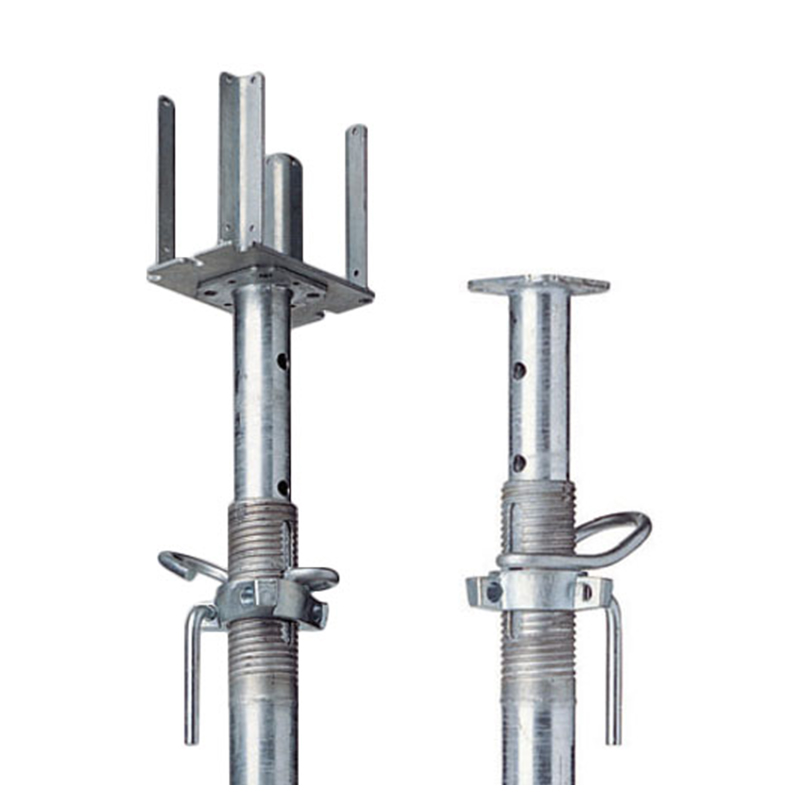
A steel prop is a vertical telescopic support designed to transfer construction loads safely toward the ground or another suitable supporting surface. It normally consists of an outer steel tube, an inner telescopic tube, an adjustment mechanism, a locking arrangement, base or end plates, and contact accessories such as an anti-slip pad or reinforced head plate. The exact configuration can vary according to the required load capacity, working height, adjustment range, and project conditions.
The prop is positioned beneath a supported element and adjusted until the top plate or head makes firm contact with the formwork, slab, beam, roof structure, or temporary frame. The support must be installed on a stable and adequately prepared base. When used correctly, it transfers vertical forces through its steel body while maintaining an appropriate margin of stability against buckling, settlement, and accidental displacement.
Steel props are not merely height-adjustment devices. Their primary purpose is structural support. Height adjustment allows the prop to match different construction dimensions, but the main engineering function is to provide a controlled vertical load path. This distinction is important when comparing steel props with other construction accessories.
Steel Props Compared with Other Adjustable Support Components
Adjustable bases are generally used to level, raise, or position the bottom of a support system. They are valuable for correcting small differences in ground elevation and establishing a suitable starting point. However, an adjustable base is not normally intended to replace a heavy-duty vertical prop or independently support the complete weight of a large formwork assembly.
Adjustable brackets and similar top accessories are typically used for fine height correction, connection adaptation, or positioning at the upper end of a support system. They improve compatibility between components but may not provide the same independent load-bearing capacity as a dedicated steel prop.
A steel prop combines telescopic adjustment with a robust load-bearing body. It can be used as a core vertical support, while adjustable bases and brackets can be added where leveling, connection, or fine positioning is required. The three component types therefore perform different functions and should be selected according to the structural design rather than treated as interchangeable products.
| Component | Primary Function | Typical Strength | Role in a Support System |
|---|---|---|---|
| Steel prop | Independent vertical load support | Heavy-duty load-bearing capacity | Core vertical support member |
| Adjustable base | Ground leveling and bottom positioning | Suitable for base adjustment | Improves contact with the supporting surface |
| Adjustable bracket | Top fine-tuning and connection adaptation | Suitable for localized adjustment | Connects or aligns upper components |
| Scaffolding frame | Creates a working and access structure | System-dependent load capacity | Provides access and distributed support |
The comparison demonstrates why steel props remain important even when a project already uses scaffolding, adjustable bases, or modular formwork. Each element contributes to the overall system, but the steel prop is specifically designed to carry concentrated vertical loads through a strong, adjustable steel member.
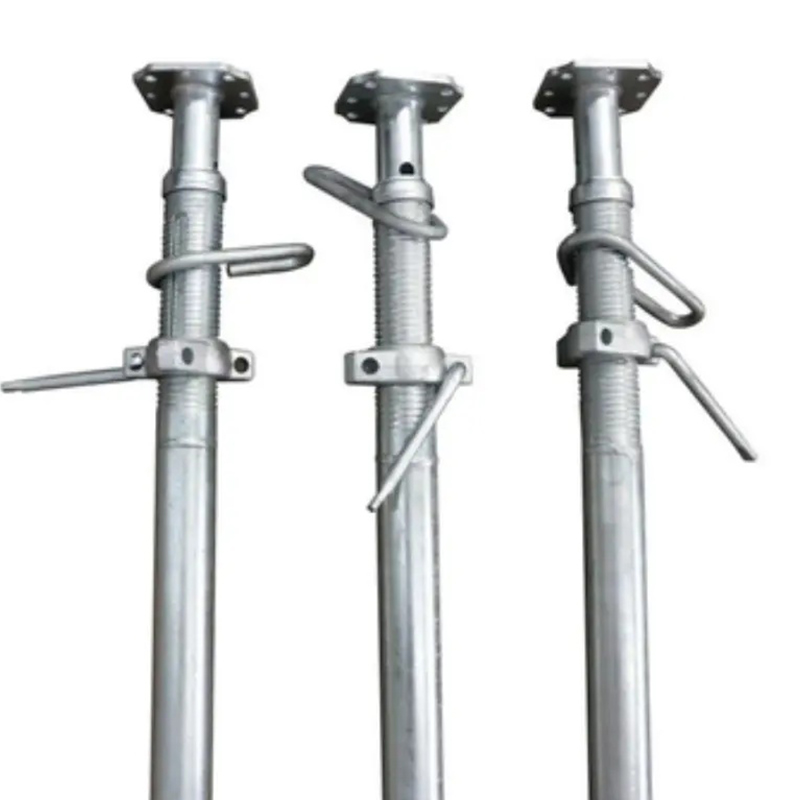
Steel Props
Heavy-Duty Load-Bearing Performance
The principal advantage of a heavy-duty steel prop is its ability to support substantial vertical loads while maintaining dimensional stability. The product described in this specification is manufactured from Q235 or Q345 high-strength carbon steel. These grades are widely used in structural and fabrication applications because they provide a practical balance of strength, weldability, availability, and cost efficiency.
For demanding construction applications, the prop may be designed for a stated vertical load range of approximately 100 kilonewtons to 200 kilonewtons, depending on its dimensions, working height, wall thickness, adjustment position, connection details, and tested configuration. The actual allowable capacity must always be confirmed by the technical data, project design, and installation conditions. A prop’s rated capacity cannot be separated from its effective length, end restraint, alignment, base condition, and risk of buckling.
A one-piece structural body reduces the number of vulnerable load paths. Reinforced ribs and carefully designed end plates help distribute force across the contact areas, while precision welding joins the components with consistent geometry. When the steel tubes, reinforcement members, and plates are correctly aligned, the prop can transfer load more evenly and reduce the likelihood of localized deformation.
Concrete formwork can experience rapidly changing loads during placement. Fresh concrete, workers, equipment, vibration, and stored materials may create temporary force variations. A reliable prop helps maintain the designed position of the formwork and reduces the risk of excessive deflection. In floor and roof applications, it can also provide temporary support while newly poured concrete gains sufficient strength.
Load-bearing capacity alone does not guarantee safe performance. Correct spacing, bracing, end contact, installation sequence, and ground preparation are equally important. Steel props should be used according to an engineered layout, manufacturer instructions, and applicable construction safety requirements. The product is a high-capacity component, but it remains part of a complete temporary works system.
Height Adjustment for Changing Construction Conditions
Construction sites rarely have identical floor-to-floor dimensions. A project may contain multiple floor heights, sloped surfaces, uneven formwork arrangements, or changing support locations. A telescopic steel prop allows contractors to adapt one product family to a broad range of working heights without fabricating a separate support for every location.
The specified adjustment range is approximately 100 millimeters to 500 millimeters, with adjustment accuracy of about plus or minus 1 millimeter under suitable operating conditions. This range provides meaningful flexibility for leveling formwork, fitting temporary roof supports, aligning floor slab supports, and adapting to variations between different work areas.
Adjustment is normally achieved through a telescopic tube and threaded or locking mechanism. The worker first sets the approximate height, then uses the adjustment device to establish firm contact with the supported structure. The locking arrangement must be fully engaged before the prop is loaded. Proper adjustment prevents loose contact, reduces impact loading, and helps maintain an efficient load path.
Compared with smaller adjustment accessories, a heavy-duty prop can accommodate a wider range of support conditions while still functioning as a load-bearing member. Adjustable bases may provide a typical correction range of around 50 to 300 millimeters, while adjustable brackets may offer approximately 30 to 150 millimeters, depending on design. These figures are product-dependent, but they illustrate the difference between a primary prop and an accessory intended mainly for positioning.
The adjustment mechanism also improves inventory efficiency. A contractor can use the same prop model across several floor heights rather than purchasing and storing many fixed-length supports. Rental companies benefit from this flexibility because adjustable products can serve more customers and project types. The result is better utilization of equipment and lower replacement or storage costs.
Precision Robotic Welding and Structural Consistency
Welding quality has a direct effect on the reliability of steel support components. Inconsistent weld size, excessive spatter, poor penetration, misalignment, and heat distortion can create weak areas or interfere with assembly. Precision robotic welding helps address these risks by controlling welding speed, current, positioning, and repeatability.
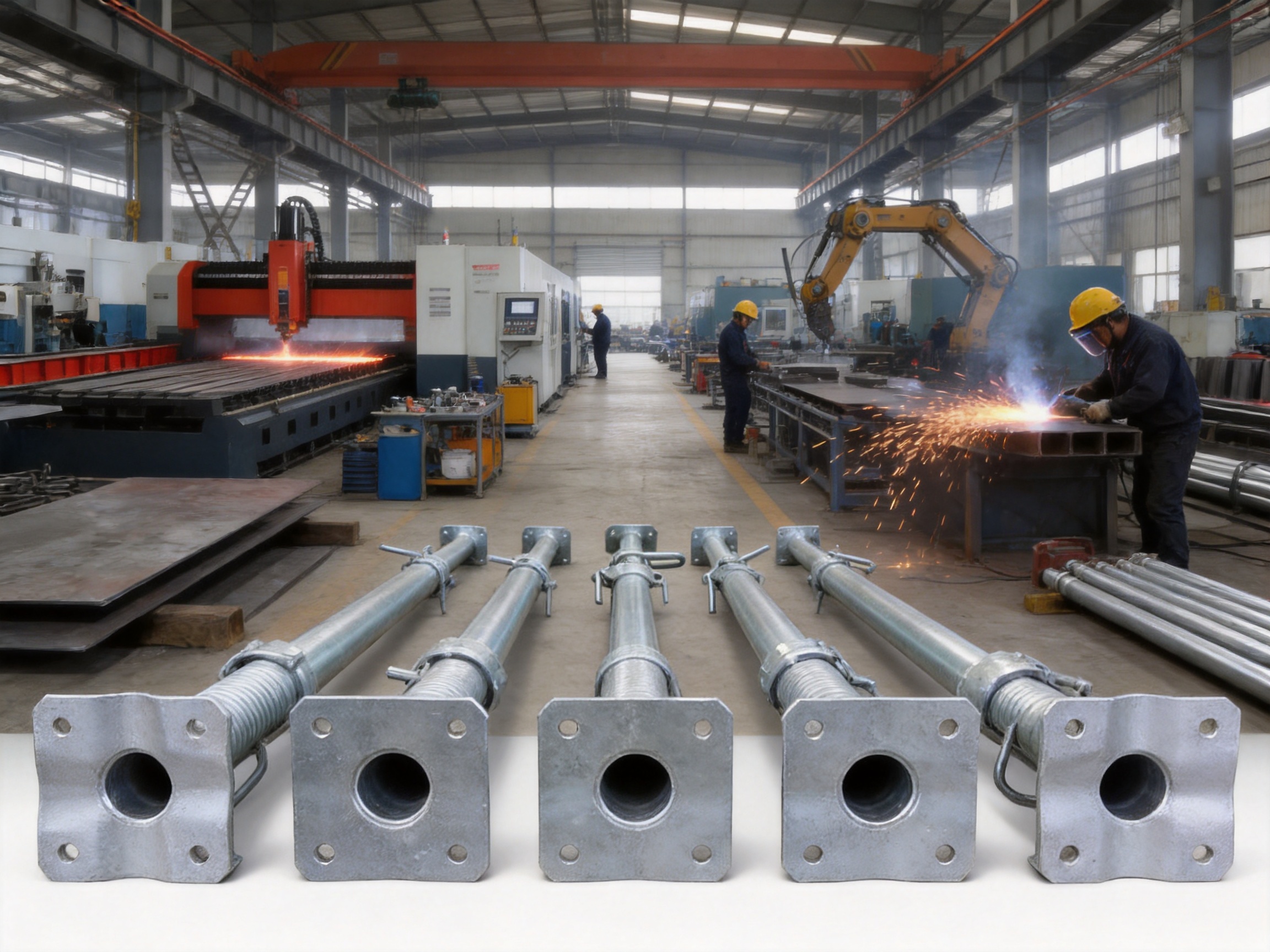
Automated welding is particularly valuable when a manufacturer produces large quantities of similar props. Once the welding parameters and fixture settings have been qualified, the system can repeat the same process across multiple units. This helps maintain consistent joint geometry and reduces variation between products. Robotic equipment also improves productivity and allows skilled technicians to focus on process supervision, inspection, fixture control, and quality assurance.
The use of dedicated fixtures helps hold tubes, ribs, plates, and other parts in their intended positions during welding. Stable positioning reduces dimensional deviation and supports accurate assembly of the telescopic mechanism. Consistent geometry is important because a prop that is out of alignment may be more vulnerable to uneven loading or difficult to adjust on site.
Robotic welding does not eliminate the need for human inspection. Qualified personnel must verify weld appearance, dimensions, surface condition, and compliance with the applicable welding procedure. Depending on the project requirements, visual examination, dimensional inspection, non-destructive testing, and load testing may be applied. Advanced manufacturing combines automation with professional supervision rather than relying on either approach alone.
High-Strength Steel Fabrication
The manufacturing process begins with the selection and preparation of steel materials. Q235 and Q345 carbon steels are commonly used because their mechanical properties support structural applications and their welding characteristics are suitable for efficient fabrication. Material certificates, thickness checks, and incoming inspection can help verify that the steel supplied to production is appropriate for the intended product.
Steel tubes and plates are cut to controlled dimensions before forming and assembly. Where the manufacturer also operates advanced laser cutting equipment, CNC processing can be used to produce accurate holes, plates, ribs, connection parts, and other non-standard components. Laser cutting provides clean edges and repeatable dimensions, which helps improve fit-up and reduces the need for extensive secondary correction.
After cutting, components may undergo drilling, bending, edge preparation, threading, or machining. The telescopic tube must be compatible with the outer tube, and the adjustment mechanism must operate smoothly without excessive clearance. Threaded parts require appropriate dimensional control because damaged or poorly formed threads may affect adjustment, locking, and service life.
Assembly follows a defined sequence. Tubes, plates, reinforcement members, handles, locking components, and contact pads are positioned using fixtures or controlled work instructions. The product is then welded and inspected. Any distortion, sharp edge, incomplete weld, or dimensional deviation should be corrected or rejected before surface finishing.
This integrated process enables a manufacturer to supply both standard steel props and customized support components. Customers may require different working heights, tube diameters, plate configurations, locking systems, corrosion protection specifications, or connection details. A factory with in-house cutting, bending, and welding capabilities can respond more efficiently to these requirements than a supplier that depends entirely on external processing.
Hot-Dip Galvanized Corrosion Protection
Construction equipment is frequently exposed to water, cement slurry, dust, mud, underground humidity, outdoor rain, and changing temperatures. Unprotected carbon steel can corrode under these conditions, especially at welds, edges, threaded areas, and locations where water collects. Corrosion may reduce appearance, complicate adjustment, and eventually affect structural performance if it is not controlled.
Hot-dip galvanizing provides a durable protective coating over the steel surface. The specified coating thickness is at least 80 micrometers, subject to the applicable production and inspection requirements. During the process, prepared steel is immersed in molten zinc, allowing the coating to cover external surfaces and form a metallurgical bond with the substrate.
Compared with a thin paint film, hot-dip galvanizing provides both barrier protection and sacrificial protection. Zinc can help protect exposed areas near small scratches, although major damage should still be repaired. The galvanized surface is especially useful for equipment that must be repeatedly moved between indoor and outdoor locations or used in damp construction environments.
Corrosion protection improves the service life and rental value of steel props. A prop that remains structurally sound and visually acceptable after repeated use is easier to inspect, maintain, and redeploy. For contractors, this can reduce the frequency of replacement. For rental companies, a durable finish can support more rental cycles and improve the return on equipment investment.
Galvanizing must be integrated with the design. Drainage and venting requirements, threaded areas, contact surfaces, and post-treatment inspection should be considered before production. The finished component should be checked for coating continuity, excessive zinc build-up, blocked holes, sharp projections, or other conditions that could interfere with assembly.
Surface Finishing and Wear Resistance
In addition to galvanizing, surface polishing and edge treatment improve the practical usability of the prop. Smooth edges reduce the risk of cuts during handling and help prevent damage to adjacent formwork or protective clothing. Removing burrs and weld spatter also makes the adjustment mechanism easier to operate.
Steel props may be assembled, adjusted, transported, stacked, and disassembled hundreds of times. Wear can occur at contact points, threads, locking holes, handles, and base plates. A properly finished surface reduces friction and helps protect the product from premature deterioration. The stated reuse cycle of 400 or more uses is a significant advantage for professional contractors and rental fleets, provided the props are inspected and maintained throughout their service life.
Reuse should never be determined by a numerical cycle count alone. Each prop must be examined for bending, buckling, cracked welds, damaged threads, excessive corrosion, deformed plates, missing locking parts, and other defects. Products that no longer meet the required condition should be removed from service. A high reuse potential is valuable because it supports lifecycle efficiency, but inspection remains essential.
Quick Locking and Single-Worker Installation
Construction productivity depends heavily on how quickly workers can install, adjust, and remove temporary supports. A prop that requires complicated tools or repeated repositioning can increase labor costs and slow the construction sequence. A user-friendly quick-locking design allows the approximate height to be established efficiently before final adjustment and secure locking.
The non-slip handle supports controlled operation while reducing the likelihood that the worker’s hand will slide during adjustment. The handle should be used according to the manufacturer’s instructions, and workers should keep hands clear of pinch points when telescopic sections move. Clear operating procedures are particularly important when props are installed in confined spaces or beneath partially assembled formwork.
Under suitable conditions, one trained worker can install and adjust the prop without specialized tools. This can reduce dependence on lifting equipment for lightweight positioning tasks and improve workflow in repetitive support operations. However, the product’s weight, working height, access conditions, and project safety plan must be considered. Heavy props or high-level installations may still require two-person handling or mechanical assistance.
Fast installation does not mean that inspection can be skipped. After adjustment, the operator should verify that the prop is vertical, both ends have full contact, the locking mechanism is engaged, the base is stable, and any required bracing is installed. Speed is beneficial only when combined with a disciplined installation sequence.
Anti-Slip Contact and System Stability
An anti-slip pad or reinforced contact surface at the top of the prop increases the contact area between the support and the supported structure. This helps reduce local pressure and improves resistance to sliding when the system is correctly aligned. It can also protect the formwork or structural surface from direct contact with a sharp steel edge.
The bottom of the prop must also rest on a firm and adequately sized supporting surface. If the ground is soft, wet, uneven, or contaminated with loose material, the prop may settle or tilt regardless of the quality of its top pad. Base plates, adjustable bases, timber spreaders, steel distribution plates, or other designed support arrangements may be required depending on the load and ground condition.
Overall stability depends on the complete arrangement. Props should be installed at the designed spacing and connected or braced where required. Unsupported slender props can be vulnerable to lateral movement and buckling, particularly at greater extensions. Workers should never improvise a support layout by using a prop outside its approved height or loading range.
The anti-slip feature is therefore one part of a broader stability strategy. It works together with vertical alignment, adequate end restraint, correct spacing, suitable base preparation, bracing, and proper load introduction. These principles apply whether the prop is supporting wall formwork, a slab, a roof, scaffolding, or a temporary structure.
Applications in Formwork Support
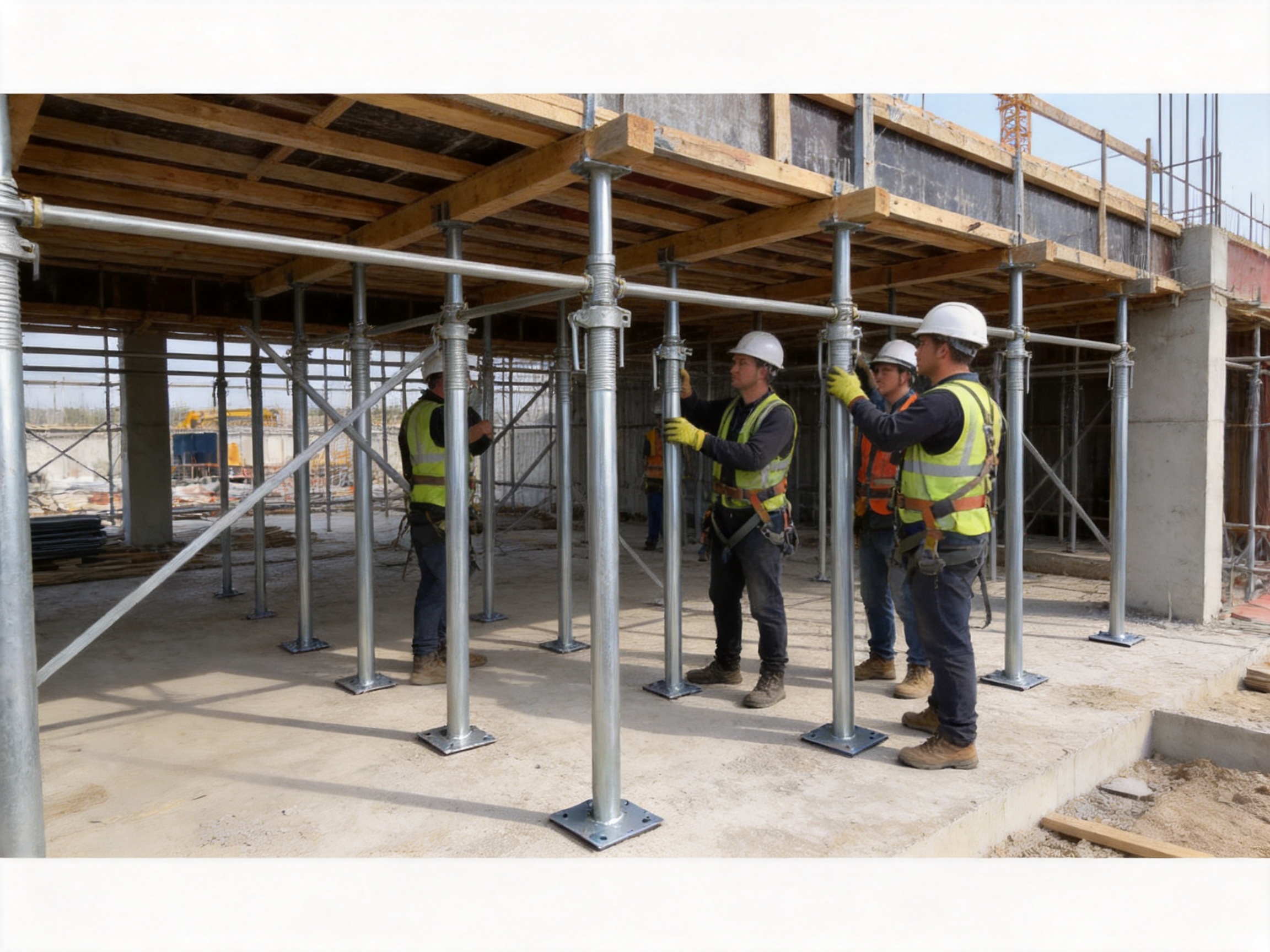
Formwork support is one of the most important applications for steel props. During concrete construction, formwork must hold fresh concrete in the intended shape until the concrete reaches the required strength. The support system must resist vertical loads from the concrete, reinforcement, workers, equipment, vibration, and the formwork itself.
Steel props can be positioned beneath slab formwork, beam formwork, wall formwork support frames, and other temporary arrangements. Their adjustable height allows the crew to establish a level working platform and correct small dimensional differences during installation. When used with suitable adjustable bases and top brackets, they can form a complete support assembly that combines stable load transfer with accurate positioning.
For slab formwork, props are generally arranged according to a designed grid. The spacing is influenced by the weight of the concrete, slab thickness, formwork type, prop capacity, floor condition, and required safety factor. The props should remain vertical and should be connected with horizontal or diagonal bracing when specified.
For wall formwork, steel props may act as vertical supports or stabilizing elements. They can help maintain the position of the formwork against temporary forces, but the exact configuration depends on wall height, panel design, tie systems, wind exposure, and concrete pressure. A prop must not be used as a substitute for a complete wall-formwork engineering design.
Floor and Roof Support
Newly poured floors and roofs may require temporary support while the structural concrete develops sufficient strength. Steel props can provide controlled support beneath the slab or roof structure and help reduce the risk of excessive deflection, settlement, or cracking during the construction phase.
In renovation and strengthening work, existing floors may also need temporary propping before damaged or removed structural elements are repaired. A heavy-duty steel prop can be adjusted to fit the available height and positioned beneath beams, slabs, or temporary distribution frames. The installation should be supervised by a competent person because existing structures may contain unknown defects or load paths.
Temporary support removal must be planned carefully. Removing props too early can transfer load suddenly to immature concrete or weakened structural members. A controlled sequence is required, and the responsible engineer or site supervisor should confirm when the supported structure can safely carry the design load without temporary assistance.
Scaffolding Auxiliary Support
Steel props can be used as auxiliary load-bearing components for ringlock scaffolding, coupler-type scaffolding, and other modular access systems. Their role may be to support concentrated loads, reinforce a heavily loaded bay, stabilize a temporary arrangement, or provide additional vertical capacity where ordinary scaffold members alone are insufficient.
Scaffolding systems are designed for specific combinations of access, working platforms, bracing, ties, and load classes. A steel prop can complement the system, but it should not be introduced without checking how the additional support changes force distribution. The prop must connect effectively to the scaffold or supported structure and must not create an unintended point load or instability.
For high-altitude operations, auxiliary props may provide a useful method of strengthening selected areas. They are particularly valuable when construction materials, concrete delivery equipment, or temporary storage create loads greater than normal working-platform loads. The final arrangement should be verified by the project’s temporary works designer or qualified site engineer.
Temporary Structural Reinforcement
Building renovation, factory maintenance, bridge repair, and equipment replacement often require temporary reinforcement. Existing columns, beams, floors, or roof areas may be weakened by age, corrosion, impact, modification, or partial demolition. Steel props can provide temporary vertical support while permanent repairs are carried out.
In industrial facilities, props may support temporary platforms, machinery bases, pipe supports, maintenance zones, or structural members during equipment installation. Their adjustable design allows the support to be fitted around existing geometry and altered as the work progresses.
Temporary reinforcement should always begin with an assessment of the existing structure and the intended load path. The prop must be placed where it can transfer force safely to the ground or a verified supporting surface. A distribution plate or spreader may be required to prevent local crushing. The upper contact point may also require a beam, cap, or load-distribution member rather than direct contact with a fragile surface.
The product’s versatility is most valuable when supported by sound engineering judgment. It can adapt to different heights and loads, but no temporary support should be installed solely by visual estimation when structural safety is involved.
Advantages Over Conventional or Lower-Duty Alternatives
Steel props offer several advantages compared with improvised timber posts, light-duty tubular supports, or accessories intended only for leveling. Their controlled steel geometry provides greater consistency, while their telescopic structure permits adjustment without cutting or packing multiple pieces of material.
Compared with timber, steel is less affected by moisture-related swelling, splitting, insect damage, and dimensional variation. Steel props can also be inspected more systematically for bending, corrosion, damaged threads, and weld defects. Timber remains useful in many construction applications, but a standardized steel prop offers a more repeatable solution for professional temporary works.
Compared with light-duty adjustable supports, heavy-duty steel props are designed for more demanding vertical loads. Reinforced construction, high-strength steel, and engineered end plates allow the product to support heavier formwork and temporary structures when the configuration is properly selected.
Compared with fixed-length steel posts, telescopic props provide greater flexibility. One product can serve multiple floor heights, reducing the number of different sizes that must be purchased and stored. This is especially beneficial for contractors working on projects with varied dimensions or for rental companies serving multiple customers.
Compared with painted steel products, hot-dip galvanized props generally provide more durable corrosion protection in damp or outdoor environments. The galvanized finish helps preserve the product’s serviceability and supports repeated reuse when the product is properly cleaned and inspected.
Integrated Manufacturing Capability
A reliable steel prop supplier should be able to control more than the final welding step. Integrated manufacturing capability includes material preparation, CNC or laser cutting, forming, machining, fixture assembly, welding, surface treatment, inspection, packaging, and technical support. Control across these stages improves production coordination and reduces the risk that quality problems will be hidden between different subcontractors.
Advanced laser cutting is especially useful for producing large steel plates, reinforcement ribs, base plates, brackets, and customized structural components. Accurate cutting supports consistent fit-up and reduces material waste. CNC bending helps form plates and brackets to repeatable angles, while controlled welding ensures that the finished assembly maintains its designed geometry.
The same manufacturing platform can support both standard catalog products and non-standard OEM components. Customers may request special dimensions, customized head plates, altered adjustment ranges, different connection holes, project-specific labels, or special packaging. A factory experienced in heavy metal fabrication can evaluate these requirements and integrate them into an established production process.
In addition to steel props, an experienced heavy fabrication manufacturer may produce custom formwork, bridge components, tunnel equipment, scaffolding, industrial frames, and other steel structures. This broader capability is valuable for customers who want several related products from one technical source. It can simplify communication, reduce coordination between vendors, and support consistent quality across a project.
Welding Standards and Quality Management
Welding procedures should be established according to the material, joint design, thickness, welding position, and required performance. AWS and EN-based welding practices provide recognized frameworks for controlling procedures, welder qualifications, inspection, and documentation. The appropriate standard depends on the contract, destination market, project specification, and product classification.
A quality management system aligned with ISO 9001 supports documented control of purchasing, production, inspection, nonconforming products, corrective action, and customer feedback. Certification alone does not guarantee that every product is suitable for every project, but a functioning quality system creates a structured method for maintaining consistency.
For construction supports, quality control may include incoming steel inspection, dimensional checks after cutting, thread inspection, weld inspection, coating thickness measurement, assembly verification, and load testing. Records should be maintained where required by the project or customer. Traceability is especially important for large infrastructure contracts and export orders.
Manufacturers with experience supplying central state-owned enterprises, infrastructure contractors, and major engineering projects are often familiar with strict documentation, inspection, and delivery requirements. Such experience can help the manufacturer understand the importance of batch control, production scheduling, packaging protection, and conformity documentation.
Inspection and Testing Before Delivery
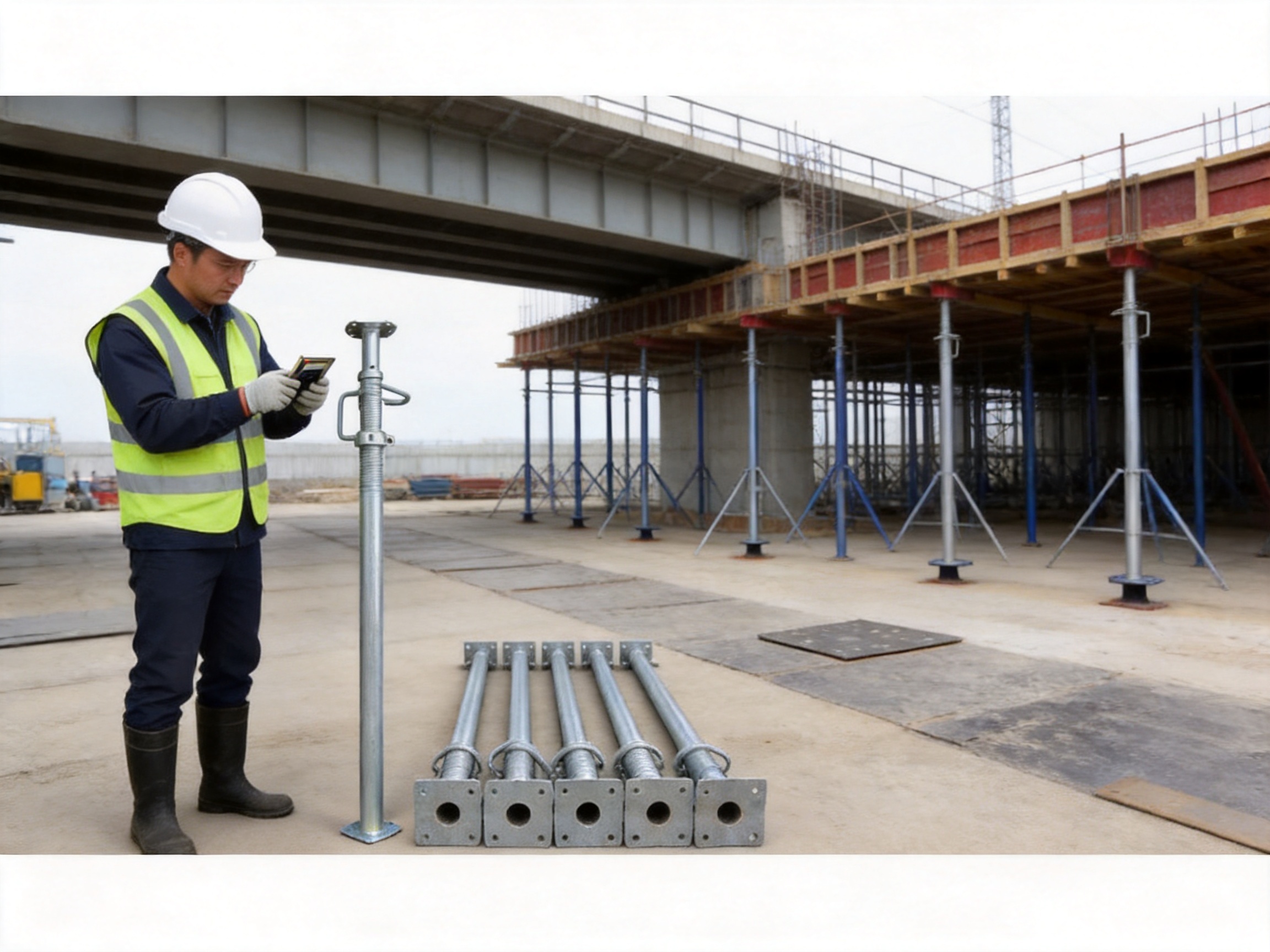
Before steel props leave the factory, each production batch should be checked for key characteristics. Visual inspection can identify surface defects, incomplete coating, weld spatter, sharp edges, deformation, and missing components. Dimensional inspection confirms working length, adjustment range, plate dimensions, hole positions, and component alignment.
Operational inspection verifies that the telescopic tube moves correctly, threads engage smoothly, locking devices function properly, and handles are firmly attached. The prop should be checked in both its retracted and extended positions because a component that operates well at one height may reveal clearance or alignment problems at another.
Load testing provides valuable information about vertical capacity and deformation behavior. Test results should be interpreted according to the specified product configuration and applicable standard. The test arrangement should reflect the intended loading direction, end conditions, and adjustment position. A test result from one configuration should not automatically be applied to every possible installation condition.
Coating inspection verifies that the galvanized finish meets the required thickness and coverage. Areas such as threads, holes, weld transitions, and plate edges deserve particular attention. Packaging inspection is also important because damage during transport can affect the surface treatment or deform the adjustment components before the product reaches the site.
Selection Guide for Contractors and Rental Companies
Choosing the correct steel prop begins with the required working height. The selected prop should accommodate the target height without operating at an unsafe extension or relying on improvised packing. The adjustment mechanism should retain sufficient engagement between telescopic sections at the intended position.
The second consideration is load. Determine the expected dead load, live construction load, impact or dynamic effects, and any temporary storage loads. The prop’s rated capacity must be checked at the actual working height and under the relevant end conditions. If the support is part of a grid, the load assigned to each prop should be calculated rather than estimated informally.
Ground and top contact conditions are equally important. The supporting surface should be strong enough to resist local pressure and settlement. Where necessary, use a designed spreader or base arrangement. The top of the prop should bear against a suitable structural or formwork member, not an unstable edge or weak finish layer.
For rental fleets, corrosion protection, repeatability, repairability, and inspection access are important. Galvanized surfaces can reduce maintenance requirements, while standardized components make sorting and replacement easier. Rental operators should maintain records of inspections, repairs, and products removed from service.
Export customers should also consider packaging, container utilization, marking, documentation, local standards, and replacement part availability. A manufacturer that provides OEM support can adapt labels, manuals, inspection documents, and packaging to meet the customer’s distribution or project requirements.
Installation Best Practices
Before installation, inspect the prop for bent tubes, cracked welds, damaged threads, missing locking parts, excessive corrosion, and contamination. Clean dirt or concrete residue from the adjustment mechanism. Do not install a prop that has suffered impact damage or shows signs of permanent deformation.
Prepare the base surface and confirm that it is stable, level, and capable of carrying the anticipated load. If the surface is uneven or weak, use an engineered leveling or load-distribution arrangement. Position the prop directly below the intended load path and avoid eccentric loading wherever possible.
Extend the prop to the approximate height, place the head beneath the supported member, and complete the fine adjustment. Confirm that both ends have firm and continuous contact. Engage the locking mechanism fully. Check that the prop is vertical and that the telescopic sections are not forced sideways.
Install horizontal or diagonal bracing when required by the design. Bracing is particularly important when props are tall, closely spaced, exposed to movement, or used beneath large formwork assemblies. Keep access routes clear and protect workers from pinch points during adjustment.
After loading, inspect the system again. Look for settlement, tilting, unusual noise, tube deformation, shifting formwork, or changes in contact. Recheck the arrangement after major construction events such as concrete placement, equipment movement, severe weather, or accidental impact.
Maintenance and Service Life
Regular maintenance helps preserve the performance of steel props. After use, remove concrete, soil, oil, and other contaminants from the tubes, threads, plates, and locking components. Store props in a dry, organized location where they will not be struck by vehicles or buried under heavy materials.
Lubricate threaded mechanisms according to the manufacturer’s recommendation, while avoiding excessive lubricant that could attract abrasive dust. Check that handles remain secure and that locking pins or collars are not worn. Inspect galvanized surfaces for scratches or exposed steel and repair them with a suitable zinc-rich treatment where appropriate.
Props should be stored vertically or in stable horizontal bundles that prevent rolling. Do not drop them from trucks or platforms. Repeated impact can deform the tubes or damage threads even when the defect is not immediately visible.
Inspection should be performed before each major use and at scheduled intervals for rental fleets. Any prop that is bent, cracked, severely corroded, mechanically damaged, or unable to lock correctly should be quarantined. Repair should be conducted only by qualified personnel using approved procedures. Unauthorized welding or cutting may alter the product’s capacity and should not be permitted.
Why OEM Capability Matters
OEM manufacturing enables customers to obtain steel props configured for their own market, project, or distribution system. Instead of selecting a generic product with unsuitable dimensions, the buyer can discuss working height, load range, surface treatment, end plate design, packaging, marking, and documentation with the factory’s technical team.
Customization may involve different tube sizes, adjustment ranges, locking arrangements, head plates, base plates, anti-slip pads, or connection details. It may also involve product branding on packaging, batch identification, inspection labels, or customer-specific manuals. All changes should be reviewed for their effect on structural performance and manufacturing repeatability.
An OEM supplier with laser cutting, bending, welding, and surface treatment resources can manage design changes more efficiently. Prototype development, sample inspection, production approval, and batch manufacturing can be coordinated within one supply chain. This reduces communication gaps and makes it easier to implement engineering improvements.
For large infrastructure and industrial projects, OEM capability also supports the manufacture of related steel components. A customer may require steel props together with formwork panels, scaffolding accessories, bridge formwork, steel platforms, or custom structural frames. A manufacturer experienced in heavy metal fabrication can help create a more coherent package of products.
Project and Industry Applications
Steel props are used in residential and commercial building construction, industrial plants, warehouses, bridges, tunnels, power facilities, transport infrastructure, and municipal works. Their adaptability makes them suitable for both repetitive building projects and specialized temporary support tasks.
In residential and commercial construction, they support slab formwork, beams, stair structures, and temporary openings. In industrial projects, they can reinforce maintenance zones, support equipment installation, and assist with plant modifications. In infrastructure projects, they may be integrated into bridge formwork, tunnel support arrangements, temporary platforms, and heavy-duty scaffolding systems.
The product is also suitable for contractors that operate across multiple project types. A standardized adjustable prop inventory can be used on building sites one month and industrial maintenance sites the next, subject to engineering approval. This flexibility helps companies reduce idle equipment and improve asset utilization.
For international customers, a supplier’s experience in infrastructure manufacturing, welding standards, quality documentation, and export packaging can be as important as the product itself. Reliable delivery, technical communication, spare parts, and after-sales support contribute to the total value of the purchase.
Technical Considerations for International Buyers
International buyers should confirm the applicable design and safety standards before ordering. Requirements may differ according to country, product classification, project owner, and intended use. The manufacturer should provide technical drawings, material information, load data, coating details, inspection documents, and operating instructions appropriate to the order.
Buyers should also clarify whether the quoted capacity refers to ultimate load, proof load, or allowable working load. These terms are not interchangeable. The rated capacity should be linked to a defined working height, tube configuration, end condition, and safety factor. When necessary, the customer should request a project-specific calculation or test report.
Packaging must protect threads, plates, galvanized surfaces, and locking parts during container loading and inland transport. Bundles should be secured to prevent movement, while individual components should be protected from impact and moisture accumulation. Correct packing can reduce damage claims and speed up site deployment.
Clear communication of quantity, delivery schedule, container requirements, spare parts, inspection expectations, and documentation standards helps prevent delays. A professional manufacturer should be able to support the customer through quotation, drawing confirmation, sample approval, production, inspection, and shipment.
Safety Responsibilities
Steel props are safety-critical temporary works components. They should be selected, installed, loaded, inspected, and removed by competent personnel. The product description and capacity data do not replace a project-specific temporary works design.
Never exceed the approved load or working height. Do not combine components from different systems unless their compatibility has been verified. Do not place loose materials, unstable packing, or unapproved extensions beneath or above a prop. Do not remove bracing or neighboring supports without approval from the responsible supervisor or engineer.
Workers should use appropriate personal protective equipment and follow site procedures for lifting, access, concrete placement, and temporary works inspection. Any unexpected movement, settlement, cracking, bending, or loss of contact should be treated seriously. The area may need to be evacuated and the support arrangement assessed before work continues.
A high-quality steel prop contributes to construction safety, but safety is achieved through the interaction of product quality, engineering design, trained workers, correct installation, inspection, and disciplined site management.
Questions and Answers
What is the primary purpose of a steel prop?
The primary purpose is to provide adjustable vertical load-bearing support during construction, renovation, repair, or maintenance. It can support formwork, slabs, roofs, walls, scaffolding arrangements, and temporary structures when selected and installed according to an appropriate design.
Can a steel prop replace an adjustable base?
No. A steel prop and an adjustable base have different primary functions. The prop is intended to carry vertical loads, while the base is mainly used for leveling and positioning at the bottom of a support system. They may be used together when the project design requires both functions.
What adjustment range is available?
The described product provides an adjustment range of approximately 100 to 500 millimeters. The exact usable range depends on the model, working height, locking arrangement, and required load capacity.
What load can the prop support?
The stated vertical load-bearing range is approximately 100 to 200 kilonewtons for suitable configurations. The allowable working load must be confirmed from the technical documentation because capacity changes with working height, tube dimensions, end restraint, alignment, bracing, and ground conditions.
Why is Q235 or Q345 steel used?
Q235 and Q345 are high-strength carbon steels commonly used for structural fabrication. They offer useful strength, good weldability, and practical availability. The selected grade and thickness should match the product design and project requirements.
Why is hot-dip galvanizing beneficial?
Hot-dip galvanizing protects the steel from moisture and corrosion by applying a durable zinc coating. It is useful for props exposed to damp construction sites, outdoor weather, underground humidity, and repeated transport. The specified coating thickness is at least 80 micrometers, subject to inspection requirements.
Can one worker install a steel prop?
The quick-locking design and non-slip handle can allow one trained worker to install and adjust the prop under suitable conditions. However, the product weight, access height, site risks, and project procedures must be considered. Two-person handling or mechanical assistance may be necessary in some situations.
How often should steel props be inspected?
Props should be checked before use and after events that may cause damage or movement. Rental fleets should also use a documented periodic inspection program. Check for bent tubes, cracked welds, damaged threads, corrosion, missing locking parts, plate deformation, and other defects.
Can a steel prop be used with scaffolding?
Yes, it can serve as an auxiliary load-bearing or stabilizing component for ringlock, coupler-type, and other scaffolding systems. The combined arrangement must be reviewed to ensure that loads, connections, bracing, and ground conditions remain suitable.
Can the product be customized?
OEM customization may include dimensions, adjustment range, tube configuration, end plates, locking details, surface treatment, packaging, labels, and documentation. Any customization affecting structural performance should be reviewed and verified before mass production.
What manufacturing processes improve product consistency?
Controlled material inspection, CNC or laser cutting, precision forming, fixture-based assembly, robotic welding, dimensional inspection, galvanizing, coating measurement, and load testing all contribute to consistent product quality. Human supervision and documented quality procedures remain important throughout the process.
Is a steel prop suitable for permanent structural support?
Steel props are generally temporary support components unless a qualified engineer specifically approves another use. They should not be treated as permanent structural members without a dedicated design, corrosion assessment, connection design, and applicable approvals.
Conclusion
Heavy-duty steel props provide a dependable and flexible method for supporting vertical construction loads. Their main advantages include strong carbon-steel construction, reinforced structural geometry, precision robotic welding, telescopic height adjustment, hot-dip galvanized corrosion protection, anti-slip contact surfaces, quick locking, and high reuse potential.
Compared with adjustable bases, small brackets, fixed-length posts, improvised timber supports, and lower-duty accessories, steel props provide a more complete combination of load-bearing capability and dimensional flexibility. They can serve as core components in formwork support, floor and roof support, scaffolding reinforcement, temporary structural strengthening, and industrial maintenance arrangements.
The strength of the product is closely connected to the strength of the manufacturing system behind it. Advanced laser cutting, CNC processing, controlled welding, qualified AWS and EN craftsmanship, ISO-based quality management, galvanizing, inspection, and load testing help create stable and reliable components for demanding projects. An OEM manufacturer with integrated heavy metal fabrication capability can further support customized dimensions, related steel products, export requirements, and large project supply.
For best results, steel props must be selected according to the required height and load, installed on suitable supporting surfaces, braced where necessary, inspected regularly, and operated by trained personnel. When product quality and engineering discipline are combined, steel props can improve construction efficiency, reduce temporary works risk, extend equipment service life, and provide reliable support across a wide range of building and infrastructure applications.
References
1. ISO 9001, Quality Management Systems — Requirements.
2. AWS D1.1, Structural Welding Code — Steel.
3. EN 74, Couplers, Spigot Pins and Baseplates for Use in Falsework and Scaffolds.
4. BS 1139, Metal Scaffolding — General Requirements and Testing Considerations.
5. Technical principles for temporary works, formwork support, scaffolding stability, and construction load management.
6. Manufacturer technical information for adjustable steel props, galvanized steel components, and heavy-duty temporary support systems.
Product: Steel Props



- Location
- Group 3, Fangzhuang Village, Rucheng Subdistrict, Rugao City, Nantong, Jiangsu, China
- Follow us
- Phone
- +86-13646196162
- info@hysonindustry.com
