 +86-13646196162
 info@hysonindustry.com




 русский
 عربى



Cuplock Scaffolding: High-Load Modular Support for Safer and More Efficient Construction
 2026.09.17
Content
- 1 Understanding the Cuplock Scaffolding System
- 2 Core Components and Their Functions
- 3 How the Cup Locking Mechanism Works
- 4 Major Advantages Compared with Conventional Scaffolding
- 5 Manufacturing Quality and Process Control
- 6 Application in Bridge Formwork Support
- 7 Application Around Curved and Circular Structures
- 8 Application in Industrial Maintenance
- 9 Application in Building and Masonry Construction
- 10 Comparison of Scaffolding System Characteristics
- 11 Company Manufacturing Strengths and OEM Capability
- 12 Customization and OEM Services
- 13 Inspection, Safe Use, and Maintenance
- 14 Logistics, Packing, and Site Efficiency
- 15 Why Product Selection Should Consider Total Cost
- 16 Project Selection and Procurement Checklist
- 17 Frequently Asked Questions
- 17.1 What is cuplock scaffolding mainly used for?
- 17.2 How does the cuplock connection differ from a conventional clamp?
- 17.3 Can cuplock scaffolding support heavy concrete formwork?
- 17.4 Is cuplock scaffolding suitable for curved structures?
- 17.5 What steel grades are used?
- 17.6 Are the cuplock connectors forged or cast?
- 17.7 Can the system be used by rental companies?
- 17.8 What quality standards are relevant to the product?
- 17.9 Can the manufacturer produce customized components?
- 17.10 How should cuplock components be maintained?
- 17.11 Does the cup mechanism make the scaffold automatically safe?
- 17.12 What information should be supplied when requesting a quotation?
- 18 Conclusion
- 19 References
- 20 Product: Cuplock Scaffolding
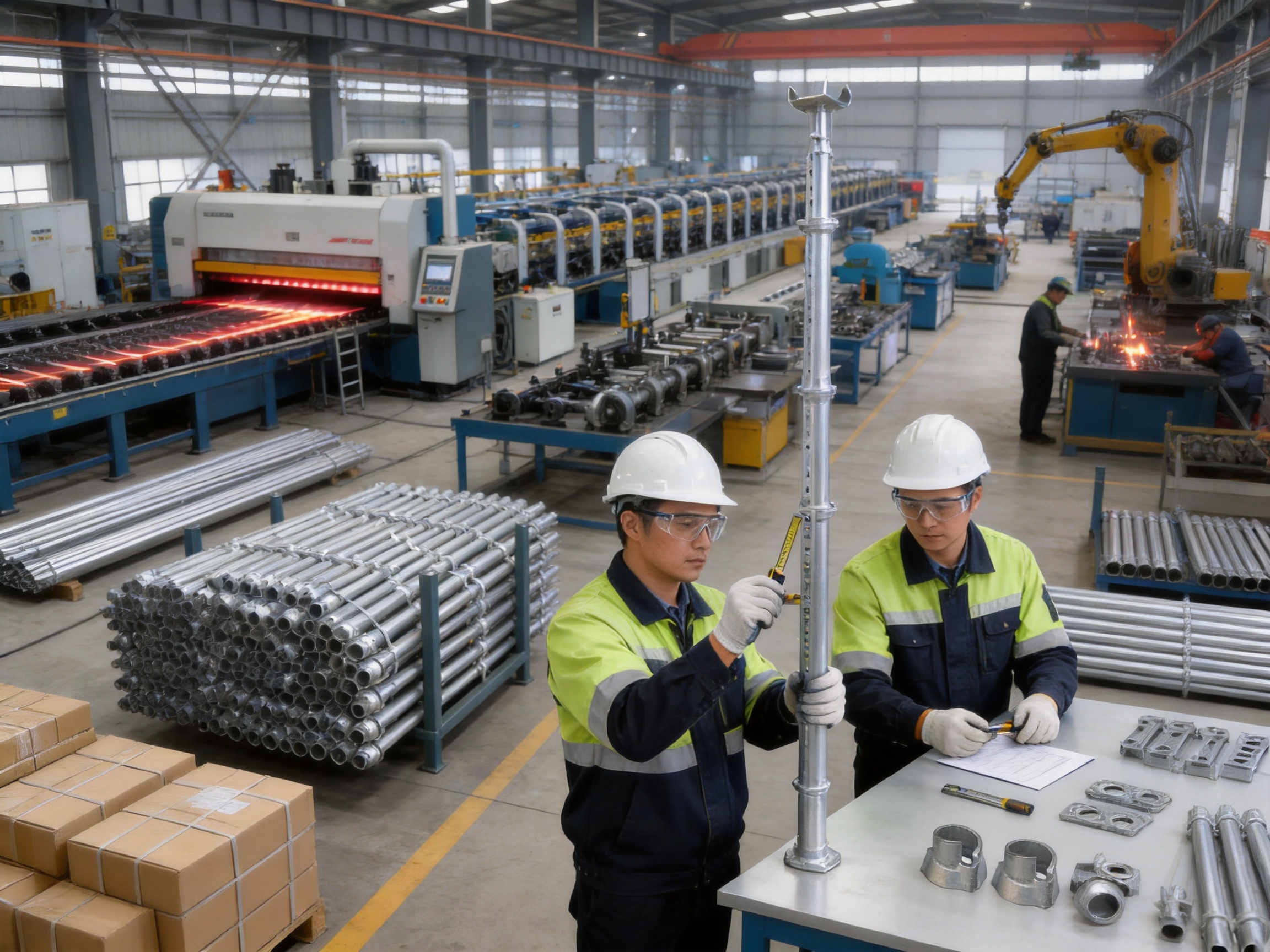
Cuplock scaffolding is a multi-purpose modular steel scaffolding system developed for demanding construction, infrastructure, industrial maintenance, and formwork support applications. Its defining feature is a distinctive cup-shaped node that connects vertical standards and horizontal ledgers without relying on conventional bolts, nuts, or loose wedges. This locking principle enables fast assembly, consistent connection quality, efficient material handling, and dependable structural performance.
In modern construction, scaffolding is no longer viewed merely as a temporary access platform. It can serve as a working platform, a load-bearing support frame, a bridge formwork tower, an industrial maintenance structure, or a temporary support system for complex geometries. Each application requires a combination of strength, stability, installation speed, adaptability, and quality control. Cuplock scaffolding addresses these requirements through a modular design manufactured from high-strength Q235 or Q345 carbon steel, supported by controlled fabrication, professional welding, and systematic inspection.
Compared with traditional tube-and-fitting scaffolding, which requires workers to position and tighten individual clamps, cuplock scaffolding uses an integrated node-locking system. A fixed lower cup is welded to the vertical standard, while a movable upper cup is used to secure up to four horizontal members at a single connection. With a hammer strike, the upper cup compresses the ledgers against the lower cup and creates a rigid connection. This reduces the number of loose components, simplifies erection, and helps maintain a more orderly job site.
The system is especially suitable for projects involving high loads, repeated assembly and dismantling, irregular layouts, or tight construction schedules. It can be configured for bridge deck support, heavy concrete beams, curved walls, towers, industrial plants, masonry work, exterior finishing, and general access. For rental companies, contractors, infrastructure builders, and industrial service providers, the combination of reusable components and low parts loss creates important lifecycle advantages.
Understanding the Cuplock Scaffolding System
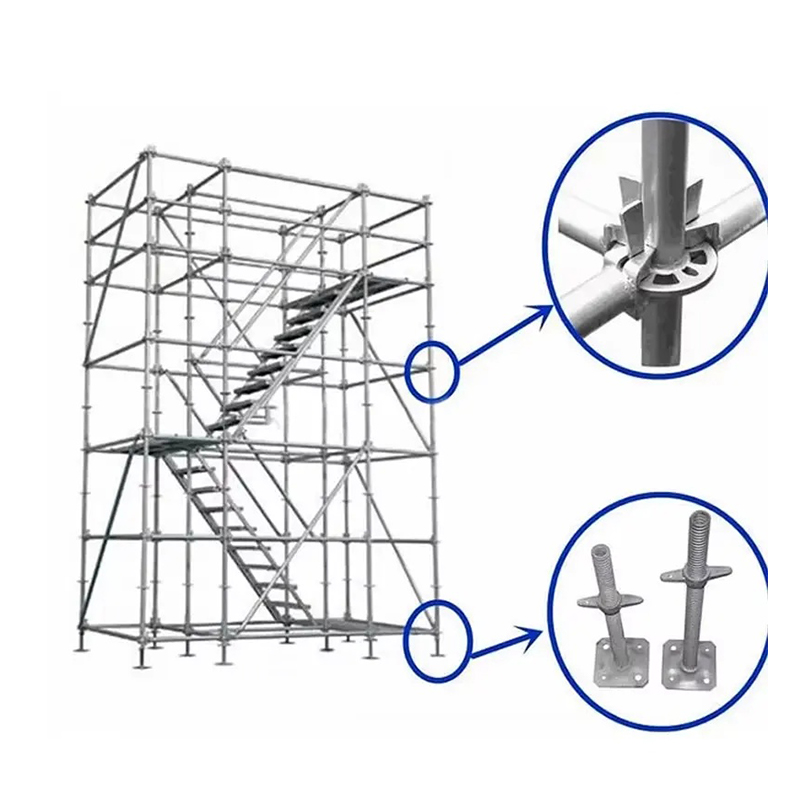
A typical cuplock scaffolding structure consists of vertical standards, horizontal ledgers, transoms, base jacks, base plates, diagonal braces, working platforms, guardrails, access ladders, and related accessories. The vertical standards form the primary load path. Ledgers connect the standards horizontally, while transoms support platforms or distribute loads across the frame. Braces improve overall stability and control deformation caused by lateral forces.
The connection node is the central engineering feature of the system. Each standard includes fixed cups positioned at regular intervals. The upper cup is designed to move vertically along the standard and lock the ends of the ledgers and transoms into the lower cup. Depending on the configuration, up to four horizontal members can be connected at one node. This creates a compact and strong joint while minimizing the need for additional fittings.
Because the connection points are arranged at predetermined vertical intervals, the scaffolding can be assembled into repeated lifts. The standard modular dimensions make it easier to plan quantities, prepare material lists, and establish consistent platform heights. At the same time, the node design permits a degree of rotational flexibility, allowing horizontal members to be positioned for curved structures, circular tanks, towers, and other non-rectangular layouts.
The system is not limited to a single type of construction. It may be used as access scaffolding around buildings, as a support tower beneath bridge formwork, as an interior platform in industrial facilities, or as a temporary frame for masonry and finishing operations. Its performance depends on correct design, appropriate component selection, proper erection, and compliance with applicable safety requirements.
Core Components and Their Functions
Vertical Standards
Vertical standards are the main load-bearing members of a cuplock system. They transfer loads from ledgers, transoms, platforms, formwork, equipment, and workers toward the base. Standards are manufactured in different lengths and are joined vertically to achieve the required height. Their dimensions, wall thickness, end details, cup spacing, and material grade influence the overall capacity of the scaffold.
High-quality standards require straightness control, reliable welded connections, consistent cup positioning, and sufficient resistance to compression and buckling. During manufacturing, tubes must be checked for surface defects, dimensional accuracy, and compatibility with the intended connection components. A straight and correctly aligned standard helps the completed structure maintain verticality and reduces unintended eccentric loading.
Ledgers and Transoms
Ledgers connect standards in the longitudinal and transverse directions. They help maintain the geometry of the scaffold and provide support for working platforms, guardrails, and intermediate bracing. Transoms may span between ledgers or standards to carry decking and distribute loads.
Each horizontal member has end connectors designed to fit into the cup node. These connectors must be formed and welded accurately so that they seat completely in the cup. Poorly manufactured ends can create incomplete engagement, excessive movement, or difficulty during assembly. Consistent end geometry is therefore essential to achieving the intended performance of the locking mechanism.
Base Jacks and Base Plates
Base components transfer the scaffold load into the supporting ground or structural surface. Adjustable base jacks can compensate for moderate level differences and help achieve accurate vertical alignment. Base plates distribute pressure over a larger area and reduce the risk of local settlement or damage to the supporting surface.
For heavy bridge formwork and industrial support applications, the base arrangement requires particular attention. The supporting ground must have sufficient bearing capacity, drainage must be considered, and sole boards or other load-distribution measures may be required. Adjustable components should be used within their permitted range and secured against unintended movement.
Braces, Platforms, and Safety Accessories
Diagonal braces control sway and improve the three-dimensional stability of the scaffold. Platforms provide working surfaces, while guardrails, toe boards, access ladders, and access gates help protect personnel. The selection of accessories depends on whether the structure is primarily an access scaffold, a load-bearing tower, or a combined work and support system.
Safety accessories are not optional additions to a properly planned scaffold. They must be integrated into the design and installed according to the project requirements. A strong primary frame still requires adequate edge protection, safe access, platform restraint, and inspection procedures.
How the Cup Locking Mechanism Works
The cuplock node is designed to connect multiple horizontal members at one level. During erection, the ledger or transom end connectors are placed over the fixed lower cup. The movable upper cup is then lowered over the connectors. A hammer blow to the upper cup drives it downward and locks the components against the lower cup.
This process creates a positive connection without requiring workers to handle a separate nut, bolt, or wedge for every joint. The locking action is simple, visible, and repeatable. Workers can generally identify whether the cup has been driven into its locked position by visual inspection and by checking the seating of the components.
The mechanism offers several practical advantages. First, it reduces the number of loose items on the site. Second, it allows several horizontal members to be secured at the same time. Third, it supports rapid dismantling because workers can release the node with the appropriate hammer action rather than removing multiple fittings. Fourth, it creates a consistent connection pattern across the structure.
The cup does not replace the need for correct erection procedures. Components must be fully seated, standards must be aligned, bracing must be installed, and the structure must be checked before loading. Nevertheless, the integrated node significantly simplifies the work compared with systems that depend on individually tightened couplers at every intersection.
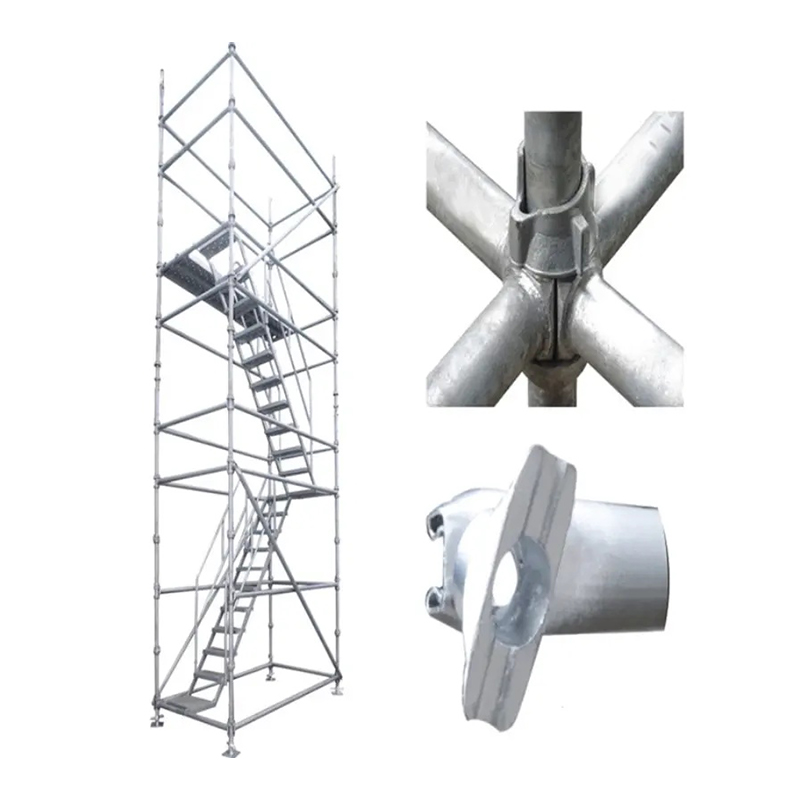
Cuplock Scaffolding
Major Advantages Compared with Conventional Scaffolding
Fewer Loose Parts and Lower Loss Rates
Traditional tube-and-fitting scaffolding normally requires a large quantity of clamps, bolts, nuts, and washers. These small components can be misplaced, damaged, mixed with other equipment, or left behind after dismantling. The resulting losses increase replacement costs and make rental inventory management more difficult.
Cuplock scaffolding integrates the main locking components into the standards and horizontal members. The fixed lower cup is permanently attached to the standard, while the upper cup remains associated with the standard assembly. This reduces dependence on loose hardware and helps rental companies maintain more accurate inventories. Fewer loose parts also mean less time spent sorting, counting, and preparing equipment for the next project.
Lower loss rates have a direct economic impact. The initial product price is only one part of the total cost of ownership. Transportation, storage, inspection, repair, replacement, labor, and downtime may account for a substantial portion of lifecycle expenditure. A system that reduces component loss and simplifies handling can provide greater long-term value even when its initial purchase price is not the lowest available option.
Rapid Erection and Dismantling
One of the most frequently recognized advantages of cuplock scaffolding is its installation speed. A single hammer strike can lock several horizontal members at one node. This can increase erection productivity by approximately 30 to 50 percent compared with many conventional tubular systems, depending on project layout, worker experience, site access, and the number of fittings required by the competing system.
Faster erection reduces labor hours and can allow other construction activities to begin earlier. On bridge and industrial projects, this may shorten the period during which roads, work areas, production equipment, or plant access routes are affected by temporary works. On building projects, quicker installation can support faster progress in masonry, plastering, painting, cladding, and mechanical work.
Dismantling is also more orderly. Once the supported load has been removed and the structure has been confirmed safe to dismantle, workers can release the nodes and lower the components in a controlled sequence. Reduced dependence on individual fittings helps make the process more predictable.
High Load-Bearing Capability
Cuplock scaffolding is suitable for high-load applications when correctly designed and erected. Q235 and Q345 carbon steel provide a useful combination of strength, weldability, and availability. Q345 steel, in particular, can be selected for components requiring higher strength characteristics, subject to the applicable design and manufacturing specifications.
The system is commonly applied to support concrete slabs, beams, bridge decks, and other substantial temporary loads. Its modular arrangement allows loads to be distributed through multiple standards and ledgers, while bracing helps maintain structural stability. The node design also reduces the number of separate clamp connections that must be checked and tightened.
Load-bearing performance is not determined by material grade alone. It also depends on standard length, wall thickness, node spacing, member condition, base support, bracing, eccentricity, lift height, horizontal loads, and the quality of erection. A professionally supplied system should therefore be accompanied by appropriate technical information and should be evaluated by qualified personnel for each project.
Forged Node Components for Impact Resistance
Critical top connectors are manufactured from forged steel rather than relying exclusively on brittle cast components. Forging refines the material structure through controlled deformation and can provide improved resistance to impact and repeated loading when the process is properly controlled.
This is important because scaffolding components are frequently handled, transported, assembled, dismantled, and reused. Node components may be struck during locking, exposed to accidental impacts, or subjected to high forces in support applications. A forged connector is better suited to these conditions than a lower-quality component that may crack or fracture under impact.
Forged construction does not eliminate the need for inspection. Components that are bent, severely corroded, cracked, excessively worn, or otherwise damaged must be removed from service. However, the use of forged steel in key connection areas improves the robustness of the system and supports safer repeated use.
Flexible Layout for Irregular Structures
Many construction projects do not have simple rectangular geometries. Water tanks, curved walls, circular towers, industrial vessels, bridge piers, silos, and architectural façades may require changing angles or non-standard platform arrangements. Conventional fixed-frame systems can be difficult to adapt to these conditions without additional tube cutting, special fittings, or complicated connection details.
The cuplock node allows horizontal members to rotate around the standard connection. This makes it possible to follow curved or circular layouts more effectively. Contractors can configure the system around irregular structures while retaining the basic modular components used on conventional areas of the project.
Adaptability can reduce the need for on-site modification. Less cutting and improvisation improves consistency and reduces the possibility of creating non-standard connections. It also allows material to be recovered and reused on future projects rather than being permanently altered for one specific geometry.
Strong Resistance to Movement and Vibration
A scaffold must resist vertical loads as well as lateral movement caused by wind, worker activity, equipment vibration, impact, and construction operations. The cuplock node creates a compact connection between horizontal and vertical members, while the circular node arrangement helps distribute forces around the standard.
When combined with diagonal bracing, proper ties, suitable foundations, and correct platform loading, the system provides a stable frame for demanding work. It is particularly useful in environments where repeated movement, vibration, or temporary dynamic effects may occur, such as industrial maintenance areas and large infrastructure projects.
The term earthquake-resistant should be understood in the context of complete system design. No individual node can guarantee performance during every seismic event. Seismic suitability requires engineering evaluation of the full temporary structure, including anchorage, bracing, foundation conditions, geometry, connection behavior, and local regulations. The integrated node nevertheless contributes to a structure with fewer loose components and more consistent joint engagement.
Manufacturing Quality and Process Control
The performance of cuplock scaffolding begins with manufacturing discipline. A reliable product requires more than standard steel tubes and welded cups. The material, forming, welding, heat treatment where applicable, dimensional control, surface finishing, inspection, and packing process must work together to create components that perform consistently in the field.
Material Selection
Q235 and Q345 carbon steel are widely used for structural components because they offer practical strength, weldability, and cost efficiency. Material selection must match the intended component and its loading requirements. Incoming steel should be verified against purchase specifications, including grade, thickness, dimensions, surface condition, and traceability documentation where required.
Material storage is also important. Tubes, plates, forged parts, and accessories should be protected from excessive moisture, contamination, and mechanical damage. Organized storage prevents material mix-ups and makes production planning more efficient.
Laser Cutting and Precision Component Preparation
Advanced laser cutting equipment can be used to produce precise plates, brackets, gussets, end components, and custom steel parts. Laser cutting provides narrow heat-affected zones, accurate contours, repeatable dimensions, and clean edges. These advantages are valuable when components must fit together with limited clearance or when a project includes customized support details.
Computer-controlled cutting also reduces manual layout errors and improves material utilization. For large steel components and non-standard formwork, digital production files can be converted into cutting programs, allowing the manufacturer to maintain repeatability across multiple batches.
For a scaffolding system, precision is relevant to the connection ends, cup components, base accessories, braces, and customized attachments. Consistent parts make assembly smoother and reduce the risk of forced fitting or excessive movement at the node.
Tube Processing and Forming
Standards and horizontal members must be cut to controlled lengths and prepared for end connector installation. Tube ends should be square and free from excessive burrs or deformation. Formed connectors must maintain the correct profile so that they enter the cup completely and remain seated during loading.
Production lines may use jigs and fixtures to hold components in the correct position during forming and welding. This is especially important for cup spacing and the alignment of connectors. Even small variations can accumulate in a tall scaffold, so process control at the component level supports accurate assembly at the project level.
Forging of Critical Connectors
Forged steel connectors are produced through controlled deformation of heated steel billets or preforms. The process can improve toughness and create a strong, compact component suitable for repeated impact and loading. After forging, the parts may undergo trimming, machining, dimensional inspection, and surface treatment.
The manufacturing advantages of forging are particularly relevant to cuplock top cups and end connectors. These parts must withstand hammer locking, handling impacts, and repeated service. A forged connector with accurate dimensions can help maintain secure engagement throughout the product lifecycle.
Welding and Fabrication
Welding connects cups, end fittings, braces, base components, and other parts to the steel tube. The weld must provide adequate strength without excessive distortion, undercut, porosity, incomplete fusion, or other defects. Consistent welding parameters, qualified procedures, suitable consumables, and trained operators are essential.
Professional fabrication may follow AWS and EN welding practices depending on the project and customer requirements. Welding personnel should be appropriately qualified for the processes they perform, and production staff should follow approved work instructions. Fixtures help maintain alignment while welding, reducing dimensional variation between components.
After welding, visual inspection is typically used to identify surface defects and assess weld appearance. Additional testing may be specified for critical components or special projects. Welded assemblies should also be checked for distortion, cup position, connector alignment, and overall dimensional compliance.
Surface Treatment and Corrosion Protection
Scaffolding is often used outdoors and may be exposed to rain, humidity, concrete residue, dust, and industrial chemicals. Surface treatment helps slow corrosion and preserve component usability. Depending on project requirements, products may receive painting, powder coating, hot-dip galvanizing, or another specified protective treatment.
The selected finish should be compatible with the expected environment, maintenance plan, and rental cycle. Surface preparation is important because dirt, oil, mill scale, and rust can reduce coating adhesion. A well-controlled coating process improves appearance and extends service life, while also making damage easier to identify during inspections.
Inspection, Testing, and Documentation
A structured quality control system should cover raw materials, in-process production, final dimensions, weld quality, surface treatment, packing, and dispatch. Inspection records can support traceability and help customers manage their own quality documentation.
Typical checks may include tube dimensions, wall thickness, component length, cup spacing, connector geometry, weld appearance, overall straightness, coating condition, and packaging integrity. Depending on the product specification, load tests or other performance evaluations may be conducted on representative assemblies or critical components.
Compliance with ISO 9001 principles supports a process-based approach to quality management. International references such as BS1139 and EN74 may also be relevant to scaffolding components and couplers, subject to the exact product configuration and project requirements. Customers should confirm the standards, test scope, and certification documents applicable to their order before production.
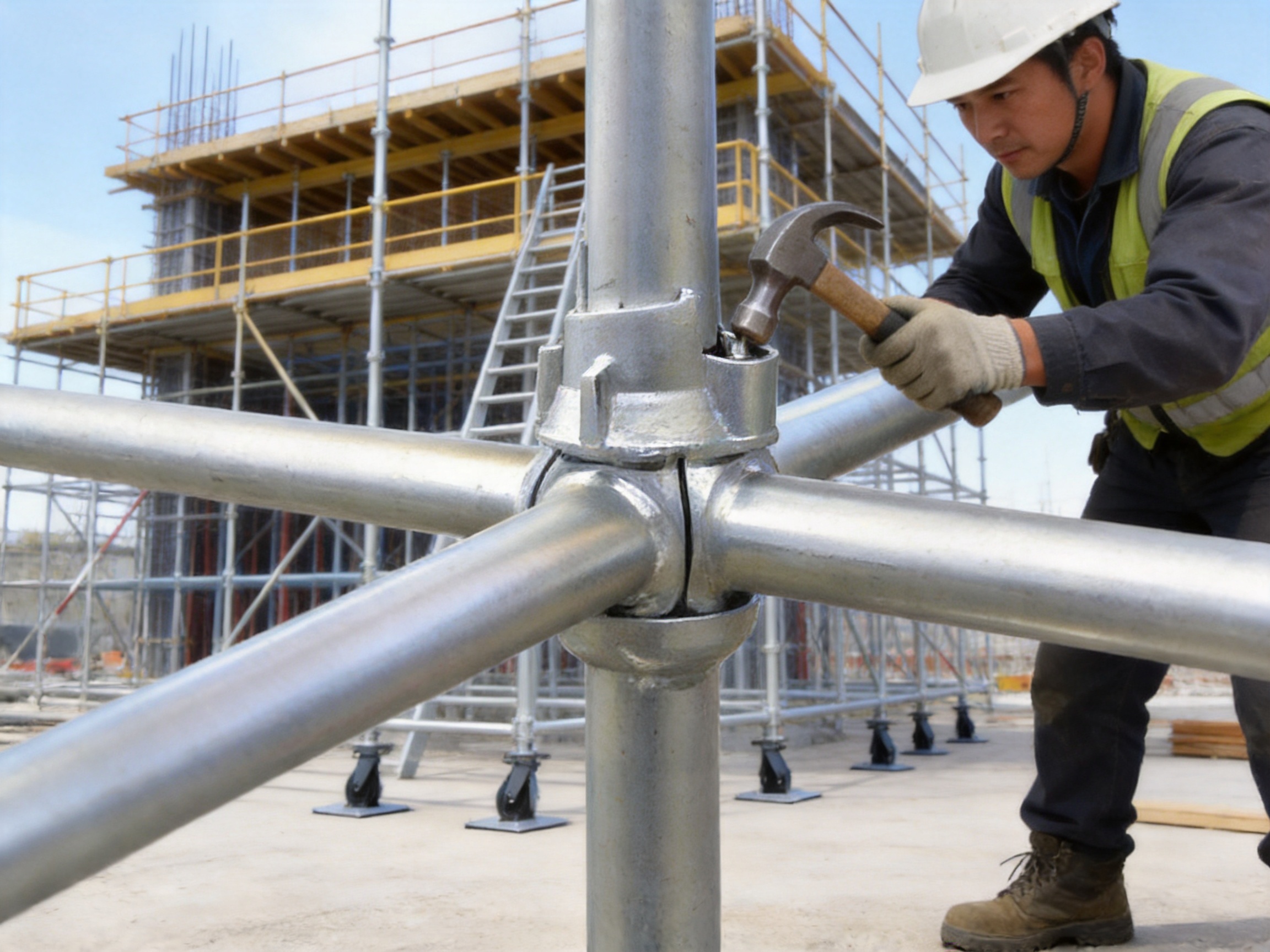
Application in Bridge Formwork Support
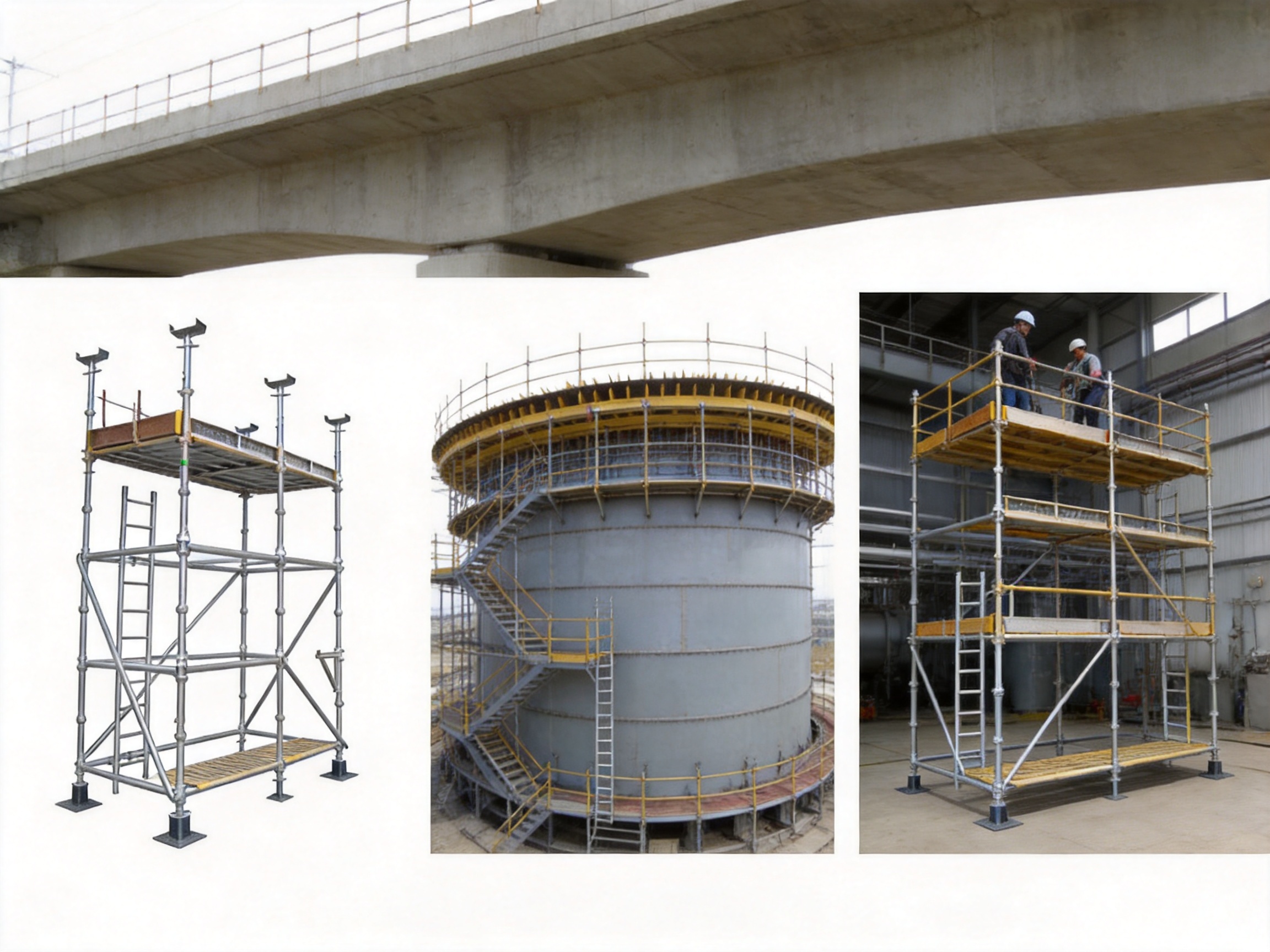
Bridge construction often requires temporary support systems capable of carrying heavy concrete elements, formwork, reinforcement, workers, equipment, and construction loads. Cuplock scaffolding is well suited to this role because its modular standards can be assembled into towers or continuous support grids beneath bridge decks and beams.
The system can be arranged at different heights and spacing according to the engineering design. Adjustable base jacks help accommodate elevation differences, while ledgers and transoms form a stable grid for supporting formwork. Diagonal bracing and tie arrangements contribute to resistance against lateral movement.
Bridge work frequently takes place over uneven ground, beside waterways, near roads, or in locations where access is restricted. A system with fewer loose fittings can simplify transportation and assembly. Reusable components can be deployed across different spans and support zones, reducing the need for project-specific fabrication.
For heavy bridge applications, the temporary works design must account for concrete placement sequence, fresh concrete pressure, construction equipment, wind, impact, differential settlement, and possible eccentric loading. The scaffold should not be treated as a generic tower without structural verification. A qualified engineer must determine the required standard spacing, bracing pattern, base arrangement, allowable loads, and erection sequence.
Infrastructure contractors have used this type of modular support concept on major transportation projects, including bridge construction associated with large river crossings. The value of the system lies in its combination of high-load potential, fast erection, repeatability, and adaptability to changing project geometry.
Application Around Curved and Circular Structures
Curved structures create challenges for access, working platform alignment, and material support. A rectangular scaffold may leave excessive gaps at some points while interfering with the structure at others. Cuplock nodes offer rotational flexibility that allows horizontal components to follow a curved alignment more naturally.
This is useful for circular water tanks, curved concrete walls, cooling towers, silos, towers, and architectural façades. The system can be arranged in segments around the circumference, with platforms and guardrails adjusted to suit the working area. Because the main components remain modular, the contractor can avoid extensive on-site bending or cutting of tubes.
Adaptable scaffolding improves both productivity and safety. A better-fitting platform can reduce awkward reaches and unnecessary movement by workers. It can also create more consistent access for inspection, reinforcement installation, concrete finishing, waterproofing, painting, and cladding.
Where the curve is especially tight or the structure changes shape significantly, special design attention is still required. Platform width, clearance, load distribution, tie locations, and access routes should be reviewed before erection. The ability to rotate members is an advantage, but it does not replace a planned layout.
Application in Industrial Maintenance
Refineries, power plants, thermal power stations, chemical facilities, warehouses, and manufacturing plants frequently require temporary access platforms for inspection, repair, coating, pipework, insulation, welding, and equipment replacement. Industrial environments often impose tight schedules because plant downtime is expensive.
Cuplock scaffolding allows maintenance teams to create platforms quickly and reconfigure them as work progresses. The system can be built around tanks, vessels, pipe racks, turbines, boilers, ducts, and structural frames. Its integrated nodes reduce the number of small fittings that must be moved through congested plant areas.
Industrial maintenance also demands careful control of access, loading, fire risk, contamination, and interference with operating equipment. The scaffold must be planned around emergency routes, process lines, electrical installations, hot work zones, and lifting operations. Where necessary, the system can be combined with specialized access equipment, protective sheeting, debris containment, and designated material handling routes.
In time-sensitive shutdown projects, installation speed can directly influence the maintenance window. A rapid and organized scaffold system enables trades to access more work fronts sooner. After the work is complete, efficient dismantling helps return the area to normal operation more quickly.
Application in Building and Masonry Construction
Cuplock scaffolding is also suitable for general building work. It can support bricklaying, blockwork, plastering, exterior wall finishing, painting, cladding, glazing, insulation, and façade maintenance. Platforms can be arranged at different levels to provide safe access for materials and workers.
Compared with improvised timber supports or loosely assembled tubular structures, a properly designed modular scaffold provides more consistent geometry and a clearer load path. Guardrails, toe boards, ladders, and platform accessories can be integrated into the overall arrangement.
For repetitive building work, standard component dimensions make it easier to establish an erection method statement. Material can be delivered in organized bundles, assembled in predictable sequences, and reused from one elevation to another. This supports better labor planning and reduces unnecessary handling.
Rental companies can benefit from the system’s durability and relatively low loss rate. Components can be issued as standard kits, inspected after return, cleaned, sorted, and prepared for the next customer. Because the system is suitable for many applications, a single inventory can serve building, industrial, infrastructure, and maintenance markets.
Comparison of Scaffolding System Characteristics
| Evaluation Factor | Cuplock Scaffolding | Conventional Tube-and-Fitting Scaffolding | Practical Implication |
|---|---|---|---|
| Primary connection method | Integrated cup-shaped node | Separate clamps, bolts, and nuts | Cuplock reduces loose hardware and simplifies connection work |
| Number of members per node | Up to four horizontal members at one level | Depends on fitting type and worker installation | Multiple connections can be secured efficiently |
| Erection speed | Fast hammer-lock assembly | Individual fitting adjustment and tightening | Potentially lower labor demand and shorter installation time |
| Adaptability | Suitable for straight, curved, and irregular layouts | Flexible but often dependent on numerous fittings | Useful for circular tanks, towers, and complex structures |
| Inventory management | Fewer loose parts | Large quantity of small fittings | Lower sorting effort and reduced risk of missing components |
| Heavy-load suitability | Suitable when engineered with proper spacing and bracing | Also possible, but highly dependent on fitting quality and tightening | Both require professional design; cuplock offers a consistent node arrangement |
| Repeated reuse | Well suited to rental and multi-project use | Reusable but subject to fitting wear and loss | Lifecycle value can improve through standardized components |
| Key quality concern | Cup alignment, forged connectors, tube strength, and weld quality | Clamp strength, bolt condition, tightening, and fitting compatibility | Quality control remains essential for either system |
Company Manufacturing Strengths and OEM Capability
The manufacturer behind this product is a professional steel fabrication enterprise specializing in custom steel formwork, modular scaffolding, heavy-duty steel structures, and OEM metal fabrication. Its production capabilities combine automated processing with experienced structural fabrication, allowing standard scaffolding products and customized components to be manufactured within the same industrial system.
Advanced laser cutting equipment supports the production of accurate plates, brackets, connection parts, and non-standard steel components. Bending, forming, and welding operations are organized to support both repeat products and project-specific designs. This is particularly valuable for customers who require custom dimensions, special support frames, bridge formwork accessories, or integrated steel assemblies.
The company applies AWS and EN welding practices and maintains a quality management approach aligned with ISO 9001 principles. Its manufacturing background includes certified welding craftsmanship, standardized production lines, and process inspection. These capabilities are relevant to customers who need consistent weld quality, reliable dimensions, and documentation suitable for international procurement.
With experience serving major infrastructure contractors and central state-owned engineering enterprises, the manufacturer understands the requirements of large projects where delivery reliability, traceability, and conformity are essential. Experience connected with projects such as the Sutong Yangtze River Bridge, Taizhou Bridge, and Sudan Thermal Power Plant reflects exposure to bridge, power, and heavy construction environments.
The company also holds multiple utility patents and applies engineering experience to product improvement. Its broader product portfolio includes bridge and infrastructure formwork, hydraulic tunnel trolleys, steel props, industrial steel structures, scaffolding systems, and heavy steel OEM components. This portfolio allows customers to source related temporary works and structural products from one manufacturing partner.
For overseas clients, integrated fabrication is a significant advantage. Laser cutting, bending, welding, assembly, surface treatment, inspection, and packing can be coordinated under one quality system. This reduces the communication gap between separate subcontractors and helps control dimensional compatibility between connected products.
Customization and OEM Services
Different projects may require variations in standard length, cup spacing, tube thickness, platform width, base adjustment range, bracing arrangement, surface finish, or packaging method. OEM manufacturing allows these requirements to be reviewed during the engineering and quotation stages.
A customer may provide drawings, sketches, load requirements, a bill of materials, or a general arrangement. The manufacturer can then evaluate the design, confirm manufacturability, identify critical dimensions, and prepare production data. For complex projects, a technical discussion should cover application, loading, environmental conditions, applicable standards, inspection requirements, and delivery schedule.
Customization should be controlled carefully. Any change to standard component geometry can affect compatibility, capacity, or erection procedures. A professional manufacturer should issue clear drawings or specifications for approval before production. Non-standard components should be visibly identified and packed separately to prevent confusion at the job site.
OEM services may include custom bridge formwork, support frames, welded steel structures, laser-cut plates, brackets, access systems, and special scaffolding accessories. This makes the manufacturer suitable not only for distributors and rental companies, but also for engineering contractors and project owners with unique temporary works requirements.
Inspection, Safe Use, and Maintenance
Proper manufacturing is only one part of scaffold safety. Components must be inspected before dispatch, upon arrival, before erection, during use, and after dismantling. Standards should be checked for bends, cracks, corrosion, damaged cups, deformed ends, and excessive wear. Ledgers and transoms should be checked for straightness, connector condition, and weld integrity.
Before erection, the site team should confirm that the foundation is suitable and that the planned arrangement matches the approved design. Base plates, jacks, sole boards, bracing, ties, platforms, guardrails, and access systems should be installed in the correct sequence. The structure should be kept plumb and adequately braced as it rises.
Loads must remain within the design capacity. Materials should not be stored randomly on platforms, and concentrated loads should be distributed as planned. Unauthorized alteration, removal of braces, or relocation of standards can seriously affect stability. Any change to the scaffold should be reviewed by the responsible competent person.
During use, the scaffold should be monitored for settlement, movement, impact damage, corrosion, unauthorized modification, and overloading. Weather conditions such as strong wind, heavy rain, flooding, or seismic activity may require additional inspection or temporary closure.
After dismantling, components should be cleaned, sorted, inspected, and stored off the ground where possible. Damaged parts must be clearly identified and repaired or removed from service. A disciplined maintenance program increases service life and preserves the value of the inventory.
Logistics, Packing, and Site Efficiency
Scaffolding is a high-volume product, so packaging and logistics affect total project cost. Components should be bundled according to type and length, with protective measures applied to prevent deformation and excessive surface damage. Clear labels can assist unloading, counting, and distribution across the site.
Standards, ledgers, transoms, braces, jacks, and accessories should be separated in a way that supports efficient erection. For rental companies, standardized packing makes it easier to create repeatable shipment units. For large infrastructure projects, shipment plans can be coordinated with erection zones and construction sequences.
Efficient logistics can reduce crane time, manual sorting, storage congestion, and the risk of mixing different component sizes. The integrated nature of cuplock parts already reduces the number of small fittings. Organized packing extends this advantage through the transportation and site-handling stages.
Why Product Selection Should Consider Total Cost
Comparing scaffolding solely on purchase price may produce an incomplete assessment. A lower-priced system may generate higher costs through slower erection, greater parts loss, more frequent repairs, difficult inventory control, or limited adaptability. Total cost should include labor, handling, transport, storage, inspection, maintenance, replacement, and project delay risks.
Cuplock scaffolding can create value through faster assembly, reduced loose-part losses, repeated reuse, flexible configuration, and suitability for multiple applications. A rental company can use the same inventory for building projects, bridge support, plant maintenance, and industrial access. A contractor can redeploy components across different phases of a major project.
The strongest economic advantage appears when the system is matched to the right application and managed correctly. Proper design prevents overuse, correct erection protects performance, and routine maintenance preserves the components. When these practices are combined with controlled manufacturing, the scaffold becomes a long-term productive asset rather than a disposable temporary material.
Project Selection and Procurement Checklist
Before ordering cuplock scaffolding, customers should define the intended application. Important questions include whether the system will be used for access, formwork support, bridge construction, industrial maintenance, masonry, or a combination of these activities. The required height, bay dimensions, platform levels, design load, environmental exposure, and expected reuse cycle should also be established.
Customers should request information about steel grade, tube dimensions, cup spacing, connector manufacturing method, welding standards, surface treatment, applicable certifications, and inspection procedures. If the system is intended for heavy support, the supplier should be informed of the design loads and project conditions rather than being asked to supply a generic set without technical review.
Delivery planning should cover component quantities, packing method, marking, spare parts, documentation, and replacement policy. For international orders, customers may also need to confirm container loading arrangements, export packing, customs documentation, and applicable destination-country requirements.
A capable OEM manufacturer should be able to discuss drawings, samples, production schedules, quality inspection, and technical support before the order is finalized. Clear communication at this stage prevents compatibility problems and reduces costly changes after delivery.
Frequently Asked Questions
What is cuplock scaffolding mainly used for?
Cuplock scaffolding is used for access platforms, bridge formwork support, industrial maintenance, masonry, exterior finishing, curved structures, towers, tanks, and general construction. Its modular design allows it to function as both a working scaffold and a temporary load-bearing support system when properly engineered.
How does the cuplock connection differ from a conventional clamp?
A conventional tube-and-fitting system uses separate clamps, bolts, and nuts to connect each member. A cuplock system uses a fixed lower cup and movable upper cup integrated with the standard. Horizontal members are placed into the node and locked with a hammer strike, reducing the number of loose components and simplifying erection.
Can cuplock scaffolding support heavy concrete formwork?
Yes, it can be used for heavy concrete formwork and bridge support when the complete structure is designed for the required loads. Standard spacing, member dimensions, base conditions, bracing, platform arrangement, concrete placement sequence, and lateral forces must all be checked by qualified engineering personnel.
Is cuplock scaffolding suitable for curved structures?
Yes. The node allows horizontal members to rotate, making the system suitable for curved walls, circular water tanks, towers, silos, and other irregular structures. The final arrangement must still provide sufficient clearance, platform stability, access, and bracing.
What steel grades are used?
The product is manufactured using high-strength Q235 or Q345 carbon steel, depending on the component and customer specification. The selected material should be confirmed in the technical documentation and matched to the intended loading and applicable standards.
Are the cuplock connectors forged or cast?
Key top connectors are manufactured from forged steel. Forged construction offers improved impact resistance and is suitable for components exposed to repeated hammer locking, handling, and heavy loading. The components should nevertheless be inspected regularly and removed from service if damaged.
Can the system be used by rental companies?
Yes. The limited number of loose parts, standardized components, broad application range, and reusable steel construction make cuplock scaffolding suitable for rental fleets. Rental operators should maintain systematic inspection, sorting, cleaning, repair, and inventory records.
What quality standards are relevant to the product?
Quality requirements may include ISO 9001 process control, BS1139 and EN74 references, AWS and EN welding practices, material certificates, dimensional inspection, and project-specific testing. The exact standards depend on the product configuration, destination market, and customer contract.
Can the manufacturer produce customized components?
Yes. The manufacturer provides OEM fabrication for customized scaffolding parts, bridge formwork, structural components, laser-cut plates, brackets, support frames, and related steel products. Customers should provide drawings or project requirements for technical review before production.
How should cuplock components be maintained?
Components should be inspected for bends, cracks, corrosion, damaged cups, deformed connectors, and weld defects. They should be cleaned after use, stored in an organized and dry location, and protected from unnecessary impact. Damaged components must be repaired by an approved process or removed from service.
Does the cup mechanism make the scaffold automatically safe?
No. The cup mechanism improves connection efficiency and reduces loose-part risks, but safety depends on the complete design and erection process. Foundations, bracing, ties, platform loading, guardrails, access, inspection, weather conditions, and worker training all remain essential.
What information should be supplied when requesting a quotation?
A quotation request should include quantities, component lengths, intended application, design load if applicable, surface treatment, standards, packing requirements, delivery destination, preferred schedule, and any drawings or special dimensions. Detailed information allows the manufacturer to prepare a more accurate and technically appropriate proposal.
Conclusion
Cuplock scaffolding provides a practical solution for projects that require speed, strength, flexibility, and repeatable assembly. Its cup-shaped locking mechanism eliminates much of the loose hardware associated with traditional tube-and-fitting systems. By securing several horizontal members at one node, it can improve erection productivity, simplify inventory management, and reduce material loss.
The system is particularly valuable for bridge formwork support, industrial maintenance, curved structures, masonry, and general building construction. High-strength Q235 or Q345 steel, forged connector components, controlled welding, precision fabrication, and systematic inspection contribute to dependable performance. The ability to reuse the same modular inventory across different projects further improves lifecycle value.
The manufacturer’s combination of laser cutting, bending, welding, OEM fabrication, quality management, and heavy steel production provides additional advantages for customers requiring customized or project-specific solutions. Experience with major infrastructure and industrial projects supports the capability to manufacture products for demanding applications while maintaining attention to accuracy and delivery reliability.
For the best result, cuplock scaffolding should be selected as part of a complete temporary works strategy. The structure must be engineered for its intended loads, erected by trained personnel, inspected throughout its service life, and maintained after every use. When product quality, manufacturing control, technical design, and site discipline are combined, cuplock scaffolding becomes a safe, efficient, and durable platform for modern construction and infrastructure development.
References
1. BS1139, Metal Scaffolding: General Requirements and Related Guidance.
2. EN74, Couplers, Spigot Pins and Base-Plates for Use in Falsework and Scaffolding.
3. ISO 9001, Quality Management Systems: Requirements.
4. AWS Structural Welding Code and Recommended Welding Practices for Steel Fabrication.
5. General Principles of Temporary Works Design for Scaffolding and Formwork Support.
6. Construction Safety Guidance for the Erection, Inspection, Use, Modification, and Dismantling of Scaffolding.
7. Technical Literature on Q235 and Q345 Carbon Steel for Structural Fabrication.
8. Engineering Guidance on Bridge Formwork, Temporary Support Towers, and Modular Access Systems.
Product: Cuplock Scaffolding



- Location
- Group 3, Fangzhuang Village, Rucheng Subdistrict, Rugao City, Nantong, Jiangsu, China
- Follow us
- Phone
- +86-13646196162
- info@hysonindustry.com
