 +86-13646196162
 info@hysonindustry.com




 русский
  عربى
عربى 


High-Performance Tie Beam Formwork for Bridge and Foundation Construction
 2026.08.22
Content
- 1 1. The Structural Role of Tie Beams
- 2 2. Main Design Characteristics
- 3 3. Leak-Proof Joint Technology
- 4 4. Manufacturing Process and Quality Control
- 5 5. Advantages Compared with Conventional Formwork
- 6 6. Efficient Assembly and Disassembly
- 7 7. Customization and Adjustable Configurations
- 8 8. Application in Bridge Substructure Construction
- 9 9. Application in Deep Foundation Engineering
- 10 10. Application in Precast Concrete Production
- 11 11. Application in Subway and Rail Transit Projects
- 12 12. Company Manufacturing Strengths
- 13 13. OEM and Heavy Metal Fabrication Capability
- 14 14. Inspection, Maintenance, and Service Life
- 15 15. Recommended Construction Workflow
- 16 16. Safety Considerations
- 17 17. Selecting the Right Tie Beam Formwork Supplier
- 18 18. Specification and Selection Table
- 19 19. Environmental and Economic Benefits
- 20 20. Why Precision Matters in Large Infrastructure Projects
- 21 21. Technical Cooperation and Project Support
- 22 22. Frequently Asked Questions
- 22.1 22.1 What is tie beam formwork used for?
- 22.2 22.2 What steel is used for the formwork?
- 22.3 22.3 How does the system reduce concrete leakage?
- 22.4 22.4 Can the formwork be customized?
- 22.5 22.5 How many times can it be reused?
- 22.6 22.6 Is it suitable for rental companies?
- 22.7 22.7 Can it be used for precast concrete?
- 22.8 22.8 How is the formwork assembled?
- 22.9 22.9 What should be checked before concrete pouring?
- 22.10 22.10 Does the manufacturer provide OEM fabrication?
- 22.11 22.11 What quality standards support production?
- 22.12 22.12 Can the formwork be exported?
- 23 23. Conclusion
- 24 References
- 25 Product: Tie Beam
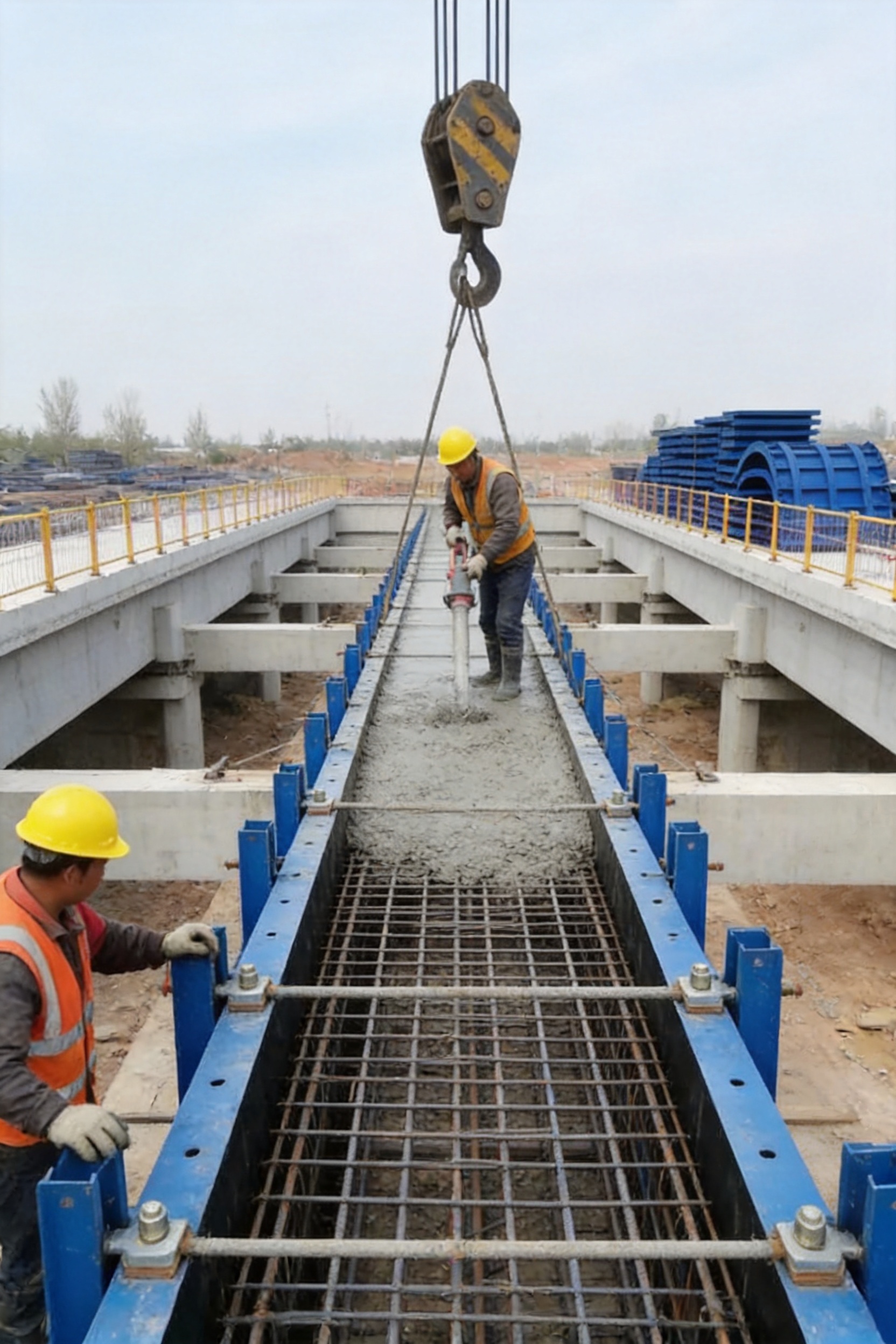
Tie beam formwork is a specialized steel formwork system used to create reinforced concrete beams that connect structural elements, stabilize foundations, and improve the overall behavior of bridge and infrastructure systems. Although a tie beam may appear relatively simple compared with a bridge deck, pier, or foundation cap, its geometry, alignment, surface quality, and dimensional consistency have a direct influence on structural performance. For this reason, contractors and engineering companies require formwork that can withstand repeated loading, maintain accurate dimensions, prevent concrete leakage, and support efficient site operations.
The tie beam formwork described in this article is a heavy-duty solution developed for bridge substructures, deep foundation works, precast concrete production, subway construction, railway infrastructure, and other demanding civil engineering applications. Manufactured from Q235B carbon steel and processed through precision laser cutting, the system combines structural strength with practical installation features. Reinforced ribs, standardized bolt holes, lifting lugs, sealed joints, and adjustable configurations allow the formwork to be used across a wide range of construction conditions.
Compared with ordinary fabricated molds, low-grade steel panels, timber formwork, or loosely assembled modular systems, precision steel tie beam formwork offers better dimensional stability, longer service life, faster installation, and improved concrete appearance. It is particularly valuable where formwork must be reused many times, moved between construction zones, or supplied to rental fleets. With a potential reuse cycle of 300 or more pours under appropriate handling and maintenance conditions, it can reduce total project costs while maintaining consistent production quality.
1. The Structural Role of Tie Beams
A tie beam is generally designed to connect two or more structural components. In bridge construction, it commonly links bridge piers or pile caps, increasing lateral stability and helping the substructure resist horizontal forces, vibration, and seismic effects. In building and industrial foundation systems, a tie beam may span between pile caps or foundation elements to distribute loads and restrain relative movement. In transportation infrastructure, tie beams can also be incorporated into underground structures and rail transit systems where space is limited and precision is essential.
The concrete tie beam must be formed according to an approved structural drawing. Its cross-section, length, reinforcement arrangement, chamfers, embedded components, and connection details must remain within the specified tolerances. Any deformation or misalignment in the formwork can result in an incorrect beam profile, uneven load transfer, insufficient concrete cover, or difficulty connecting the finished beam to adjacent structures.
Formwork therefore performs more than a temporary containment function. It defines the final geometry of the concrete member, transfers fresh-concrete pressure to the supporting structure, protects the reinforcement arrangement during placement, and contributes to the quality of the finished surface. A well-designed steel system improves all these functions at the same time.
For bridge and foundation contractors, the most important requirements usually include adequate strength, low deformation, leak-resistant joints, rapid assembly, safe lifting, simple stripping, compatibility with reinforcement placement, and the ability to adapt to different beam lengths. The tie beam formwork system addresses these requirements through a combination of material selection, structural reinforcement, precision fabrication, and standardized connection details.
2. Main Design Characteristics
2.1 Heavy-Duty Q235B Steel Construction
The primary material is Q235B carbon steel, a commonly used structural steel known for its balanced strength, weldability, and availability. When correctly processed and protected, Q235B is suitable for heavy fabricated formwork that must resist repeated assembly, transportation, concrete pressure, vibration, and stripping operations.
Material selection has a direct effect on the service life of a formwork panel. Thin or inconsistent steel may buckle under pressure, deform around bolt holes, or develop permanent distortion after repeated use. In contrast, properly designed Q235B panels with suitable plate thicknesses and reinforcing ribs can maintain their shape during demanding construction cycles.
The steel components are produced according to controlled manufacturing procedures. Plate preparation, cutting, edge treatment, welding, dimensional inspection, and final assembly are coordinated to minimize cumulative error. This process is especially important for long tie beam molds, where a small deviation at one end can create a significant alignment problem across the complete assembly.
2.2 Reinforced Panel Structure
Steel formwork must resist the lateral pressure generated by fresh concrete. The pressure may vary according to concrete slump, pouring speed, temperature, vibration intensity, beam height, and the use of admixtures. To maintain stability, the formwork uses reinforced panel construction rather than relying solely on a flat steel plate.
Reinforcing ribs increase the stiffness of the panels and help distribute pressure over a larger area. They also reduce the risk of local buckling and permanent deformation. The reinforcement layout can be engineered according to the dimensions of the tie beam, expected concrete pressure, support spacing, and lifting requirements.
A rigid panel offers several practical benefits. It helps maintain a consistent beam width, reduces the need for corrective adjustment during installation, improves the quality of the concrete surface, and permits repeated use. For rental companies and contractors operating large formwork inventories, resistance to deformation is especially important because equipment may be handled by different crews and transported to multiple projects.
2.3 Precision-Cut Components
Advanced laser cutting technology is used to produce accurately shaped steel plates and connection components. Compared with manual flame cutting or uncontrolled mechanical cutting, laser processing offers narrower cutting tolerances, cleaner edges, and more repeatable results. This is beneficial for panel joints, bolt-hole alignment, chamfer details, lifting points, and other areas where dimensional accuracy affects assembly.
Precision cutting also improves manufacturing efficiency. Components can be produced from digital drawings with consistent geometry, reducing the risk of variations between batches. When several tie beam molds are required for a large project, repeatability is essential. Panels manufactured to the same digital standard can be exchanged, combined, or repaired with less disruption.
CNC processing is particularly valuable for sealing areas. Tight-fitting joints reduce openings through which cement paste may escape. Cleaner joints also reduce the amount of grinding or surface repair required after stripping, helping the contractor achieve a more uniform fair-faced concrete finish.
3. Leak-Proof Joint Technology
Concrete leakage is one of the most common problems associated with poorly designed formwork. Fresh concrete can escape through gaps between panels, around bolt holes, at end closures, or at changes in beam geometry. Leakage may create fins, honeycombing, surface voids, exposed reinforcement, and localized loss of concrete cover. It can also contaminate the reinforcement and increase cleaning and repair work.
The tie beam formwork uses a sealing-oriented joint design combined with precision CNC cutting. The objective is to make adjacent panels meet closely and securely so that concrete paste remains inside the mold. Depending on the project requirements, additional sealing materials or approved joint treatment methods may be used by the construction team.
A leak-resistant joint provides benefits beyond appearance. By retaining cement paste, it helps preserve the designed concrete composition at the formwork boundary. It reduces the risk of weak edges and surface defects, protects embedded steel from exposure, and minimizes the need for post-pour patching. On projects involving repeated tie beam production, the cumulative savings in repair labor and materials can be significant.
Joint quality is influenced by both manufacturing accuracy and site handling. Even a well-made panel can leak if it is installed on an uneven base, if bolts are not tightened correctly, or if old concrete residue remains on the contact surface. For this reason, proper cleaning, inspection, release-agent application, and controlled tightening should be included in the installation procedure.
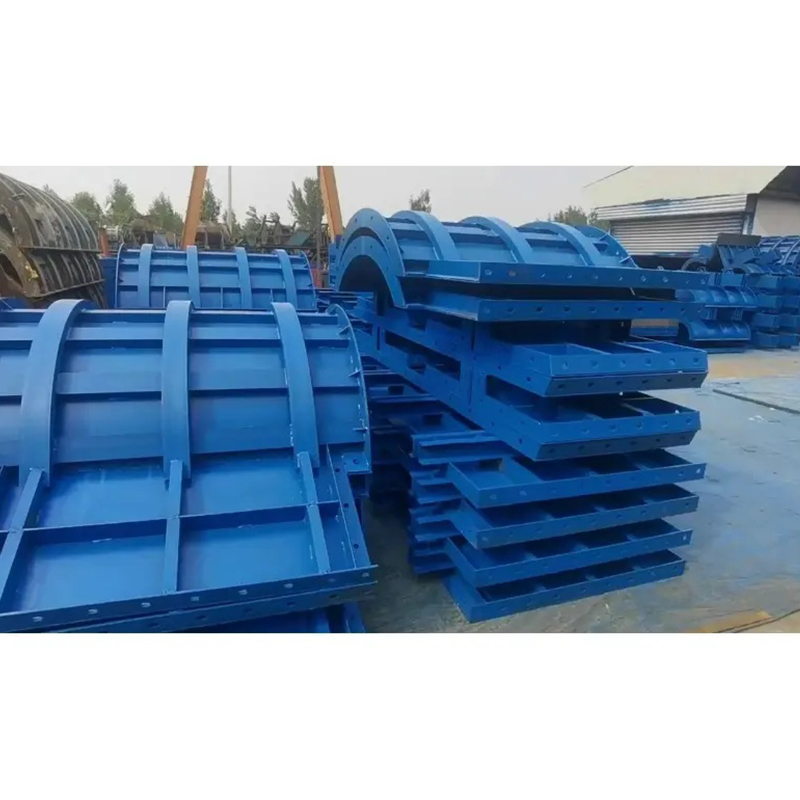
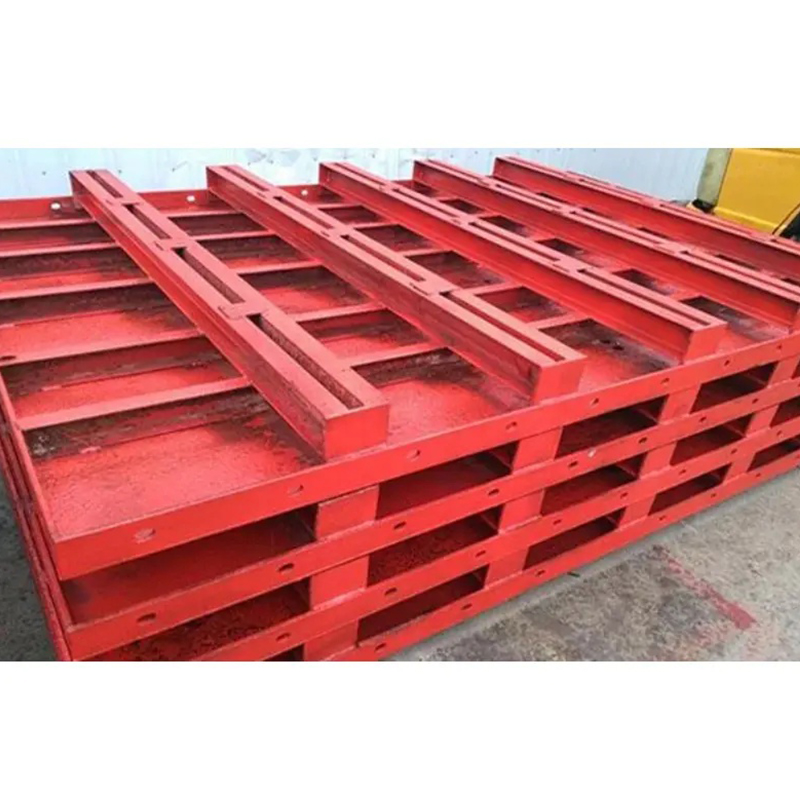
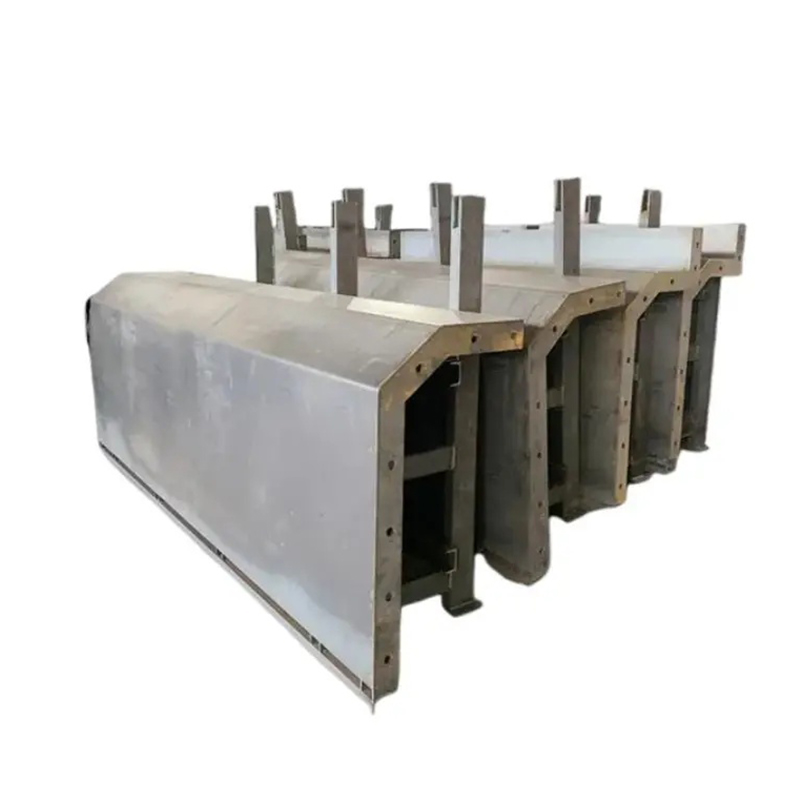
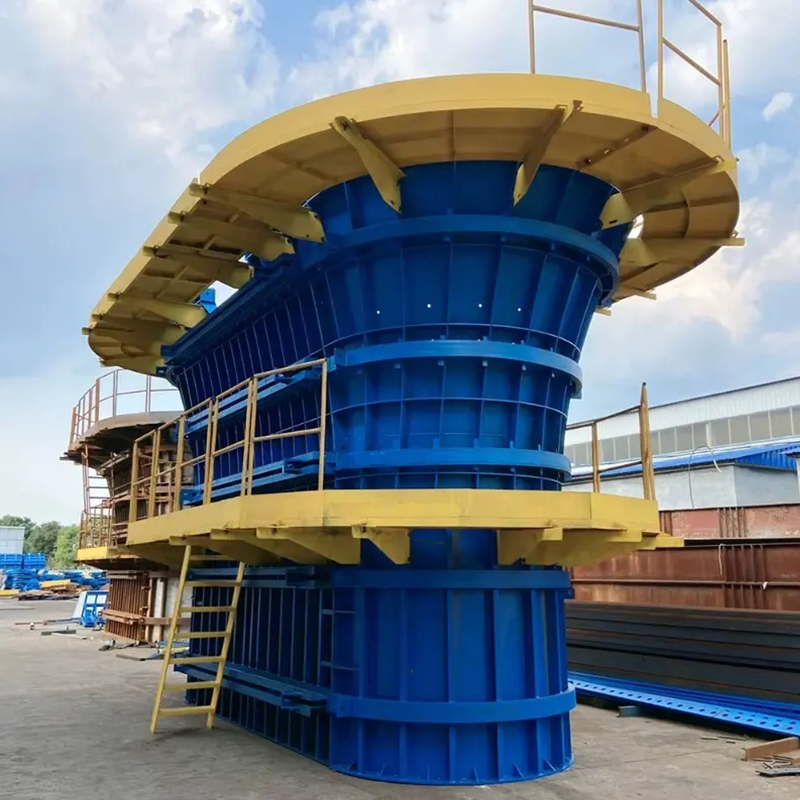
Tie Beam
4. Manufacturing Process and Quality Control
The performance of a steel tie beam mold begins with the manufacturing process. A formwork supplier must be able to transform engineering drawings into stable, repeatable, and accurately assembled components. This requires more than access to a cutting machine. It requires process control from material purchasing through final inspection.
4.1 Engineering Review and Production Planning
Before fabrication begins, the design information is reviewed to confirm beam dimensions, panel arrangement, connection locations, lifting requirements, support conditions, chamfer details, and any embedded or reserved components. The manufacturing team can identify potential interference between reinforcement, tie rods, bolts, lifting lugs, and external supports before steel is cut.
Production planning also considers whether the mold will be used for a single project, a series of identical beams, a precast production line, or a rental fleet. A formwork system intended for repeated relocation may require additional lifting points, wear-resistant contact details, replaceable components, or reinforced handling zones.
4.2 Steel Plate Preparation
Steel plates are checked before entering the cutting process. The inspection may include material identification, thickness verification, visual examination, and review of the applicable material documentation. Consistent raw material quality reduces the risk of unexpected variation during welding and assembly.
Plate surfaces are prepared so that cutting and welding can be carried out effectively. Contamination, excessive rust, oil, and other surface conditions can interfere with weld quality or coating performance. Proper preparation is therefore an important part of long-term durability.
4.3 Laser Cutting and CNC Processing
Laser cutting is used to produce the main plates, ribs, end panels, connection plates, and other shaped components. Digital control allows the same geometry to be repeated accurately across a production order. CNC drilling or machining can be used for bolt holes and other connection features, improving alignment during assembly.
Accurate hole positioning is particularly important because standardized bolt patterns allow workers to assemble the mold quickly without extensive field modification. If holes are misaligned, crews may need to enlarge openings, use improvised fasteners, or apply excessive force during assembly. These practices reduce safety and can weaken the formwork. Precision production avoids these problems.
4.4 Forming, Fit-Up, and Welding
After cutting, plates and ribs are positioned according to the approved fabrication drawings. Fit-up checks confirm that components are correctly aligned before welding. Welded connections must provide adequate strength without creating excessive distortion.
Hyson applies certified AWS and EN welding craftsmanship within its production system. Welding procedures, operator qualifications, joint preparation, heat input, and inspection requirements can be controlled according to project specifications. Proper welding practice is essential because formwork is repeatedly exposed to vibration, impact, lifting forces, and concrete pressure.
Welding sequence also affects dimensional accuracy. Excessive heat concentrated in one area can cause warping or shrinkage. Controlled sequencing, temporary fixtures, and intermediate measurements help keep panels within the required tolerances. After welding, critical dimensions can be checked again before the components are assembled into complete mold sections.
4.5 Final Assembly and Inspection
Final inspection may include checking overall length, width, height, diagonals, flatness, bolt-hole positions, lifting lug alignment, weld appearance, panel contact surfaces, and the condition of protective coatings. Components are assembled or trial-fitted when necessary to verify that the system can be installed as intended.
Inspection records support traceability and provide a reference for future maintenance. For large projects, identification marks can help crews match panels with drawings and installation sequences. This reduces the possibility of using the wrong component or reversing a panel during site assembly.
The company operates under ISO 9001 quality management principles. A documented quality system encourages consistent procedures, corrective action, process monitoring, and continuous improvement. For contractors, this provides greater confidence that repeat orders and replacement parts will conform to the original requirements.
5. Advantages Compared with Conventional Formwork
5.1 Steel Versus Timber Formwork
Timber formwork can be economical for small or irregular projects, but it is more vulnerable to moisture, swelling, damage, dimensional changes, and inconsistent surface quality. Repeated stripping may also damage timber edges and make it difficult to maintain exact beam dimensions.
Steel tie beam formwork provides greater dimensional stability and is better suited to repetitive construction. It can withstand wet concrete, mechanical handling, and controlled vibration without the same level of deterioration. Its smooth contact surface can produce a more consistent concrete finish, particularly when the panels are cleaned and coated correctly.
Timber may still be useful for minor adjustments or temporary closures, but a steel mold is generally more efficient when many identical tie beams must be produced or when the project requires a reliable fair-faced finish.
5.2 Steel Versus Low-Quality Fabricated Molds
Low-quality fabricated molds may appear less expensive at the purchase stage, but their total cost can increase through frequent repairs, dimensional correction, leakage, and premature replacement. Poorly positioned bolt holes slow installation, weak ribs permit deformation, and rough welded surfaces can damage workers or interfere with stripping.
The tie beam system is designed as an engineered product rather than a collection of loosely connected steel plates. Its components are produced through controlled cutting, welding, and inspection. The resulting accuracy supports faster assembly and more predictable performance across multiple pours.
5.3 Steel Versus Generic Modular Panels
Generic modular panels provide flexibility, but they may require many accessories and field adjustments when used for specialized tie beam dimensions. A purpose-designed tie beam mold can reduce the number of pieces and simplify the connection arrangement. This is valuable when beam geometry is fixed or when the contractor wants a dedicated production system.
At the same time, the tie beam formwork can be customized for different lengths, spans, chamfers, and project requirements. It therefore combines the advantages of dedicated tooling with a useful degree of adaptability.
5.4 Lower Total Cost of Ownership
Purchase price is only one part of formwork economics. A more useful evaluation considers labor, installation time, repair, cleaning, storage, transportation, reuse cycles, concrete surface correction, and downtime. A durable and accurate mold can provide lower total cost of ownership even when its initial price is higher than a basic alternative.
With proper maintenance and handling, the formwork can be reused 300 times or more. Actual service life depends on loading conditions, lifting practices, cleaning methods, storage, release-agent use, and repair procedures. Nevertheless, high reuse potential makes the system suitable for contractors and rental companies seeking long-term asset value.
6. Efficient Assembly and Disassembly
Construction sites often operate under time pressure. A formwork system that requires extensive training or complicated temporary arrangements can slow the entire foundation sequence. The tie beam system uses standardized bolt holes, practical connection details, and lifting lugs to make assembly and disassembly more straightforward.
Panels can be positioned using approved lifting equipment and connected with bolts or other specified fasteners. Standardized connections reduce the need for field cutting and drilling. Workers can follow an installation sequence based on panel identification and project drawings, helping to reduce errors between different work shifts.
Efficient stripping is equally important. After the concrete reaches the required strength and the engineer or site supervisor approves removal, panels can be released and lifted away for cleaning or relocation. Smooth contact surfaces and suitable release agents help reduce adhesion between steel and concrete.
Faster assembly can reduce crane occupancy, labor hours, and the time required before concrete placement. Faster disassembly can accelerate the movement of equipment to the next beam or work zone. These time savings become increasingly valuable on bridge projects involving many identical piers or foundation connections.
Although the connection system is user-friendly, safety procedures must always be followed. Workers should use appropriate lifting plans, inspect lifting lugs and bolts, maintain exclusion zones, and avoid standing beneath suspended panels. Assembly should be carried out on a stable and properly prepared base, with temporary bracing installed whenever required by the engineering method statement.
7. Customization and Adjustable Configurations
Infrastructure projects rarely use exactly the same tie beam dimensions in every location. Span length, cross-sectional size, pier spacing, pile cap arrangement, reinforcement congestion, access conditions, and construction sequence may vary. A formwork supplier must therefore offer customization rather than only standard sizes.
7.1 Length Adjustment
The formwork can be configured or extended to accommodate different tie beam lengths. Adjustable length arrangements may use additional panels, end closures, splice connections, or project-specific modules. The final arrangement should be verified against structural drawings so that the mold remains stable and the joints are properly sealed.
Length flexibility is especially useful for contractors working on multiple projects. Instead of purchasing a completely different mold for every beam, the contractor may use a base system with interchangeable or extendable sections. This can improve equipment utilization and simplify inventory management.
7.2 Chamfering Options
Custom chamfering strips can be supplied where the finished beam requires softened corners or a defined architectural edge. Chamfers can improve appearance, reduce the risk of edge damage during handling, and support consistent concrete finishing.
Chamfer details should be agreed during the design stage. The strip must be securely fixed, accurately aligned, and compatible with stripping. Precision manufacturing helps ensure that chamfers remain consistent across repeated pours.
7.3 Project-Specific Accessories
Depending on the application, the mold may be adapted with additional supports, access openings, embedded-item provisions, lifting points, working platforms, or special end closures. These details should be designed in cooperation with the engineering and construction teams rather than improvised on site.
Customization is not limited to physical dimensions. Documentation, identification marks, assembly drawings, inspection requirements, and packaging can also be adapted to project needs. Such coordination reduces installation uncertainty and supports better control of large infrastructure work packages.
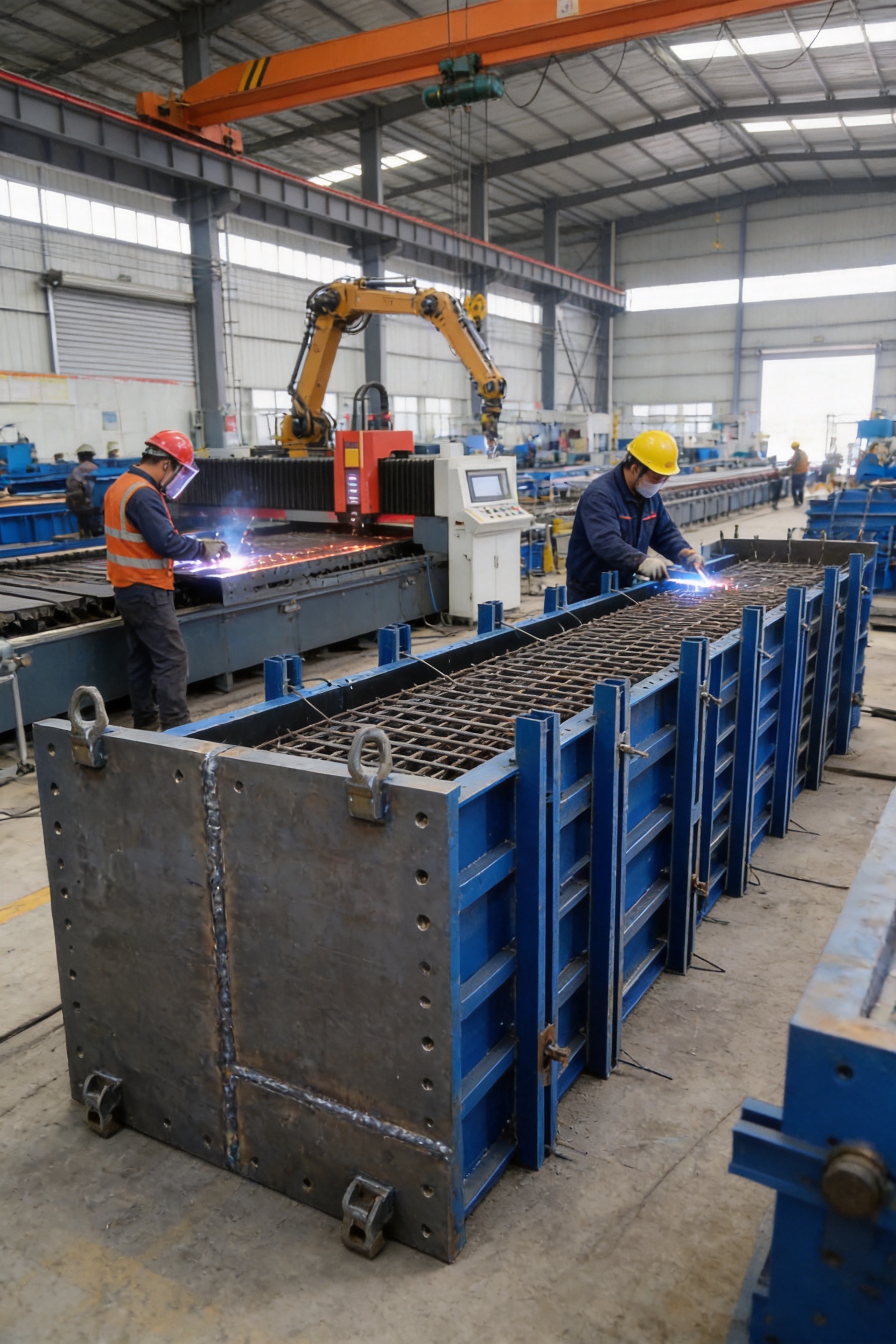
8. Application in Bridge Substructure Construction
Bridge substructure work is one of the main applications for tie beam formwork. A tie beam connecting bridge piers can increase lateral stiffness, improve the interaction between support elements, and contribute to the overall stability of the bridge system. It may be used in highway bridges, railway bridges, viaducts, and other elevated transportation structures.
On a bridge site, construction conditions may include restricted access, changing ground levels, high reinforcement density, temporary works, and strict project schedules. The formwork must be sufficiently robust to withstand these conditions while remaining practical to transport and position.
Before installation, the contractor typically confirms the location of the piers or pile caps, checks the elevation, prepares the supporting base, and verifies the reinforcement cage. The panels are then positioned according to the approved drawings. Bolted joints are tightened, end closures are installed, and all contact areas are inspected for possible gaps.
During concrete placement, the pouring rate and sequence should be controlled to avoid sudden unbalanced pressure. Vibration should be performed carefully so that the concrete is fully compacted without damaging the reinforcement or overloading local areas of the formwork. After curing and approval for stripping, the panels can be removed, cleaned, inspected, and reused.
A properly manufactured mold helps produce a clean tie beam surface with accurate edges and consistent dimensions. This reduces corrective work and supports the efficient connection of the tie beam to adjacent bridge components.
9. Application in Deep Foundation Engineering
Deep foundation projects often include pile caps, ground beams, foundation beams, and connecting members that distribute loads between piles or structural supports. Tie beam formwork can be used to cast beams spanning between pile caps or connecting foundation elements in industrial facilities, high-rise buildings, warehouses, power facilities, and other major structures.
In these applications, the formwork must accommodate reinforcement that may be dense and difficult to access. Accurate panel geometry helps ensure that the designed concrete cover is maintained. Tight joints reduce the risk that cement paste will escape around congested reinforcement, while adjustable lengths allow the system to adapt to different foundation layouts.
Foundation construction may take place in muddy, wet, dusty, or confined conditions. Steel formwork is advantageous because it is less sensitive to moisture than timber and can be cleaned after use. Reinforced panels also resist damage during movement by cranes or forklifts when appropriate handling procedures are followed.
For high-rise and industrial projects, tie beam construction is often coordinated with multiple trades. A formwork system that can be installed and removed quickly helps reduce interference with reinforcement, concrete delivery, waterproofing, drainage, and subsequent structural work.
10. Application in Precast Concrete Production
Precast plants require molds that can produce repeated units with stable dimensions and predictable surface quality. Tie beam formwork is suitable for manufacturing standardized beams in a controlled production environment. Its steel construction supports repeated cycles, while precision-cut components help maintain consistency from one unit to the next.
In precast production, the mold is normally placed on a prepared casting bed or production platform. Reinforcement and embedded components are installed, release agent is applied, and concrete is placed and compacted. After the required curing period, the mold is stripped and prepared for the next cycle.
The quality of the mold directly affects production efficiency. If the panel distorts, workers may need to make adjustments before every pour. If the joints leak, the precast unit may require grinding or patching. If the surface is uneven, the finished products may fail visual or dimensional inspections. A rigid, accurately assembled steel mold reduces these sources of variation.
Fair-faced concrete requirements are often strict in precast manufacturing. Clean contact surfaces, well-maintained edges, appropriate release agents, and leak-resistant joints can help achieve smooth and uniform finishes. The mold can also be supplied with custom chamfer strips to create repeatable edge details across a production batch.
11. Application in Subway and Rail Transit Projects
Subway and rail transit construction frequently takes place in restricted spaces where equipment access, ventilation, work sequencing, and safety control are critical. Tie beams and connecting foundation members may be required in underground stations, tunnel approaches, elevated sections, depots, and rail viaducts.
In confined environments, the formwork must be easy to position and remove without unnecessary handling. Standardized connection points and lifting lugs help crews organize installation. Custom dimensions can be developed to suit limited clearances, unusual reinforcement layouts, and complex underground geometry.
Rail infrastructure also demands dimensional accuracy. Small deviations can affect connections, clearances, drainage details, or subsequent installation of structural and mechanical components. Precision steel formwork provides a stable reference during concrete placement and helps reduce variation between repeated structural units.
Because rail projects often involve long construction schedules and repeated work zones, equipment durability is important. A reusable system that can be cleaned, inspected, relocated, and reinstalled many times can support consistent progress throughout the project.
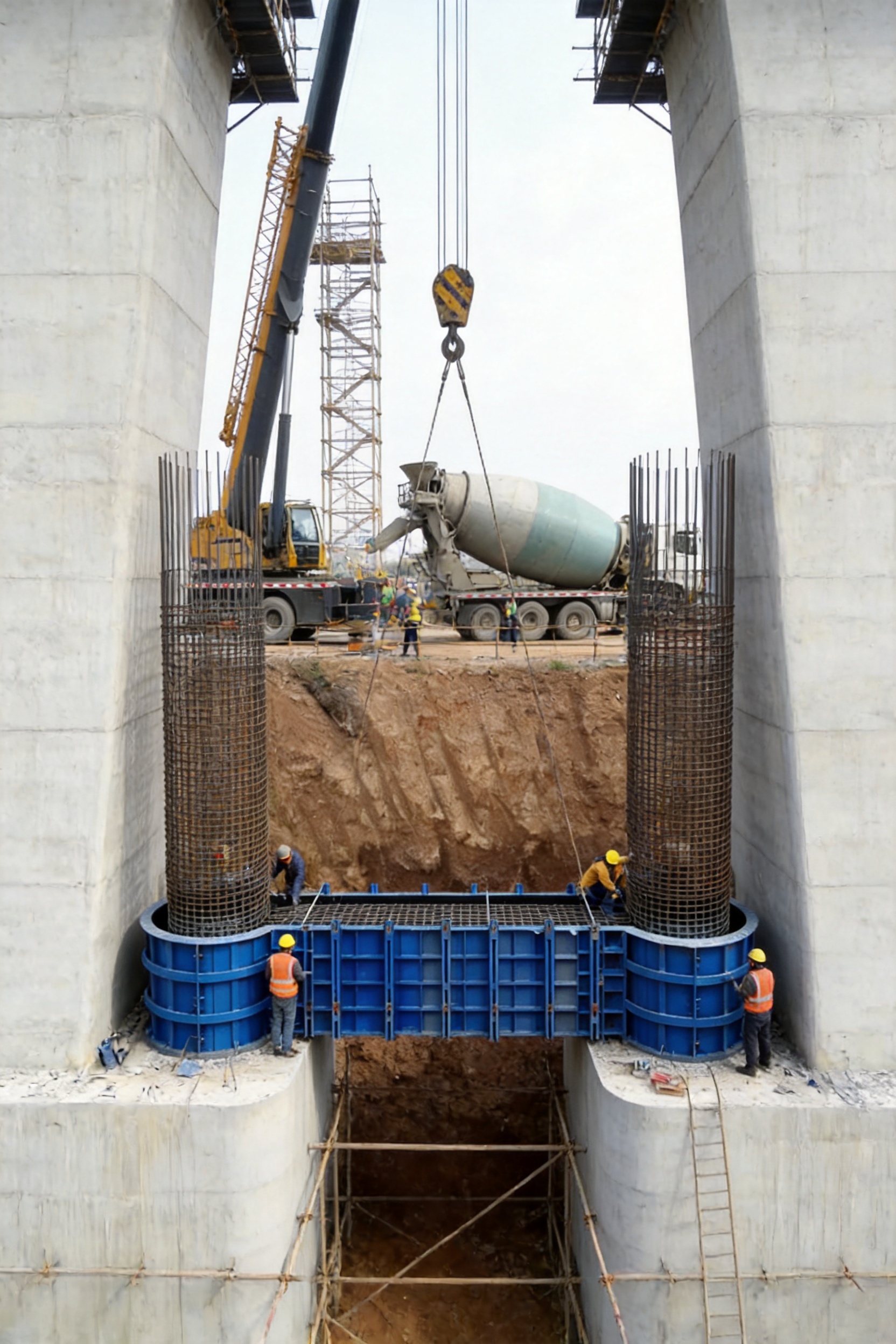
12. Company Manufacturing Strengths
Nantong Hyson Road and Bridge Formwork Co., Ltd. is a professional manufacturer of custom steel formwork, ringlock scaffolding, steel props, heavy-duty steel structures, and OEM metal fabrication. Its product range is supported by advanced laser cutting equipment, standardized production lines, and integrated bending and welding capabilities.
The company’s manufacturing model combines automated processing with qualified fabrication skills. Laser cutting provides accurate plate geometry, while bending and forming operations create the required profiles. Welding is carried out according to certified AWS and EN craftsmanship requirements, supporting reliable connections for structural and formwork components.
This integrated capability is important for customers requiring non-standard steel products. Instead of coordinating separate suppliers for cutting, bending, drilling, welding, and finishing, a client can work with one manufacturer for a more complete production solution. Centralized manufacturing can simplify communication, reduce dimensional inconsistencies, and improve production scheduling.
Hyson operates under ISO 9001 quality management principles and reports compliance with BS1139 and EN74 standards for applicable scaffolding products. The company also has 12 utility patents and experience supplying major construction organizations. These credentials indicate an established approach to product development, process management, and engineering support.
The company has served strategic customers including CCCC, CRCC, and other large infrastructure organizations. Its project experience includes major bridge and industrial works such as the Sutong Yangtze River Bridge, Taizhou Bridge, and Sudan Thermal Power Plant. Experience on large projects can strengthen a manufacturer’s understanding of dimensional control, documentation, delivery coordination, and high-volume production requirements.
Although each project must be evaluated according to its own specifications, experience with large infrastructure clients provides a useful foundation for manufacturing tie beam formwork intended for demanding applications. It also supports the development of customized solutions for contractors, precast plants, rental companies, and overseas engineering partners.
13. OEM and Heavy Metal Fabrication Capability
Heavy metal fabrication involves the production of large, thick, or structurally significant steel components. It requires suitable machinery, trained personnel, controlled welding procedures, accurate measurement, and an understanding of how fabrication tolerances influence field installation.
For tie beam formwork, OEM capability means that the mold can be manufactured according to the customer’s drawings, dimensions, connection requirements, and construction method. The supplier can assist with engineering clarification, fabrication optimization, component identification, packaging, and delivery planning.
Hyson provides integrated laser cutting, bending, and welding services for heavy steel components used in construction, mining, agriculture, transportation, and industrial applications. This broad experience can be beneficial when a project requires related products, such as bridge formwork, hydraulic tunnel trolleys, steel supports, platforms, access structures, or custom structural frames.
OEM manufacturing also supports brand-neutral supply. Contractors and distributors can request products manufactured to their own specifications, quality requirements, and project documentation standards. Where necessary, the supplier can coordinate production of repeat batches so that replacement panels or additional molds remain compatible with the original equipment.
14. Inspection, Maintenance, and Service Life
Even the strongest formwork requires proper maintenance. Before every use, workers should inspect panel faces, joints, bolt holes, lifting lugs, reinforcing ribs, welds, and support connections. Any deformation, cracking, excessive corrosion, or damage should be evaluated before the mold is returned to service.
Concrete residue should be removed after stripping. Hardened concrete left on the contact surface can create dimensional inaccuracies, interfere with sealing, and damage the panel during subsequent assembly. Cleaning should use methods that do not excessively scratch or deform the steel surface.
Release agents should be applied evenly and according to the product manufacturer’s instructions. Excessive release agent can contaminate the concrete surface, while insufficient application can make stripping difficult. A controlled release-agent program helps protect both the mold and the finished beam.
Bolts, nuts, lifting accessories, and replaceable sealing elements should be checked regularly. Damaged fasteners should not be reused where their strength or thread condition is uncertain. Lifting lugs deserve special attention because they are exposed to dynamic handling forces during relocation.
Storage conditions also affect service life. Panels should be placed on stable supports, kept off standing water, and protected from unnecessary impact. If the formwork is stored outdoors for extended periods, suitable corrosion protection and periodic inspection should be arranged.
Under appropriate use and maintenance conditions, the system can achieve a reuse rate of 300 or more cycles. The actual number depends on design loads, concrete pressure, handling methods, cleaning, storage, and repair quality. A maintenance record can help rental companies and contractors determine when a panel requires refurbishment or replacement.
15. Recommended Construction Workflow
15.1 Preparation Before Delivery
The contractor should confirm that the formwork dimensions match the latest approved drawings. Beam length, width, depth, chamfers, connection points, reinforcement clearance, and embedded components should be reviewed before the equipment arrives at the site.
Site access should also be considered. The delivery route must accommodate the dimensions and weight of the panels. Suitable unloading equipment, storage areas, lifting plans, and temporary supports should be prepared in advance.
15.2 Inspection Upon Arrival
Upon delivery, the receiving team should check the packing list, component identification, quantities, visible damage, and accessory completeness. Any discrepancy should be recorded and communicated promptly. Early inspection prevents delays during installation.
15.3 Base and Reinforcement Preparation
The supporting base must be sufficiently level and stable. Survey points should be established so that the formwork can be aligned accurately. Reinforcement cages, starter bars, embedded parts, and construction joints should be checked before panel installation.
Where tie beams connect piers or pile caps, the adjacent structural elements should be cleaned and verified. The reinforcement must be positioned according to the design, with adequate cover blocks and temporary supports.
15.4 Panel Installation
Panels are lifted and positioned in the planned sequence. Standardized bolt holes and connection details help guide assembly. The crew should check verticality, level, length, diagonals, and alignment before all fasteners are fully tightened.
Joints, corners, end closures, and chamfer strips should be inspected carefully. Any specified sealing material should be installed continuously and without breaks. The formwork should be braced in accordance with the approved temporary works design.
15.5 Concrete Placement
Concrete should be placed at a controlled rate and distributed evenly. Sudden loading of one side may cause unnecessary pressure and movement. Vibration should be sufficient to achieve compaction but should not be used in a way that damages joints or displaces reinforcement.
During the pour, the site team should observe the mold for leakage, movement, unusual noise, or visible deformation. If a problem is identified, concrete placement should be controlled or paused while the issue is assessed and corrected safely.
15.6 Stripping and Reuse
Stripping should occur only after the concrete has achieved the required strength and the responsible engineer or supervisor has approved removal. Panels should be released carefully, without using uncontrolled impacts that may damage edges, welds, or lifting points.
After removal, the mold should be cleaned, inspected, and prepared for the next cycle. Defects should be documented so that repairs can be completed before the next installation.
16. Safety Considerations
Steel formwork panels can be heavy and may create significant hazards if lifted or assembled incorrectly. A project-specific method statement and risk assessment should define the lifting equipment, rigging arrangement, crew responsibilities, exclusion zones, temporary bracing, and emergency procedures.
Lifting lugs must be used only within their approved capacity and configuration. Slings, shackles, hooks, and cranes should be inspected before use. Workers must not stand beneath suspended panels or place hands between components while they are being aligned.
During assembly, bolts should be installed in the correct sequence and tightened according to the project procedure. Temporary supports should remain in place until the assembly is stable and the permanent restraint system has been completed.
Work platforms and access arrangements should be provided where workers need to reach elevated connection points. Good housekeeping is also essential because loose bolts, concrete residue, lifting accessories, and steel edges can create trip or impact hazards.
Safety performance depends on both product design and site management. Standardized holes, lifting lugs, and manageable components can make work easier, but they do not replace training, supervision, inspection, and compliance with local regulations.
17. Selecting the Right Tie Beam Formwork Supplier
Customers should evaluate more than the appearance or quoted price of a mold. A capable supplier should be able to explain material grades, panel construction, reinforcement, connection details, welding procedures, inspection methods, surface treatment, packaging, and after-sales support.
Drawing review is another important factor. The supplier should ask for sufficient project information and identify potential conflicts before manufacturing. A supplier that simply copies dimensions without considering installation, lifting, reinforcement, and stripping may create avoidable problems later.
Production capacity matters when a project requires multiple molds or a short delivery schedule. The supplier should have suitable cutting, forming, welding, inspection, and storage facilities. It should also be able to maintain consistent quality between the first and last production batch.
Past experience with bridges, foundations, precast products, or heavy steel components can provide useful evidence of practical competence. Customers may also consider quality certifications, welding qualifications, patent ownership, project references, and the ability to provide technical documentation.
For international customers, communication and export coordination are equally important. Clear drawings, packing lists, component marks, inspection records, and installation instructions can reduce uncertainty during overseas delivery and site assembly.
18. Specification and Selection Table
| Item | Typical Requirement or Feature | Project Benefit |
|---|---|---|
| Product type | Heavy-duty steel tie beam formwork | Suitable for repeated bridge and foundation construction |
| Primary material | Q235B carbon steel | Good balance of strength, weldability, and durability |
| Processing method | Laser cutting and CNC processing | Accurate geometry and repeatable component production |
| Structural reinforcement | Reinforced ribs and stiffened panels | Improved resistance to deformation under concrete pressure |
| Joint design | Precision-fit, sealing-oriented panel joints | Reduced concrete leakage and surface repair |
| Connections | Standardized bolt holes and practical fasteners | Faster assembly with less field modification |
| Handling | Integrated lifting lugs | More organized crane handling and relocation |
| Customization | Adjustable lengths and custom chamfer strips | Adaptation to different beam spans and appearance requirements |
| Reuse potential | 300 or more cycles under suitable conditions | Lower long-term equipment cost and rental value |
| Quality system | ISO 9001-based process control | Improved consistency, traceability, and corrective action |
| Fabrication capability | Laser cutting, bending, welding, and OEM production | Integrated supply for customized steel components |
| Application range | Bridges, foundations, precast plants, subway, and rail transit | Broad suitability for infrastructure projects |
19. Environmental and Economic Benefits
Reusable steel formwork can support more efficient resource use than single-use or short-life alternatives. When a mold is reused for hundreds of cycles, the material and energy invested in manufacturing it are distributed across a large number of concrete units. This can reduce the need for frequent replacement and lower the volume of discarded temporary materials.
Steel formwork also creates opportunities for refurbishment. Individual bolts, sealing components, chamfer strips, or damaged panels may be repaired or replaced rather than discarding the entire system. Proper maintenance extends the useful life of the equipment and supports more responsible asset management.
Economic benefits arise from several sources. Faster installation can reduce labor requirements. Better joints can reduce concrete repair. Rigid panels can reduce dimensional correction. High reuse can lower the cost per pour. Standardized components can simplify storage and fleet management. When these factors are considered together, a well-engineered tie beam system can provide a strong return on investment.
Rental companies can particularly benefit from durable formwork. Equipment that withstands frequent transportation and repeated use can generate revenue over a longer period. Clear identification, replaceable components, and documented maintenance help the rental operator monitor asset condition and provide reliable equipment to different customers.
20. Why Precision Matters in Large Infrastructure Projects
Large infrastructure projects consist of many interconnected structural elements. A dimensional error in one component can affect reinforcement installation, concrete cover, bearing locations, drainage, formwork alignment, and the construction sequence of adjacent work. Precision formwork helps control these risks at an early stage.
Laser-cut components and CNC-drilled holes make the fabricated system more predictable. Accurate panels fit together with less force, and standardized connection points reduce field improvisation. Consistency is especially important when numerous tie beams are produced according to the same design.
Precision also supports quality documentation. When the manufactured product corresponds closely to the approved drawings, inspection teams can verify dimensions more efficiently. This creates a clearer relationship between design intent, fabrication, installation, and completed concrete work.
For international projects, precision is valuable because it reduces dependence on local modification. Components that arrive ready for installation can shorten the time required to organize additional cutting or welding equipment on site. This is particularly helpful in remote locations or regions with limited fabrication resources.
21. Technical Cooperation and Project Support
A successful formwork project involves cooperation between the manufacturer, contractor, structural engineer, site supervisor, and sometimes the rental company. The manufacturer should understand how the mold will be transported, assembled, loaded, stripped, cleaned, and reused.
During the quotation stage, customers should provide beam drawings, expected quantities, concrete parameters, project location, reuse requirements, lifting limitations, and any applicable standards. This information enables the supplier to recommend suitable panel dimensions, reinforcement, connection details, and accessories.
For complex projects, manufacturing may be supported by drawing confirmation, shop drawings, assembly diagrams, inspection documents, and packing identification. These deliverables help the site team understand the equipment before it arrives and reduce the possibility of installation delays.
After delivery, technical communication may continue through clarification of assembly order, maintenance procedures, repair requirements, or future expansion. A supplier with broad experience in formwork and heavy steel fabrication can provide more useful support when the project involves several related steel systems.
22. Frequently Asked Questions
22.1 What is tie beam formwork used for?
Tie beam formwork is used to create reinforced concrete tie beams that connect bridge piers, pile caps, foundation elements, or other load-bearing components. It is suitable for bridge substructures, deep foundations, precast production, subway construction, and rail transit infrastructure.
22.2 What steel is used for the formwork?
The main material is Q235B carbon steel. Its combination of structural strength and weldability makes it suitable for fabricated panels, ribs, connection plates, and other heavy-duty formwork components.
22.3 How does the system reduce concrete leakage?
Precision-cut panels and sealing-oriented joint details allow the formwork sections to fit closely together. Correct assembly, proper bolt tightening, clean contact surfaces, and suitable joint treatment are also necessary to achieve leak-resistant performance on site.
22.4 Can the formwork be customized?
Yes. The system can be customized for different beam lengths, spans, cross-sections, chamfer details, lifting requirements, and project-specific accessories. Adjustable or extendable configurations can help contractors use the equipment across different structural layouts.
22.5 How many times can it be reused?
Under suitable conditions, the formwork can be reused 300 times or more. Actual service life depends on concrete pressure, transportation, lifting, cleaning, release-agent application, storage, inspection, and repair practices.
22.6 Is it suitable for rental companies?
Yes. Its reinforced steel construction, repeatable dimensions, standardized connections, and high reuse potential make it suitable for rental fleets. Rental operators should establish inspection, cleaning, repair, and cycle-tracking procedures to protect equipment value.
22.7 Can it be used for precast concrete?
Yes. The formwork is suitable for repeated production of standardized tie beams in precast plants. Accurate geometry, smooth contact surfaces, tight joints, and optional chamfers can support consistent dimensions and fair-faced concrete finishes.
22.8 How is the formwork assembled?
Panels are positioned according to the approved drawings and connected through standardized bolt holes and designated connection details. Lifting lugs support organized handling. The completed assembly must be checked for level, alignment, dimensions, joint condition, and stability before concrete placement.
22.9 What should be checked before concrete pouring?
The crew should check panel alignment, dimensions, bolt tightening, joint sealing, end closures, chamfer strips, reinforcement position, concrete cover, embedded items, support stability, release agent, and the condition of lifting or temporary bracing components.
22.10 Does the manufacturer provide OEM fabrication?
Yes. The manufacturer provides OEM metal fabrication based on customer drawings and project requirements. Its capabilities include laser cutting, bending, welding, and production of customized steel formwork and structural components.
22.11 What quality standards support production?
The company operates under ISO 9001 quality management principles and applies certified AWS and EN welding craftsmanship. BS1139 and EN74 compliance is associated with applicable scaffolding products. Specific project requirements should be confirmed during technical review.
22.12 Can the formwork be exported?
Yes. The manufacturer supplies customized steel products for global customers. Export projects should confirm packaging, delivery terms, documentation, local regulations, installation requirements, and any special corrosion-protection needs before production.
23. Conclusion
High-quality tie beam formwork is an important production tool for bridge, foundation, precast, subway, and rail transit construction. Its value lies not only in containing concrete but also in maintaining structural dimensions, protecting reinforcement, reducing leakage, improving surface quality, and supporting an efficient construction sequence.
The system described here combines Q235B steel, reinforced panel construction, precision laser cutting, CNC processing, standardized bolt holes, lifting lugs, sealing-oriented joints, and customizable configurations. These characteristics provide practical advantages over timber molds, low-quality fabricated panels, and generic systems that require extensive field modification.
Its potential reuse of 300 or more cycles makes it suitable for major contractors and rental companies seeking lower long-term costs. Adjustable lengths and custom chamfering improve flexibility, while the integrated manufacturing process supports accurate and repeatable production. The manufacturer’s capabilities in laser cutting, bending, welding, heavy steel fabrication, and OEM supply allow customers to obtain customized solutions for demanding infrastructure applications.
By combining controlled engineering review, certified welding practices, ISO 9001-based quality management, inspection, and technical cooperation, the supplier can support the complete path from project drawing to ready-to-install formwork. When the equipment is correctly selected, assembled, maintained, and reused, it can contribute to safer operations, faster construction, better concrete quality, and more reliable structural results.
References
1. International Organization for Standardization. ISO 9001: Quality Management Systems—Requirements.
2. American Welding Society. Structural Welding Code—Steel, AWS D1.1/D1.1M.
3. European Committee for Standardization. EN 74: Couplers, Spigot Pins and Baseplates for Use in Falsework and Scaffolds.
4. British Standards Institution. BS 1139: Metal Scaffolding—Applicable Product and Performance Requirements.
5. American Concrete Institute. Guide to Formwork for Concrete, ACI 347.
6. fib. Model Code for Concrete Structures: Principles of Concrete Construction and Structural Performance.
7. International Federation for Structural Concrete. Guidance on Concrete Formwork, Construction Tolerances, and Surface Quality.
8. General bridge and foundation construction practice concerning reinforced concrete placement, temporary works, lifting operations, and formwork inspection.
Product: Tie Beam



- Location
- Group 3, Fangzhuang Village, Rucheng Subdistrict, Rugao City, Nantong, Jiangsu, China
- Follow us
- Phone
- +86-13646196162
- info@hysonindustry.com
