 +86-13646196162
 info@hysonindustry.com




 русский
  عربى
عربى 


Cuplock Scaffolding: High-Load Modular Support for Construction and Industrial Projects
 2026.09.03
Content
- 1 What Is Cuplock Scaffolding?
- 2 Core Components of the System
- 3 How the Cuplock Connection Works
- 4 Main Advantages Over Conventional Scaffolding Systems
- 5 Application in Bridge Formwork and Heavy Temporary Support
- 6 Use in Curved Structures and Irregular Buildings
- 7 Industrial Maintenance and Shutdown Operations
- 8 General Construction, Masonry, and Finishing Work
- 9 Manufacturing Process and Quality Control
- 10 Advanced Fabrication Strengths
- 11 Comparison with Other Scaffolding Systems
- 12 Engineering and Safe Use Considerations
- 13 Maintenance, Rental, and Lifecycle Value
- 14 Customization and OEM Support
- 15 Why Manufacturing Precision Matters
- 16 Procurement Checklist for Buyers
- 17 Frequently Asked Questions
- 17.1 What is the main advantage of cuplock scaffolding?
- 17.2 Is cuplock scaffolding suitable for bridge formwork?
- 17.3 What steel grades are used for the system?
- 17.4 How quickly can cuplock scaffolding be erected?
- 17.5 Can cuplock scaffolding be used around curved structures?
- 17.6 Are the connectors forged or cast?
- 17.7 Does the cup connection remove the need for inspection?
- 17.8 Can the manufacturer provide custom components?
- 17.9 What standards are associated with the product?
- 17.10 Is cuplock scaffolding suitable for rental companies?
- 17.11 What information should be supplied when requesting a quotation?
- 18 Conclusion
- 19 References
- 20 Product: Cuplock Scaffolding
Cuplock scaffolding is a multi-purpose modular steel scaffolding system developed for projects that demand dependable load-bearing capacity, fast assembly, flexible configuration, and long service life. Its defining feature is a cup-shaped node connection that locks horizontal and diagonal members to vertical standards without relying on numerous loose bolts, nuts, or wedges. This simple but robust arrangement gives contractors a practical alternative to conventional tube-and-fitting scaffolding and other modular systems.
Manufactured from high-strength Q235 or Q345 carbon steel, cuplock scaffolding can be configured for access platforms, temporary work decks, bridge formwork support, industrial maintenance, masonry, exterior finishing, and general construction. The system is particularly valuable where large quantities of equipment must be erected, adjusted, inspected, relocated, and stored efficiently. By reducing the number of loose components required for each connection, it can improve site organization while helping rental companies control equipment loss and maintenance costs.
Modern infrastructure projects increasingly require scaffolding that performs as both a safe access system and a temporary structural support system. Bridge construction, power plant maintenance, industrial shutdowns, curved building projects, and large-scale concrete works all place different demands on temporary works. A well-designed cuplock arrangement can respond to these requirements through standardized components, adjustable node levels, and a connection method that supports rapid erection.
The manufacturing quality of the system is equally important. Nantong Hyson Road And Bridge Formwork Co., Ltd. combines steel plate processing, component forming, precision welding, automated production, and inspection procedures to produce custom and standard steel products for international construction markets. Its experience in bridge formwork, heavy steel structures, scaffolding, and OEM fabrication allows cuplock components to be produced with attention to dimensional consistency, welding quality, surface protection, and project-specific requirements.
What Is Cuplock Scaffolding?
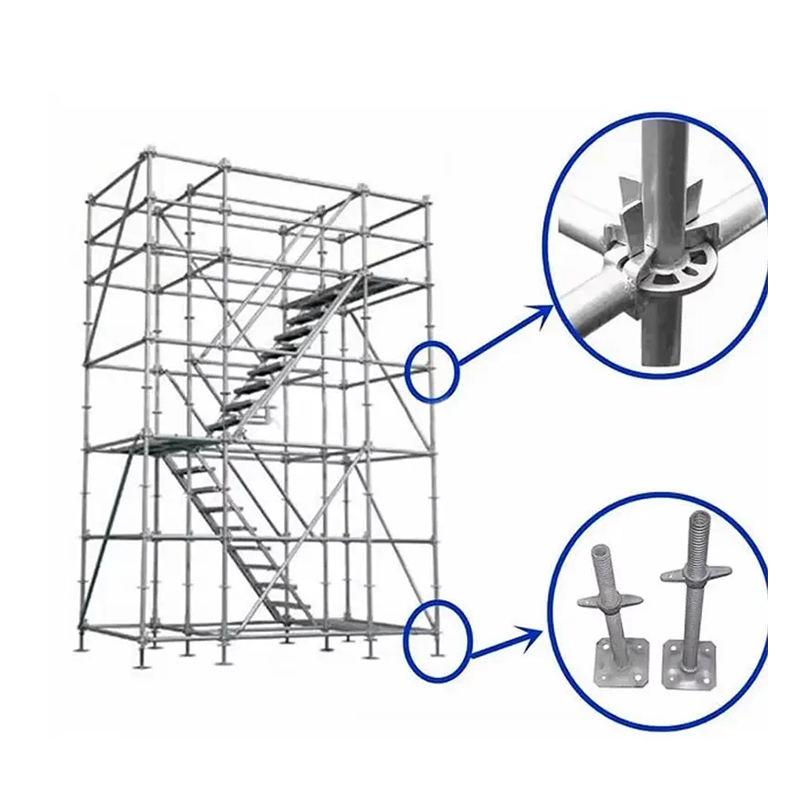
Cuplock scaffolding is a modular steel system made from vertical standards, horizontal ledgers, transoms, diagonal braces, base jacks, base plates, working platforms, guardrails, and related accessories. The vertical standards are generally manufactured with fixed lower cups positioned at regular intervals. Movable upper cups are placed over the connections, allowing several horizontal or diagonal members to be secured at one node.
The basic connection is formed by inserting the end blades or forged connectors of the horizontal members into the lower cup. The upper cup is then placed over the connectors and driven downward with a hammer. This action creates a rigid connection around the vertical standard. Depending on the system configuration, up to four horizontal members can be connected at one level using a single node.
Unlike tube-and-fitting systems, cuplock scaffolding does not require workers to tighten a separate clamp at every intersection. Unlike systems that depend on multiple removable wedges, it can reduce the number of small components that need to be handled and tracked. The connection is therefore fast to assemble while remaining mechanically straightforward and visually easy to inspect.
The modular arrangement also allows vertical standards to be connected at consistent intervals. This makes it easier to establish a regular scaffold grid, calculate material quantities, install platforms, and coordinate the support arrangement with formwork beams or construction floors. When a project includes uneven levels or special geometry, adjustable base jacks, variable member lengths, and supplementary components can help accommodate site conditions.
Core Components of the System
Vertical Standards
Vertical standards are the primary load-carrying members of a cuplock scaffold. They transfer loads from working platforms, formwork, stored materials, workers, and temporary equipment toward the base and supporting ground or structure. Standards are manufactured with welded or formed cups at predetermined vertical intervals, creating the node levels needed for horizontal members and bracing.
Standard length, outside diameter, wall thickness, cup spacing, and end preparation should be selected according to the intended application and engineering design. Bridge support towers and heavy-duty shoring arrangements may require larger or thicker components than light access scaffolds. Consistent dimensions are essential because the locking components must fit accurately without excessive movement or difficult assembly.
Ledgers and Transoms
Ledgers connect the standards horizontally along the length and width of the scaffold. They help stabilize the scaffold grid, support platforms, and maintain the spacing between vertical members. Transoms can provide additional platform support and may be arranged to suit boards, steel decks, formwork beams, or specialized access arrangements.
The ends of these members are fitted with connectors designed to engage with the cup nodes. Their geometry must be controlled during fabrication so that each connector seats properly in the cup. Poorly formed end connectors can cause assembly difficulties, uneven loading, or incomplete locking, which is why forming accuracy and weld inspection are important production controls.
Diagonal Braces
Diagonal braces increase the lateral stability of a scaffold structure. They are especially important for tall access towers, exposed outdoor work, bridge support towers, and arrangements subject to wind, vibration, or accidental impact. The number and location of braces should be determined by the scaffold design, height, width, loading, tie-in arrangement, and local safety requirements.
Although the cuplock node provides strong resistance against movement, no modular scaffold should rely on connection strength alone. Proper bracing, base preparation, ties, access arrangements, and load control remain essential. The advantage of the cuplock system is that the nodes provide convenient and regular connection points for organizing these stabilizing members.
Base Jacks and Base Plates
Base jacks and base plates provide the interface between the scaffold and the supporting surface. Adjustable base jacks help compensate for minor level differences and allow the height of the first working level to be set accurately. Base plates distribute load and help protect the ends of the standards from direct contact with the ground.
For heavy bridge formwork or industrial support, the foundation and bearing surface must be designed to carry the calculated reaction forces. Adjustable components are not a substitute for a stable foundation. The use of sole boards, spreader beams, concrete pads, or other measures may be necessary depending on soil conditions and project design.
Platforms, Guardrails, and Access Components
Working platforms can be produced from steel boards, aluminum boards, timber boards, or other approved materials. Guardrails, toe boards, ladders, stair units, and access gates can be integrated into the modular arrangement to create a complete temporary access system. The selection of platform and access components should reflect the working load, environment, fall-protection requirements, and local regulations.
A properly configured system provides more than a collection of steel tubes. It creates a coordinated temporary structure that supports people, tools, and materials while allowing safe movement between levels. The standardized node arrangement makes it easier to plan the position of guardrails and intermediate rails throughout the scaffold.
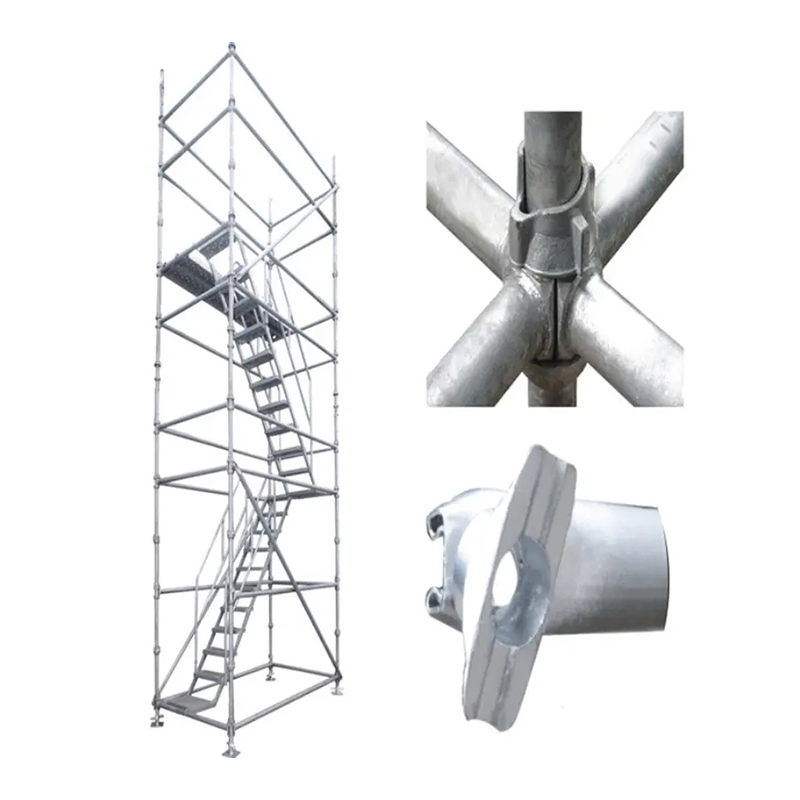
Cuplock Scaffolding
How the Cuplock Connection Works
The cuplock connection is based on a fixed lower cup and a movable upper cup. The lower cup is permanently attached to the vertical standard. When a ledger, transom, or brace is placed into the node, its connector rests in the lower cup. The upper cup is then positioned over the connector and struck downward to lock the assembly.
This connection has several practical advantages. First, the components are captured at the node instead of being held by a collection of completely separate small fasteners. Second, one operation can secure several horizontal members at the same level. Third, the connection can be checked visually because the upper cup should be seated firmly and evenly around the inserted connectors.
The locking action is simple enough for repetitive site work but strong enough for demanding temporary structures when the system is correctly designed and assembled. Workers do not need to carry a spanner for every node, and the erection sequence can be easier to standardize across large projects. The use of a hammer does not eliminate the need for training; operators must still ensure that the connectors are fully inserted and that the cups are properly engaged.
The node also offers useful flexibility. Horizontals can be arranged in several directions around the standard, allowing the scaffold grid to follow straight, angled, or partially curved layouts. This is beneficial for circular tanks, curved façades, towers, industrial vessels, and irregular support arrangements where a rigid rectangular scaffold pattern may be difficult to adapt.
Main Advantages Over Conventional Scaffolding Systems
Fewer Loose Parts and Lower Loss Rates
Traditional tube-and-fitting scaffolding relies on numerous clamps, bolts, nuts, and swivel fittings. These parts must be stored, transported, counted, inspected, and maintained separately. On a busy construction site, small fittings can be misplaced, damaged, or left behind after dismantling.
The fixed lower cup and movable upper cup used in cuplock scaffolding reduce dependence on loose nuts, bolts, and wedges. This can simplify inventory management for rental companies and contractors. Fewer small parts may also mean less time spent sorting components before erection and fewer shortages that interrupt work.
Lower component loss does not mean that every part is permanently attached. Standards, ledgers, braces, jacks, and platforms remain separate items and must be controlled carefully. However, the node connection reduces the number of independent pieces associated with each individual joint, which can improve material accountability across repeated projects.
Faster Assembly and Dismantling
A single hammer strike can secure up to four horizontal members at one cup node. This creates a faster repetitive erection process than systems requiring workers to install and tighten separate fittings at every connection. On large projects, the time saved at thousands of nodes can produce a significant improvement in overall productivity.
Depending on the design, crew experience, site conditions, and material handling arrangements, cuplock scaffolding may be erected substantially faster than conventional tubular scaffolding. The commonly cited improvement of approximately 30 to 50 percent should be treated as a project-dependent benchmark rather than a guaranteed result. Access, lifting equipment, platform installation, bracing, inspection, and foundation preparation all affect actual productivity.
Faster dismantling can also improve project turnover. Industrial maintenance contractors working during short shutdown windows may benefit from a system that can be rapidly installed, modified, and removed. Contractors can redirect labor toward other tasks while reducing the duration of temporary access operations.
High Load-Bearing Potential
Cuplock scaffolding is suitable for both access and heavy-duty support applications when the correct component specifications and engineering calculations are used. Its regular grid, direct load path, and strong node connections make it appropriate for supporting formwork, concrete slabs, bridge beams, and other temporary construction loads.
The use of Q235 or Q345 carbon steel provides a practical combination of strength, weldability, availability, and cost efficiency. Q345 steel can be selected for applications requiring higher yield strength, while Q235 may be suitable for certain general components depending on the design. Material selection should always be confirmed against the required standard, component role, loading, and customer specification.
High load-bearing capacity is not determined by steel grade alone. It also depends on standard spacing, effective length, bracing, vertical alignment, base conditions, connection condition, eccentricity, height-to-width ratio, tie-ins, and allowable imperfections. A qualified engineer should verify the complete temporary works arrangement before use.
Forged Connectors for Impact Resistance
Critical top connectors and node components can be manufactured from forged steel rather than brittle cast material. Forging refines the metal structure and can provide reliable resistance to impact and repeated handling when the process is controlled correctly. This is valuable because scaffold components are frequently loaded, unloaded, assembled, dismantled, transported, and reused.
Forged connectors are particularly useful in high-demand environments such as bridge construction, industrial plants, and heavy formwork support. A connector that can tolerate normal site impacts without cracking supports longer service life and improves confidence during repeated erection cycles. Manufacturing quality, heat treatment where applicable, dimensional inspection, and weld integrity remain essential to realizing the advantages of forged construction.
Adaptability to Complex Geometries
Many construction projects cannot be reduced to a simple straight façade. Circular tanks, curved walls, tapered towers, industrial vessels, bridge piers, and irregular architectural forms require temporary works that can follow changing geometry. Cuplock nodes allow members to be arranged at different directions around the standard, reducing the need for complex pipe bending or excessive custom fittings.
This adaptability can reduce fabrication time for temporary access structures. Contractors can use a standardized inventory while adjusting bay orientation and support locations to match the project. Special components may still be required for highly unusual shapes, but the modular system provides a flexible foundation for most curved and non-standard arrangements.
Stable and Organized Structural Layout
The circular node arrangement allows several members to be secured at a single level. When combined with systematic bracing and proper base preparation, this creates a stable scaffold grid with predictable geometry. The regular arrangement helps supervisors inspect the structure and identify missing ledgers, incomplete braces, misaligned standards, or improperly seated cups.
The absence of small wedge pieces that can fall from a connection also reduces the risk of loose objects dropping during erection or use. Nevertheless, all work at height requires suitable exclusion zones, toe boards, tool control, and fall-protection procedures. The cuplock mechanism supports safer organization but does not replace comprehensive site safety management.
Application in Bridge Formwork and Heavy Temporary Support
Bridge formwork support is one of the most demanding applications for modular scaffolding. Temporary towers may need to support heavy concrete slabs, beams, deck formwork, reinforcement, wet concrete, workers, equipment, and construction-induced effects. These loads must be transferred safely through the scaffold into foundations or prepared support points.
Cuplock scaffolding can be arranged as a dense support tower beneath bridge decks, pier caps, approach structures, and other elevated concrete elements. The adjustable node levels help coordinate the scaffold with formwork beams and soffit elevations. Standards can be positioned in a regular grid, while ledgers and transoms provide horizontal restraint and support for working platforms.
Bridge sites often involve uneven ground, restricted access, changing elevations, traffic management, and exposure to weather. The scaffold design must therefore include foundation assessment, lateral bracing, tie-ins where possible, safe access, load restrictions, and a documented inspection plan. Components should be checked for deformation, corrosion, damaged cups, cracked welds, and excessive wear before installation.
Hyson’s experience in road and bridge formwork supports the production of steel components for major infrastructure environments. The company has supplied solutions associated with projects such as the Sutong Yangtze River Bridge and Taizhou Bridge. Such experience is relevant because large infrastructure projects demand disciplined manufacturing, traceability, dimensional control, and coordination between the temporary works design and the finished product.
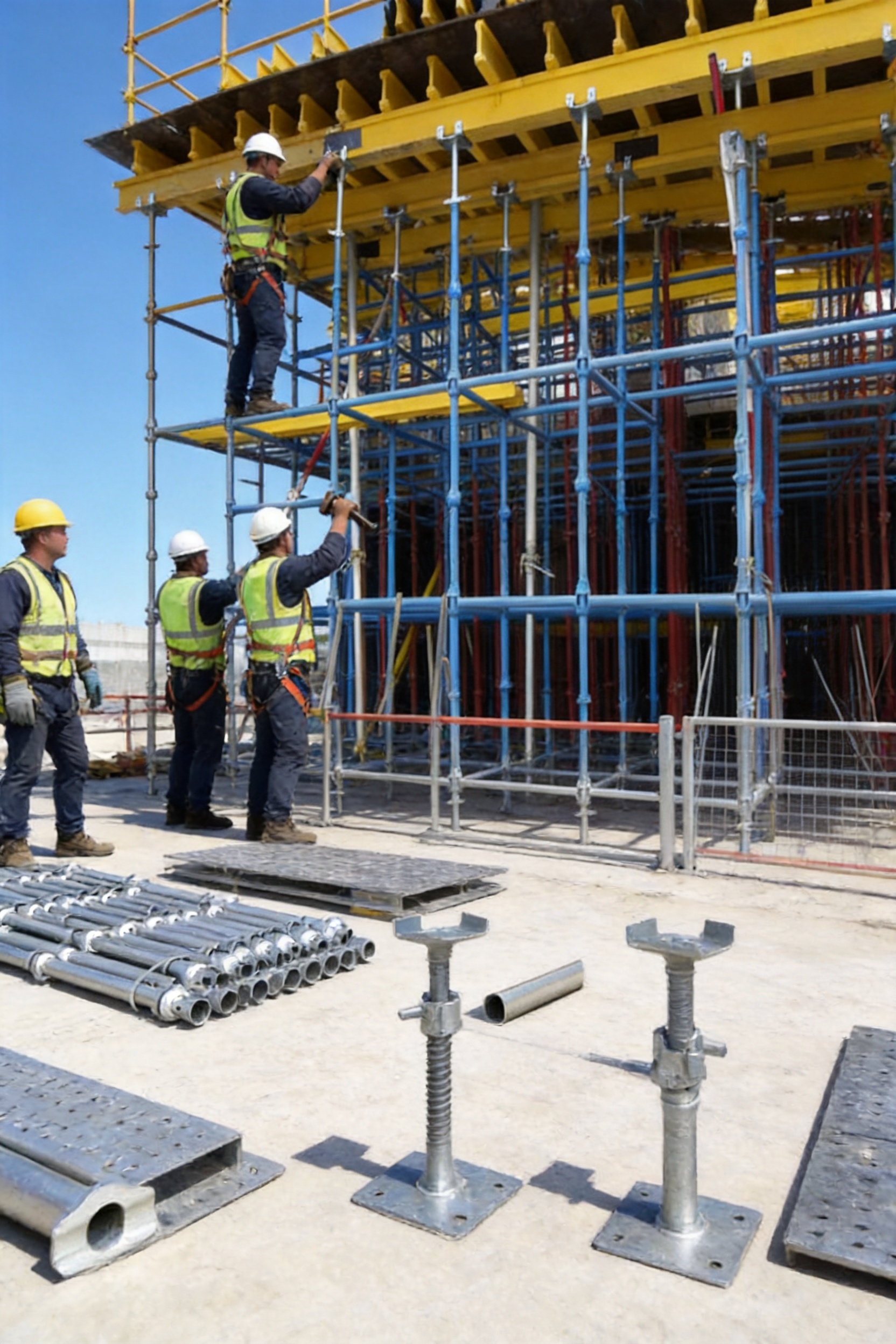
Use in Curved Structures and Irregular Buildings
Curved buildings, circular water tanks, towers, silos, and industrial vessels require access systems that can follow the contour of the structure. A conventional straight scaffold arrangement may leave excessive gaps, require many custom tubes, or create complicated working platforms. The directional flexibility of cuplock nodes can help form a segmented layout around these shapes.
For a circular structure, standards can be arranged around the perimeter at calculated intervals. Ledgers and transoms can be connected to create a polygonal approximation of the curve. The number of standards and bay width should be selected according to the radius, working clearance, platform requirements, and loading. Smaller bay spacing may be required where the curve is tight or where the platform must closely follow the surface.
For tapered or irregular structures, different standard lengths and adjustable components can be combined to maintain safe working levels. Additional braces may be required to manage changing geometry and wind exposure. The scaffold should be tied to the permanent structure where appropriate and should never be altered by untrained personnel simply to improve access around an obstruction.
Industrial Maintenance and Shutdown Operations
Refineries, power plants, chemical facilities, cement plants, steel mills, and processing sites frequently require temporary access for inspection, repair, coating, insulation, equipment replacement, and maintenance. Shutdown periods are expensive, so contractors need scaffolding that can be erected quickly and reconfigured as work fronts change.
Cuplock scaffolding offers a practical solution for creating access platforms around vessels, pipe racks, turbines, boilers, storage tanks, and structural frames. Its modular components can be transported through industrial areas, assembled at different elevations, and adjusted to avoid existing equipment. The node system reduces the need for extensive fitting inventories and can help crews work efficiently under time pressure.
Industrial locations also impose special requirements. The scaffold may need to accommodate restricted walkways, hot-work controls, classified areas, heavy protective clothing, temporary lighting, equipment isolation procedures, and strict permit systems. The scaffold design must be coordinated with plant operations. It should not obstruct emergency routes, fire equipment, valves, inspection points, or ventilation systems.
Where the environment is corrosive, surface protection becomes especially important. Hot-dip galvanizing, painted coatings, or other specified finishes can help protect steel components, but the appropriate treatment depends on the operating atmosphere and customer requirements. Damaged coatings should be repaired according to an approved procedure, and corrosion should be addressed before it reduces wall thickness or affects connection performance.
General Construction, Masonry, and Finishing Work
For bricklaying, blockwork, plastering, painting, cladding, insulation, and exterior decoration, cuplock scaffolding can provide stable working platforms at multiple elevations. Ledgers and transoms create a regular support structure for decks, while guardrails and toe boards help establish protected work zones.
The system is suitable for many commercial and residential construction tasks, although the arrangement must be selected according to the working load. Masonry operations may place substantial loads on platforms because bricks, blocks, mortar, tools, and workers can accumulate in a concentrated area. Platform loading limits should be clearly marked and enforced.
For façade work, tie-ins and bracing are important because the scaffold may be exposed to wind and may be affected by building openings or temporary façade conditions. The presence of a modular node does not automatically make an unsupported tower safe at any height. Design, assembly, inspection, and use must follow applicable regulations and project procedures.
Manufacturing Process and Quality Control
Material Selection and Incoming Inspection
Reliable scaffolding begins with controlled raw materials. Steel coils, plates, tubes, forgings, and other inputs should be verified against purchase specifications before entering production. Material certificates, dimensions, chemical composition, mechanical properties, and surface condition may be reviewed according to the required quality plan.
Q235 and Q345 carbon steels are widely used because they provide suitable mechanical performance and good weldability for many structural applications. The selected grade should correspond to the design requirements and applicable standards. Traceability helps manufacturers identify the material used in each production batch and supports investigation if a non-conformance is later discovered.
Tube and Plate Processing
Modern steel fabrication relies on accurate cutting and forming. Hyson is equipped with advanced laser cutting equipment and standardized production lines that support the preparation of steel plates and components. CNC laser cutting can produce repeatable profiles, openings, connection parts, and reinforcement elements with clean edges and controlled dimensions.
Accurate cutting reduces the need for excessive grinding or manual correction. It also improves fit-up during welding and helps maintain consistent geometry between batches. For large or non-standard steel components, digital production data can connect design information with cutting and fabrication operations, reducing transcription errors and improving repeatability.
Tube cutting, end preparation, bending where required, drilling, and forming must be coordinated with the final assembly. Cup components and connector blades must be positioned accurately on the standards and ledgers. Small dimensional errors can accumulate across a large scaffold, so fixture design and in-process inspection are necessary.
Forging and Connector Production
Connectors that experience impact during assembly and loading require careful manufacturing. Forged steel components are shaped under controlled pressure to produce a strong and durable part. The forging process can improve resistance to impact and reduce the risk associated with brittle fracture when compared with unsuitable cast materials.
After forging, connectors may undergo trimming, machining, surface preparation, and dimensional checks. Their seating surfaces must match the cup geometry. Any deformation, sharp edge, incomplete forming, or dimensional deviation can affect the locking action. Connector inspection should therefore be integrated into the production process rather than performed only at final packing.
Welding and Assembly
Scaffold standards and horizontal members contain welded joints that must withstand repeated use. Welding quality influences the strength, fatigue resistance, and service life of the components. Hyson applies certified AWS and EN welding craftsmanship within its fabrication operations, supported by qualified procedures and trained personnel.
Important welding controls include joint preparation, fit-up, welding parameters, consumable management, preheating where applicable, interpass control, visual inspection, and correction of defects. For critical or customer-specified components, additional non-destructive testing may be required. Welds should be free from unacceptable cracks, lack of fusion, excessive porosity, undercut, and other defects defined by the applicable standard.
Jigs and fixtures help maintain the alignment of cups, sleeves, end connectors, and tubes during welding. Consistent fixture positioning reduces variation between components. After welding, parts may be checked for distortion, overall length, cup spacing, straightness, and connector orientation.
Surface Treatment and Protection
Steel scaffolding may be supplied with painted, powder-coated, galvanized, or otherwise specified surface protection. Surface treatment improves resistance to rust during storage, transportation, and outdoor use. The correct preparation process may include degreasing, abrasive cleaning, chemical treatment, or other methods appropriate to the selected coating.
Coating thickness, adhesion, coverage, and visual appearance can be inspected. Galvanized components should be checked for complete coverage and excessive buildup that could interfere with fitting. Painted components should be protected from impact during handling and repaired if the coating is damaged before delivery.
Final Inspection, Packing, and Delivery
Final inspection should verify component dimensions, cup and connector fit, weld appearance, surface condition, marking, quantity, and packaging. Components must be packed in a way that prevents mixing of sizes and protects connection parts from damage. Clear labeling can reduce erection errors and speed up distribution on large sites.
For export projects, packaging must also consider long-distance transport, humidity, salt exposure, container loading, and unloading equipment. Standards, ledgers, braces, jacks, platforms, and accessories can be bundled according to their type and length. A documented packing list helps customers receive and inspect the shipment efficiently.
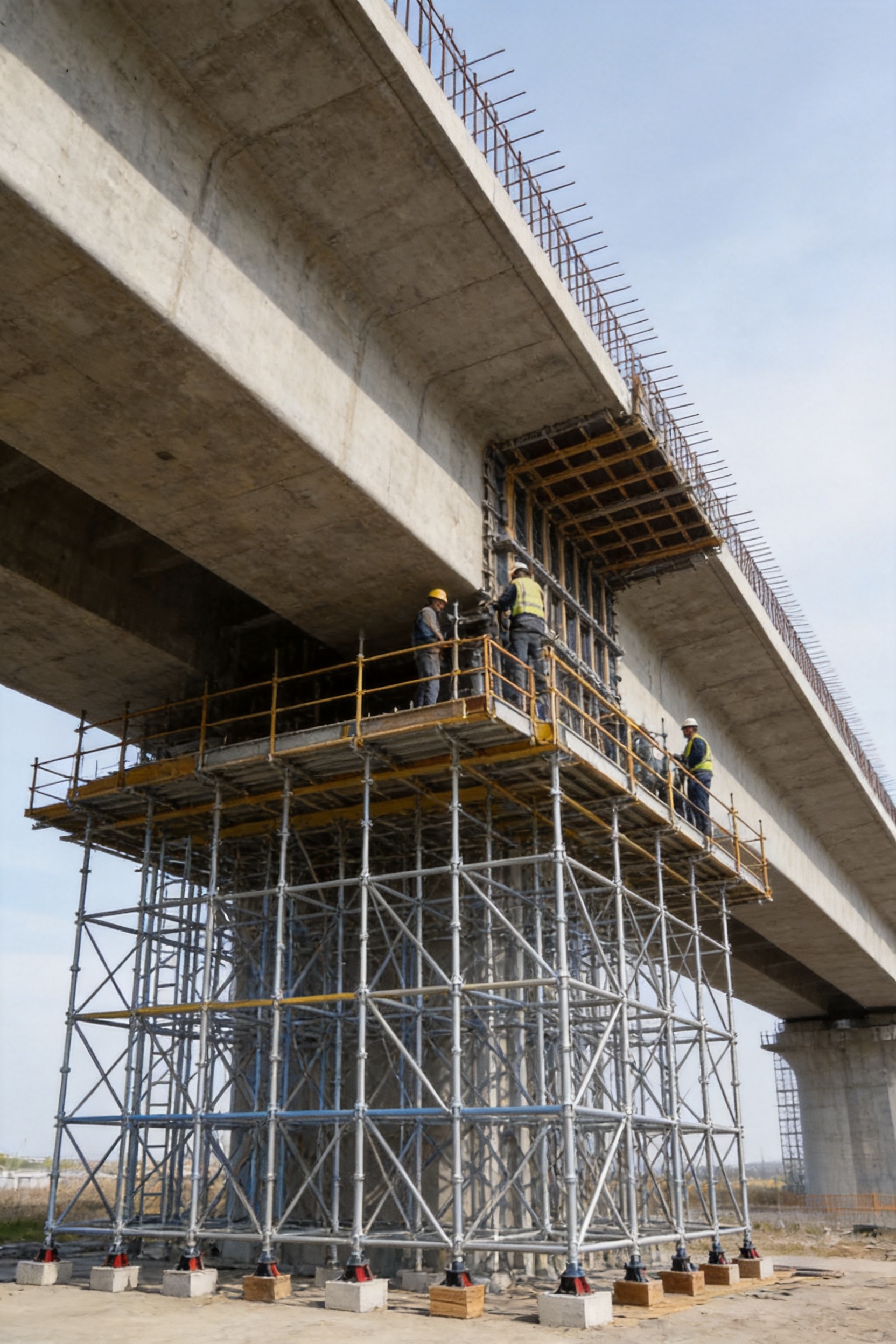
Advanced Fabrication Strengths
Nantong Hyson Road And Bridge Formwork Co., Ltd. operates as a professional manufacturer of custom steel formwork, ringlock and cuplock-related scaffolding products, heavy-duty steel structures, and OEM metal components. Its manufacturing capabilities combine automated processing with structural fabrication experience, allowing the company to support both standardized product orders and non-standard engineering requirements.
The company’s laser cutting, bending, and welding capabilities allow it to supply integrated steel components rather than isolated raw parts. This is valuable for customers seeking ready-to-install products for construction, mining, agriculture, transportation, and industrial projects. A coordinated production process can reduce the need for customers to source cutting, forming, and welding from separate suppliers.
Hyson reports compliance with ISO 9001, BS1139, and EN74 requirements and has developed 12 utility patents. These credentials and technical assets support a structured approach to quality management and product development. Compliance should always be evaluated against the exact component, contract specification, and destination-market requirements, but standards-based production provides a useful foundation for international procurement.
The company’s supply relationships with major infrastructure organizations, including CCCC and CRCC, have exposed its manufacturing operations to the demanding expectations of large transportation and civil engineering projects. Experience with landmark applications such as the Sutong Yangtze River Bridge, Taizhou Bridge, and Sudan Thermal Power Plant demonstrates familiarity with complex project coordination, heavy steel fabrication, and infrastructure delivery requirements.
Comparison with Other Scaffolding Systems
| Criterion | Cuplock Scaffolding | Tube-and-Fitting Scaffolding | Typical Bolt-Based Modular Scaffolding |
|---|---|---|---|
| Connection method | Fixed lower cup and movable upper cup | Separate clamps, bolts, and nuts | Bolted or pinned proprietary connection |
| Assembly speed | Fast repetitive erection with a hammer-operated node | Usually slower because each fitting is installed separately | Fast, depending on the connection design |
| Loose components | Reduced number of small joint components | Many clamps, bolts, and nuts | Connection hardware varies by manufacturer |
| Geometry adaptability | Good flexibility for straight, angled, and curved layouts | Very flexible but requires more manual fitting | Good within the limits of the proprietary components |
| Heavy support suitability | Suitable when correctly designed and braced | Suitable with detailed engineering and sufficient fittings | Depends on system rating and component specifications |
| Inspection approach | Visual checking of cup seating, standards, braces, and alignment | Inspection of every clamp and bolt connection | Inspection of pins, bolts, wedges, and node engagement |
| Rental inventory control | Standardized members and fewer small joint pieces | Large variety of fittings must be counted and maintained | Depends on the equipment range |
| Best-known applications | Bridge support, industrial maintenance, access platforms, and general construction | Irregular access and highly customized arrangements | Rapid modular access and specialized construction systems |
This comparison does not mean that one scaffolding system is ideal for every project. Tube-and-fitting systems remain highly adaptable for unusual obstacles and complex access conditions. Other modular systems may provide specialized advantages such as integrated decking or proprietary safety features. Cuplock scaffolding is especially competitive where contractors need a strong balance of high-load capability, standardized assembly, flexible node positioning, and reduced loose-part management.
Engineering and Safe Use Considerations
Scaffolding must be designed for its actual use. Access scaffolds, shoring towers, loading platforms, façade scaffolds, and industrial maintenance structures can have very different load cases. A qualified temporary works engineer should determine the required member sizes, bay spacing, base arrangement, bracing, tie-ins, platform loading, and allowable height.
Before erection, the ground or supporting structure should be evaluated. Soft, uneven, sloping, excavated, or waterlogged ground can cause settlement or instability. Sole boards, spreaders, concrete pads, or other foundation measures may be needed. Base jacks should be adjusted within their approved limits and should not be extended beyond safe dimensions.
Standards should be installed vertically and connected with the required ledgers and braces as erection progresses. The scaffold should not be left partially assembled at a height where it is vulnerable to wind or accidental impact. Platforms, guardrails, toe boards, ladders, and access gates should be installed according to the design and local regulations.
After erection, the scaffold should be inspected by a competent person before use and at intervals defined by the project or applicable law. Additional inspections are appropriate after high winds, impact, unauthorized alteration, significant loading changes, or prolonged inactivity. Damaged components should be removed from service and clearly identified to prevent accidental reuse.
Users must observe posted load limits and avoid concentrating materials in one small area. Bricks, blocks, steel components, formwork materials, and equipment should be distributed according to the design. Unauthorized removal of ledgers, braces, guardrails, or ties can seriously reduce stability and should be prohibited.
Maintenance, Rental, and Lifecycle Value
Cuplock scaffolding is particularly attractive to rental companies because it can be reused across many projects. Its standardized members simplify fleet planning, while the reduced number of small node fittings can lower sorting and replacement effort. However, rental equipment must be inspected systematically after every return.
Inspection personnel should look for bent standards, damaged cups, cracked welds, distorted connectors, excessive corrosion, worn threads, damaged base plates, and missing or illegible markings. Components with questionable structural integrity should be quarantined until they are repaired, tested, or rejected. Straightening or welding repairs should only be carried out under an approved procedure by qualified personnel.
Cleaning is also important. Concrete, mortar, paint, oil, and soil can interfere with cup engagement, screw adjustment, and platform seating. Components should be cleaned using methods that do not damage the steel or protective coating. During storage, equipment should be stacked securely on level supports and protected from standing water.
A well-maintained scaffold fleet can provide long-term value because the same components can support access work, bridge formwork, industrial shutdowns, and general construction. Standardized inventory also allows contractors to transfer equipment between projects without purchasing a separate system for every application.
Customization and OEM Support
Although cuplock scaffolding is modular, customer requirements can differ significantly. Buyers may specify tube diameter, wall thickness, steel grade, cup spacing, component length, surface finish, platform type, connector design, packaging method, markings, or inspection documentation. OEM production allows the system to be aligned with local regulations, rental fleet standards, and project-specific engineering designs.
Hyson’s broader capabilities in steel plate laser cutting, bending, welding, formwork, and structural fabrication support the manufacture of supplementary components. These may include special brackets, working platforms, access frames, support beams, connection plates, walkways, handrails, and non-standard steel structures. Integrating such components with the main scaffold system can simplify procurement and improve dimensional coordination.
For an OEM project, the technical process should begin with drawings, material requirements, load information, applicable standards, coating specifications, inspection criteria, and packaging instructions. Sample approval or first-article inspection may be used before mass production. This approach is useful when a customer needs a private-label product, a region-specific configuration, or a replacement component compatible with an existing fleet.
Why Manufacturing Precision Matters
Scaffolding is assembled from many repeated components, so small dimensional deviations can affect the whole structure. If cup spacing varies, platforms may not align. If standards are not straight, the scaffold can develop unwanted eccentricity. If connector blades are inconsistent, workers may experience difficult or incomplete locking. Precision manufacturing therefore contributes directly to safety, productivity, and service life.
Automated laser cutting and standardized production lines help reduce variation in fabricated parts. Welding fixtures improve repeatability, while inspection at several stages identifies errors before the final assembly. The combination of advanced equipment and experienced technicians is especially important for heavy steel structures, where component dimensions and weld quality influence installation efficiency.
Manufacturing precision also affects logistics. Consistent lengths and profiles allow components to be bundled efficiently, reduce packing confusion, and make it easier for customers to calculate quantities. Clear product identification supports traceability throughout manufacturing, shipment, rental, and maintenance.
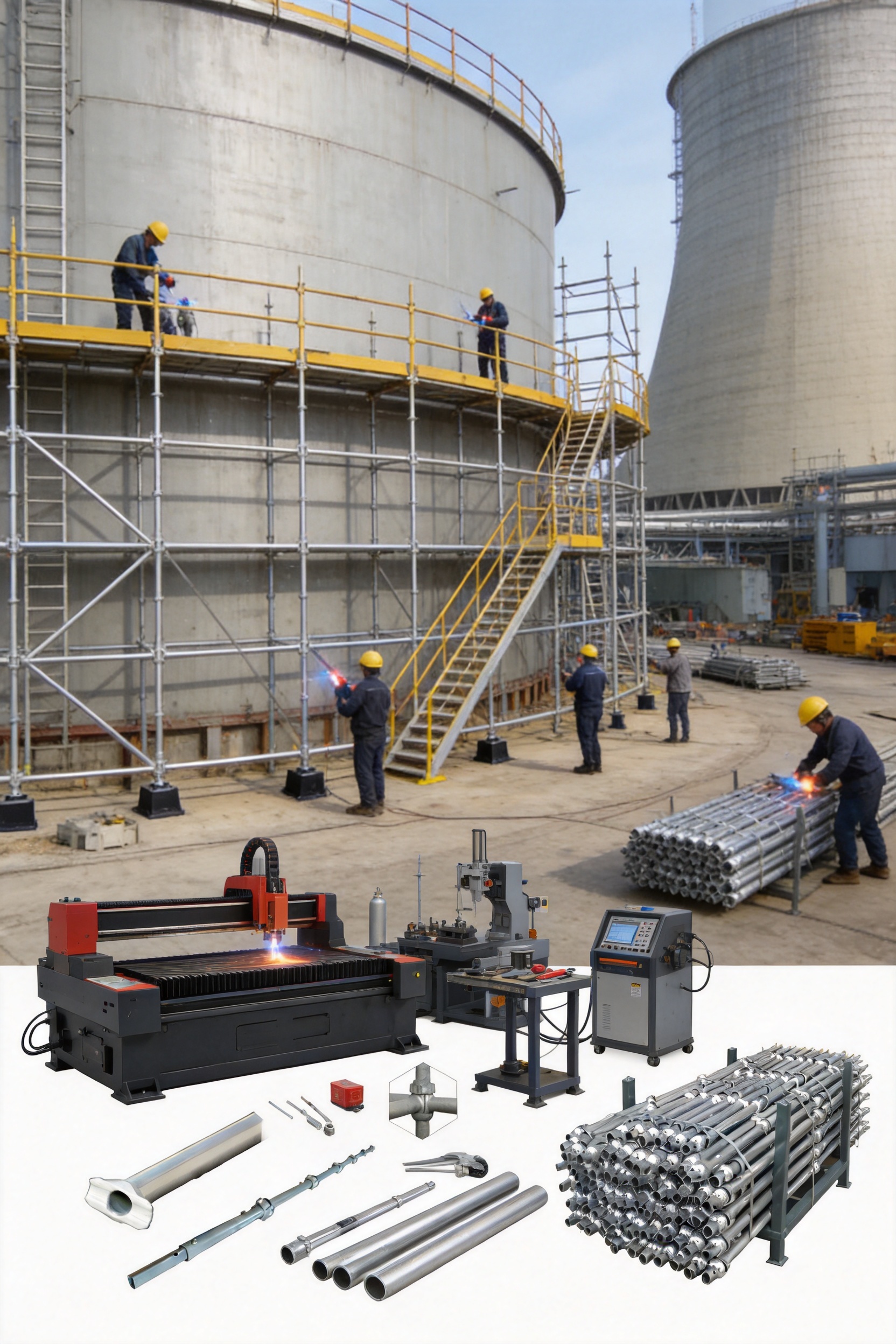
Procurement Checklist for Buyers
When purchasing cuplock scaffolding, buyers should first define the intended application. A system for light-duty façade access may have different requirements from a bridge formwork support tower. The required working loads, environmental conditions, scaffold height, bay dimensions, platform arrangements, and project duration should be provided to the manufacturer.
Buyers should confirm the steel grade and mechanical properties, tube dimensions, cup spacing, connector construction, surface treatment, and applicable standards. They should also request information about welding qualifications, inspection procedures, dimensional tolerances, marking, and traceability. If the equipment will be rented repeatedly, durability and repairability should receive special attention.
Packaging and delivery details are also important. Component quantities should be listed by type and length. Bundles should be protected against impact and moisture, and accessories should be separated clearly from primary standards and ledgers. Export customers should confirm container loading plans, documentation, and any destination-specific labeling or certification requirements.
Finally, buyers should evaluate technical support. A capable manufacturer can assist with component selection, layout coordination, custom fabrication, inspection documentation, and after-sales service. For complex bridge or industrial projects, early communication between the manufacturer, designer, contractor, and site team can prevent costly changes during erection.
Frequently Asked Questions
What is the main advantage of cuplock scaffolding?
The main advantage is its cup-shaped node connection, which allows several horizontal or diagonal members to be secured at one level without separate nuts, bolts, or many loose wedges. This can speed up erection, simplify inventory management, and provide a stable modular structure when correctly designed and assembled.
Is cuplock scaffolding suitable for bridge formwork?
Yes. Cuplock scaffolding is commonly used for bridge formwork support and other heavy temporary works because its modular grid can be arranged as support towers beneath slabs, beams, and deck structures. The actual suitability depends on component capacity, tower geometry, bracing, foundation conditions, and engineering calculations.
What steel grades are used for the system?
The product can be manufactured using Q235 or Q345 carbon steel. The appropriate grade depends on component function, design loading, customer requirements, and applicable standards. Material certificates and inspection documents should be requested for projects with specific structural or contractual requirements.
How quickly can cuplock scaffolding be erected?
It can generally be erected faster than tube-and-fitting scaffolding because one hammer-operated node can secure multiple members. Productivity varies according to crew training, height, access, lifting arrangements, ground conditions, bracing requirements, and platform installation. A potential improvement of 30 to 50 percent is a project-dependent reference rather than a universal guarantee.
Can cuplock scaffolding be used around curved structures?
Yes. The node arrangement allows horizontal members to be positioned in different directions around the standard. This makes the system suitable for curved façades, circular water tanks, towers, industrial vessels, and other irregular structures. The layout should be designed to maintain safe clearances, platform continuity, bracing, and structural stability.
Are the connectors forged or cast?
Key connectors can be manufactured from forged steel. Forged construction offers strong impact resistance and is well suited to components that are repeatedly handled and loaded. Buyers should confirm the connector material and manufacturing specification for the exact product configuration they are ordering.
Does the cup connection remove the need for inspection?
No. The cup connection simplifies assembly but does not eliminate inspection. Standards, cups, connectors, welds, braces, platforms, guardrails, base jacks, foundations, and tie-ins must all be checked. The upper cup must be fully seated, and damaged or deformed components must be removed from service.
Can the manufacturer provide custom components?
Yes. A manufacturer with laser cutting, bending, welding, formwork, and heavy steel fabrication capabilities can produce custom brackets, platforms, support members, access components, and other non-standard parts. Custom orders should be based on approved drawings, material specifications, load information, tolerances, and inspection requirements.
What standards are associated with the product?
The company information identifies ISO 9001, BS1139, and EN74 compliance within its manufacturing and product capabilities. The exact standard applicable to a particular order should be confirmed according to the component, destination market, project contract, and required certification scope.
Is cuplock scaffolding suitable for rental companies?
Yes. Its standardized components, reduced number of small node fittings, and broad application range make it suitable for rental fleets. Rental operators should maintain strict procedures for counting, cleaning, inspecting, repairing, and storing all components between projects.
What information should be supplied when requesting a quotation?
A quotation request should include the intended application, estimated quantity, component list, dimensions, steel grade, surface finish, applicable standards, drawings, packaging requirements, delivery destination, and inspection documentation. For heavy support applications, load data and preliminary layout information are also valuable.
Conclusion
Cuplock scaffolding provides a strong and adaptable solution for contractors that need efficient modular access and temporary structural support. Its fixed lower cup and movable upper cup reduce loose connection hardware, while the hammer-operated locking method can accelerate repetitive erection. Forged connectors, Q235 or Q345 steel construction, flexible node directions, and standardized components make the system suitable for bridge formwork, industrial maintenance, curved structures, masonry, façade work, and general construction.
Its competitive value extends beyond the connection design. The system can reduce inventory complexity, support rental fleet utilization, adapt to irregular geometries, and provide a practical basis for high-load temporary works. These benefits are maximized when the equipment is correctly engineered, professionally erected, regularly inspected, and properly maintained.
Manufacturing capability is a decisive factor in product performance. Hyson combines laser cutting, bending, welding, forging-related component production, standardized assembly, and quality control to supply reliable scaffolding and heavy steel products. Its experience in bridge formwork, major infrastructure, industrial steel structures, and OEM fabrication supports the production of both standard cuplock components and customized steel solutions.
For global contractors, rental companies, infrastructure developers, and industrial maintenance providers, a carefully specified cuplock system can improve construction efficiency while supporting safe and repeatable operations. By combining modular design with advanced steel fabrication, it provides a durable platform for the demanding temporary works required by modern infrastructure and industrial projects.
References
1. BS 1139, Metal Scaffolding: Technical requirements and performance considerations for scaffold components.
2. EN 74, Couplers, Spigot Pins and Baseplates for Use in Falsework and Scaffolds: Product requirements and test methods.
3. ISO 9001, Quality Management Systems: Requirements for controlled manufacturing and continuous improvement.
4. AWS Structural Welding Requirements: Guidance on qualified welding procedures, personnel, inspection, and fabrication quality.
5. European and international guidance on temporary works design, scaffold stability, access platforms, fall protection, and construction-site inspection.
6. Manufacturer-provided technical information for cuplock scaffolding, Q235 and Q345 steel fabrication, bridge formwork, and OEM heavy steel components.
Product: Cuplock Scaffolding



- Location
- Group 3, Fangzhuang Village, Rucheng Subdistrict, Rugao City, Nantong, Jiangsu, China
- Follow us
- Phone
- +86-13646196162
- info@hysonindustry.com
