 +86-13646196162
 info@hysonindustry.com




 русский
 عربى



Heavy-Duty Steel Props for Reliable Formwork, Floor Support, and Temporary Structural Reinforcement
 2026.09.15
Content
- 1 Understanding the Role of Steel Props in Construction
- 2 Key Advantages of Heavy-Duty Steel Props
- 3 Comparison with Other Adjustable Support Components
- 4 Applications in Formwork Support
- 5 Floor and Roof Slab Support
- 6 Scaffolding Auxiliary Support
- 7 Temporary Structural Reinforcement
- 8 Manufacturing Process and Quality Control
- 9 Why Integrated Heavy Steel Fabrication Matters
- 10 Engineering and Project Support
- 11 Operational Benefits for Contractors and Rental Companies
- 12 Installation and Safe Use Recommendations
- 13 Maintenance, Storage, and Reuse
- 14 OEM Customization and Global Supply Capability
- 15 Frequently Asked Questions
- 15.1 What is the primary purpose of a steel prop?
- 15.2 How is a steel prop different from an adjustable base?
- 15.3 What adjustment range is available?
- 15.4 What load can the steel prop carry?
- 15.5 Can steel props be used for concrete formwork?
- 15.6 Can steel props be used for scaffolding?
- 15.7 Are the props suitable for outdoor or damp environments?
- 15.8 How many times can a steel prop be reused?
- 15.9 Can one worker install a steel prop?
- 15.10 What steel grades are used?
- 15.11 Can the product be customized?
- 15.12 What should be checked before use?
- 16 Conclusion
- 17 References
- 18 Product: Steel Props
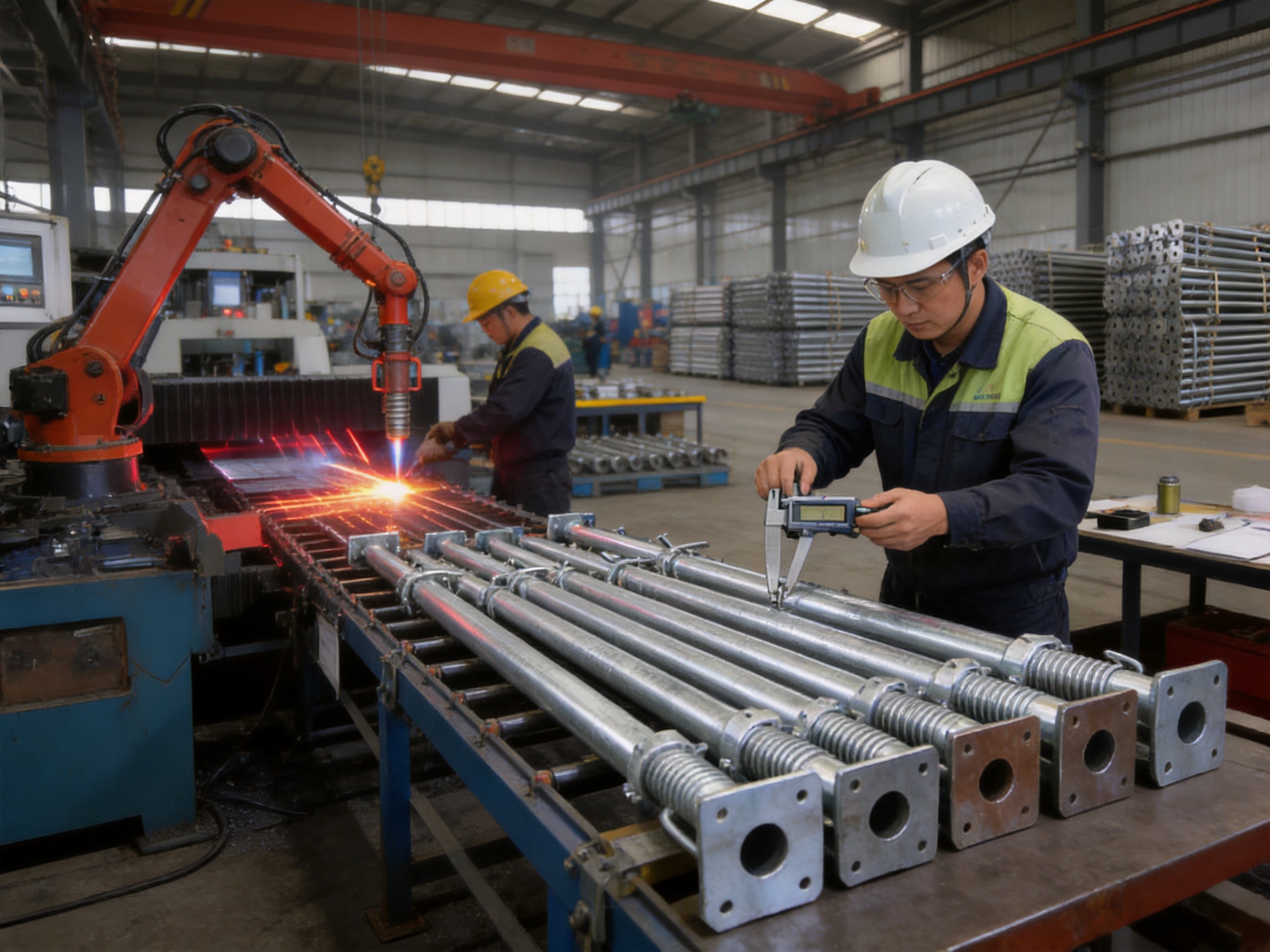
Steel props are essential vertical load-bearing components for modern construction, infrastructure, industrial maintenance, and temporary structural support. They are designed to carry, transfer, and stabilize vertical loads while concrete, formwork, floors, roofs, scaffolding systems, or temporary structures are being constructed, repaired, reinforced, or maintained. When properly selected and installed, a steel prop provides a dependable line of support between a supported structure and the ground or another stable bearing surface.
Unlike components that are primarily intended for leveling, connection adjustment, or minor positioning, a heavy-duty steel prop is designed to perform a core structural support function. It can independently carry significant vertical loads and can be integrated into a wider shoring or formwork system. This makes it particularly valuable in demanding construction environments where ordinary adjustable bases, light-duty supports, or improvised timber members may not provide sufficient strength, durability, or repeatability.
Modern steel props combine high-strength carbon steel, telescopic adjustment, reinforced structural details, precision welding, protective surface treatment, and practical locking features. These characteristics enable one component to adapt to different working heights and support requirements without sacrificing stability. For contractors, rental companies, formwork specialists, and infrastructure builders, the result is a reusable product that can improve construction safety, reduce installation time, and support consistent project quality.
Nantong Hyson Road And Bridge Formwork Co., Ltd. manufactures steel props as part of a broader portfolio of steel formwork, scaffolding systems, heavy steel structures, steel plate cutting, and OEM metal fabrication products. Its production capabilities allow the company to control material preparation, cutting, forming, welding, finishing, inspection, and delivery within an integrated manufacturing system. This is especially important for customers requiring reliable support equipment in large quantities or customized steel components for specialized projects.
Understanding the Role of Steel Props in Construction
A steel prop is a vertical support member that transfers loads from a temporary or partially completed structure toward a stable base. During concrete construction, it may support formwork and freshly poured concrete until the concrete reaches the required strength. During renovation or repair, it may temporarily carry the load of a floor, beam, roof, wall, or other structural element while permanent work is performed. In scaffolding applications, it may serve as an auxiliary load-bearing member that increases stability under demanding site conditions.
The basic function appears simple, but the engineering requirements are substantial. A prop must resist compression, remain stable over its operating height, maintain reliable adjustment, and distribute forces effectively through its top and bottom bearing areas. Its components must also withstand repeated assembly, disassembly, transportation, exposure to moisture, and contact with construction debris. Poorly manufactured or inadequately protected supports can suffer from thread damage, local buckling, corrosion, deformation, or connection failure.
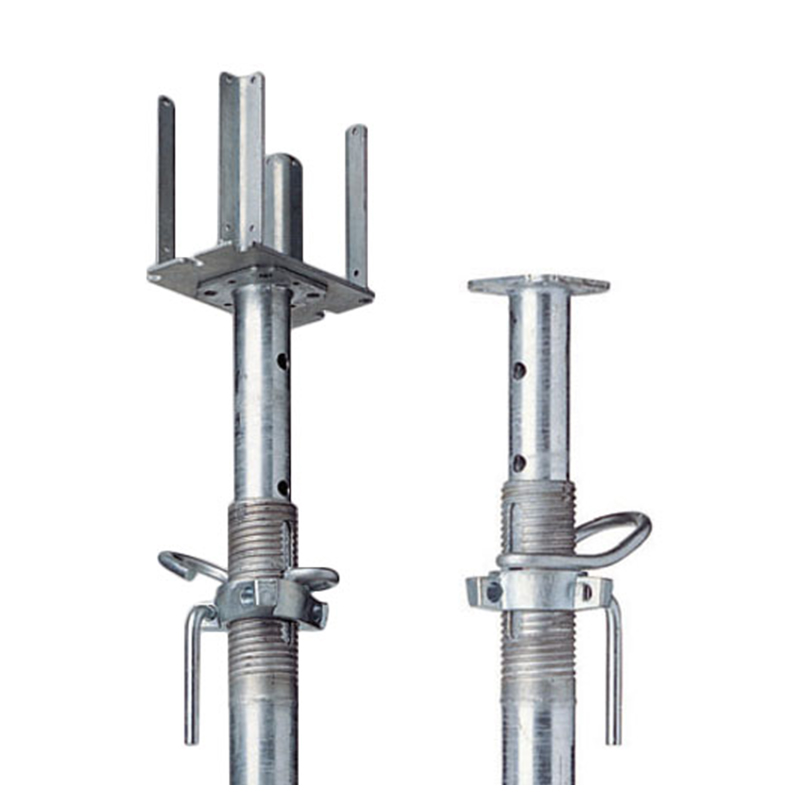
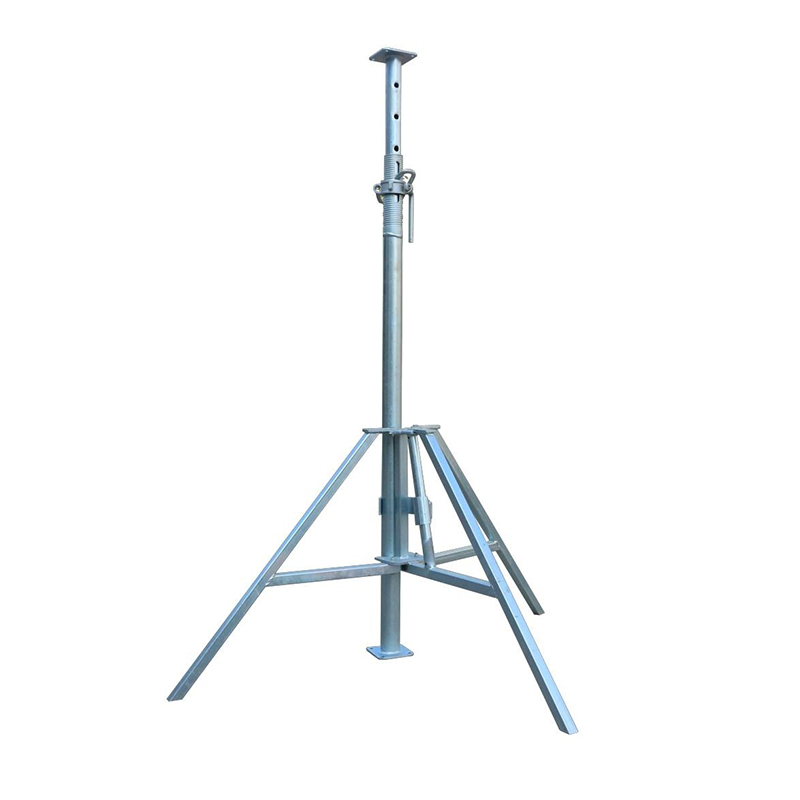
For this reason, a professional steel prop is more than a length of steel tube. It is a coordinated load-bearing assembly. The tube, adjustment mechanism, locking components, welded joints, reinforcement details, top plate, bottom plate, handles, and surface treatment must work together. Manufacturing accuracy is directly connected to field performance because dimensional deviations can affect height adjustment, vertical alignment, bearing contact, and the distribution of load.
Steel props are commonly used in combination with other construction equipment. Adjustable bases can help level or position a system at the ground interface, while adjustable supports or brackets may provide fine-tuning at a connection point. A steel prop, by contrast, is selected when the principal requirement is vertical load-bearing capacity. These components can be combined to create a complete support arrangement, but their functions should not be confused during design or installation.
Key Advantages of Heavy-Duty Steel Props
High Vertical Load-Bearing Capacity
The principal advantage of a heavy-duty steel prop is its ability to support substantial vertical loads. The product described in the supplied specifications is manufactured from Q235 or Q345 high-strength carbon steel and is designed for a vertical load-bearing range of approximately 100 kN to 200 kN, depending on the model, extension, loading condition, and approved configuration.
This capacity enables the prop to support demanding applications such as large-volume concrete formwork, floor slabs, roof structures, temporary shoring, and heavy scaffolding arrangements. When used within an engineered system and installed on suitable foundations, it can reduce the risk of support deformation, excessive settlement, and unwanted movement during construction.
The load-bearing performance of a prop depends on more than the nominal steel grade. Tube geometry, wall thickness, effective length, connection design, welding quality, load eccentricity, bearing conditions, and lateral restraint all influence actual performance. A professionally manufactured product therefore needs a consistent production process that keeps these variables under control.
Stable Structural Design
Steel props are exposed to compressive forces, and compression members must be designed to resist both direct crushing and instability. A slender support can buckle if its effective length, alignment, or restraint is unsuitable. Reinforced ribs, properly proportioned tubes, secure locking features, and accurate welded connections help maintain structural stability.
The product uses reinforced structural details and robotic welding technology to reduce weak points in the assembly. Consistent welding helps provide uniform connection strength from one unit to the next. It also reduces the risk of irregular weld profiles, incomplete fusion, excessive spatter, or dimensional variation that may occur when production depends entirely on uncontrolled manual operations.
The top and bottom contact areas are also important. A support that transfers force through a small or uneven bearing surface may create concentrated pressure, damage the supported structure, or become unstable. Steel props equipped with suitable plates and anti-slip features can distribute force more effectively and help maintain contact during construction activities.
Wide Height Adjustment Range
Construction projects rarely have a single standardized support height. Floor-to-floor dimensions, beam depths, slab thicknesses, ground conditions, formwork arrangements, and temporary reinforcement requirements can vary across one project. A height-adjustable steel prop makes it possible to accommodate these differences without fabricating a new support for every location.
The specified adjustment range of the product is approximately 100 mm to 500 mm, with an adjustment accuracy of about ±1 mm. This range allows the same basic support assembly to be used in multiple construction zones and reduces the need to stock numerous fixed-length components. The telescopic threaded structure supports controlled adjustment while maintaining a secure connection between the main body and the extension section.
Compared with adjustable bases that may provide an adjustment range of approximately 50 mm to 300 mm, or adjustable supports that may offer approximately 30 mm to 150 mm, a heavy-duty steel prop can provide broader height adaptability while maintaining its primary load-bearing role. The exact adjustment and load capacity should always be verified against the product model, working height, and project engineering requirements.
Accurate adjustment is valuable for both safety and productivity. A support that is too short may fail to engage the structure properly, while a support that is overextended may become less stable or difficult to align. A precise threaded mechanism allows workers to achieve the required elevation without improvised packing or unsafe modification.
Corrosion Protection for Repeated Use
Construction equipment is frequently exposed to water, cement slurry, dust, mud, outdoor rainfall, underground humidity, and fluctuating temperatures. Without suitable protection, carbon steel can corrode, especially around threads, weld zones, plate edges, and areas where surface damage occurs during handling.
The steel props are hot-dip galvanized with a specified coating thickness of at least 80 micrometers. This protective zinc coating covers the component surface and helps resist corrosion in demanding construction environments. It also supports longer service life and makes the equipment more suitable for rental fleets, where the same components may be transported and used repeatedly across different projects.
Surface polishing and appropriate finishing help reduce rough areas that can accelerate wear or interfere with adjustment. A well-protected prop is easier to clean, inspect, store, and return to service. The stated reuse cycle of at least 400 uses reflects the product’s emphasis on durability and repeatable performance, although actual service life depends on loading, handling, maintenance, environmental exposure, and inspection practices.
Fast Installation and Simple Adjustment
Construction schedules are directly affected by the speed at which temporary support can be installed, adjusted, checked, and removed. A product that requires complicated tools or excessive manual effort may increase labor costs and create opportunities for installation errors. The steel props incorporate a quick-locking design and a non-slip handle intended to simplify field operations.
In suitable working conditions, one worker can position, adjust, and secure the prop without specialized tools. This can be particularly useful when many supports must be installed within a short period. Faster installation may also reduce the time workers spend below suspended formwork or near partially completed structures.
Ease of use does not replace engineering control. The support arrangement must still be designed, the bearing surfaces must be stable, the props must be plumb, and the locking mechanism must be fully engaged. However, an intuitive product design helps workers follow the intended installation method more consistently.
Anti-Slip Contact and Improved Safety
The top anti-slip pad increases contact with the supported structure and helps prevent unwanted movement. This feature is useful when a prop is supporting formwork, floor panels, temporary beams, or other components that may be affected by vibration and construction activity.
Anti-slip features are most effective when the bearing surfaces are clean, adequately sized, and properly aligned. They should not be used to compensate for an unstable foundation, an excessive inclination, or an incorrectly selected prop. Safe support depends on the combined performance of the prop, the structure it supports, the ground or base below it, and the overall arrangement of neighboring components.
Each component is subject to load testing and quality inspection according to the manufacturer’s production and control procedures. These measures help verify that the product is suitable for its intended construction applications. Contractors should also follow site-specific engineering instructions, applicable safety regulations, and inspection requirements before loading the system.
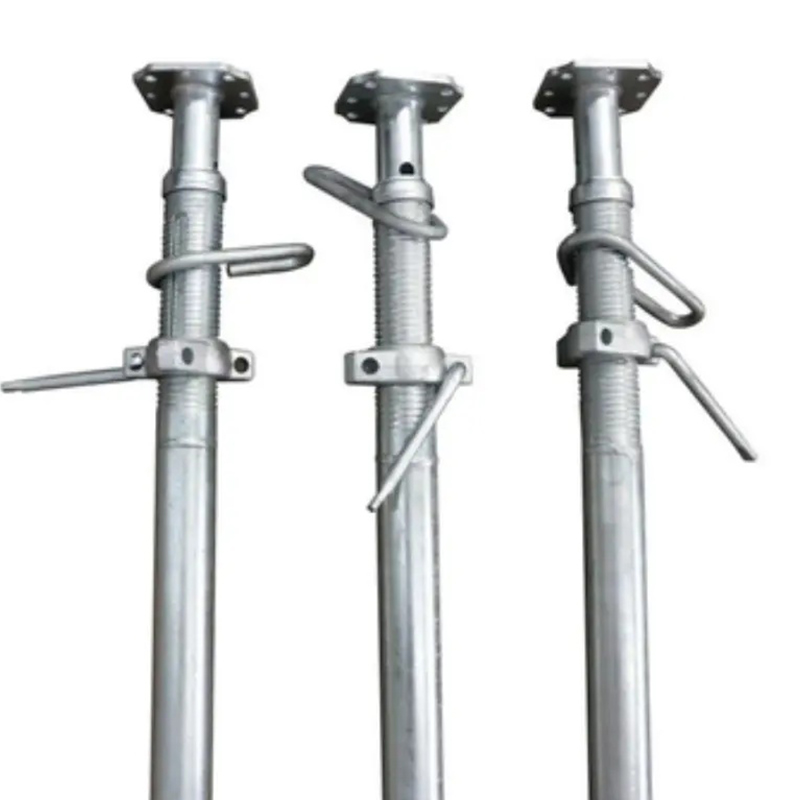
Steel Props
Comparison with Other Adjustable Support Components
Construction support systems often include several types of adjustable components. Confusion can occur when products appear similar but are intended for different functions. Understanding the distinction between steel props, adjustable bases, and adjustable supports is important for selecting the correct equipment.
| Component | Primary Function | Typical Adjustment Role | Relative Application |
|---|---|---|---|
| Heavy-duty steel prop | Independent vertical load-bearing support | Approximately 100–500 mm, depending on model | Formwork, floor and roof support, temporary reinforcement, scaffolding auxiliary support |
| Adjustable base | Leveling and positioning at the ground or base interface | Approximately 50–300 mm, depending on model | Ground leveling and auxiliary system support |
| Adjustable support or bracket | Fine-tuning, top adjustment, or connection adaptation | Approximately 30–150 mm, depending on model | Connection adaptation and localized adjustment |
An adjustable base may be essential for achieving a level starting point, but it is not necessarily designed to replace a heavy-duty vertical prop. Similarly, an adjustable bracket may help connect or fine-tune a formwork assembly, but it may not have the same independent load-bearing capacity. Steel props are selected when the project requires a dedicated vertical support member with a high load capacity and a broad adjustment range.
The three products can be used together. For example, a formwork arrangement may use an adjustable base to compensate for minor ground-level differences, a steel prop to carry the main vertical load, and an adjustable support or bracket to complete the upper connection. This combination allows each component to perform the function for which it was designed.
The competitive advantage of a heavy-duty steel prop is therefore not simply a larger adjustment range. Its value comes from the combination of load capacity, structural stability, height flexibility, corrosion resistance, installation efficiency, and reusability. A complete comparison should consider the entire service cycle rather than only the purchase price.
Applications in Formwork Support
Formwork support is one of the most important applications for steel props. During concrete placement, formwork must retain its shape and position while carrying the weight of wet concrete, reinforcement, workers, tools, vibration equipment, and other construction loads. If the support system moves or deforms, the finished concrete may develop dimensional defects, surface irregularities, cracking, or unacceptable alignment.
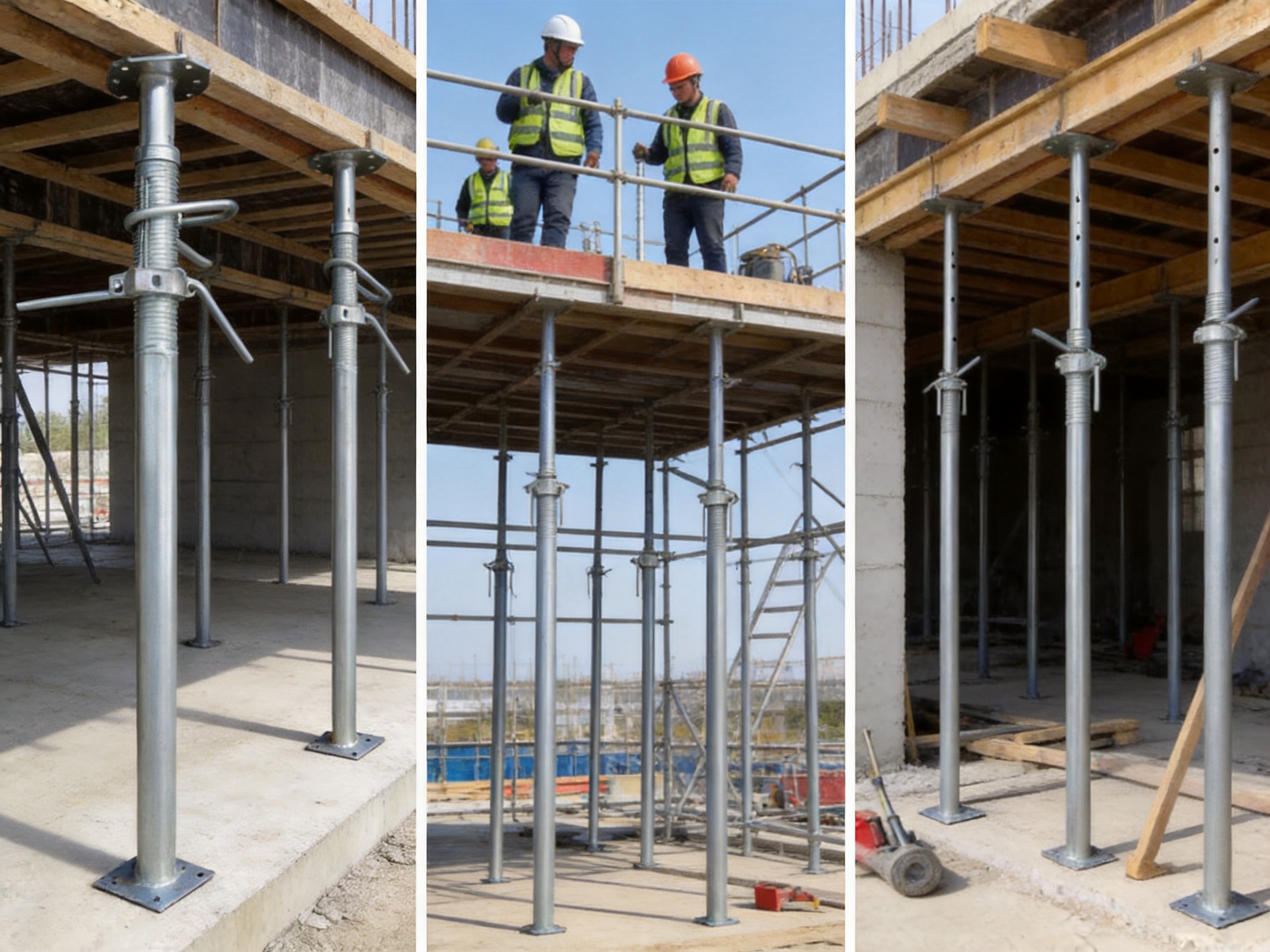
Steel props provide vertical support beneath slab formwork, beam formwork, wall formwork arrangements, and other temporary molding systems. They can be positioned according to the load distribution and adjusted to bring the formwork to the required elevation. Once properly installed and locked, they help maintain the intended geometry during concrete placement and curing.
In wall formwork systems, steel props may work with panels, walers, ties, brackets, and other stabilizing members. The prop can provide vertical resistance while the rest of the system controls alignment, lateral pressure, and connection behavior. For planar formwork, props can be arranged in a planned grid to transfer loads toward the ground or supporting slab.
The use of heavy-duty props is particularly beneficial where formwork carries large concrete volumes or where the construction sequence creates temporary load concentrations. The product’s high-strength steel body and reinforced structure provide a stronger alternative to light-duty supports that may be unsuitable for major formwork applications.
Before concrete placement, the system should be checked for correct spacing, verticality, locking engagement, top and bottom contact, base stability, and interference with access routes. A qualified person should verify the arrangement against the project design, especially where loads are high, heights are significant, or site conditions are complex.
Floor and Roof Slab Support
Freshly poured floor and roof slabs require temporary support until the concrete develops adequate strength. Steel props can be installed beneath slab formwork before pouring and may also be used as temporary back-propping after the formwork is removed. The objective is to control deflection, reduce the risk of settlement, and protect the developing structure from premature loading.
In multi-story construction, the load from upper-level construction activities may be transferred through partially cured slabs. Temporary props can help distribute these loads and limit structural movement. Their use must be coordinated with the concrete strength development schedule, formwork removal plan, and structural engineer’s instructions.
For renovation work, steel props can support an existing floor or roof while damaged members are repaired or replaced. They may also be used while openings are created, walls are altered, or new beams are installed. In these cases, the support arrangement must account for existing defects, uneven surfaces, hidden services, and uncertain load paths.
The broad adjustment range enables the same product family to accommodate different floor heights and slab conditions. Its threaded mechanism allows controlled positioning, while the top anti-slip pad helps maintain contact with the supported surface. The galvanized finish is beneficial when work continues in damp basements, outdoor structures, or buildings exposed to weather.
Scaffolding Auxiliary Support
Steel props can serve as auxiliary load-bearing components for disc-lock scaffolding and coupler-type scaffolding. Scaffolding is often required to carry workers, tools, materials, platforms, protective sheeting, and temporary construction loads. In heavy-duty or high-altitude operations, additional vertical support may be needed to improve the stability of the overall arrangement.
When incorporated into a scaffold support plan, steel props can compensate for situations in which ordinary scaffold members alone do not provide the required load capacity. They may assist with localized support under working platforms, temporary access structures, formwork interfaces, or high-load areas.
The prop should not be treated as a substitute for a complete scaffold design. Scaffolding systems require proper bracing, tying, base support, platform arrangement, guardrails, access, and inspection. The steel prop contributes vertical support, while the rest of the scaffold controls lateral stability and safe use by workers.
Compatibility is an important advantage. Steel props can be used with adjustable bases, adjustable supports, wall formwork, and common scaffolding arrangements to create a coordinated support system. Customers can therefore integrate the product into existing equipment fleets instead of developing an entirely separate temporary support method.
Temporary Structural Reinforcement
Temporary reinforcement is required in many situations beyond new building construction. Building renovation, factory maintenance, bridge repair, equipment installation, utility work, and emergency stabilization may all require a temporary vertical support. In these applications, the support must be strong enough to carry the anticipated load and flexible enough to fit the available working space.
Steel props can support temporary beams, floors, roofs, platforms, equipment bases, or structural members while permanent repairs are completed. Their height adjustment capability helps adapt to irregular conditions and different structural elevations. The product can also be removed and reused when the temporary work is finished.
For industrial maintenance, corrosion resistance is especially valuable. Factories may contain humidity, dust, chemicals, vibration, or restricted access areas. A galvanized support with a robust welded structure can provide more dependable service than an unprotected temporary member, provided the coating remains intact and the product is inspected before use.
In bridge and infrastructure projects, steel props may be used in temporary construction stages, under formwork, near access platforms, or during repair operations. Infrastructure work often requires equipment that can withstand repeated relocation and demanding site conditions. A reusable heavy-duty prop helps reduce the need for disposable support materials and can contribute to more organized project logistics.
Manufacturing Process and Quality Control
Material Selection
The performance of a steel prop begins with the selection and verification of its raw material. Q235 and Q345 carbon steels are commonly used for structural components because they provide a practical combination of strength, weldability, availability, and cost efficiency. Material control helps ensure that the tube, plates, reinforcement members, and other parts meet the specified mechanical and dimensional requirements.
For large orders or project-specific production, material identification and batch management are important. They help the manufacturer maintain consistency across production runs and provide a basis for traceability. Consistent raw material also supports predictable welding, forming, machining, and finishing results.
Precision Cutting and Preparation
Steel tubes and plates must be cut accurately before assembly. Nantong Hyson Road And Bridge Formwork is equipped with advanced laser cutting equipment and standardized production lines. Laser cutting allows complex steel plate shapes, connection plates, reinforcement elements, and other components to be produced with high dimensional accuracy and clean edges.
Accurate cutting improves assembly fit-up and reduces unnecessary gaps or forced alignment during welding. It also supports the production of non-standard components for customers with specialized formwork, scaffolding, infrastructure, or industrial requirements. CNC and laser-based preparation can improve repeatability when large quantities of similar parts are required.
Forming and Component Assembly
After cutting, selected parts may be bent, rolled, drilled, threaded, or otherwise prepared for assembly. The prop’s telescopic and adjustment components require careful dimensional coordination so that the mechanism operates smoothly while maintaining secure load transfer.
Assembly fixtures help position components consistently before welding. Proper fit-up reduces distortion and supports the accuracy of the final product. It also improves the repeatability of top plates, bottom plates, handles, reinforcement ribs, and locking components from one unit to the next.
Robotic and Certified Welding
Welding is a critical stage in the manufacturing of a load-bearing steel prop. The welded joints transfer forces between tubes, plates, reinforcement details, and connection components. Inconsistent welding can create localized weaknesses, dimensional distortion, or premature failure.
The product is manufactured using precision robotic welding technology, which supports consistent weld placement, speed, penetration, and appearance. Automated welding is especially valuable for repeated production because the same programmed process can be applied across a large number of components. It helps reduce variation caused by fatigue, inconsistent hand positioning, or changing manual technique.
Hyson also applies certified AWS and EN welding craftsmanship in its broader steel fabrication operations. This combination of automated production and qualified welding practice enables the company to serve both standardized product orders and customized OEM projects. Welding procedures should be selected according to material thickness, joint design, required strength, and applicable project standards.
Surface Treatment
After fabrication and inspection, steel props receive hot-dip galvanizing with a specified coating thickness of at least 80 micrometers. Galvanizing immerses the prepared steel in molten zinc, forming a protective metallurgical coating that covers exposed surfaces and helps shield the base steel from moisture and corrosive agents.
Surface preparation before galvanizing is important because oil, scale, rust, and welding residues can affect coating quality. Proper handling after galvanizing is also necessary to avoid unnecessary impact damage, especially around threads, plates, and contact surfaces. The finished product should be stored in a way that allows drainage and ventilation.
Inspection and Load Testing
Quality control should extend across the entire production process rather than being limited to final visual inspection. Dimensional checks, weld inspection, thread operation, locking function, coating evaluation, and load testing can all contribute to product reliability.
Load testing helps verify the behavior of the finished assembly under controlled conditions. It can reveal deformation, slippage, connection weakness, or other issues before the product reaches the construction site. In addition, quality inspection helps ensure that the prop meets the manufacturer’s internal specifications and the requirements of the intended market.
Hyson operates under ISO 9001 quality management principles and manufactures products for customers involved in major infrastructure and industrial projects. Its stated compliance with BS1139 and EN74 standards in relevant scaffolding product lines demonstrates an awareness of international construction equipment requirements. Product-specific compliance should always be confirmed according to the exact model, order specification, and destination-market regulations.
Why Integrated Heavy Steel Fabrication Matters
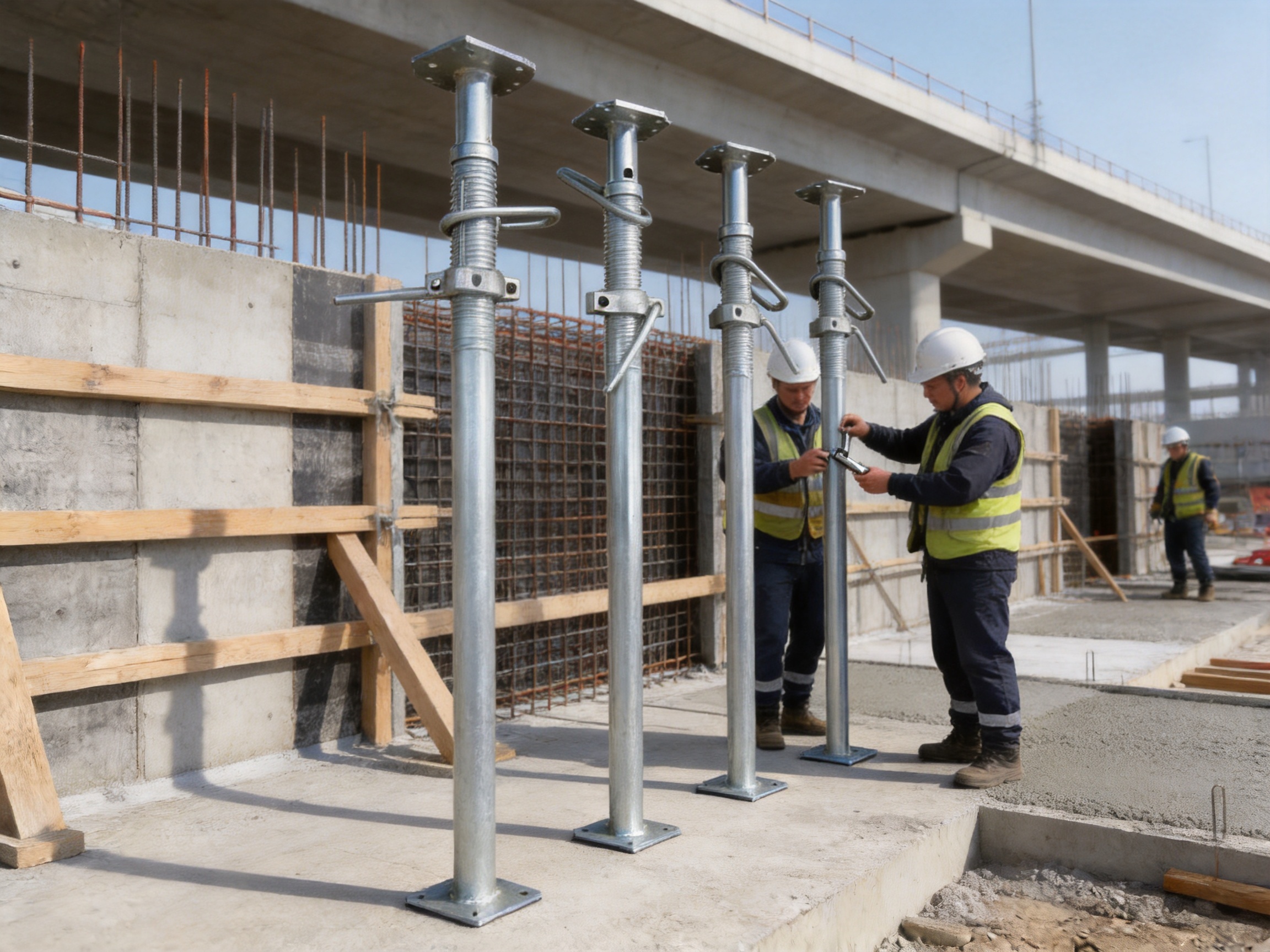
Customers purchasing steel props may also require formwork panels, scaffolding components, structural frames, brackets, base systems, steel plates, or custom connection parts. A manufacturer with integrated heavy steel fabrication capabilities can coordinate these requirements more efficiently than a supplier focused only on one small component.
Nantong Hyson Road And Bridge Formwork combines laser cutting, bending, welding, surface treatment coordination, assembly, and quality management. This makes it possible to produce both standard steel props and custom steel components for non-standard engineering applications. The same manufacturing infrastructure can support construction, mining, agricultural, transportation, and industrial projects.
Integrated production offers several advantages. First, component dimensions can be coordinated more effectively. Second, customers can reduce the number of separate suppliers involved in a project. Third, custom modifications can be discussed directly with engineers and production personnel. Fourth, production scheduling and quality documentation can be managed through a more unified process.
For OEM customers, this flexibility is particularly valuable. A buyer may require a private-label product, a modified adjustment range, a different top plate, a special connection, a project-specific coating, or a large batch of non-standard steel parts. A heavy fabrication manufacturer can evaluate these requirements using its existing cutting, forming, and welding capabilities.
Engineering and Project Support
Reliable support equipment requires more than manufacturing capacity. Customers also need assistance with product selection, configuration, packaging, delivery, and application. Hyson’s experience as a supplier to major infrastructure organizations and central state-owned enterprises has exposed the company to demanding project environments where consistency, documentation, and delivery performance are important.
The company has supplied solutions for landmark projects such as the Sutong Yangtze River Bridge, Taizhou Bridge, and Sudan Thermal Power Plant. Experience in bridge, power, and infrastructure projects helps inform the production of heavy-duty components that must perform under complex site conditions and strict project schedules.
Project support may include reviewing drawings, confirming material grades, discussing loading requirements, selecting surface treatment, coordinating production batches, and preparing products for shipment. When the customer provides project drawings or technical specifications, the manufacturer can assess whether a standard steel prop is suitable or whether a customized component should be developed.
Because steel props are load-bearing equipment, final selection should be based on engineering requirements rather than appearance alone. Important factors include design load, working height, extension length, spacing, load eccentricity, bearing surfaces, lateral restraint, environmental exposure, and applicable safety standards. The manufacturer can support the product discussion, while the project’s qualified engineer remains responsible for the final temporary works design.
Operational Benefits for Contractors and Rental Companies
Reduced Labor Requirements
A quick-locking mechanism, non-slip handle, and straightforward adjustment process can reduce the time needed to install and remove supports. When hundreds or thousands of props are used, even a small time saving per unit can have a significant effect on total labor hours.
Simple operation may also reduce the need for specialized tools. Workers can position and adjust the prop more efficiently, allowing supervisors to focus on alignment, inspection, and system-wide safety rather than managing complicated hardware.
Improved Asset Utilization
A prop with a wide adjustment range can be used across more project conditions. Contractors may need fewer different sizes in their equipment inventory, while rental companies can offer a more versatile product to customers. This improves asset utilization and can reduce storage complexity.
The reusable design and corrosion-resistant finish further support fleet management. A prop that can withstand repeated use, transport, cleaning, and adjustment provides better long-term value than a product that must be frequently repaired or replaced.
Lower Lifecycle Cost
Purchase price is only one part of the total cost of temporary support equipment. Transport, labor, installation time, maintenance, repair, downtime, replacement, and storage all affect lifecycle cost. Heavy-duty steel props can create value by combining high capacity with repeatable reuse and relatively simple operation.
The stated reuse cycle of at least 400 times provides a useful basis for evaluating potential return on investment. Actual results depend on site discipline, inspection, loading, storage, and maintenance, but a durable galvanized prop can be especially attractive for rental operations and contractors working on multiple projects.
More Consistent Construction Results
Consistent support height and stable load transfer help maintain formwork alignment and reduce unwanted movement. This can contribute to better concrete dimensions, smoother construction sequencing, and fewer corrective operations. Consistency is particularly important in repetitive floor construction, bridge work, tunnel formwork, and large-scale infrastructure projects.
Installation and Safe Use Recommendations
Before installation, inspect each prop for bent tubes, damaged threads, distorted plates, cracked welds, excessive corrosion, missing locking parts, or other defects. A damaged component should be removed from service until it has been assessed and, where appropriate, repaired by a qualified professional.
The supporting ground or base must be firm, level, and capable of carrying the expected reaction. Soft soil, loose debris, standing water, broken concrete, or unstable temporary platforms can reduce the performance of even a high-capacity prop. Where necessary, suitable base plates, sole boards, or engineered foundations should be used.
Position the prop vertically and ensure that the top and bottom contact surfaces are fully engaged. Avoid placing the prop at an unintended angle unless the system has been specifically designed for inclined loading. Eccentric loading can reduce capacity and increase the risk of bending or buckling.
Adjust the prop using its intended mechanism. Do not extend it beyond the approved range, add unauthorized pieces, weld modifications on site, or use loose packing that can slip under load. Once the required height is achieved, engage the locking mechanism fully and confirm that the adjustment is secure.
Props should be arranged according to the temporary works design. Spacing, bracing, load distribution, and sequence of loading all matter. A prop should not be considered safe simply because it appears strong when viewed individually. The entire system must be stable under expected vertical and lateral forces.
After installation, inspect the support arrangement before loading. Check verticality, top and bottom contact, locking engagement, base condition, clearance, neighboring supports, and the condition of the structure being supported. Reinspect after significant changes, heavy rain, impact, vibration, accidental displacement, or unusual loading.
During concrete placement or other loading activities, monitor the system for movement, noise, deformation, settlement, or loss of contact. If an unsafe condition is observed, stop the work and follow the project’s emergency and temporary works procedures.
Maintenance, Storage, and Reuse
Maintenance begins with cleaning. Cement residue, mud, grease, and construction debris should be removed from the prop after use, particularly around threads, locking components, and bearing plates. Contamination can interfere with adjustment and conceal early signs of damage.
Threads should be checked for deformation, corrosion, cross-threading, and excessive wear. The adjustment mechanism should operate smoothly without forcing. If lubrication is permitted by the product instructions, the correct lubricant should be applied carefully while avoiding contamination of contact surfaces.
Galvanized coatings should be inspected for deep scratches, exposed steel, flaking, or severe impact damage. Minor coating damage may be treated according to the manufacturer’s repair recommendations. Components with significant corrosion, section loss, or structural damage should not be returned to service without professional assessment.
Store props in a dry, organized location where they will not be dragged through mud or exposed unnecessarily to corrosive chemicals. Separate damaged units from serviceable units and maintain records for rental or large contractor fleets. Organized storage helps reduce handling damage and makes inspection more efficient.
Reusable equipment provides economic benefits only when it is managed responsibly. Regular inspection, clear identification, controlled loading, and proper transport can significantly extend service life and help maintain reliable performance over many project cycles.
OEM Customization and Global Supply Capability
Different markets and projects may require different dimensions, markings, connection details, coating specifications, packaging methods, or documentation. An OEM manufacturer should be able to discuss these requirements before production and confirm the technical details in an approved drawing or specification.
Hyson provides OEM metal fabrication services for global customers and can produce customized steel components using laser cutting, bending, welding, and standardized production processes. This capability allows customers to source steel props together with related formwork, scaffolding, structural, or fabricated parts.
Customization may include changes to the overall height range, tube dimensions, plate geometry, handle design, threaded adjustment system, anti-slip pad, surface coating, identification marks, or packaging. Any change affecting load-bearing performance should be reviewed and validated through appropriate engineering and testing procedures.
For international projects, packaging and logistics are also important. Steel props should be bundled or crated in a way that protects threads, plates, galvanized surfaces, and locking components during handling and transportation. Clear product identification can assist with receiving inspection, inventory management, and installation planning at the destination site.
Frequently Asked Questions
What is the primary purpose of a steel prop?
A steel prop is primarily used as a vertical load-bearing support. It can support formwork, floor slabs, roof structures, scaffolding arrangements, and temporary structures during construction, repair, maintenance, or reinforcement work.
How is a steel prop different from an adjustable base?
An adjustable base is mainly used for leveling and positioning a support system at the ground or base interface. A heavy-duty steel prop is designed to act as an independent vertical load-bearing member. Both may be used together, but they serve different structural functions.
What adjustment range is available?
The specified adjustment range for this steel prop is approximately 100 mm to 500 mm, with an adjustment accuracy of about ±1 mm. Actual performance depends on the product model, approved configuration, working height, and loading condition.
What load can the steel prop carry?
The stated vertical load-bearing capacity is approximately 100 kN to 200 kN. The allowable load must be confirmed for the specific model and installation condition because extension length, slenderness, alignment, eccentricity, restraint, bearing surface, and project design all affect capacity.
Can steel props be used for concrete formwork?
Yes. Steel props are commonly used below slab, beam, and wall formwork to carry vertical construction loads and maintain formwork alignment. They should be arranged according to an engineered formwork design and inspected before concrete placement.
Can steel props be used for scaffolding?
They can be used as auxiliary vertical load-bearing components for disc-lock and coupler-type scaffolding. However, they do not replace the need for complete scaffold design, bracing, tying, access protection, platform controls, and inspection.
Are the props suitable for outdoor or damp environments?
The hot-dip galvanized surface, with a specified coating thickness of at least 80 micrometers, helps protect the prop against moisture, rain, and other corrosive construction conditions. Regular inspection is still necessary, especially where the coating has been damaged or where aggressive chemicals are present.
How many times can a steel prop be reused?
The stated reuse cycle is at least 400 times under suitable conditions. Actual service life depends on loading, handling, storage, inspection, corrosion exposure, cleaning, and maintenance. Damaged or excessively worn props should be removed from service.
Can one worker install a steel prop?
The quick-locking design and non-slip handle are intended to allow installation and adjustment by one worker without specialized tools in suitable conditions. Large or high-load systems may still require additional personnel for positioning, alignment, inspection, and safety control.
What steel grades are used?
The product is manufactured from Q235 or Q345 high-strength carbon steel, depending on the specification and product configuration. The precise material grade should be confirmed in the purchase order and technical documentation.
Can the product be customized?
OEM customization may be possible for dimensions, plates, handles, adjustment details, coatings, markings, packaging, and related fabricated components. Any modification that affects structural performance should be reviewed and approved through technical documentation and appropriate testing.
What should be checked before use?
Inspect the tube, threads, welds, locking parts, top and bottom plates, anti-slip pad, galvanized coating, and overall straightness. Confirm that the base is stable, the prop is vertical, the adjustment is within the approved range, and the complete support arrangement matches the project design.
Conclusion
Heavy-duty steel props provide a practical and reliable solution for vertical support in construction, infrastructure, industrial maintenance, and temporary structural reinforcement. Their main advantages include high load-bearing capacity, stable steel construction, broad height adjustment, corrosion resistance, simple installation, anti-slip contact, and suitability for repeated use.
Compared with components intended mainly for leveling or fine adjustment, steel props are designed to perform the central vertical support function. They can be used independently where appropriate or integrated with adjustable bases, adjustable supports, wall formwork, floor formwork, and scaffolding systems to create a complete temporary works solution.
The quality of a steel prop depends on the quality of its materials, cutting, forming, assembly, welding, galvanizing, inspection, and testing. Nantong Hyson Road And Bridge Formwork Co., Ltd. combines advanced laser cutting equipment, standardized production lines, robotic welding, certified welding practices, ISO 9001 quality management, and heavy steel fabrication experience to serve customers requiring consistent construction components and customized OEM products.
For contractors, rental companies, formwork specialists, and international engineering buyers, the product offers value beyond its initial purchase. A durable, adjustable, reusable, and professionally manufactured steel prop can reduce installation time, improve equipment utilization, support construction safety, and contribute to reliable project results when selected and installed according to proper engineering practice.
References
1. Q235 and Q345 Structural Carbon Steel Material Specifications, general structural steel engineering references.
2. BS1139, Metal Scaffolding: applicable terminology, requirements, and testing principles for scaffolding equipment.
3. EN74, Couplers, Spigot Pins and Baseplates for Use in Falsework and Scaffolds: performance and testing references.
4. AWS Structural Welding Guidelines, welding quality and fabrication practice references for steel structures.
5. ISO 9001, Quality Management Systems: requirements for controlled manufacturing and quality assurance processes.
6. Temporary Works and Formwork Engineering Practice, general guidance on construction-stage support, load transfer, inspection, and safe installation.
7. Manufacturer product specifications for heavy-duty galvanized steel props, including adjustment range, load-bearing range, surface treatment, and reuse guidance.
Product: Steel Props



- Location
- Group 3, Fangzhuang Village, Rucheng Subdistrict, Rugao City, Nantong, Jiangsu, China
- Follow us
- Phone
- +86-13646196162
- info@hysonindustry.com
