 +86-13646196162
 info@hysonindustry.com




 русский
  عربى
عربى 


High-Precision Tetrapod Formwork for Durable Coastal Defense
 2026.07.17
Content
- 1 The Engineering Role of Tetrapod Formwork
- 2 Why Tetrapod Units Remain Valuable in Modern Breakwater Design
- 3 Product Overview: Tetrapod Formwork/Mold
- 4 Main Advantages Over Conventional or Low-Precision Mold Solutions
- 5 Key Technical and Performance Features
- 6 Efficient Demolding and Production Speed
- 7 Structural Stability and Safety of the Cast Units
- 8 Leak-Proof Precision and Clean Concrete Finish
- 9 Ecological Compatibility and Green Infrastructure Value
- 10 Durability, Maintenance, and Cost Effectiveness
- 11 Advanced Steel Plate Cutting and Processing
- 12 Certified Welding and Structural Fabrication Strength
- 13 Quality Control and International Standards
- 14 Customization for Project-Specific Requirements
- 15 Application Scenarios
- 16 How the Mold Supports Precast Plant Efficiency
- 17 Comparison With Alternative Armor Unit Production Methods
- 18 Company Manufacturing Strength Behind the Product
- 19 Heavy Metal Fabrication and Large Steel Structural Component Expertise
- 20 Practical Selection Criteria for Buyers
- 21 Operation and Maintenance Recommendations
- 22 Why Precision Formwork Improves the Entire Coastal Project
- 23 Q&A Section
- 23.1 What is a Tetrapod Formwork/Mold used for?
- 23.2 Why is steel formwork better than low-cost temporary molds?
- 23.3 How does the mold improve breakwater stability?
- 23.4 What makes this mold different from ordinary block molds?
- 23.5 Can the mold be customized?
- 23.6 How long can the mold be used?
- 23.7 How does the mold reduce grout leakage?
- 23.8 Is the tetrapod system environmentally friendly?
- 23.9 What manufacturing strengths support product quality?
- 23.10 What information should buyers provide before ordering?
- 24 Conclusion
- 25 References
- 26 Product: Tetrapod Formwork/Mold
Coastal defense engineering is changing rapidly as ports, reclaimed land, estuaries, and vulnerable shorelines face stronger wave action, rising environmental requirements, and tighter construction schedules. In this context, tetrapod concrete armor units remain one of the most recognized solutions for dissipating wave energy while maintaining permeability in breakwater structures. A tetrapod unit is not simply a mass of concrete; its performance depends on stable geometry, accurate center-of-gravity control, smooth surface formation, and consistent dimensional repeatability. For this reason, the quality of the tetrapod formwork or mold directly affects the long-term safety, durability, and ecological performance of the entire coastal protection system.
Nantong Hyson Road And Bridge Formwork Co., Ltd. manufactures Tetrapod Formwork/Mold for modern breakwater and shoreline protection projects. The product is a specialized steel mold used to cast four-legged concrete armor units designed to interlock naturally, resist overturning, and dissipate wave energy. Compared with simple block molds or low-precision fabricated molds, this steel formwork emphasizes hydrodynamic stability, casting accuracy, reliable demolding, and long service life. It is suitable for coastal breakwaters, riverbank and estuary regulation, artificial reef construction, land reclamation defense, and other marine infrastructure applications.
The product reflects the company’s broader strength in heavy metal fabrication, steel formwork manufacturing, steel structure production, and steel plate cutting and processing. With advanced laser cutting equipment, standardized production lines, automated processing, certified welding craftsmanship, and ISO 9001 quality control, the company is able to deliver customized tetrapod molds and other non-standard steel components for global infrastructure contractors. This article explains how the Tetrapod Formwork/Mold works, why its structural details matter, how it compares with competing solutions, and how advanced manufacturing processes contribute to better coastal engineering outcomes.
The Engineering Role of Tetrapod Formwork
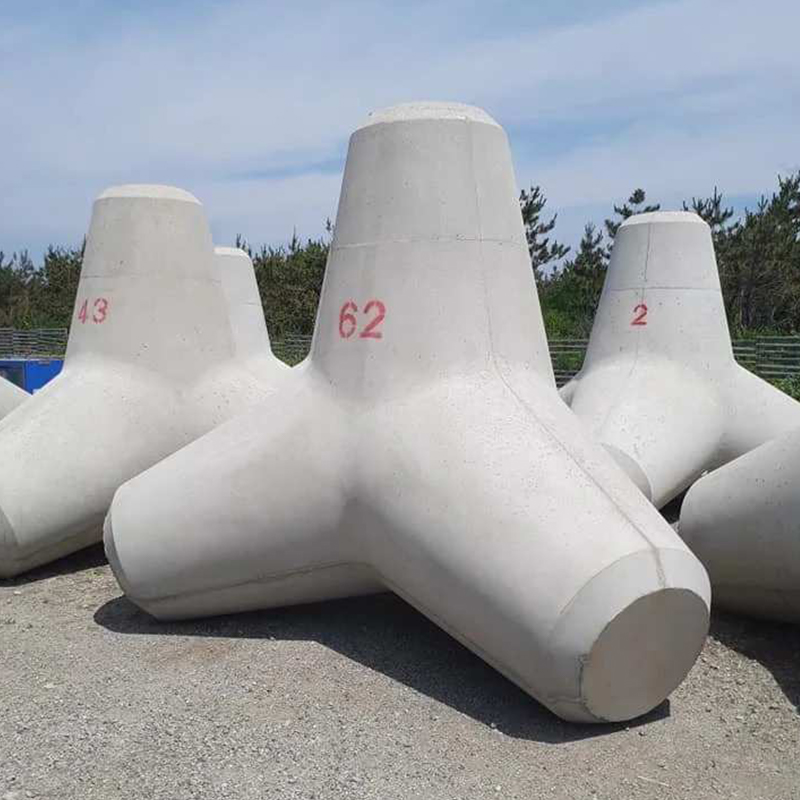
A tetrapod formwork is the precision steel casting system used to produce concrete tetrapods. Each concrete tetrapod has four projecting legs arranged in a three-dimensional shape. When placed randomly or semi-randomly on a breakwater slope, the units interlock and create a porous armor layer. Instead of behaving like a solid wall that reflects wave energy, the tetrapod layer allows partial water movement through its voids, reducing uplift, lowering run-up, and dissipating wave force through turbulence and friction.
The mold must therefore do more than hold concrete until it hardens. It must reproduce the exact geometric relationship among the four legs so that the final armor unit has predictable hydraulic behavior. If one leg is misaligned, undersized, oversized, or poorly finished, the tetrapod may not interlock correctly with neighboring units. This can create local instability, sliding, rocking, or uneven stress distribution. In a severe storm or typhoon event, small dimensional errors may contribute to armor layer failure.
High-quality tetrapod formwork helps solve these problems by controlling shape, surface quality, joint accuracy, and demolding efficiency. The steel mold from Nantong Hyson Road And Bridge Formwork is designed for standardized production in precast yards, where repeated casting cycles, vibration compaction, lifting, cleaning, and transportation place heavy demands on equipment. The mold is made from high-quality structural steel and reinforced at key connection points so that it can withstand frequent use while maintaining dimensional stability. Its service life can exceed 500 cycles when properly operated and maintained, making it suitable for large-volume projects and long-term rental or fleet use.
Why Tetrapod Units Remain Valuable in Modern Breakwater Design
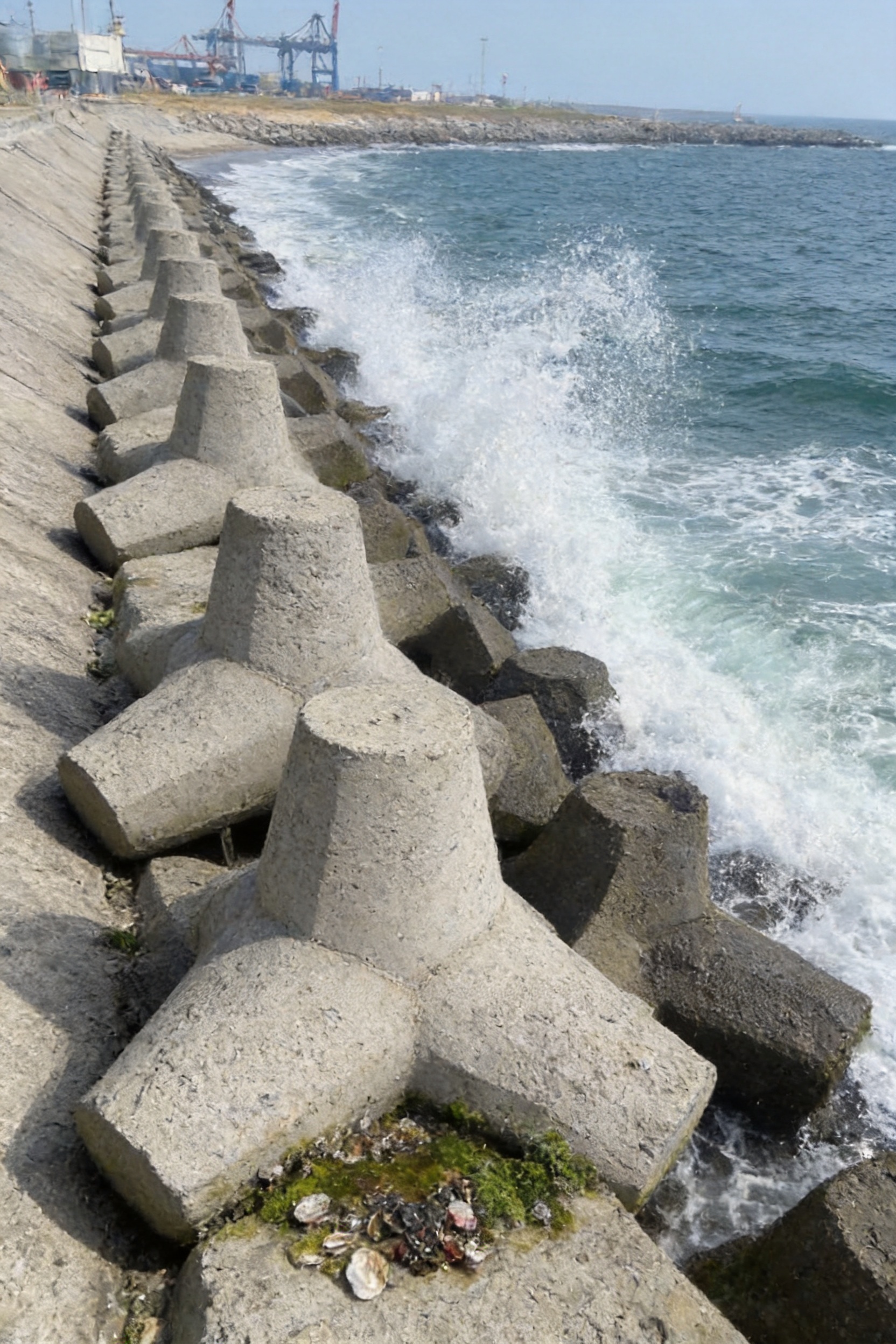
Breakwaters and revetments are not only civil structures; they are dynamic interfaces between land and sea. Traditional solid seawalls often reflect wave energy, increasing scour at the base and sometimes intensifying turbulence in adjacent waters. In contrast, tetrapod armor layers are designed to absorb and dissipate energy. Their three-dimensional shape produces stable contact points and creates a void ratio that supports permeability.
The tetrapod produced by accurate steel formwork has a low center of gravity, approximately one third of the edge height in the referenced design concept. This low center of gravity improves resistance to overturning. The four-legged configuration also allows the unit to settle naturally into a staggered arrangement. Once installed, neighboring units restrain each other mechanically, reducing the likelihood of displacement under wave attack.
In coastal protection projects, this stability is especially important under extreme weather conditions. Typhoons, storm surges, monsoon waves, and rapidly changing estuary currents can expose armor units to repeated impact, uplift, and drag. Compared with simple cubic blocks, well-cast tetrapods can provide higher overturning resistance because of their geometry and interlocking behavior. The product information indicates that the overturning torque can be increased by about 30% compared with cubic block forms under comparable conditions, making tetrapods particularly suitable for high-risk marine environments.
Tetrapods also support the trend toward green infrastructure. A breakwater formed with these units may create porosity of approximately 45%, depending on the placement pattern and design. This porosity enables water exchange and provides shelter spaces for marine organisms such as algae, fish, oysters, and other reef-associated species. When used in ecological restoration or artificial reef projects, tetrapods can help combine shoreline protection with habitat creation.
Product Overview: Tetrapod Formwork/Mold
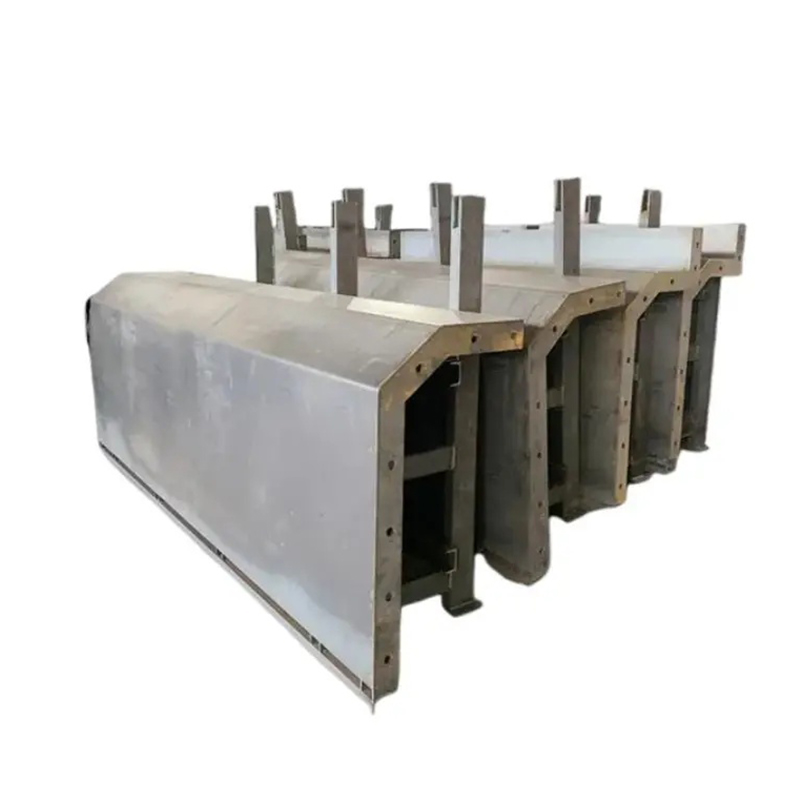
The Tetrapod Formwork/Mold is a specialized steel casting mold designed to produce concrete tetrapod armor units for breakwaters and other coastal defense structures. It belongs to the category of breakwater steel formwork and is manufactured for durability, repeatability, and efficient production. The formwork is suitable for contractors, precast component plants, marine engineering companies, port construction firms, and project owners requiring standardized tetrapod production.
The core product features include modular construction, polished inner wall surfaces, tight joints, reinforced structural ribs, high-precision cutting and welding, and reliable connection details. The inner wall is finished to support rapid demolding and clean concrete surfaces. A roughness level such as Ra≤3.2μm, when achieved through proper polishing and surface treatment, reduces adhesion between concrete and steel, shortens mold release time, and improves the visual quality of the finished unit. Faster demolding increases the number of production cycles that a precast yard can complete each day.
The mold is manufactured using laser cutting with an accuracy level up to approximately ±0.1 mm for key steel plate components. Robotic or controlled welding processes help achieve tight seams and consistent structural quality. These manufacturing methods reduce the risk of grout leakage during vibration casting. Grout leakage not only wastes material but also produces fins, honeycombing, or irregular surfaces that may require secondary grinding. By achieving tight joint precision, the formwork supports clean concrete production and reduces rework.
The product is also designed for tough working conditions. In precast yards, molds must endure repeated vibration, crane handling, bolt tightening, cleaning, coating, and exposure to cement slurry. Thickened reinforcing ribs and wear-resistant structural steel help prevent deformation. Reinforced key connections help the mold retain its original geometry after hundreds of casting cycles. This durability lowers the cost per cast, improves project schedule reliability, and creates stronger value compared with lightly fabricated molds.
Main Advantages Over Conventional or Low-Precision Mold Solutions
Many coastal projects face cost pressure, and some contractors may initially consider low-cost fabricated molds. However, a tetrapod mold is not a simple container. If the mold lacks dimensional accuracy, stiffness, and clean release performance, hidden costs appear during production and installation. These costs include slow demolding, frequent repair, concrete surface defects, grout loss, inconsistent armor unit weight, and reduced field stability. The Tetrapod Formwork/Mold manufactured by Nantong Hyson Road And Bridge Formwork is designed to reduce these risks.
One major advantage is geometric precision. Low-precision molds may produce tetrapods with uneven leg angles or inconsistent contact areas. In marine installation, such units can create unstable pockets in the armor layer. High-precision steel plate cutting and controlled welding help ensure that each cast unit meets the intended form. Repeatability is especially important when thousands of units are produced for a breakwater project.
A second advantage is demolding efficiency. When the inner wall is properly polished and the modular structure opens smoothly, the concrete unit can be released quickly without excessive hammering or force. This protects both the mold and the concrete. In experienced production teams, demolding can be completed within minutes, improving daily output and reducing labor intensity. By contrast, poorly finished molds may stick to concrete, causing edge damage, delays, and safety hazards.
A third advantage is leak-proof performance. Seam gaps in conventional molds can allow cement paste to escape, weakening local concrete surfaces and increasing cleaning work. Laser-cut plates and precise welded joints help create tight contact lines. This supports smoother concrete finishes, reduces secondary grinding, and helps achieve a clean concrete effect.
A fourth advantage is service life. Some low-cost molds may deform after repeated vibration or handling, especially at connection points. The Hyson product uses reinforced key joints and thickened ribs to improve fatigue resistance and shape retention. A longer service life above 500 cycles, depending on operating conditions, provides a lower total cost for high-volume production.
Key Technical and Performance Features
| Feature | Engineering Value | Practical Benefit for Contractors |
|---|---|---|
| High-quality structural steel | Provides stiffness, impact resistance, and dimensional stability | Supports repeated casting cycles and long service life |
| Laser-cut steel plates | Improves component accuracy and joint fit | Reduces grout leakage and secondary finishing work |
| Reinforced key connections | Strengthens areas exposed to vibration and repeated assembly | Minimizes deformation and maintenance downtime |
| Polished inner wall | Reduces concrete adhesion and improves surface quality | Enables faster demolding and cleaner finished tetrapods |
| Modular mold structure | Allows efficient opening, closing, cleaning, and handling | Improves production speed and worker safety |
| Tight welding and fitting | Controls seams and preserves mold geometry | Prevents slurry loss and supports consistent dimensions |
| Customizable fabrication | Adapts mold size and details to project requirements | Meets different breakwater designs, unit weights, and site needs |
Efficient Demolding and Production Speed
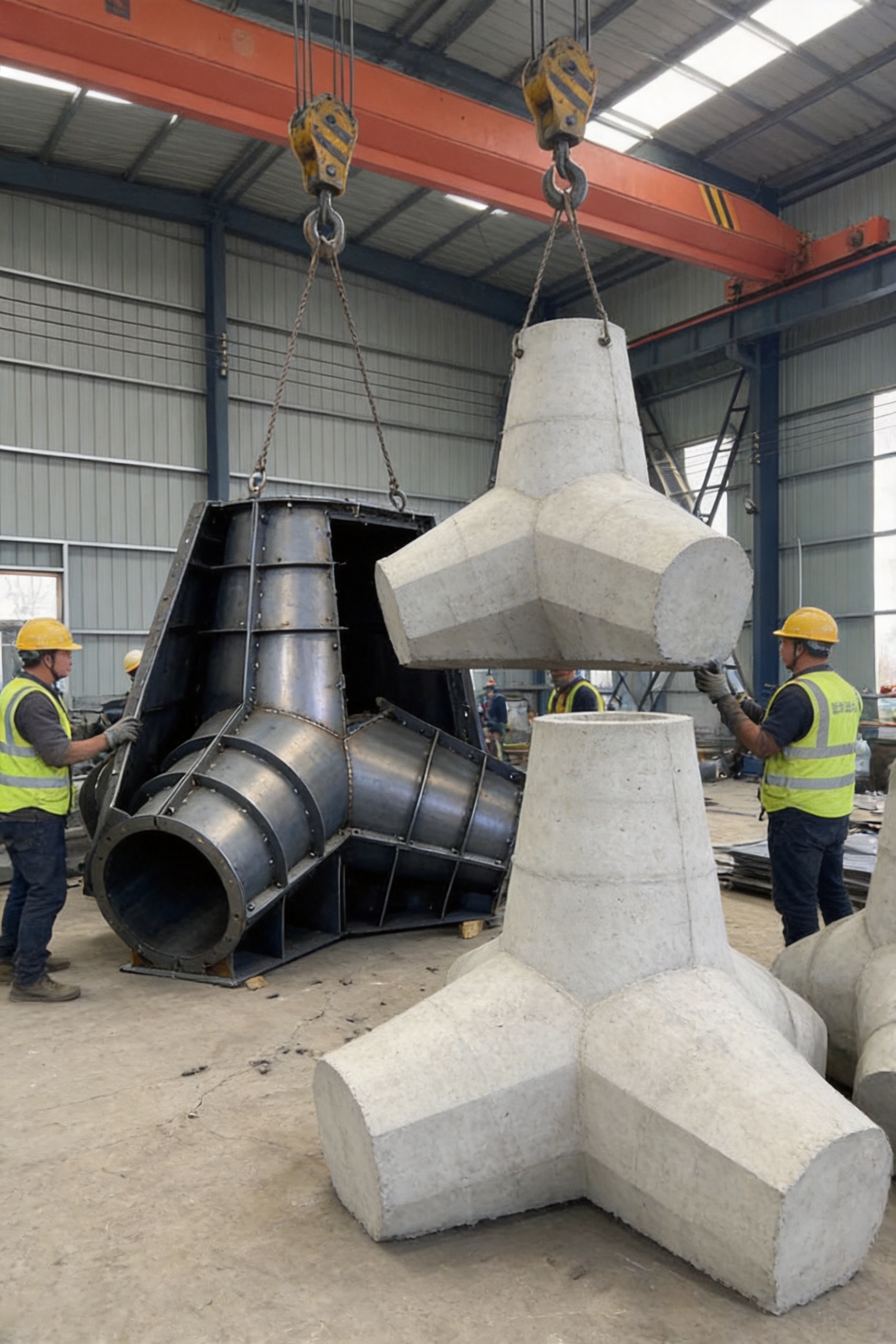
Demolding is one of the most important productivity factors in precast tetrapod manufacturing. In a large breakwater project, the number of concrete units may be substantial, and each mold must be used repeatedly. A mold that releases concrete easily can increase daily production without sacrificing quality. The Tetrapod Formwork/Mold supports efficient demolding through a modular design and smooth inner wall surfaces.
The modular design allows the mold sections to open in a controlled manner after the concrete reaches sufficient strength. Instead of relying on excessive impact or manual prying, workers can separate the mold from the concrete with less risk of damaging the unit. This is important because the projecting legs of a tetrapod are vulnerable to corner breakage if release forces are uneven. A smooth mold surface reduces friction and supports a cleaner separation line.
Fast demolding also improves mold utilization. In precast yards, cranes, vibration tables, concrete batching, curing areas, and labor crews must be coordinated. If molds remain occupied too long, the entire production line slows down. By reducing the time required for each release operation, the formwork helps increase throughput. For contractors working under tight marine construction windows, this can be a decisive advantage.
In addition, efficient demolding reduces maintenance. When concrete sticks to a rough or poorly aligned mold, workers may need to chip, grind, or scrape hardened residue. This damages coating layers and shortens mold life. A polished, accurately manufactured mold requires less aggressive cleaning, preserving the steel surface and maintaining dimensional quality for more cycles.
Structural Stability and Safety of the Cast Units
The stability of a tetrapod in service begins with accurate formwork. The mold defines the size, leg geometry, mass distribution, and contact characteristics of the concrete armor unit. If the mold accurately controls the center of gravity and the relationship among the four legs, the finished tetrapod can settle into a stable arrangement after placement. The product design emphasizes low center-of-gravity control and hydrodynamic stability.
During breakwater construction, tetrapods are usually placed on a prepared slope or armor layer using cranes or specialized marine equipment. They are not intended to form a flat wall. Instead, their random or planned interlocking creates a rough, porous, energy-dissipating surface. The geometry must allow three legs or multiple contact points to stabilize the unit naturally after installation. If the geometry is inaccurate, the tetrapod may rock, create void concentration, or fail to interlock effectively.
The mold contributes to safety by producing consistent units. When units are uniform, engineers can predict armor layer thickness, porosity, packing density, and hydraulic behavior more reliably. Installation teams can also handle and place units more efficiently because lifting points, balance, and orientation are consistent. In severe weather environments, such consistency supports long-term breakwater performance.
Compared with simple cubic blocks, tetrapods offer better resistance to overturning and sliding due to their three-dimensional shape and interlocking ability. The mold’s precision ensures that these theoretical advantages are realized in practice. This is why investment in high-quality formwork is not merely a production choice; it is a structural safety decision.
Leak-Proof Precision and Clean Concrete Finish
Concrete casting involves fluid pressure, vibration, cement paste movement, and aggregate settlement. If the formwork has gaps at seams or connection points, grout leakage may occur. Grout leakage can create surface voids, weak edges, rough fins, and inconsistent dimensions. It also increases cleanup time and material waste. For tetrapod units exposed to marine environments, surface defects may accelerate wear, reduce durability, or create stress concentration points.
The Tetrapod Formwork/Mold addresses this issue through high-precision steel processing. Laser cutting provides accurate plate edges, while controlled welding and fitting improve seam tightness. The goal is to create joints that remain stable during vibration compaction. When the mold is properly assembled and maintained, it helps prevent slurry escape and supports a smooth concrete surface.
Clean concrete finish is valuable for several reasons. First, it reduces the need for secondary grinding or repair, saving labor and time. Second, it improves dimensional accuracy because no large fins or irregular protrusions must be removed. Third, it contributes to handling safety because workers and lifting equipment encounter fewer sharp edges. Fourth, a clean surface may improve durability by reducing local weak zones.
Competitor molds with lower cutting accuracy or inconsistent welding may perform acceptably for small batches but often show problems during intensive production. Repeated assembly and vibration can widen gaps and cause misalignment. By using high-quality structural steel, reinforced connections, and precise processing, the Hyson mold maintains better seam quality throughout its service life.
Ecological Compatibility and Green Infrastructure Value
Modern coastal engineering increasingly requires environmental consideration. A breakwater must protect land and infrastructure, but it should also avoid unnecessary damage to marine systems. Tetrapod armor layers contribute to green infrastructure goals because they create permeable, rough, three-dimensional spaces. Depending on design and placement, the void ratio may be around 45%, allowing water exchange and providing habitat opportunities.
The gaps between tetrapods can become microhabitats for algae, shellfish, juvenile fish, and other marine organisms. In artificial reef applications, this rough and porous structure can support biodiversity and ecological restoration. The formwork indirectly contributes to this ecological value by ensuring that units are accurately shaped and consistently produced. Poorly cast units may not create predictable voids or stable placements, reducing the ecological and hydraulic benefits.
In addition to habitat value, permeable tetrapod breakwaters reduce wave energy without fully blocking water circulation. This can be important in harbors, estuaries, and shoreline restoration zones where stagnant water is undesirable. The structure can reduce erosion while preserving some natural hydrodynamic exchange. For projects aiming to balance protection with ecological restoration, tetrapod systems offer a practical and proven solution.
The Tetrapod Formwork/Mold is therefore not only a production tool but also an enabler of sustainable marine infrastructure. By producing accurate, durable armor units, it helps contractors meet modern project requirements for resilience, environmental compatibility, and long-term lifecycle value.
Durability, Maintenance, and Cost Effectiveness
The purchase price of a mold is only one part of its total cost. Contractors should consider cost per casting cycle, maintenance frequency, labor required for cleaning and demolding, concrete repair rates, downtime, and mold replacement risk. A robust steel mold with a long service life can be more economical than a cheaper mold that deforms quickly or causes frequent defects.
The Tetrapod Formwork/Mold is designed for durability through thickened reinforcing ribs, wear-resistant steel, and strengthened key connections. These features help the mold withstand repeated vibration in precast plants. Vibration is essential for concrete compaction, but it also creates fatigue and stress in formwork joints. Without sufficient stiffness, panels can loosen or deform, causing dimensional drift. Reinforced construction helps preserve geometry and reduces repair requirements.
Maintenance is also simplified by the mold’s surface quality and modular structure. Smooth inner walls are easier to clean. Tight joints reduce hardened slurry buildup. Modular components can be inspected, serviced, and reassembled efficiently. For companies operating mold fleets or leasing molds to multiple projects, maintenance efficiency directly affects profitability.
Cost effectiveness is especially strong in long-term projects. A mold capable of more than 500 cycles, when correctly used, can produce a large number of units while maintaining consistent quality. This reduces the cost allocated to each tetrapod. It also reduces schedule risk because replacement molds are less likely to be needed during peak production. For contractors working in remote coastal areas, avoiding unexpected equipment failure is highly valuable.
Advanced Steel Plate Cutting and Processing
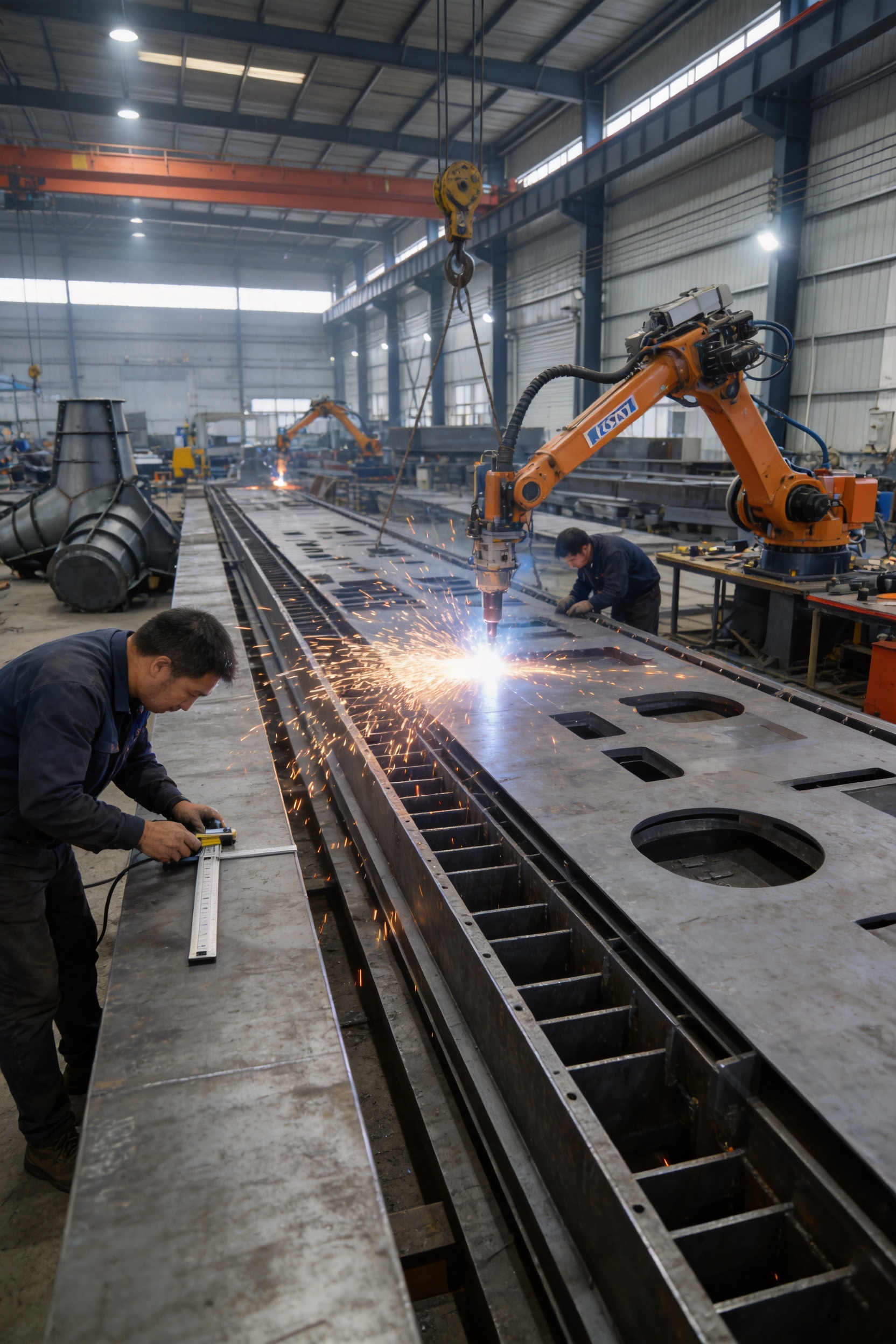
The manufacturing quality of tetrapod formwork begins with steel plate cutting. The product’s complex three-dimensional geometry requires accurate plate preparation before bending, fitting, and welding. Nantong Hyson Road And Bridge Formwork uses advanced laser cutting equipment to process steel plates with high precision. Laser cutting allows clean edges, accurate profiles, and repeatable dimensions, which are essential for tight assembly.
Compared with manual cutting or low-precision thermal cutting, laser cutting reduces edge irregularities and dimensional deviation. This improves the fit between components and reduces the amount of correction needed during fabrication. Better fit-up also supports higher weld quality because gaps are controlled and weld lines are more consistent. For a tetrapod mold, these details are critical because even small errors can affect the final concrete geometry.
Steel plate cutting and processing may also include bending, beveling, drilling, machining, and surface preparation. Each operation must be coordinated according to the mold design. Standardized production lines help ensure that each component moves through the manufacturing process in a controlled sequence. Quality inspection at intermediate stages prevents small errors from accumulating into major assembly problems.
The company’s experience in heavy metal fabrication and large steel structural components strengthens its ability to manufacture non-standard molds. Tetrapod formwork often needs customization according to unit size, weight, project standard, lifting method, and local construction requirements. Advanced processing equipment allows the company to deliver customized steel components while maintaining precision and repeatability.
Certified Welding and Structural Fabrication Strength
Welding is one of the most important processes in steel formwork production. The welds must provide strength, dimensional stability, and leak resistance. Nantong Hyson Road And Bridge Formwork combines automated processing with certified welding craftsmanship, including AWS and EN welding capabilities. This supports reliable fabrication of steel formwork, heavy-duty steel structures, scaffolding components, and OEM metal fabrication products.
In tetrapod formwork, weld quality affects both structural integrity and concrete finish. Poor welds may crack under vibration, distort the mold, or create internal protrusions that damage the concrete surface. Inconsistent welding heat input can also cause warping. Skilled welders and controlled procedures help reduce these risks. Robotic or semi-automated welding can improve consistency on suitable weld lines, while experienced craftsmen handle complex joints and inspection.
After welding, the formwork may require dimensional checks, surface grinding, polishing, and trial assembly. This ensures that all panels fit correctly and open or close smoothly. For modular molds, hinge points, bolt holes, flanges, and contact faces must align accurately. A small misalignment can slow down demolding or cause joint leakage. Full-process quality control helps identify and correct such issues before shipment.
The company’s background in landmark infrastructure projects demonstrates its ability to meet demanding manufacturing requirements. Its solutions have served major bridge and power plant projects, and it has acted as a trusted supplier for large state-owned construction enterprises. This mega-project experience supports disciplined production, inspection, documentation, and delivery practices for global clients.
Quality Control and International Standards
Quality control is essential for any product used in infrastructure construction. Nantong Hyson Road And Bridge Formwork applies full-process quality control and operates in compliance with ISO 9001 principles. The company is also associated with standards such as BS1139 and EN74 in scaffolding-related production, showing its familiarity with international construction product requirements. While tetrapod formwork has project-specific specifications, the same quality culture supports reliable mold manufacturing.
Quality control begins with design review and material selection. Steel plates and structural components must match the required thickness, strength, and durability. During cutting, dimensions are checked against drawings. During welding, weld appearance, penetration, distortion, and joint fit are controlled. After assembly, the mold is inspected for overall dimensions, opening mechanism, seam tightness, surface smoothness, and reinforcement quality.
For customized molds, communication with clients is especially important. Project drawings, concrete unit dimensions, weight requirements, lifting arrangements, and production methods must be clarified before fabrication. The company’s OEM service capability allows it to adapt the mold to different engineering needs. This may include customized size, connection structure, panel thickness, reinforcement pattern, surface treatment, or packing method.
Quality documentation can help contractors manage procurement and project acceptance. Consistent manufacturing records, inspection reports, and communication procedures reduce uncertainty for international clients. In marine infrastructure projects, where replacement or rework can be costly, reliable quality control provides a major competitive advantage.
Customization for Project-Specific Requirements
Every coastal project has its own design conditions. Wave height, water depth, slope angle, foundation material, tidal range, transportation method, available cranes, concrete mix, curing schedule, and installation sequence may differ. Therefore, tetrapod molds often need to be customized. A standard mold may not satisfy every project requirement, particularly when the concrete unit weight or local specification differs from common designs.
Nantong Hyson Road And Bridge Formwork offers custom tetrapod mold services. The company can manufacture molds according to client drawings or assist with fabrication optimization based on production needs. Customization may involve different tetrapod sizes, plate thicknesses, reinforcing rib layouts, assembly methods, demolding mechanisms, lifting accessories, and surface finish levels. For large-scale production, mold design can also be optimized for faster handling and easier cleaning.
Customization provides practical advantages. A mold matched to the contractor’s production line reduces handling conflicts. For example, the mold opening direction must fit the crane layout and workspace. Bolt positions should be accessible to workers. The mold weight must match lifting equipment capacity. The demolding sequence should protect the concrete unit from damage. These details can determine whether production runs smoothly or suffers repeated delays.
The company’s broad manufacturing capacity, including steel formwork, ringlock scaffolding, hydraulic tunnel trolleys, steel props, industrial steel structures, and heavy OEM fabrication, gives it strong engineering flexibility. It can integrate cutting, bending, welding, assembly, and finishing services to deliver ready-to-use steel components for construction, transportation, mining, agricultural, and marine infrastructure industries.
Application Scenarios
Coastal Breakwaters
Coastal breakwaters are one of the primary applications of tetrapod concrete units. When placed on the outer armor layer, the units form a permeable barrier that reduces wave rise, dissipates energy, and protects ports, harbors, industrial shorelines, and coastal communities. Accurate tetrapod formwork ensures that the concrete units interlock properly and maintain stable geometry under wave action.
Riverbank and Estuary Regulation
Riverbanks and estuaries may experience strong currents, sediment movement, tidal influence, and erosion. Tetrapod units can help stabilize riverbeds and protect vulnerable banks. Their porous arrangement reduces flow energy while allowing water passage. In delta environments, where currents can shift quickly, durable armor units contribute to long-term structural stability.
Ecological Restoration and Artificial Reefs
Tetrapod units can be used as artificial reef components because their gaps and rough surfaces provide habitat opportunities. Algae, fish, oysters, and other marine organisms may colonize the protected voids. In restoration projects, tetrapod breakwaters can combine wave attenuation with biodiversity support. Accurate molds help produce consistent units that form reliable void networks.
Land Reclamation Defense
Newly reclaimed land is highly vulnerable to wave erosion before the shoreline system becomes fully stabilized. Tetrapods can serve as the main protective armor layer of seawalls and revetments, protecting reclaimed areas from wave impact. High-quality molds help ensure rapid production of large quantities of durable units for demanding reclamation schedules.
How the Mold Supports Precast Plant Efficiency
Precast component plants rely on repeatable workflows. The Tetrapod Formwork/Mold supports this workflow by combining durability, modular operation, and clean release. A typical production cycle includes mold cleaning, release agent application, mold assembly, reinforcement or lifting insert placement if required by the design, concrete pouring, vibration compaction, curing, demolding, inspection, and storage. Any weakness in the mold can slow this cycle.
Accurate fit-up reduces the time required for assembly. Workers can close mold sections quickly and achieve tight joints without repeated adjustment. Strong reinforcement prevents shape distortion during concrete vibration. Smooth inner surfaces reduce sticking and shorten cleaning time. Reliable demolding mechanisms reduce labor intensity and improve safety. These advantages accumulate over hundreds of cycles.
Plant efficiency also depends on predictable quality. If every unit comes out with similar dimensions and clean surfaces, inspection and storage become simpler. Fewer rejected units mean less material waste and fewer schedule disruptions. Consistent unit geometry also improves transportation and site placement because lifting and stacking procedures can be standardized.
For contractors producing tetrapods near coastal project sites, equipment reliability is crucial. Remote marine projects may face limited access to repair services, spare parts, or replacement molds. A well-manufactured steel mold with robust joints and long service life reduces operational risk. This is one reason heavy-duty fabrication quality should be prioritized over the lowest initial price.
Comparison With Alternative Armor Unit Production Methods
Coastal engineers may choose among different armor units, including cubes, rocks, dolosse, accropodes, and tetrapods. Each has its own design logic. However, tetrapods remain attractive because of their proven interlocking behavior, relatively straightforward casting process, and strong performance in many breakwater applications. The quality of formwork determines whether these advantages are fully achieved.
Compared with simple block molds, tetrapod molds require more complex fabrication. However, the resulting unit offers better hydraulic performance and mechanical interlocking. Cubic blocks are easier to cast but may provide lower overturning resistance and less efficient wave energy dissipation in certain conditions. Tetrapods create a more open, irregular surface that reduces wave run-up and supports permeability.
Compared with poorly fabricated tetrapod molds, high-precision steel molds provide better repeatability. Low-cost molds may appear economical at first, but they can introduce cumulative losses through repair, rework, and slow demolding. A precision mold helps maintain unit consistency, which is essential when thousands of units are installed together as one hydraulic system.
Compared with disposable or temporary casting systems, steel formwork provides superior long-term value. It can be reused many times, repaired when necessary, and adapted for systematic production. For contractors handling multiple marine projects, durable molds can become valuable production assets. The Hyson mold’s reinforced steel construction and service life potential make it suitable for both direct project use and mold leasing scenarios.
Company Manufacturing Strength Behind the Product
Nantong Hyson Road And Bridge Formwork Co., Ltd. is a professional manufacturer specializing in custom steel formwork, ringlock scaffolding, heavy-duty steel structures, and OEM metal fabrication. The company is located in Rugao City, Nantong, Jiangsu, China, an area with strong industrial manufacturing resources and convenient supply chain access. Its capabilities include laser cutting, bending, welding, steel structure fabrication, scaffolding production, and custom non-standard component manufacturing.
The company is equipped with advanced laser cutting equipment and standardized production lines. This allows it to combine automated processing with experienced welding craftsmanship. Certified AWS and EN welding practices support high-quality fabrication, while ISO 9001 quality management helps ensure stable production control. The company also holds 12 utility patents, reflecting continuous technical development in formwork and related steel products.
As a strategic supplier for major construction enterprises such as CCCC and CRCC, the company has participated in large infrastructure supply chains. Its solutions have served landmark projects including the Sutong Yangtze River Bridge, Taizhou Bridge, and Sudan Thermal Power Plant. This project background is relevant because marine formwork buyers need suppliers who understand strict tolerances, deadlines, documentation, and engineering responsibility.
Hyson’s broader product range includes bridge and infrastructure formwork, hydraulic tunnel trolleys, certified scaffolding and steel props, industrial steel structures, and heavy steel OEM fabrication. This integrated capability allows clients to source not only tetrapod molds but also related steel components and fabrication services. For international contractors, working with one experienced manufacturer can reduce procurement complexity and improve coordination.
Heavy Metal Fabrication and Large Steel Structural Component Expertise
Tetrapod formwork benefits directly from heavy metal fabrication expertise. Unlike light sheet metal products, breakwater molds must handle large concrete volumes, vibration energy, lifting forces, and repeated assembly loads. They require the same disciplined approach used in large steel structural components. Plate thickness, rib spacing, weld size, connection design, and surface finishing all contribute to performance.
The company’s experience in large steel structural components supports robust mold design. Heavy fabrication requires careful control of distortion during welding, accurate measurement of large assemblies, and safe handling of bulky components. These skills are directly applicable to tetrapod mold manufacturing. A mold that appears simple externally may involve complex internal geometry and multiple reinforcement zones.
Large component fabrication also requires reliable logistics and packing. Tetrapod molds may need to be shipped internationally, transported to remote sites, or stored outdoors before use. Proper packing and protection help prevent damage during transportation. The company’s experience with infrastructure products supports practical packaging and delivery solutions.
For customers requiring OEM heavy metal fabrication, the same production platform can be used for custom steel parts beyond tetrapod molds. This includes steel plate cutting, welded frames, construction formwork, support structures, machine bases, and ready-to-install components. The integration of tetrapod formwork manufacturing with broader fabrication services gives clients more flexibility when planning complex projects.
Practical Selection Criteria for Buyers
When selecting tetrapod formwork, buyers should evaluate more than price. The first criterion is dimensional accuracy. The mold must reproduce the required concrete unit shape consistently. Buyers should review cutting methods, assembly procedures, and inspection capabilities. Laser cutting and controlled fitting are strong indicators of precision.
The second criterion is structural stiffness. The mold must resist deformation during vibration and repeated lifting. Reinforcing ribs, plate thickness, weld quality, and connection design should match the expected production intensity. For high-volume precast plants, a lightly built mold may become expensive due to downtime and repair.
The third criterion is demolding performance. The mold should open smoothly, release concrete without excessive force, and allow easy cleaning. Inner surface roughness, modular design, and practical access points all affect productivity. Buyers should ask how the mold is designed to protect projecting tetrapod legs during release.
The fourth criterion is leak-proof performance. Tight joints reduce grout loss and improve concrete finish. Buyers should inspect seam design, machining or cutting accuracy, flange contact, and welding quality. Joint stability after repeated cycles is more important than initial appearance alone.
The fifth criterion is supplier capability. A reliable supplier should provide customization, quality control, manufacturing experience, and responsive communication. Nantong Hyson Road And Bridge Formwork combines specialized formwork expertise with heavy steel fabrication capacity, making it a strong option for contractors seeking durable tetrapod molds and related steel solutions.
Operation and Maintenance Recommendations
Proper operation helps maximize mold life. Before each casting cycle, the mold should be cleaned thoroughly to remove hardened concrete residue. The inner surface should be inspected for scratches, dents, or buildup that could affect release quality. A suitable release agent should be applied evenly according to concrete mix and site conditions.
During assembly, workers should check that all bolts, clamps, hinges, and contact faces are properly aligned. Over-tightening or uneven tightening should be avoided because it may distort the mold. During concrete pouring and vibration, operators should follow the recommended vibration intensity and duration. Excessive vibration may stress the mold unnecessarily, while insufficient vibration may reduce concrete quality.
After curing, demolding should follow the correct sequence. Workers should avoid striking the mold violently or prying against vulnerable concrete edges. Modular sections should be opened gradually to release the unit safely. Once the tetrapod is removed, the mold should be cleaned before residue hardens.
Periodic maintenance should include inspection of welds, hinges, fasteners, ribs, and contact surfaces. Any deformation or wear should be corrected early. If the mold is stored for long periods, it should be protected from corrosion and placed on stable supports to prevent distortion. With proper care, the steel mold can deliver long service life and consistent casting quality.
Why Precision Formwork Improves the Entire Coastal Project
The impact of high-quality tetrapod formwork extends beyond the precast yard. It improves the entire project chain. During production, it increases output and reduces defects. During transportation, consistent unit shape and weight improve handling predictability. During installation, accurate units interlock more reliably and support planned armor layer geometry. During service, stable units resist wave action and protect the coastline.
In coastal engineering, failures are expensive. If armor units move during a storm, repair may require marine equipment, divers, cranes, and emergency mobilization. The cost of failure can far exceed the cost of better formwork. Therefore, investing in reliable molds is a preventive measure. It helps ensure that the concrete units meet design assumptions and perform as intended.
Precision formwork also supports project documentation and quality assurance. When molds are manufactured under controlled processes, contractors can demonstrate that unit production is based on stable equipment. This is helpful for owner acceptance, consultant review, and long-term asset management. In international projects, clear manufacturing quality can reduce disputes and improve trust among stakeholders.
For ecological projects, consistent tetrapod geometry helps create predictable voids and stable habitat structures. For reclamation projects, rapid production supports tight construction timelines. For port projects, durable armor improves operational security. Across these scenarios, the mold is a small part of the total project cost but a major contributor to final performance.
Q&A Section
What is a Tetrapod Formwork/Mold used for?
It is used to cast concrete tetrapod armor units for breakwaters, revetments, estuary protection, land reclamation defense, and artificial reef projects. The steel mold controls the geometry of the four-legged concrete unit so it can interlock properly and dissipate wave energy.
Why is steel formwork better than low-cost temporary molds?
Steel formwork provides higher dimensional accuracy, stronger resistance to vibration, better demolding performance, longer service life, and cleaner concrete surfaces. Although the initial cost may be higher, the cost per casting cycle is usually lower in high-volume production.
How does the mold improve breakwater stability?
The mold accurately forms the tetrapod’s geometry and center of gravity. Consistent units interlock more reliably, resist overturning, and create a stable porous armor layer. This helps the breakwater dissipate wave energy instead of simply reflecting it.
What makes this mold different from ordinary block molds?
Ordinary block molds produce simple shapes that may have limited interlocking behavior. Tetrapod molds create complex four-legged units with improved hydrodynamic performance, lower center of gravity, and better resistance to sliding and overturning under severe wave conditions.
Can the mold be customized?
Yes. Nantong Hyson Road And Bridge Formwork can provide custom tetrapod mold services based on project drawings, unit size, concrete weight, production method, lifting requirements, and site conditions.
How long can the mold be used?
With correct operation and maintenance, the mold can have a service life exceeding 500 casting cycles. Actual service life depends on concrete mix, vibration intensity, cleaning methods, handling practices, and maintenance quality.
How does the mold reduce grout leakage?
Laser-cut steel plates, accurate fitting, and controlled welding create tight joints. These joints help prevent cement paste from escaping during vibration, improving concrete surface quality and reducing cleanup work.
Is the tetrapod system environmentally friendly?
Tetrapod breakwaters can support ecological compatibility because their porous structure allows water exchange and creates habitat spaces for marine organisms. They are often suitable for green infrastructure and artificial reef applications.
What manufacturing strengths support product quality?
The manufacturer uses advanced laser cutting equipment, standardized production lines, certified welding craftsmanship, full-process quality control, and heavy steel fabrication experience. These capabilities support precision, durability, and customization.
What information should buyers provide before ordering?
Buyers should provide tetrapod drawings, unit dimensions, target concrete weight, required quantity, production cycle expectations, lifting and demolding requirements, surface finish expectations, and any applicable project standards.
Conclusion
Tetrapod concrete armor units are proven solutions for coastal protection, but their performance depends heavily on the quality of the mold used to cast them. The Tetrapod Formwork/Mold manufactured by Nantong Hyson Road And Bridge Formwork Co., Ltd. is designed to deliver geometric precision, efficient demolding, leak-proof joints, clean concrete surfaces, long service life, and reliable structural stability. These advantages help contractors improve productivity while supporting safer and more durable breakwater systems.
Compared with conventional block molds or low-precision fabricated molds, this product offers clear engineering and economic benefits. It helps produce tetrapods with consistent low-center-of-gravity geometry, strong interlocking capability, and improved resistance to harsh marine conditions. Its modular design and polished inner surface support rapid demolding, while reinforced steel construction allows repeated use in demanding precast environments. For projects involving coastal breakwaters, estuary regulation, artificial reefs, and land reclamation defense, the mold provides practical value from production through installation and long-term service.
The company’s advanced manufacturing base further strengthens the product. With laser cutting, steel plate processing, certified welding, standardized production, ISO 9001 quality control, utility patents, and experience in major infrastructure supply chains, Hyson is well positioned to provide custom tetrapod molds and broader heavy metal fabrication services. For global contractors seeking accurate, durable, and cost-effective steel formwork, this Tetrapod Formwork/Mold represents a strong choice for modern coastal defense construction.
References
1. Coastal Engineering Manual, U.S. Army Corps of Engineers, coastal structures and armor unit design guidance.
2. CIRIA, The Rock Manual: The Use of Rock in Hydraulic Engineering, guidance on breakwaters, revetments, and hydraulic stability.
3. PIANC, Guidelines for the Design of Armored Slopes and Breakwater Structures, international navigation and port engineering recommendations.
4. ISO 9001 Quality Management Systems, principles for process control and manufacturing quality assurance.
5. AWS Structural Welding Code, welding quality principles applicable to steel fabrication and structural components.
6. EN welding and construction product standards, European practice references for fabricated steel components.
7. BS1139 and EN74 scaffolding component standards, international references for construction steel product quality and safety management.
Product: Tetrapod Formwork/Mold


- Location
- Group 3, Fangzhuang Village, Rucheng Subdistrict, Rugao City, Nantong, Jiangsu, China
- Follow us
- Phone
- +86-13646196162
- info@hysonindustry.com
