 +86-13646196162
 info@hysonindustry.com




 русский
 عربى



Adjustable Jack Base for Scaffolding and Formwork: Precision Support for Demanding Construction Projects
 2026.10.17
Content
- 1 1. The Role of a Jack Base in Temporary Support Systems
- 2 2. Product Construction and Working Principle
- 3 3. Main Technical Advantages
- 4 4. Applications in Construction and Infrastructure
- 5 5. Manufacturing Process and Quality Control
- 6 6. Why Manufacturing Capability Matters to Buyers
- 7 7. Product Selection Guide
- 8 8. Installation and Safe Use
- 9 9. Maintenance, Inspection, and Reuse
- 10 10. Comparison with Alternative Support Methods
- 11 11. OEM Customization Opportunities
- 12 12. Cost and Project Value
- 13 13. Choosing a Reliable Manufacturing Partner
- 14 14. Frequently Asked Questions
- 14.1 14.1 What is an adjustable jack base?
- 14.2 14.2 What adjustment range is available?
- 14.3 14.3 What materials are used?
- 14.4 14.4 What is the load-bearing capacity?
- 14.5 14.5 Can the jack base be used on muddy ground?
- 14.6 14.6 Is hot-dip galvanizing available?
- 14.7 14.7 Can it be used with ringlock or disc-lock scaffolding?
- 14.8 14.8 Can the product be customized?
- 14.9 14.9 Does a jack base replace scaffold bracing?
- 14.10 14.10 How should used jack bases be inspected?
- 14.11 14.11 What information should be provided for an OEM quotation?
- 15 15. Conclusion
- 16 References
- 17 Product: Jack Base
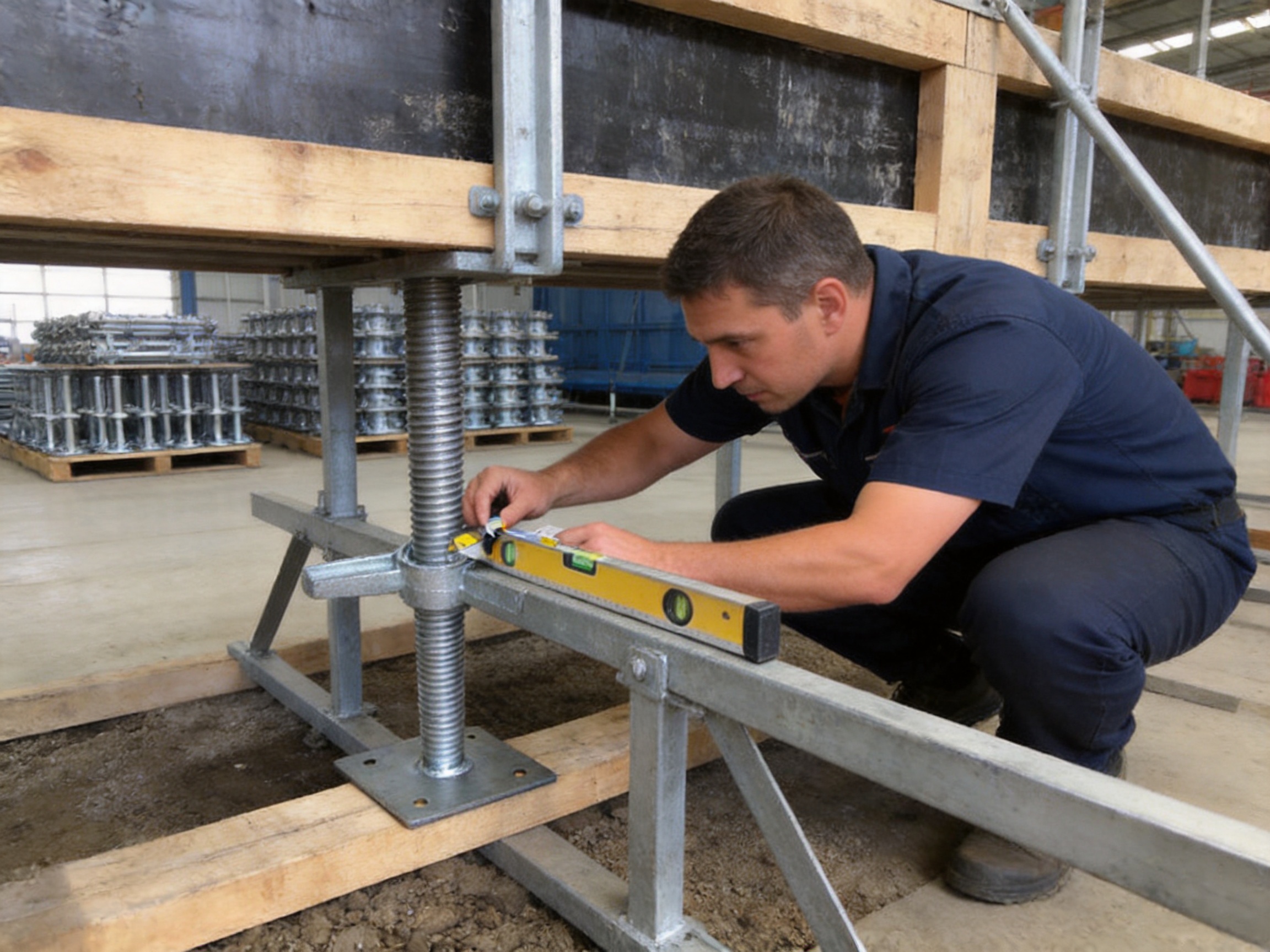
In modern construction, the reliability of a temporary support system depends on more than the strength of its main frames, standards, ledgers, and braces. The connection between the support system and the ground is equally important. When the ground is uneven, soft, sloped, or affected by construction tolerances, even a well-designed scaffold or formwork assembly can lose stability. An adjustable jack base provides the practical solution by creating a controllable interface between the supporting structure and the ground.
An adjustable jack base is a height-adjustment and leveling component used with scaffolding, formwork, temporary supports, and selected structural support arrangements. Through a threaded lifting mechanism, the component allows workers to raise or lower a support point, compensate for differences in ground elevation, and establish a level working platform or formwork support line. It also helps transfer vertical loads into the ground through a base plate or tray, reducing the risk of concentrated pressure, settlement, and local instability.
Designed for demanding construction environments, the jack base described in this article combines high-strength carbon steel, a precision-threaded adjustment system, a load-distributing base tray, surface protection, and compatibility with common support systems. Its adjustment range, load-bearing capacity, material selection, and finish can also be adapted to project requirements. These characteristics make it suitable for construction contractors, scaffolding rental companies, formwork specialists, infrastructure builders, and distributors seeking a dependable OEM support component.
1. The Role of a Jack Base in Temporary Support Systems
Temporary support systems are expected to carry significant loads while remaining adjustable, reusable, and easy to install. Scaffolding must provide a stable platform for workers and materials. Formwork supports must hold panels and fresh concrete until the concrete reaches the required strength. Bridge and infrastructure projects often require temporary platforms, shoring arrangements, or support towers on ground conditions that are far from ideal.
A jack base performs several essential functions within these systems. First, it provides a contact point between the vertical support member and the ground or a supporting surface. Second, it permits vertical adjustment. Third, it distributes the applied load over a larger area than a plain tube end or narrow support leg. Finally, it contributes to the overall stability of the temporary structure by helping workers establish a level and properly aligned support arrangement.
Without a suitable adjustable base, workers may attempt to compensate for uneven ground with loose packing materials, timber blocks, improvised wedges, or non-standard components. Such practices can create unpredictable load paths and inconsistent support conditions. A properly manufactured jack base provides a controlled alternative. Its threaded mechanism offers incremental adjustment, while its base plate or tray creates a broader and more stable bearing area.
The jack base is therefore not merely an accessory. It is a functional structural component that influences load transfer, alignment, installation efficiency, and site safety. Selecting the correct design and using it according to the project engineer’s requirements can help reduce the risk of settlement, tilting, differential support, and formwork deformation.
2. Product Construction and Working Principle
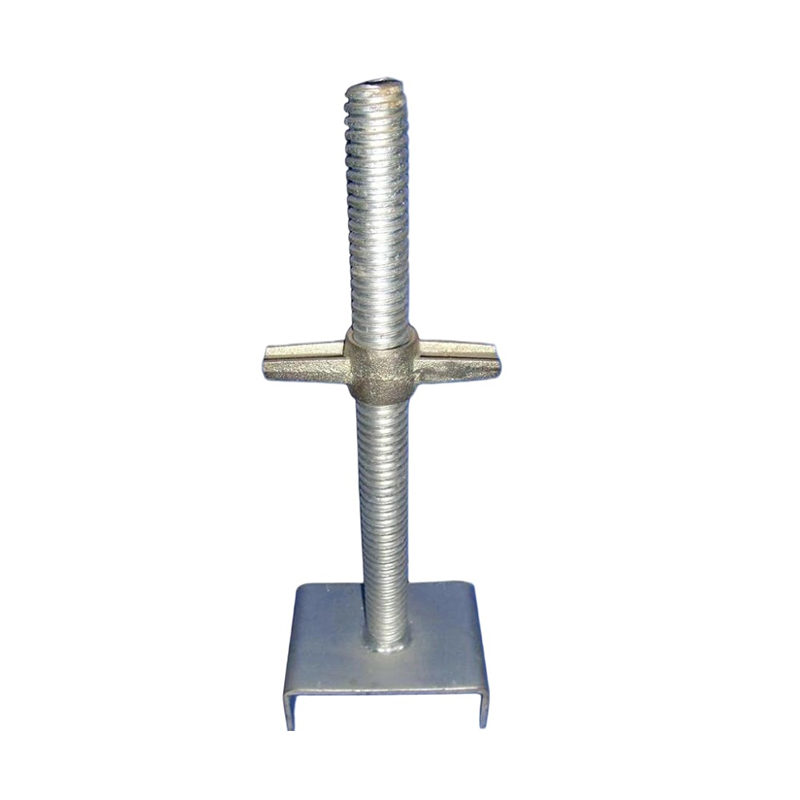
The basic adjustable jack base consists of a steel threaded stem, an adjustment collar or nut, and a base plate or load-bearing tray. Depending on the application, the top section may include a U-head, flat head, socket, or standardized connection detail. The stem is inserted into the lower portion of a scaffold standard, support frame, prop, or related structural member. By turning the adjustment mechanism, the user changes the exposed length of the stem and therefore changes the support height.
The threaded lifting structure converts rotational movement into controlled vertical movement. This arrangement is simple, robust, and suitable for repeated use. It does not require electrical power, hydraulic equipment, or specialized adjustment tools. A worker can normally make corrections with the built-in adjustment collar or a suitable lever, depending on the design and site procedure.
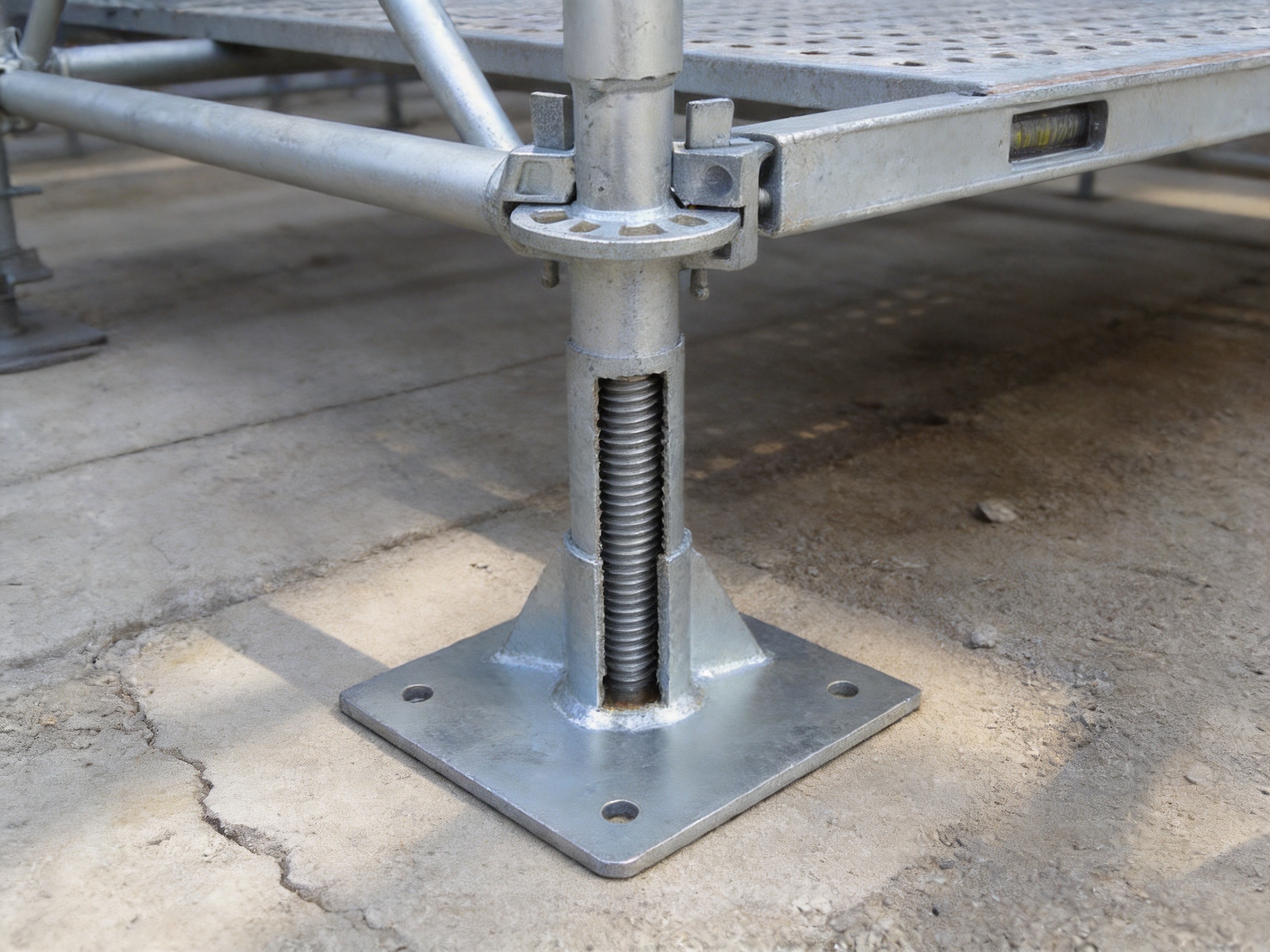
The base tray transfers the applied force from the stem into the supporting surface. Its enlarged geometry helps distribute pressure and reduces the likelihood that the stem will penetrate soft ground or become unstable on a narrow bearing point. For projects with particularly weak or sensitive ground, the jack base may be installed on a supplementary sole board, steel spreader plate, or engineered foundation arrangement.
The design can be manufactured in different dimensions to suit load requirements, scaffold standards, formwork frames, and local regulations. Stem diameter, thread size, base plate dimensions, adjustment range, material grade, welding details, and surface treatment can all be considered during engineering and production.
2.1 Threaded Adjustment Mechanism
The threaded adjustment mechanism is the central operating feature of the product. A properly formed thread allows the support height to be changed in small increments, making it possible to level a scaffold bay, align a formwork table, or compensate for differences between adjacent support points. The supplied product is designed for precise adjustment, with an adjustment accuracy that can reach approximately plus or minus 1 millimeter when correctly installed and operated.
The available adjustment range is commonly specified from 50 millimeters to 300 millimeters, with other dimensions available for customized projects. The selected range should correspond to the expected ground variation and the required structural configuration. Excessive extension of the stem can reduce stability or alter the load-bearing behavior of the support system, so adjustment limits should always be respected.
Thread quality is important because damaged, poorly formed, or contaminated threads can make adjustment difficult and reduce the usable life of the component. Controlled manufacturing, appropriate thread inspection, and protective finishing help maintain smooth operation over repeated construction cycles.
2.2 Load-Bearing Tray or Base Plate
The lower tray is designed to provide a stable bearing interface. Compared with a small tube end, an enlarged plate distributes the vertical reaction over a wider surface. This is especially valuable on compacted soil, concrete slabs, temporary platforms, and other surfaces where point loading could cause local damage or settlement.
The dimensions and thickness of the tray influence load distribution and resistance to bending. For heavy-duty applications, the plate may be reinforced or produced in a larger format. The connection between the threaded stem and the tray must also be manufactured and welded carefully because this region transfers the applied force into the base.
Where the ground is muddy, wet, or irregular, the base tray can be combined with a suitable sole board or engineered bearing solution. The jack base should not be used as a substitute for ground preparation. Instead, it works as one part of a complete support arrangement that includes adequate bearing capacity, drainage, compaction, and stability control.
3. Main Technical Advantages
The adjustable jack base offers a combination of adjustment, strength, adaptability, and durability that makes it more useful than improvised supports or basic fixed bases. Its advantages are particularly relevant where construction tolerances, changing site conditions, and repeated installation are part of normal project operations.
3.1 Precise Leveling and Height Control
One of the most important advantages is the ability to make controlled height corrections. Construction sites rarely provide perfectly level surfaces. Excavation, backfilling, concrete tolerances, temporary ramps, drainage slopes, and different floor elevations can all create variations between support points.
A threaded jack base allows the installer to correct these variations without cutting tubes, inserting loose packing pieces, or changing the entire support frame. The adjustment can be performed point by point, enabling the upper structure to be aligned more accurately. For formwork, improved leveling can help maintain slab thickness, wall alignment, and the intended geometry of the finished concrete. For scaffolding, it can help produce a more stable and level working platform.
The fine adjustment capability also supports faster commissioning. Workers can establish the required level during initial installation and make further corrections if the support system settles slightly or if adjacent construction activities alter the site conditions.
3.2 High Load-Bearing Capacity
The product is manufactured from high-strength carbon steel grades such as Q235 or Q345, subject to the specified design and application. Depending on the configuration, the rated load-bearing capacity can be selected within a range of approximately 50 kilonewtons to 100 kilonewtons. The actual permissible load must be confirmed through engineering calculations, testing, and the complete support-system design.
High load capacity is essential in formwork applications because fresh concrete creates substantial temporary pressure. It is also important in bridge construction, heavy-duty shoring, industrial maintenance platforms, and support towers carrying concentrated loads. The base must not only resist the vertical force but also maintain adequate stability when the support system is subject to accidental horizontal forces, vibration, wind, or minor installation imperfections.
A robust jack base helps reduce the risk of local deformation at the bottom of the support. Its enlarged bearing surface distributes pressure, while the steel stem and adjustment components provide a dependable load path. Nevertheless, the overall system capacity depends on many factors, including stem extension, thread engagement, frame geometry, bracing, ground bearing capacity, and the condition of connected components.
3.3 Corrosion Resistance and Long Service Life
Construction components are frequently exposed to rain, mud, cement slurry, groundwater, humidity, and outdoor storage conditions. Corrosion can reduce cross-sectional area, interfere with thread operation, and make inspection more difficult. To address these conditions, the jack base can be protected with hot-dip galvanizing. A coating thickness of at least 75 micrometers is specified for the product configuration described in the supplied material.
Hot-dip galvanizing creates a metallurgically bonded zinc coating that provides barrier protection and sacrificial protection to the underlying steel. This finish is particularly valuable for scaffolding and formwork components that are repeatedly moved between outdoor construction sites. It can help reduce maintenance requirements and extend the practical service life of the component.
The base tray can also receive an anti-slip treatment to increase friction against the supporting surface. Surface treatment does not eliminate the need for proper bracing, ground preparation, or safe installation, but it can improve contact behavior and reduce the risk of sliding under appropriate loading conditions.
3.4 Compatibility with Multiple Support Systems
A standardized interface is a major advantage for contractors and rental companies that operate several types of temporary works equipment. The adjustable jack base can be configured for use with disc-lock scaffolding, coupler-type scaffolding, triangular supports, wall formwork supports, frame systems, and other compatible arrangements.
Broad compatibility reduces the need to stock separate base components for every project. It also simplifies procurement, transportation, storage, and training. When dimensions and interfaces follow recognized industry practices, the component can be integrated into existing systems with minimal modification.
For OEM customers, the interface can be reviewed during the design stage. The manufacturer can consider the diameter of the receiving tube, required insertion depth, head configuration, thread dimensions, base plate size, and project-specific connection requirements. This makes the product suitable for both standard distribution and customized support solutions.
3.5 Simple Operation and Improved Installation Efficiency
The jack base is designed to be operated without complicated equipment. The worker positions the base, inserts or connects the supported member, and rotates the adjustment mechanism until the desired height and level are achieved. This straightforward process reduces installation time compared with systems that require cutting, welding, or repeated disassembly.
Fast adjustment is valuable when construction schedules are compressed. It also makes the component useful for rental fleets, where equipment must be prepared, inspected, installed, removed, and redeployed efficiently. The less time required for leveling and correction, the more productive the installation crew can be.
Operational simplicity also supports consistent work practices. When a proper adjustment component is available, workers are less likely to rely on makeshift methods. Clear markings, suitable handles, and a smooth thread can further improve usability.
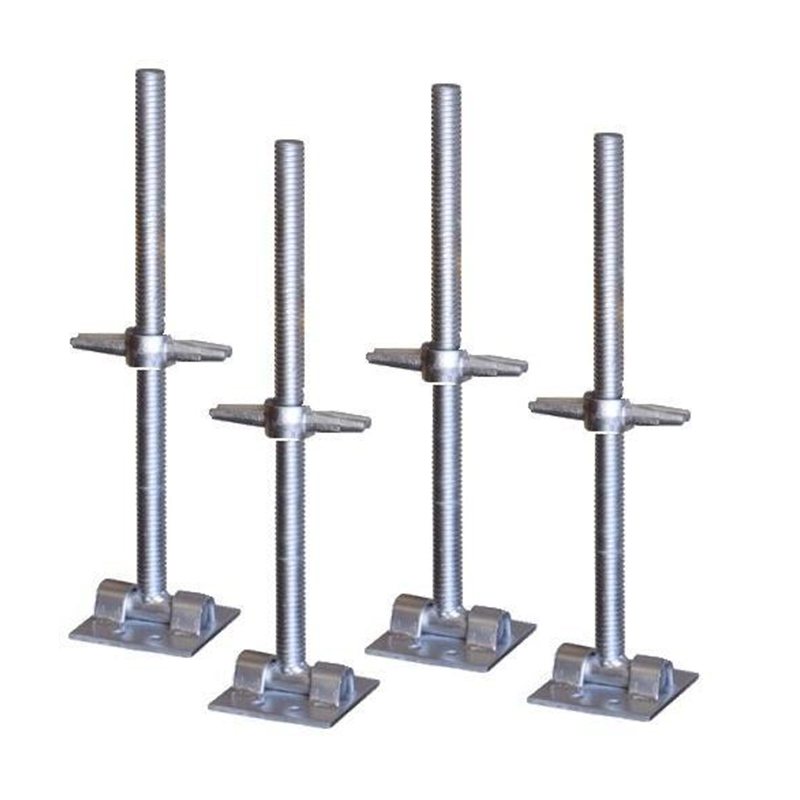
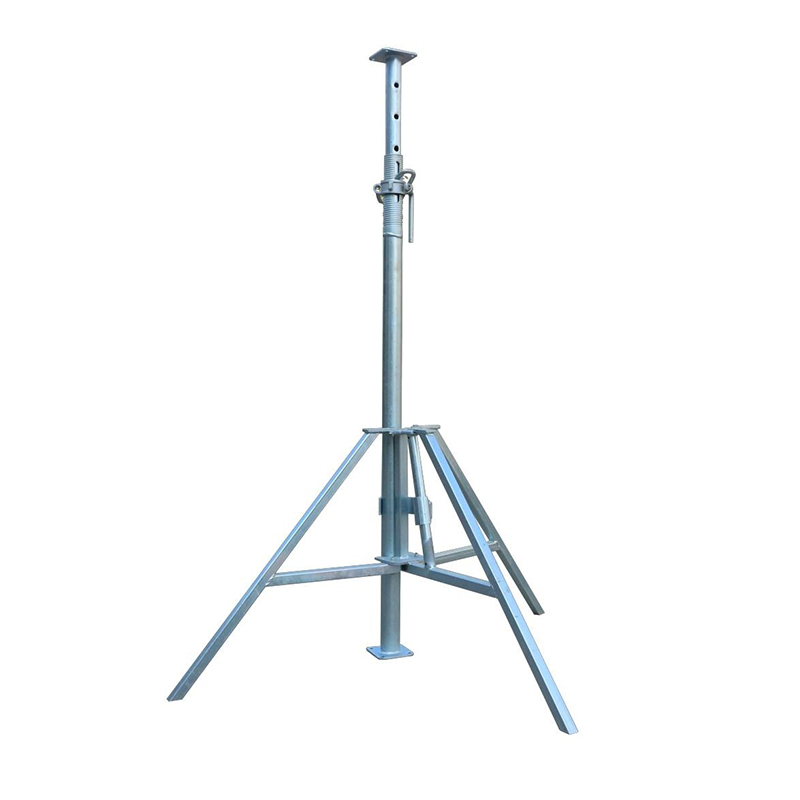
Jack Base
4. Applications in Construction and Infrastructure
4.1 Scaffolding Support
In scaffolding applications, the adjustable jack base is installed beneath standards or vertical legs. It allows the scaffold to be leveled even when the supporting surface has minor elevation differences. Leveling the first lift is especially important because errors at the base can become larger as the scaffold rises.
A properly adjusted base helps maintain the intended position of ledgers, transoms, platforms, stair units, and access components. It can also support more consistent installation of guardrails and working decks. On sloping ground, each base must be adjusted within the allowable range, and the scaffold must be braced and tied according to the approved design.
The component is suitable for building facades, industrial maintenance, bridge access, infrastructure repairs, commercial construction, and temporary work platforms. In rental operations, galvanized jack bases are useful because they can withstand repeated handling and outdoor exposure when correctly maintained.
4.2 Formwork Support
Formwork systems require accurate support because fresh concrete can magnify small installation errors. Adjustable bases help establish the correct elevation for wall formwork, slab formwork, beam formwork, table forms, and other temporary molds. They can be used beneath props, shoring towers, frame supports, or specialized support arrangements.
During installation, the base can be adjusted to bring the formwork into level and alignment before pouring. This helps reduce the risk of uneven slab thickness, wall displacement, joint misalignment, and surface defects. After the concrete has been placed, the support system remains responsible for carrying the temporary load until the approved striking or reshoring procedure begins.
For formwork engineers, the jack base is one component within a larger design. The design must account for fresh concrete pressure, construction live loads, impact, vibration, wind, panel reactions, prop spacing, bracing, and foundation conditions. The base should be selected according to the calculated reactions rather than used solely on the basis of appearance or nominal size.
4.3 Bridge and Infrastructure Construction
Bridge projects frequently involve uneven terrain, temporary access routes, riverbanks, piers, abutments, and complex elevation changes. Adjustable bases can help establish stable support points for scaffolding, formwork, access platforms, temporary walkways, and auxiliary structures.
In infrastructure work, installation conditions may change as excavation, drainage, backfilling, and concrete operations progress. A component that can be adjusted and reused is more practical than a fixed support that must be fabricated for one elevation. Galvanized protection is also beneficial where the project is exposed to rain, groundwater, or prolonged outdoor construction cycles.
The use of jack bases in bridge work must be coordinated with the project temporary works plan. Soil investigation, bearing pressure, settlement behavior, lateral restraint, and environmental loading should be reviewed by qualified personnel. Where loads are high or the ground is weak, additional spreader beams, steel plates, timber mats, or engineered foundations may be required.
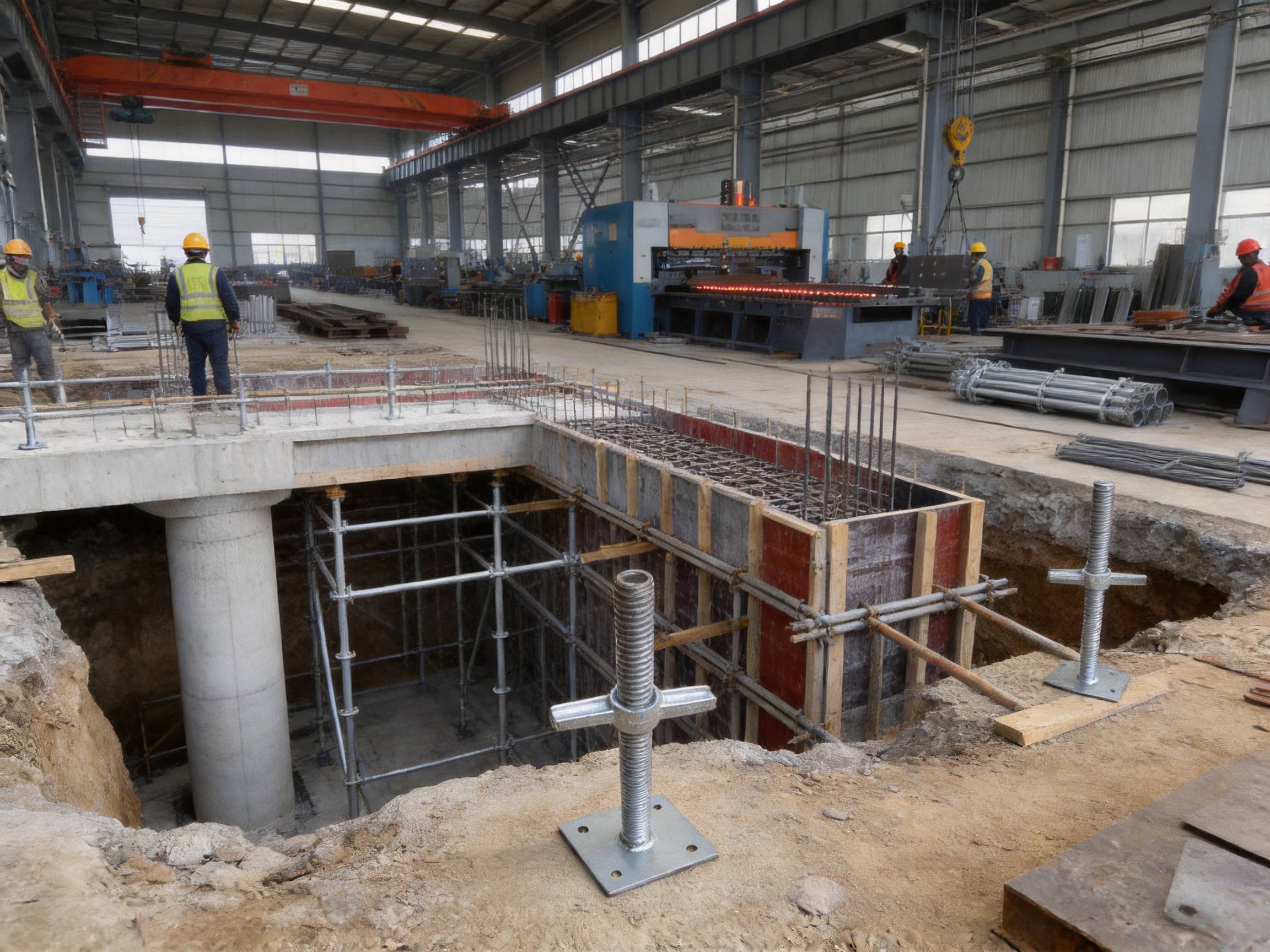
4.4 Uneven, Muddy, or Difficult Sites
Construction rarely takes place under ideal conditions. Temporary supports may be installed over compacted fill, rough concrete, paving, muddy soil, or a partially completed structure. The adjustable jack base helps compensate for moderate height differences and provides a defined bearing point in these circumstances.
Its use on difficult sites should begin with an assessment of the ground. Mud, loose fill, and waterlogged soil may not provide adequate bearing capacity, even when the base plate is large. In these cases, the jack base should be combined with ground improvement, drainage, compaction, a sole board, or a spreader arrangement. Adjustment can correct elevation, but it cannot create bearing capacity where the soil cannot support the load.
4.5 Heavy-Duty Temporary Supports
Triangular supports, temporary equipment platforms, industrial maintenance structures, and heavy-duty shoring systems may require a base that can carry substantial vertical reactions. The adjustable jack base can be specified for these applications when the stem, thread, tray, and connection details are selected for the calculated load.
For heavy-duty applications, the user should pay close attention to the amount of thread engagement, the unsupported length of the stem, the position of the adjustment nut, and the alignment of the applied load. Eccentric loading can reduce capacity and create bending stress. The support should be kept as vertical as practical, and lateral bracing should be provided as required by the design.
5. Manufacturing Process and Quality Control
The performance of a jack base depends on manufacturing consistency. A product may appear simple, but the interaction between the steel grade, thread quality, welding, dimensional accuracy, surface treatment, and inspection process determines its reliability in the field. Advanced manufacturing is therefore essential for producing components that can be used repeatedly in professional construction environments.
5.1 Engineering Review and Material Selection
Production begins with reviewing the required application, dimensions, load rating, interface, and surface treatment. The manufacturer can evaluate whether the product is intended for general scaffolding, formwork support, heavy-duty shoring, rental use, or a custom OEM program.
Q235 and Q345 carbon steel are commonly considered for the main components. The final material selection depends on the required strength, manufacturability, welding procedure, coating process, and customer specification. Material certificates and incoming inspection records can be used to verify conformity before processing begins.
Engineering review should also identify the critical dimensions. These may include stem diameter, thread pitch, thread length, plate thickness, plate width, overall height, insertion length, weld size, and adjustment range. Establishing these parameters in advance helps prevent variation between production batches.
5.2 CNC Cutting and Component Preparation
Modern steel processing equipment allows the manufacturer to cut plates and components accurately before forming and welding. CNC laser cutting can produce repeatable base plate shapes, holes, slots, and custom details with clean edges and controlled dimensions. Accurate preparation reduces the amount of manual correction required later in the production process.
For OEM orders, CNC cutting is particularly useful because it enables efficient production of custom plates and connection details. Digital drawings can be translated into repeatable cutting programs, allowing multiple batches to maintain consistent geometry. This is also beneficial when different jack base variants are required for different scaffold or formwork systems.
5.3 Threaded Stem Production
The threaded stem must be manufactured with sufficient dimensional control to support smooth adjustment and reliable load transfer. Depending on the design, the thread may be formed or machined, and the stem may be cut to a specified length before the base assembly is completed.
Inspection should verify thread profile, pitch, usable length, straightness, surface condition, and compatibility with the adjustment collar. Threads should be free from excessive burrs, distortion, and damage. The production process should also protect the thread during handling and coating so that the final product remains practical to operate.
5.4 Welding and Assembly
The connection between the stem and the base tray is a critical structural region. It must be properly fitted, aligned, and welded using a controlled procedure. The manufacturer described in the supplied information applies certified welding practices aligned with AWS and EN craftsmanship requirements. Such standards support consistent preparation, welder qualification, process control, and inspection.
Welding quality can influence load capacity, fatigue behavior, dimensional stability, and resistance to accidental impact. Depending on the customer requirement, welds may be inspected visually or by additional non-destructive testing. Weld spatter, sharp edges, incomplete fusion, undercut, and unacceptable porosity should be controlled through appropriate procedures.
Assembly also includes fitting the adjustment collar, checking movement, confirming the base plate position, and ensuring that the product remains square and stable. A component that is structurally strong but difficult to adjust does not provide the full value expected from an adjustable support.
5.5 Surface Treatment
After fabrication and inspection, the jack base may be hot-dip galvanized. Before immersion, the steel surface is prepared through cleaning and fluxing processes designed to remove oil, rust, scale, and contaminants. The prepared component is then immersed in molten zinc, allowing the coating to bond to the steel surface.
The final coating should be checked for coverage, adhesion, appearance, and thickness. A coating thickness of at least 75 micrometers is specified for the described product configuration, although the required value may vary according to the applicable standard and customer specification.
Galvanizing must be managed carefully around threaded areas. Excess zinc can interfere with adjustment, so the thread should be designed and treated in a way that preserves functional movement. Protective packaging and appropriate storage further reduce the risk of damage before the component reaches the construction site.
5.6 Final Inspection and Traceability
Final inspection may include dimensional checks, thread operation checks, visual examination, coating inspection, load testing, and packaging verification. The inspection plan should reflect the intended application and the risks associated with the product.
Traceability helps connect finished products with material batches, production dates, welding records, coating records, and inspection results. This is especially valuable for large OEM orders, infrastructure projects, and rental fleets where equipment may remain in service for many years.
6. Why Manufacturing Capability Matters to Buyers
Purchasing a jack base from a manufacturer with broad steel-processing capability offers advantages beyond the individual component. A factory that can manage cutting, forming, welding, machining, galvanizing coordination, inspection, and packaging under an organized production system can provide greater consistency and better control over customized orders.
For distributors, manufacturing capability supports stable supply and repeatable product specifications. For contractors, it can reduce the risk that replacement parts will have slightly different dimensions from the original batch. For engineering companies, it provides a practical route for modifying the base plate, thread, head connection, or adjustment range to meet project requirements.
The manufacturer described in the supplied materials specializes in custom steel formwork, ringlock scaffolding, heavy-duty steel structures, and OEM metal fabrication. Its production resources include laser cutting equipment, standardized production lines, automated processing, and certified AWS and EN welding practices. The company also reports ISO 9001 quality management, compliance with BS1139 and EN74 requirements, and a portfolio of utility patents.
These capabilities are relevant because a jack base may be purchased as part of a larger temporary works package. A supplier capable of manufacturing scaffolding accessories, steel props, formwork, structural components, and custom fabricated parts can coordinate interfaces across the project rather than treating each component as an isolated item.
6.1 Integrated Steel Fabrication
Integrated fabrication allows a supplier to produce components that share compatible dimensions and manufacturing standards. For example, the same production team may manufacture a jack base, a supporting frame, a steel prop, a scaffold component, or a custom formwork bracket. This can simplify technical communication and reduce the risk of mismatch.
It also supports efficient customization. If a customer requires a wider base plate, a special U-head, a different stem length, additional reinforcement, or a non-standard coating, the request can be reviewed within the supplier’s existing engineering and production system.
6.2 Experience with Large Infrastructure Projects
Experience serving major infrastructure projects can strengthen a supplier’s understanding of temporary works requirements. The supplied company information identifies experience connected with projects such as the Sutong Yangtze River Bridge, Taizhou Bridge, and Sudan Thermal Power Plant, as well as cooperation with major construction organizations.
Project experience does not replace project-specific engineering, but it demonstrates familiarity with demanding procurement procedures, delivery schedules, documentation, inspection requirements, and field conditions. This background can be valuable when supplying components for bridges, power facilities, industrial structures, transportation projects, and large building developments.
6.3 Quality Management and International Standards
Quality management systems provide a framework for controlling documents, suppliers, production processes, inspections, corrective actions, and customer feedback. ISO 9001 certification or compliance can help buyers evaluate whether a supplier has established repeatable management practices.
BS1139 and EN74 are associated with scaffolding components and couplers in international construction markets. The applicable requirements depend on the specific product, market, testing basis, and project documentation. Buyers should request relevant certificates, test reports, drawings, and declarations rather than assuming that a general standard reference automatically covers every product configuration.
7. Product Selection Guide
Selecting the correct jack base requires more than choosing a nominal size. The product should be matched to the support system, the calculated reaction, the ground condition, the expected adjustment, and the project environment.
7.1 Determine the Required Load
Begin with the maximum design reaction at each support point. This may include dead load, fresh concrete load, workers, equipment, impact, wind, and other temporary actions. The selected jack base should have an appropriate capacity with a suitable margin and should be evaluated as part of the complete support system.
A stated capacity range of 50 kilonewtons to 100 kilonewtons can cover many demanding applications, but the actual capacity depends on the specific model, thread extension, material, welding, and loading condition. Buyers should obtain technical data for the exact product rather than relying on a general catalog description.
7.2 Select the Adjustment Range
The adjustment range should be sufficient to compensate for the expected difference in ground elevation while keeping the threaded stem within the safe operating limits. Common adjustment ranges may extend from 50 millimeters to 300 millimeters. If a larger correction is required, it may be safer to use a different support frame, a properly designed packing arrangement, or a custom product.
The adjustment collar should retain adequate thread engagement throughout operation. The stem should not be extended beyond the manufacturer’s stated maximum. Excessive extension can increase slenderness, reduce lateral stability, and create a larger bending moment if the support is not perfectly vertical.
7.3 Evaluate the Ground and Bearing Surface
The base plate size should be considered together with the bearing capacity of the ground. A larger tray reduces contact pressure, but it does not automatically make weak soil suitable for heavy loads. On soil, a sole board, steel plate, or engineered mat may be required. On concrete, the slab thickness, strength, reinforcement, and local punching or cracking risk may need review.
Water, mud, voids, loose fill, and recently placed backfill should be treated as warning conditions. The base must sit flat and remain in full contact with the supporting surface. Uneven bearing under the plate can create eccentric loading and reduce stability.
7.4 Confirm Interface Compatibility
Check the receiving tube or support member diameter, internal clearance, insertion depth, head type, connection arrangement, and required adjustment direction. A standardized interface can simplify installation, but compatibility should still be confirmed through drawings or sample inspection.
For OEM projects, provide the manufacturer with dimensional drawings and information about the connected equipment. This allows the supplier to verify fit before mass production and reduces the risk of field modifications.
7.5 Choose the Appropriate Finish
Hot-dip galvanizing is suitable for many outdoor, humid, and reusable applications. Where the component will be exposed to aggressive chemicals, marine conditions, or unusual temperatures, the coating specification may require additional review. The buyer should also specify packaging requirements to protect the galvanized finish and threads during transport.
8. Installation and Safe Use
Before installation, inspect the jack base for bent plates, damaged threads, cracks, severe corrosion, missing parts, or coating damage that could affect function. Confirm that the selected model matches the approved temporary works design.
Prepare the supporting surface so that it is firm, level enough for the intended arrangement, and free from loose debris. Position a sole board or spreader plate when required. Place the jack base centrally beneath the supported member and ensure that the base tray has full and stable contact.
Insert or connect the scaffold standard, frame leg, prop, or other support member according to the system instructions. Adjust the collar gradually and check the elevation with an appropriate measuring tool. Do not use loose objects, unstable packing, or unauthorized extensions to increase the height.
After adjustment, install the required ledgers, transoms, braces, ties, frames, and other stabilizing components. A jack base provides vertical adjustment, but it does not replace the lateral bracing and anchorage required for a complete scaffold or formwork system.
During use, monitor the support for settlement, tilting, sliding, thread movement, plate deformation, and changes in the surrounding ground. Stop work and reassess the arrangement if unexpected movement or damage is observed. Loads should remain within the approved design limits, and support systems should not be altered without authorization from the responsible competent person.
When dismantling, unload the structure in accordance with the project procedure. Remove the component without striking or dropping it unnecessarily. Clean off concrete, mud, and debris, then inspect and store the jack base in a dry, organized location.
9. Maintenance, Inspection, and Reuse
One of the key economic benefits of an adjustable jack base is its potential for repeated use. Reuse is practical only when the component is inspected and maintained between projects. Rental companies and contractors should establish a documented inspection routine.
Inspect the base plate for bending, cracks, deep corrosion, distortion, or excessive wear. Check the stem for straightness and inspect the thread for flattening, galling, dents, and contamination. Rotate the adjustment collar through its working range to confirm that it moves smoothly and retains adequate engagement.
Galvanized surfaces may show normal discoloration or handling marks without losing their protective value. However, areas with exposed steel, heavy rust, deep abrasion, or coating separation should be evaluated. Damaged components should be repaired only through an approved process or removed from service.
Do not weld, drill, heat, or cut a load-bearing jack base in the field unless the modification has been designed and approved. Uncontrolled modifications can change the load path, damage the protective coating, or weaken the material around the connection.
Storage should keep the bases off standing water and away from corrosive chemicals. Threads can be protected from impact and contamination with suitable covers or organized stacking. Components should be sorted by model and capacity so that workers do not unintentionally mix products with different specifications.
10. Comparison with Alternative Support Methods
Several alternative methods may be used to support scaffolding or formwork, but they do not provide the same combination of controlled adjustment, load distribution, and reusability.
| Support method | Adjustment capability | Load distribution | Reuse potential | Typical limitations |
|---|---|---|---|---|
| Adjustable threaded jack base | Fine and controlled vertical adjustment | Broad bearing plate or tray | High when inspected and maintained | Requires correct thread engagement and stable ground |
| Fixed base plate | Little or no adjustment | Depends on plate dimensions | Generally high | Requires accurately leveled ground or additional packing |
| Timber packing or wedges | Variable and difficult to control | Dependent on arrangement and condition | Limited and condition-sensitive | Can slip, crush, split, or create an uneven load path |
| Field-cut steel tube | Adjustment requires fabrication | Depends on the cut and bearing detail | Low for repeated standard use | Slow, inconsistent, and may require welding or additional plates |
| Hydraulic lifting equipment | Very high during lifting | Requires separate bearing arrangement | Reusable but specialized | Higher cost, trained operators, and maintenance requirements |
The threaded jack base is not intended to replace engineered hydraulic systems or permanent foundations. Its advantage is that it provides a practical, portable, and comparatively simple adjustment method for many temporary support applications. Compared with improvised packing, it offers a more predictable geometry and a more repeatable installation process.
11. OEM Customization Opportunities
Different markets and support systems may require different jack base configurations. OEM customization can address these requirements while preserving the core operating principle.
Possible customization areas include overall height, adjustment range, stem diameter, thread specification, base plate width and thickness, tray shape, head configuration, insertion length, reinforcement details, surface treatment, identification marks, and packaging. The supplier can also review special requirements for rental fleets, project color coding, private labeling, and batch traceability.
Customization should begin with a technical exchange that includes application drawings, target load, support-system details, expected quantity, applicable standards, inspection requirements, and delivery schedule. Prototype or sample approval can be used before mass production, particularly where the jack base must connect to an existing scaffold or formwork system.
A custom product should not be modified solely for visual preference. Every change to the stem, thread, plate, or welded connection can influence structural performance. The manufacturer and customer should therefore confirm the engineering basis for the requested design.
12. Cost and Project Value
The purchase price of a jack base is only one part of its total value. A durable and adjustable component can reduce installation labor, improve leveling accuracy, limit the need for custom site fabrication, and support repeated use across multiple projects.
For contractors, faster installation can improve equipment utilization and reduce schedule pressure. For rental companies, galvanized steel and standardized interfaces can help extend fleet life and simplify inventory management. For formwork users, accurate adjustment can reduce corrective work associated with misalignment and uneven elevations.
Project value also includes risk reduction. A component manufactured with controlled steel processing, certified welding practices, coating inspection, and traceability is more likely to perform consistently than an unverified substitute. Proper documentation can support internal quality systems, customer approvals, and project audits.
Buyers should compare suppliers on more than unit cost. Important factors include material quality, production capacity, dimensional consistency, load testing, coating quality, customization support, packaging, delivery reliability, technical communication, and after-sales service.
13. Choosing a Reliable Manufacturing Partner
A reliable manufacturing partner should be able to provide clear drawings, material information, production details, inspection procedures, and realistic technical advice. The supplier should understand that scaffolding and formwork components operate within complete systems and should not make unsupported capacity claims.
Manufacturing resources such as CNC laser cutting, standardized production lines, controlled welding, surface-treatment coordination, and final inspection indicate that the supplier can manage both standard and customized orders. Quality certifications, patent experience, project references, and international standards knowledge may provide additional confidence when evaluated together with product-specific documentation.
The company information supplied for this product identifies Nantong Hyson Road And Bridge Formwork Co., Ltd. as a manufacturer of custom steel formwork, ringlock scaffolding, heavy-duty steel structures, and OEM metal fabrication. Its stated capabilities include advanced laser cutting, automated processing, AWS and EN welding craftsmanship, ISO 9001 quality management, BS1139 and EN74 compliance, and experience supporting major infrastructure and industrial projects.
Its broader product range includes bridge and infrastructure formwork, hydraulic tunnel trolleys, scaffolding, steel props, industrial steel structures, and heavy steel fabricated components. This wider capability may be valuable for customers seeking a single source for related temporary works and structural steel products.
14. Frequently Asked Questions
14.1 What is an adjustable jack base?
An adjustable jack base is a steel support component used beneath scaffolding, formwork frames, props, and other temporary support members. It uses a threaded mechanism to adjust vertical height and a base tray or plate to distribute load onto the supporting surface.
14.2 What adjustment range is available?
The described product commonly provides an adjustment range of approximately 50 millimeters to 300 millimeters. Custom ranges may be available, but the selected range should be matched to the support-system design and should not exceed the approved operating limits.
14.3 What materials are used?
The main components can be manufactured from high-strength carbon steel grades such as Q235 or Q345. The final grade and dimensions should be confirmed according to the required load, manufacturing specification, and applicable project standards.
14.4 What is the load-bearing capacity?
Depending on the model and configuration, the load-bearing range may be approximately 50 kilonewtons to 100 kilonewtons. The actual permissible load depends on thread extension, support alignment, material, welds, base condition, and the complete temporary works design.
14.5 Can the jack base be used on muddy ground?
It can help compensate for moderate unevenness, but it cannot make weak or unstable soil safe by itself. Muddy ground may require drainage, compaction, a sole board, a steel spreader plate, or another engineered bearing solution before the jack base is installed.
14.6 Is hot-dip galvanizing available?
Yes. The supplied product information specifies hot-dip galvanizing with a coating thickness of at least 75 micrometers for the described configuration. The precise coating requirement should be confirmed for the target market and project specification.
14.7 Can it be used with ringlock or disc-lock scaffolding?
Yes, the product is intended to be compatible with disc-lock scaffolding and other standardized support systems when the dimensions and interface are correctly matched. Compatibility should be confirmed using technical drawings or sample testing before large-scale deployment.
14.8 Can the product be customized?
Yes. Possible customizations include stem dimensions, thread details, adjustment range, plate size, head configuration, coating, markings, and packaging. OEM customization should be based on engineering information and confirmed before production.
14.9 Does a jack base replace scaffold bracing?
No. A jack base provides vertical adjustment and a bearing interface. It does not replace ledgers, transoms, diagonal braces, ties, anchors, or other components required for the stability of the complete scaffold or formwork system.
14.10 How should used jack bases be inspected?
Inspect the base plate, stem, thread, adjustment collar, welds, and galvanized surface. Look for bending, cracks, severe corrosion, thread damage, distortion, and difficult movement. Damaged components should be removed from service or repaired through an approved procedure.
14.11 What information should be provided for an OEM quotation?
Provide the intended application, support-system drawings, required load, adjustment range, dimensions, interface details, material preference, surface treatment, quantity, inspection requirements, packaging needs, and delivery destination. This information enables the manufacturer to prepare a more accurate proposal.
15. Conclusion
An adjustable jack base is a compact but important component in scaffolding, formwork, shoring, and temporary support systems. By combining a threaded adjustment mechanism with a broad load-bearing tray, it helps contractors establish level, stable, and accurately positioned support points on a wide range of construction sites.
Its principal advantages include precise height adjustment, high load-bearing potential, corrosion resistance, compatibility with multiple support systems, simple operation, and suitability for repeated use. These benefits are strengthened when the product is manufactured from verified steel, welded under controlled procedures, finished with reliable surface protection, and inspected for dimensional and functional consistency.
The manufacturing capabilities associated with the supplied product include CNC laser cutting, automated steel processing, AWS and EN welding practices, hot-dip galvanizing, ISO 9001 quality management, and experience with large infrastructure and industrial projects. Such capabilities support both standard orders and customized OEM requirements.
For safe and effective use, the jack base must be selected according to the actual design load, adjustment requirement, ground condition, support-system interface, and applicable regulations. It should be installed on a suitable bearing surface, kept within its operating limits, combined with the required bracing and anchorage, and inspected before reuse.
When these principles are followed, the adjustable jack base becomes more than a basic scaffold accessory. It becomes a dependable part of a complete temporary works strategy, helping improve installation accuracy, construction efficiency, equipment service life, and overall support-system reliability.
References
1. ISO 9001, Quality Management Systems: Requirements.
2. BS1139, Metal Scaffolding: Requirements for Scaffolding Components and Related Practices.
3. EN 74, Couplers, Spigot Pins and Base-Plates for Use in Falsework and Scaffolds.
4. AWS Structural Welding Standards and Recommended Practices for Steel Fabrication.
5. European and international guidance on temporary works, scaffolding stability, formwork support, and construction-site safety.
6. Manufacturer-provided technical information for steel adjustable jack bases, including material grades, adjustment range, load-bearing range, hot-dip galvanizing, and application scenarios.
7. Manufacturer-provided company information concerning custom steel formwork, scaffolding, heavy steel structures, OEM fabrication, laser cutting, welding, quality management, and infrastructure project experience.
Product: Jack Base



- Location
- Group 3, Fangzhuang Village, Rucheng Subdistrict, Rugao City, Nantong, Jiangsu, China
- Follow us
- Phone
- +86-13646196162
- info@hysonindustry.com
